SABR volatility model
In mathematical finance, the SABR model is a stochastic volatility model, which attempts to capture the volatility smile in derivatives markets. The name stands for "stochastic alpha, beta, rho", referring to the parameters of the model. The SABR model is widely used by practitioners in the financial industry, especially in the interest rate derivative markets. It was developed by Patrick S. Hagan, Deep Kumar, Andrew Lesniewski, and Diana Woodward.[1]
Dynamics
The SABR model describes a single forward , such as a LIBOR forward rate, a forward swap rate, or a forward stock price. This is one of the standards in market used by market participants to quote volatilities. The volatility of the forward is described by a parameter . SABR is a dynamic model in which both and are represented by stochastic state variables whose time evolution is given by the following system of stochastic differential equations:




with the prescribed time zero (currently observed) values and . Here, and are two correlated Wiener processes with correlation coefficient :



The constant parameters satisfy the conditions . is a volatility-like parameter for the volatility. is the instantaneous correlation between the underlying and its volatility. thus controls the height of the ATM implied volatility level. The correlation controls the slope of the implied skew and controls its curvature.




The above dynamics is a stochastic version of the CEV model with the skewness parameter : in fact, it reduces to the CEV model if The parameter is often referred to as the volvol, and its meaning is that of the lognormal volatility of the volatility parameter .

Asymptotic solution
We consider a European option (say, a call) on the forward strike at , which expires years from now. The value of this option is equal to the suitably discounted expected value of the payoff under the probability distribution of the process .




= 및 = 1 의 특수한 경우를 제외하고 이 확률 분포에 대한 닫힌 형태 표현식은 알려져 있지 않다. 일반적인 경우는 파라미터 = 일반적인 시장 조건에서 이 파라미터는 작고 대략적인 해법은 실제로 상당히 정확하다 또한, 이 솔루션은 다소 단순한 기능 형태를 가지고 있고, 컴퓨터 코드로 구현하기 매우 쉬우며, 실시간으로 옵션의 대규모 포트폴리오의 리스크 관리에 잘 적합하다.


옵션을 에 내재된 변동성 측면에서 솔루션을 표현하는 것이 편리하다. 즉, 옵션의 SABR 모델 가격을 블랙 모델 가치평가 공식의 형태로 강제한다. 그 후 암시적 변동성은 블랙이 SABR 가격과 일치하도록 강요하는 블랙의 모델에서 대수 정규적 변동성 변수의 가치인 것으로 대략 다음과 같이 제시된다.

![{\displaystyle \sigma _{\text{impl}}=\alpha \;{\frac {\log(F_{0}/K)}{D(\zeta )}}\;\left\{1+\left[{\frac {2\gamma _{2}-\gamma _{1}^{2}+1/\left(F_{\text{mid}}\right)^{2}}{24}}\;\left({\frac {\sigma _{0}C(F_{\text{mid}})}{\alpha }}\right)^{2}+{\frac {\rho \gamma _{1}}{4}}\;{\frac {\sigma _{0}C(F_{\text{mid}})}{\alpha }}+{\frac {2-3\rho ^{2}}{24}}\right]\varepsilon \right\},}](https://wikimedia.org/api/rest_v1/media/math/render/svg/ec6c1110b626c06ba7d6a2fdc1b192e9cfd73b46)
여기서, 명확성을 위해 C( )= {\를 설정했다. The value denotes a conveniently chosen midpoint between and (such as the geometric average or the arithmetic average ). 우리는 또한 설정했다.



그리고
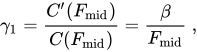
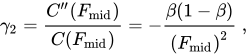
공식을 입력하는 ( ) 함수에는 다음이 제공된다.


또는 SABR 가격을 바첼리어의 모델로 표현할 수 있다. 그러면 암시적인 정상 변동성은 다음 식을 이용하여 점증적으로 계산할 수 있다.
![{\displaystyle \sigma _{\text{impl}}^{\text{n}}=\alpha \;{\frac {F_{0}-K}{D(\zeta )}}\;\left\{1+\left[{\frac {2\gamma _{2}-\gamma _{1}^{2}}{24}}\;\left({\frac {\sigma _{0}C(F_{\text{mid}})}{\alpha }}\right)^{2}+{\frac {\rho \gamma _{1}}{4}}\;{\frac {\sigma _{0}C(F_{\text{mid}})}{\alpha }}+{\frac {2-3\rho ^{2}}{24}}\right]\varepsilon \right\}.}](https://wikimedia.org/api/rest_v1/media/math/render/svg/466d7825e8511dbfa3290a9a5b472c111380f8bd)
일반적인 SABR 암묵적 변동성은 일반적으로 대수적 암묵적 변동성보다 다소 더 정확하다는 점에 주목할 필요가 있다.
가격 옵션에 한β {\}을(를) 가진 CEV 모델에서 등가 변동성을 사용할 경우 근사 정확도와 차익거래 정도를 더욱 개선할 수 있다.[2]
마이너스 금리에 대한 SABR
최근 몇 년간 인기를 끈 마이너스 금리에 대한 SABR 모델 연장은 시프트된 SABR 모델이며, 여기서 시프트된 선도금리는 SABR 과정을 따르는 것으로 가정된다.


일부 포지티브 시프트 시프트는 시장 견적에 포함되며, 음률이 어떻게 될 수 있는지에 대한 직관적인 소프트 경계가 있기 때문에, 시프트 SABR은 음률을 수용하는 시장 모범 사례가 되었다.

또한 SABR 모델은 다음과 같이 마이너스 이자율을 적용하도록 수정할 수 있다.

1/ 1 및 F= 에 대한 자유 경계 조건 0 상관 관계에 대한 정확한 솔루션과 일반 사례에 대한 효율적인 근사치를 사용할 수 있다.[3]


이 접근방식의 분명한 단점은 자유경계를 통한 잠재적 고부정 금리에 대한 선행적 가정이다.
내재된 변동성 수식의 차익거래 문제
점근법은 구현이 매우 쉽지만, 특히 매우 낮은 타격(부정적이 되거나 밀도가 하나로 통합되지 않음)의 경우 근사치가 암시하는 밀도가 항상 재정거래가 없는 것은 아니다.
수식을 "수정"할 수 있는 한 가지 가능성은 확률적 결합 방법을 사용하고, 예를 들어 정상과 같은 차익거래가 없는 변수의 다항식(다항식)에 해당하는 암시적, 왜곡된 모형을 투영하는 것이다. 이렇게 하면 생성된 밀도가 차익거래가 없는 동안 콜러케이션 지점에서 확률의 균등이 보장된다.[4] 투영법을 사용하면 유럽 옵션 가격을 분석할 수 있으며 묵시적 휘발성은 점증식 공식에 의해 처음 얻은 가격과 매우 근접하게 유지된다.
또 다른 가능성은 0번째와 첫 번째 순간을 숫자적으로 보존하여 차익거래의 부재를 보장하는 전방 PDE의 등가 확장에 빠르고 강력한 PDE 해결사에 의존하는 것이다.[5]
확장
SABR 모델은 매개변수가 시간 의존적이라고 가정하여 확장할 수 있다. 그러나 이는 교정 절차를 복잡하게 만든다. 시간에 의존하는 SABR 모델의 고급 교정 방법은 소위 "유효 파라미터"[6]에 기초한다.
시뮬레이션
확률적 변동성 과정은 기하학적 브라운 운동을 따르므로 정확한 시뮬레이션은 간단하다. 그러나 선도자산 프로세스의 시뮬레이션은 사소한 작업이 아니다. 오일러-마루야마 또는 밀슈타인과 같은 테일러 기반 시뮬레이션 체계가 일반적으로 고려된다. 최근 SABR 모델의 거의 정확한 몬테카를로 시뮬레이션을 위한 새로운 방법들이 제안되고 있다.[7] 최근 SABR 모델에 대한 광범위한 연구가 검토되고 있다.[8] 일반 SABR 모델(= 에서 경계 조건이 없는 = })의 경우 폐쇄형 시뮬레이션 방법을 알고 있다.[9]
참고 항목
참조
- ^ PS 하간, D 쿠마르, A 레스니에프스키, DE Woodward(2002) 스마일 리스크 관리, Wilmott, 84-108.
- ^ Choi, J; Wu, L (2021). "The equivalent constant-elasticity-of-variance (CEV) volatility of the stochastic-alpha-beta-rho (SABR) model". Journal of Economic Dynamics and Control . 128: 104143. arXiv:1911.13123. doi:10.1016/j.jedc.2021.104143. SSRN 3495464.
- ^ Antonov, Alexandre; Konikov, Michael; Spector, Michael (January 28, 2015). "The Free Boundary SABR: Natural Extension to Negative Rates". SSRN 2557046. Cite 저널은 필요로 한다.
journal=(도움말) - ^ Grzelak, LA; Oosterlee, CW (2017). "From arbitrage to arbitrage-free implied volatilities". Journal of Computational Finance. 20 (3): 31–49. doi:10.21314/JCF.2016.316. SSRN 2529684.
- ^ Le Floc'h, Fabien; Kennedy, Gary (2016). "Finite difference techniques for arbitrage-free SABR". Journal of Computational Finance.
- ^ Van der Stoep, A.W.; Grzelak, L.A.; Oosterlee, C.W. (2015). "The Time-Dependent FX-SABR Model: Efficient Calibration based on Effective Parameters". International Journal of Theoretical and Applied Finance. 18 (6): 1550042. doi:10.1142/S0219024915500429. SSRN 2503891.
- ^ Leitao, A.; Grzelak, L. A.; Oosterlee, C. W. (2017). "On an efficient multiple time step Monte Carlo simulation of the SABR model". Quantitative Finance. 17 (10): 1549–1565. doi:10.1080/14697688.2017.1301676. SSRN 2764908.
- ^ Cui, Z.; Kirkby, J.L.; Nguyen, D. (2018). "A General Valuation Framework for SABR and Stochastic Local Volatility Models". SIAM Journal on Financial Mathematics. 9 (2): 520–563. doi:10.1137/16M1106572. S2CID 207074154.
- ^ Choi, J; Liu, C; Seo, BK (2019). "Hyperbolic normal stochastic volatility model". Journal of Futures Markets. 39 (2): 186–204. arXiv:1809.04035. doi:10.1002/fut.21967. S2CID 158662660. SSRN 3068836.
외부 링크
- Smile Risk 관리, P. Hagan 등 – SABR 모델을 소개하는 원본 문서.
- 확률적 변동성의 SABR 모델의 확률 분포, P. Hagan 등 – 정상 SABR 모델, 열 커널 확장, 점근 확률 분포 도입.
- SABR 모델에 따른 위험회피, B. Bartlett – SABR 모델에 따른 개선된 위험 관리.
- SABR 스타일의 확률적 변동성을 가진 LIBOR 시장 모델, P. Hagan과 A. 레스니에프스키 – 기간 구조 모델링을 위한 SABR의 LMM 확장.
- 차익거래 프리 SABR, P. Hagan 등 – 거의 0 포워드 처리.
- Obloj, Jan (2007). "Fine Tune Your Smile – Correction to Hagan et al". arXiv:0708.0998 [q-fin.CP].
- 지분파생상품에 대한 SABR모형에 대한 접근방법의 요약
- Henry-Labordere, Pierre (2006). "Unifying the BGM and SABR models: a short ride in hyperbolic geometry". arXiv:physics/0602102.
- CEV 및 SABR 모델에 대한 점근법
- 온라인에서 SABR 테스트(보정 포함)
- SABR 교정
- SABR 모델을 위한 고급 분석 – 상관 관계 제로 사례에 대한 정확한 공식 포함
- SABR 모델의 소스트라이크 잠재된 변동성 확대 – 소액 파업 및 장기 옵션의 차익거래 무증상 공식