
변동성 차익거래
Volatility arbitrage금융에서 변동성 차익거래(또는 vol arb)는 변동성에 기반하여 직접 의존하는 금융 차익거래 기법의 용어다.
일반적인 유형의 vol arb는 옵션과 그 기초의 델타 중립 포트폴리오를 거래함으로써 구현되는 통계적 차익거래의 유형이다. 목적은 옵션의 내재된 변동성과[1] 옵션의 기초가 되는 미래 실현된 변동성의 예측 사이의 차이를 활용하는 것이다. 변동성 차익거래에서 가격보다는 변동성이 상대적 측정의 단위로 사용되는데, 즉 거래자는 변동성이 낮을 때는 변동성을 사고, 높을 때는 변동성을 매도하려고 한다.[2][3]
개요
변동성 차익거래를 하는 옵션거래자에게 옵션계약은 기초가격에 대한 방향적 베팅보다는 기초변수의 변동성을 추측하는 방법이다. 딜러가 델타중립 포트폴리오의 일부로 옵션을 구매하면 변동성이 길다고 한다. 옵션을 팔면 변동성이 짧다고 한다. 거래가 델타중립적으로 이루어지는 한, 옵션 매입은 기초의 미래 실현 변동성이 높을 것이라는 베팅인 반면, 옵션 매도란 미래 실현 변동성은 낮을 것이라는 베팅이다. 풋-콜 패리티 때문에 거래되는 옵션이 콜인지 풋인지는 중요하지 않다. 이는 풋콜 패리티가 통화, 풋 및 기초의 일부 양 사이의 위험 중립 동등성 관계를 보유하기 때문에 사실이다. 따라서 델타헤드 콜이 길면 델타헤드 풋이 긴 것과 동일한 수익이 발생한다.
변동성 차익거래는 (위험이 없는 이익기회라는 의미에서) "진정한 경제적 차익거래"가 아니다. 그것은 묵시적 변동성의 미래 방향을 예측하는 것에 의존한다. 변동성 위험을 "분배"하려는 포트폴리오 기반의 변동성 차익거래 접근법도 암시적 변동성의 변화가 복수의 증권과 심지어 시장 간에 상관관계가 있을 때 "흑백조" 이벤트를 경험할 수 있다. 장기자본운용은 변동성 차익거래 접근법을 사용했다.
Forecast volatility
To engage in volatility arbitrage, a trader must first forecast the underlying's future realized volatility. This is typically done by computing the historical daily returns for the underlying for a given past sample such as 252 days (the typical number of trading days in a year for the US stock market). The trader may also use other factors, such as whether the period was unusually volatile, or if there are going to be unusual events in the near future, to adjust his forecast. For instance, if the current 252-day volatility for the returns on a stock is computed to be 15%, but it is known that an important patent dispute will likely be settled in the next year and will affect the stock, the trader may decide that the appropriate forecast volatility for the stock is 18%.
Market (implied) volatility
As described in option valuation techniques, there are a number of factors that are used to determine the theoretical value of an option. However, in practice, the only two inputs to the model that change during the day are the price of the underlying and the volatility. Therefore, the theoretical price of an option can be expressed as:
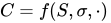
where is the price of the underlying, and is the estimate of future volatility. Because the theoretical price function is a monotonically increasing function of , there must be a corresponding monotonically increasing function that expresses the volatility implied by the option's market price , or


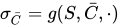
Or, in other words, when all other inputs including the stock price are held constant, there exists no more than one implied volatility for each market price for the option.

Because implied volatility of an option can remain constant even as the underlying's value changes, traders use it as a measure of relative value rather than the option's market price. For instance, if a trader can buy an option whose implied volatility is 10%, it is common to say that the trader can "buy the option for 10%". Conversely, if the trader can sell an option whose implied volatility is 20%, it is said the trader can "sell the option at 20%".
For example, assume a call option is trading at $1.90 with the underlying's price at $45.50 and is yielding an implied volatility of 17.5%. A short time later, the same option might trade at $2.50 with the underlying's price at $46.36 and be yielding an implied volatility of 16.5%. Even though the option's price is higher at the second measurement, the option is still considered cheaper because the implied volatility is lower. This is because the trader can sell stock needed to hedge the long call at a higher price.
Mechanism
Armed with a forecast of volatility, and capable of measuring an option's market price in terms of implied volatility, the trader is ready to begin a volatility arbitrage trade. A trader looks for options where the implied volatility, is either significantly lower than or higher than the forecast realized volatility , for the underlying. In the first case, the trader buys the option and hedges with the underlying to make a delta neutral portfolio. In the second case, the trader sells the option and then hedges the position.
보유 기간 동안, 기초의 실현된 변동성이 시장의 예측(즉, 내재된 변동성)보다 자신의 예측에 더 가까우면 거래자는 거래에서 이익을 실현할 것이다. 이익은 포트폴리오 델타 중립성을 유지하기 위해 필요한 지속적인 재헤딩을 통해 거래에서 추출된다.
참고 항목
참조
- ^ Mahdavi Damghani, Babak (2013). "De-arbitraging With a Weak Smile: Application to Skew Risk". Wilmott. 2013 (1): 40–49. doi:10.1002/wilm.10201. S2CID 154646708.
- ^ Javaheri, Alireza (2005). Inside Volatility Arbitrage, The Secrets of Skewness. Wiley. ISBN 978-0-471-73387-4.
- ^ Gatheral, Jim (2006). The Volatility Surface: A Practitioner's Guide. Wiley. ISBN 978-0-471-79251-2.


