Implied volatility
In financial mathematics, the implied volatility (IV) of an option contract is that value of the volatility of the underlying instrument which, when input in an option pricing model (such as Black–Scholes), will return a theoretical value equal to the current market price of said option. A non-option financial instrument that has embedded optionality, such as an interest rate cap, can also have an implied volatility. Implied volatility, a forward-looking and subjective measure, differs from historical volatility because the latter is calculated from known past returns of a security. To understand where implied volatility stands in terms of the underlying, implied volatility rank is used to understand its implied volatility from a one-year high and low IV.
Motivation
An option pricing model, such as Black–Scholes, uses a variety of inputs to derive a theoretical value for an option. Inputs to pricing models vary depending on the type of option being priced and the pricing model used. However, in general, the value of an option depends on an estimate of the future realized price volatility, σ, of the underlying. Or, mathematically:

where C is the theoretical value of an option, and f is a pricing model that depends on σ, along with other inputs.
The function f is monotonically increasing in σ, meaning that a higher value for volatility results in a higher theoretical value of the option. Conversely, by the inverse function theorem, there can be at most one value for σ that, when applied as an input to , will result in a particular value for C.

Put in other terms, assume that there is some inverse function g = f−1, such that
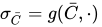
where is the market price for an option. The value is the volatility implied by the market price , or the implied volatility.


In general, it is not possible to give a closed form formula for implied volatility in terms of call price. However, in some cases (large strike, low strike, short expiry, large expiry) it is possible to give an asymptotic expansion of implied volatility in terms of call price.[1]
Example
A European call option, , on one share of non-dividend-paying XYZ Corp with a strike price of $50 expires in 32 days. The risk-free interest rate is 5%. XYZ stock is currently trading at $51.25 and the current market price of is $2.00. Using a standard Black–Scholes pricing model, the volatility implied by the market price is 18.7%, or:


To verify, we apply implied volatility to the pricing model, f , and generate a theoretical value of $2.0004:

which confirms our computation of the market implied volatility.
Solving the inverse pricing model function
In general, a pricing model function, f, does not have a closed-form solution for its inverse, g. Instead, a root finding technique is often used to solve the equation:
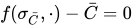
While there are many techniques for finding roots, two of the most commonly used are Newton's method and Brent's method. Because options prices can move very quickly, it is often important to use the most efficient method when calculating implied volatilities.
Newton's method provides rapid convergence; however, it requires the first partial derivative of the option's theoretical value with respect to volatility; i.e., , which is also known as vega (see The Greeks). If the pricing model function yields a closed-form solution for vega, which is the case for Black–Scholes model, then Newton's method can be more efficient. However, for most practical pricing models, such as a binomial model, this is not the case and vega must be derived numerically. When forced to solve for vega numerically, one can use the Christopher and Salkin method or, for more accurate calculation of out-of-the-money implied volatilities, one can use the Corrado-Miller model.[2]

Specifically in the case of the Black[-Scholes-Merton] model, Jaeckel's "Let's Be Rational"[3] method computes the implied volatility to full attainable (standard 64 bit floating point) machine precision for all possible input values in sub-microsecond time. The algorithm comprises an initial guess based on matched asymptotic expansions, plus (always exactly) two Householder improvement steps (of convergence order 4), making this a three-step (i.e., non-iterative) procedure. A reference implementation[4] in C++ is freely available. Besides the above mentioned root finding techniques, there are also methods that approximate the multivariate inverse function directly. Often they are based on polynomials or rational functions.[5]
For the Bachelier ("normal", as opposed to "lognormal") model, Jaeckel[6] published a fully analytic and comparatively simple two-stage formula that gives full attainable (standard 64 bit floating point) machine precision for all possible input values.
Implied volatility parametrisation
With the arrival of Big Data and Data Science parametrising the implied volatility has taken central importance for the sake of coherent interpolation and extrapolation purposes. The classic models are the SABR and SVI model with their IVP extension.[7]
Implied volatility as measure of relative value
As stated by Brian Byrne, the implied volatility of an option is a more useful measure of the option's relative value than its price. The reason is that the price of an option depends most directly on the price of its underlying asset. If an option is held as part of a delta neutral portfolio (that is, a portfolio that is hedged against small moves in the underlying's price), then the next most important factor in determining the value of the option will be its implied volatility. Implied volatility is so important that options are often quoted in terms of volatility rather than price, particularly among professional traders.
Example
A call option is trading at $1.50 with the underlying trading at $42.05. The implied volatility of the option is determined to be 18.0%. A short time later, the option is trading at $2.10 with the underlying at $43.34, yielding an implied volatility of 17.2%. Even though the option's price is higher at the second measurement, it is still considered cheaper based on volatility. The reason is that the underlying needed to hedge the call option can be sold for a higher price.
As a price
Another way to look at implied volatility is to think of it as a price, not as a measure of future stock moves. In this view, it simply is a more convenient way to communicate option prices than currency. Prices are different in nature from statistical quantities: one can estimate volatility of future underlying returns using any of a large number of estimation methods; however, the number one gets is not a price. A price requires two counterparties, a buyer, and a seller. Prices are determined by supply and demand. Statistical estimates depend on the time-series and the mathematical structure of the model used. It is a mistake to confuse a price, which implies a transaction, with the result of a statistical estimation, which is merely what comes out of a calculation. Implied volatilities are prices: they have been derived from actual transactions. Seen in this light, it should not be surprising that implied volatilities might not conform to what a particular statistical model would predict.
그러나 위의 견해는 묵시적 휘발성 값이 계산에 사용된 모델에 따라 다르다는 사실을 무시한다. 동일한 시장 옵션 가격에 적용되는 다른 모델은 서로 다른 묵시적 휘발성을 산출할 것이다. 따라서, 만약 어떤 사람이 내재된 변동성의 이러한 관점을 가격으로 채택한다면, 사람들은 또한 고유한 내재적 가변성-가격은 없으며, 동일한 거래에서 구매자와 판매자가 서로 다른 "가격"으로 거래될 수 있다는 것을 인정해야 한다.
일정하지 않은 암시적 변동성
일반적으로 동일한 기초에 기초하지만 스트라이크 값과 만료 시간이 서로 다른 옵션은 서로 다른 묵시적 볼륨성을 산출할 것이다. 이는 일반적으로 기초의 변동성이 일정하지 않고 그 대신에 기초의 가격 수준, 기초의 최근 가격 변동 및 시간의 경과와 같은 요소에 의존한다는 증거로 본다. 변동성 표면(Schonbusher, SVI, gSVI)에 대한 알려진 파라메타레이션뿐만 아니라 이들의 디어비타징 방법론도 거의 존재하지 않는다.[8] 자세한 내용은 확률적 변동성과 변동성 미소를 참조하십시오.
변동성상품
변동성 금융상품은 다른 파생상품 증권의 내재적 변동성 가치를 추적하는 금융상품이다. 예를 들어, CBOE 변동성 지수(VIX)는 S&P 500 지수에서 다양한 옵션의 묵시적 볼륨성의 가중 평균으로부터 계산된다. VXN지수(나스닥100지수 선물 변동성 측정), QQV(QQQ 변동성 측정), IVX - 묵시적 변동성 지수(미국 증권 및 거래소 거래소 거래상품의 미래 기간에 예상되는 주가 변동성) 등 흔히 언급되는 그 밖의 변동성 지수들도 있다.이러한 변동성 지수 자체에 직접적으로 영향을 미친다.
참고 항목
참조
- ^ 대수 정규 잠재 변동성의 점증적 팽창, 그룬스팬, C.(2011년)
- ^ Akke, Ronald. "Implied Volatility Numerical Methods". RonAkke.com. Retrieved 9 June 2014.
- ^ Jaeckel, P. (January 2015), "Let's be rational", Wilmott Magazine, 2015 (75): 40–53, doi:10.1002/wilm.10395
- ^ Jaeckel, P. (2013). "Reference Implementation of "Let's Be Rational"". www.jaeckel.org.
- ^ Salazar Celis, O. (2018). "A parametrized barycentric approximation for inverse problems with application to the Black–Scholes formula". IMA Journal of Numerical Analysis. 38 (2): 976–997. doi:10.1093/imanum/drx020. hdl:10067/1504500151162165141.
- ^ Jaeckel, P. (March 2017). "Implied Normal Volatility". Wilmott Magazine: 52–54. 참고 인쇄 버전에는 www.jaeckel.org에서 올바른 형식 지정 오류가 포함되어 있다.
- ^ Mahdavi-Damghani, Babak. "Introducing the Implied Volatility Surface Parametrization (IVP)". SSRN 2686138. Cite 저널은 필요로 한다.
journal=(도움말) - ^ Mahdavi Damghani, Babak (2013). "De-arbitraging With a Weak Smile: Application to Skew Risk". Wilmott. 2013 (1): 40–49. doi:10.1002/wilm.10201. S2CID 154646708.
추가 참조사항[1]
- Beckers, S. (1981), "Standard deviations implied in option prices as predictors of future stock price variability", Journal of Banking and Finance, 5 (3): 363–381, doi:10.1016/0378-4266(81)90032-7, retrieved 2009-07-07
- Mayhew, S. (1995), "Implied volatility", Financial Analysts Journal, 51 (4): 8–20, doi:10.2469/faj.v51.n4.1916
- Corrado, C.J.; Su, T. (1997), "Implied volatility skews and stock index skewness and kurtosis implied by S" (PDF), The Journal of Derivatives (SUMMER 1997), doi:10.3905/jod.1997.407978, S2CID 154383156, retrieved 2009-07-07
- Grunspan, C. (2011), "A Note on the Equivalence between the Normal and the Lognormal Implied Volatility: A Model Free Approach" (Preprint), SSRN 1894652 Cite 저널은 필요로 한다.
journal=(도움말) - Grunspan, C. (2011), "Asymptotics Expansions for the Implied Lognormal Volatility in a Model Free Approach" (Preprint), SSRN 1965977 Cite 저널은 필요로 한다.
journal=(도움말)[2]
외부 링크
- Serdar SEN에 의한 암시적 변동성 계산
- 크리스토프 루주, ESILV에 의한 온라인 암시적 변동성 계산 테스트
- 시각적 암시적 변동성 계산기
- Excel에서 베타 계산