뉴욕 지하철
New York City Subway| 뉴욕 지하철 | |||
|---|---|---|---|
 | |||
 | |||
 | |||
| 개요 | |||
| 주인 | 뉴욕 시 | ||
| 제공 면적 | 브롱크스, 브루클린, 맨해튼, 퀸스 | ||
| 로캘 | 뉴욕 시 | ||
| 경유유형 | 쾌속환승 | ||
| 선수 | 36행[note 1] 28개 서비스 (1개 예정)[note 2] | ||
| 역수 | 472[1](MTA총계)[note 3][note 4] 423개의 고유 스테이션[note 4][1](국제 표준과 비교할 때) 14[note 3] 계획중 | ||
| 연간승차권 | 1,793,073,000[6]: 2 [note 5] (2022) | ||
| 웹사이트 | new | ||
| 작동 | |||
| 가동개시 | 1904년 10월 27일, 전 ( (원래 지하철) 1868년 7월 3일; 전 ([7] (첫번째 철도 운행)[note 6] | ||
| 연산자 | 뉴욕 교통국(NYCTA) | ||
| 차량수 | 6,418[8] | ||
| 헤드웨이 | 피크 시간: 3~12분[9] 오프피크: 12~20분[9] | ||
| 테크니컬 | |||
| 시스템길이 | 248 mi (399 km)[10] (route길이) 665 mi (1,070 km)[10] (트랙 길이, 수익) 850 mi (1,370 km)[11] (트랙 길이, 총합) | ||
| 트랙게이지 | 4피트 8+1 ⁄ 2인치(1,435mm) 표준 게이지 | ||
| 전기화 | 제3 레일, 600-650 V DC(공칭 625V)[11][12] | ||
| 평균속도 | 17.4 mph (28.0 km/h)[13] | ||
| 최고속도 | 시속 55마일(89km/h)[13] | ||
| |||

| 에 관한 일련의 기사의 일부 |
 |
뉴욕 지하철(New York City Subway)은 뉴욕 맨해튼, 브루클린, 퀸스, 브롱크스 자치구의 지하철입니다. 뉴욕시 정부가 소유하고 있으며 주 정부가 운영하는 MTA(Metropolitan Transport Authority)[14]의 산하 기관인 뉴욕시 교통국에 임대되어 있습니다.[15] 1904년 10월 27일에 개통된 뉴욕 지하철은 세계에서 가장 오래된 대중 교통 시스템 중 하나이며, 가장 많이 이용되는 지하철 중 하나이며,[16] 가장 많은 역이 있는 지하철로 472개의 역이 운영되고[17] 있습니다(환승으로 연결된 역을 단일 역으로 계산하면 423개).[1]
이 시스템은 대부분의 역사를 통해 비상 및 재해를 방지하면서 연중무휴로 24시간 서비스를 운영해 왔습니다. 연간 승객 수 기준으로 뉴욕 지하철은 서반구와 서구 세계에서 가장 붐비는 고속 교통 시스템이며, 세계에서 11번째로 붐비는 고속 교통 철도 시스템입니다.[18] 지하철은 2022년에 1,793,073,000명의 승객을 태웠습니다.[6]: 2 [note 5] 2015년 10월 29일, 620만 명 이상의 사람들이 지하철을 탔고, 1985년 정기적으로 승차 인원을 모니터링한 이후 가장 높은 일일 승차 인원을 수립했습니다.[20]
이 시스템은 또한 세계에서 가장 긴 시스템 중 하나입니다. 전체적으로 이 시스템에는 248마일(399km)의 경로가 포함되어 있으며,[10] 665마일(1,070km)의 수익 트랙과[10] 비수익 트랙을 포함하여 총 850마일(1,370km)의 수익 트랙이 포함되어 있습니다.[11] 이 시스템의 28개 노선 또는 "서비스"(보통 다른 서비스와 선로 또는 "선"을 공유함) 중 25개 노선이 맨해튼을 통과하며, 예외는 G 트레인, 프랭클린 애비뉴 셔틀, 로커웨이 파크 셔틀입니다. 맨하탄 외곽의 지하철의 상당 부분은 고가, 제방, 또는 노천 컷으로 되어 있으며, 선로의 40%는 지상으로 되어 있습니다.[21] 많은 노선과 역에는 급행과 지역 서비스가 있습니다. 이 선들은 서너 개의 트랙이 있습니다. 일반적으로 외부 2개는 지역 열차가 사용하고 내부 1~2개는 고속 열차가 사용합니다.[11]
2018년[update] 기준 뉴욕시 지하철의 지출에 대한 예산 부담은 87억 달러이며, 요금, 교량 통행료, 할당된 지역 세금 및 요금 징수와 주 및 지방 정부의 직접적인 자금 지원으로 지원됩니다.[22]
역사


알프레드 엘리 비치(Alfred Ely Beach)는 1869년 뉴욕(New York City)에서 지하 교통 시스템에 대한 최초의 시연회를 건설하고 1870년 2월에 개장했습니다.[23][24] 그의 해변 공압 교통은 워렌 스트리트에서 머레이 스트리트까지[23] 운행하는 로워 맨해튼 브로드웨이 아래 312 피트 (95 미터) 밖에 확장되지 않았으며 지하철로서 대기 철도에 대한 그의 아이디어를 보여주었습니다. 터널은 정치적, 재정적 이유로 확장된 적이 없습니다.[25] 오늘날 이 터널은 브로드웨이 아래에 있는 오늘날의 시청역의 한계 내에 있었기 때문에 이 노선의 일부는 남아 있지 않습니다.[26][27][28][29]
1888년의 그레이트 블리자드는 지하 교통 시스템의 이점을 증명하는 데 도움이 되었습니다.[30] 지하철 건설 계획은 1894년에 승인되었고, 1900년에 건설이 시작되었습니다.[31] 지하철의 지하 부분은 아직 지어지지 않았지만, 오늘날의 뉴욕 지하철의 지상 부분은 이미 그 무렵에 운행되고 있었습니다. 1885년에 브루클린의[32][33][34][35][36] BMT 렉싱턴 애비뉴 선의 일부로 개통되었으며 현재는 BMT 자메이카 선의 일부입니다.[37] 코니 아일랜드 크릭 근처의 BMT 웨스트 엔드 라인의 일부인 가장 오래된 우측 통행로는 1864년 브루클린, 배스, 코니 아일랜드 철도라고 불리는 증기 철도로 사용되었습니다.[38][39][40]
1904년 10월 27일, 뉴욕시 최초의 고가선 개통 이후 약 36년 만에 인터버러 고속철도(IRT)가 건설한 지하철의 첫 지하선이 개통되었습니다.[41][42] 9.1마일(14.6km)의 지하철 노선은 시청역에서 북쪽으로 라파예트 거리(당시 엘름 거리)와 파크 애비뉴(당시 4번가) 아래를 지나 42번가에서 서쪽으로 방향을 틀었습니다. 그 후 타임스퀘어에서 다시 북쪽으로 휘어져 브로드웨이 아래를 계속하다가 할렘 145번가 역에서 종착했습니다.
이 회사의 운영은 인터버러 고속 교통 회사에 임대되었으며 15만 명이 넘는 승객들이 운영 첫날에 5 ¢ 요금(2022년 2달러)을 지불하고 이를 탔습니다.
1900년대 말과 1910년대 초까지 이 노선들은 IRT와 브루클린 래피드 트랜짓 컴퍼니(BRT, 후에 브루클린-맨해튼 트랜짓 코퍼레이션, BMT)의 두 개인 소유 시스템으로 통합되었습니다. 시는 대부분의 노선을 건설하여 회사에 임대했습니다.[46] 도시가 소유하고 운영하는 독립 지하철의 첫 번째 노선은 1932년에 개통되었습니다.[47] 이 시스템은 민간 시스템과 경쟁하고 고가 철도의 일부가 철거될 수 있도록 하기 위한 것이었지만 창업 자본이 적기 때문에 도시 핵심부 내에 머물렀습니다.[14] 이를 위해서는 '원가로' 운행해야 했고, 당시 5센트 요금의 두 배인 10 ¢(2022년 기준 3달러)까지 요금이 필요했습니다.
1940년, 그 도시는 두 개의 개인 시스템을 구입했습니다. 일부 고가 노선은 즉시 운행을 중단했고 다른 노선은 곧 폐쇄되었습니다.[49] 통합은 느렸지만 IND와 BMT 사이에 몇 가지 연결이 구축되었습니다.[50][51][52] 이것들은 이제 B 디비전이라고 불리는 하나의 디비전으로 운영됩니다. 구 IRT 터널은 폭이 더 좁고 곡선이 더 선명하며 역 승강장이 짧기 때문에 B 디비전 차량을 수용할 수 없으며 구 IRT는 독자적인 디비전인 A 디비전으로 남아 있습니다.[53] 이전 세 회사의 역 간 승객 환승이 많이 생겨 네트워크 전체를 하나의 단위로 취급할 수 있게 되었습니다.[54]
1940년대 후반 동안 이 시스템은 높은 승객 수를 기록했으며 1946년 12월 23일 시스템 전체에서 8,872,249명의 요금 기록이 수립되었습니다.[55]: 73
뉴욕시가 주재하는 공공기관인 뉴욕시 교통국(NYCTA)은 1953년에 도시로부터 지하철, 버스, 노면전차 운행을 인수하기 위해 설립되었으며 1968년에 주 단위의 대도시 교통국의 통제하에 놓였습니다.[54][56]

1934년 BRT, IRT 및 IND의 운송 노동자들에 의해 조직된 [57]미국 운송 노동자 조합 로컬 100은 노동 조합 중 가장 크고 가장 영향력 있는 로컬로 남아 있습니다.[58] 노조 창립 이후 MTA와의 계약 분쟁으로 노조 파업이 1966년 12일,[60][61] 1980년 11일,[62] 2005년 3일 [59]등 세 차례 있었습니다.[63][64]
1970년대와 1980년대에 뉴욕 지하철은 사상 최저치를 기록했습니다.[65][66] 기수는 1910년대 수준으로 떨어졌으며 낙서와 범죄가 기승을 부렸습니다. 유지 보수가 부실했고, 지연 및 선로 문제가 일반적이었습니다. 그럼에도 불구하고, 뉴욕시 교통국은 1980년대에 6개의 새로운 지하철역을 열었고,[67][68] 현재의 지하철 차량들을 낙서가 없도록 만들었으며, 1,775대의 새로운 지하철 차량을 주문했습니다.[69] 1990년대 초반까지 상황은 크게 개선되었지만, 20년 동안 축적된 유지 보수 백로그는 오늘날에도 여전히 고쳐지고 있습니다.[66]

21세기에 들어서면서 여러 차례의 재난에도 불구하고 진전이 계속되었습니다. 9.11 테러는 로워 맨해튼을 관통하는 노선, 특히 세계 무역 센터 바로 아래 IRT 브로드웨이-세븐 애비뉴 라인에서 서비스 중단을 초래했습니다.[70] 터널의 일부 구간과 트윈 타워 바로 아래에 있던 코틀랜드 스트리트 역이 심하게 손상되었습니다. 재건을 위해서 체임버스 가 남쪽에 있는 노선의 운행을 중단해야 했습니다. 근처에 있는 다른 10개 역은 청소를 위해 폐쇄되었습니다. 2002년 3월까지, 그 역들 중 7개가 다시 문을 열었습니다. 코틀랜드 스트리트를 제외한 나머지는 체임버스 스트리트 남쪽의 서비스와 함께 2002년 9월에 재개장했습니다.[71][72][73] 코틀랜드 거리는 2018년 9월에 다시 문을 열었습니다.[74][75]
2012년 10월, 허리케인 샌디는 뉴욕 항구 근처의 몇몇 수중 터널과 다른 시설물들과 자메이카 만 위의 흔적들을 물에 잠겼습니다. 당장의 피해는 6개월 안에 고쳐졌지만, 장기적인 회복력과 재활 사업은 계속되고 있습니다. 허리케인 이후 복구 프로젝트에는 2012년부터 2017년까지 새 사우스 페리 역 복구, 2013년부터 2014년까지 몬태규 스트리트 터널 전면 폐쇄, 2019년부터 2020년까지 14번가 터널 부분 폐쇄가 포함되었습니다.[76] 2019년 총 17억 명에 육박했던 뉴욕시 지하철의 연간 승객 수는 코로나19 팬데믹 기간 동안 급격히 감소하여 2022년까지 다시 10억 명을 돌파하지 못했습니다.[77]
시공방법
.jpg)
1904년 IRT 지하철이 첫 선을 보였을 때,[41] 전형적인 터널 건설 방식은 컷 앤 커버(cut-and-cover)였습니다.[78] 도로는 위에서 재건되기 전에 아래 터널을 파기 위해 찢어진 것입니다.[78] 위의 도로는 도로를 파서 교통이 중단될 것입니다.[79] 임시 철교와 나무교는 그 공사 위에 표면 교통을 운반했습니다.[80]
이러한 유형의 건설업체는 자연적 또는 인간이 만든 많은 장애물에 직면했습니다. 그들은 펌프가 필요한 암석층과 지하수를 처리해야 했습니다. 12마일의 하수도와 수도 및 가스 메인, 전기 도관 및 증기 파이프를 다시 연결해야 했습니다. 그 작업을 허용하기 위해 도로 철도는 해체되어야 했습니다. 고층 건물의 기초는 종종 지하철 공사 근처를 달렸고, 어떤 경우에는 안정성을 보장하기 위해 기초가 필요했습니다.[81]
이 방법은 노면 근처의 부드러운 흙과 자갈을 파는 데 잘 사용되었습니다.[78] 터널링 실드는 주철관을 사용하는 할렘과 이스트 강 터널과 같은 더 깊은 구간에 필요했습니다. 파크 애비뉴 아래 33번가에서 42번가, 브로드웨이 아래 116번가에서 120번가, 브로드웨이와 세인트 아래 145번가에서 다이크먼 스트리트(포트 조지)까지의 구간에 암반 또는 콘크리트 라인 터널이 사용되었습니다. Nicholas Avenue; 그리고 96번가와 브로드웨이에서 센트럴 파크 노스와 레녹스 애비뉴까지.[78]
지하철 시스템의 약 40%는 강철 또는 주철 고가 구조물, 콘크리트 고가교, 제방, 개방 절단 및 표면 경로를 포함한 지상 또는 고가 선로에서 운행됩니다.[82] 2019년[update] 현재 168마일(270km)의 고가 선로가 있습니다.[83] 이 모든 건설 방법은 도로 및 보행자 건널목과 완전히 분리되어 있으며, 두 지하철 선로의 대부분 건널목은 비행 분기점과 함께 등급 분리되어 있습니다. 정규 운행 중인 두 노선의 등급 교차점의 유일한 예외는 142번가와[84] 머틀 애비뉴 교차점과 로저스 교차점의 IRT 이스턴 파크웨이 라인의 동일 방향 선로 쌍입니다.[85][86]
원래 지하철 노선을 건설한 7,700명의 노동자들은 대부분 맨해튼에 사는 이민자들이었습니다.[31][87]
보다 최근의 프로젝트는 터널 보링 머신을 사용하므로 비용이 증가합니다. 그러나 거리 수준에서 중단을 최소화하고 이미 존재하는 유틸리티를 피합니다.[88] 이러한 프로젝트의 예로는 IRT 플러싱 라인과[89][90][91][92] IND 2번가 라인의 연장이 있습니다.[93][94][95]
팽창

1904년 원래의 뉴욕 지하철 노선이 개통된 이후,[41] 여러 공식 및 계획 기관들은 지하철 시스템에 대한 수많은 연장을 제안했습니다. 더 확장적인 제안 중 하나는 "IND 2차 시스템"이었는데, 이는 기존의 지하철 노선과 철도 통행권을 인수하는 것 외에 새로운 지하철 노선을 건설하는 계획의 일부였습니다. 1929년에 구상된 가장 웅장한 IND 제 2 지하철 계획은 시에서 운영하는 IND의 일부가 되는 것이었고, 현재 지하철 시스템의 거의 1개의 ⁄ 3을 구성하는 것이었습니다. 1939년까지 통일이 계획된 상태에서 세 가지 시스템이 모두 계획에 포함되었고, 이는 궁극적으로 실행되지 않았습니다.[98][99] 지하철이 존재한 지 수년 동안 많은 다양한 계획들이 제안되었지만, 지하철 시스템의 확장은 제 2차 세계 대전 동안 대부분 중단되었습니다.[100]
수십 년 동안 제안된 대부분의 노선은 건설된 적이 없지만, 기존 지하철 용량 제약과 과밀화를 완화하기 위해 이러한 노선 중 일부를 개발하기 위한 논의가 여전히 강하며, 가장 주목할 만한 것은 2번가 지하철에 대한 제안입니다. 새로운 노선에 대한 계획은 1910년대 초로 거슬러 올라가며, 시스템이 존재하는 여러 해 동안 확장 계획이 제안되었습니다.[52][96]
1940년 IND 6번가 선이 완공된 후,[101] 시는 엄청난 부채에 시달리게 되었고, 그 이후로 33개의 새로운 역만 시스템에 추가되었으며, 그 중 19개는 이미 존재했던 폐지된 철도의 일부였습니다. 폐선된 뉴욕, 웨스트체스터, 보스턴 철도에 5개의 역이 있었는데, 1941년 IRT 다이어 애비뉴 라인으로 시스템에 통합되었습니다.[102] 1955년에 개장한 폐선된 LIRR 로커웨이 비치 지점(현재의 IND 로커웨이 선)에 14개의 역이 더 있었습니다.[103] 두 개의 역(57번가와 그랜드 스트리트)은 크리스티 스트리트 커넥션의 일부였으며 1968년에 문을 열었고 [104][105]할렘-148번가 터미널은 같은 해 관련 없는 프로젝트로 문을 열었습니다.[106]
6개는 1968년 계획의 일부로 지어졌습니다:[108] 1988년에 개통된 아처 애비뉴 라인에 3개,[107] 1989년에 개통된 63번가 라인에 3개. 새 사우스 페리역은 기존의 화이트홀 거리와 연결되어 지어졌습니다.2009년 사우스 페리 역.[109] 맨해튼 서쪽에 있는 지하철 7호선은 34번가로 구성되어 있습니다.허드슨 야드 역은 2015년에 개통되었고,[110][111][note 7] 어퍼 이스트 사이드의 2번가 지하철에 있는 세 개의 역은 2017년 초에 1단계 노선의 일부로 개통되었습니다.[112]
노선 및 노선
| 연간 여객 수송량 | ||
|---|---|---|
| 연도 | 승객들 | %± |
| 1901 | 253,000,000 | — |
| 1905 | 448,000,000 | +77.1% |
| 1910 | 725,000,000 | +61.8% |
| 1915 | 830,000,000 | +14.5% |
| 1920 | 1,332,000,000 | +60.5% |
| 1925 | 1,681,000,000 | +26.2% |
| 1930 | 2,049,000,000 | +21.9% |
| 1935 | 1,817,000,000 | −11.3% |
| 1940 | 1,857,000,000 | +2.2% |
| 1945 | 1,941,000,000 | +4.5% |
| 1946 | 2,067,000,000 | +6.5% |
| 1950 | 1,681,000,000 | −13.4% |
| 1955 | 1,378,000,000 | −18.0% |
| 1960 | 1,345,000,000 | −2.4% |
| 1965 | 1,363,000,000 | +1.3% |
| 1970 | 1,258,000,000 | −7.7% |
| 1975 | 1,054,000,000 | −16.2% |
| 1980 | 1,009,000,000 | −4.3% |
| 1982 | 989,000,000 | −2.0% |
| 1985 | 1,010,000,000 | +2.1% |
| 1990 | 1,028,000,000 | +1.8% |
| 1995 | 1,093,000,000 | +6.3% |
| 2000 | 1,400,000,000 | +28.1% |
| 2005 | 1,450,000,000 | +3.6% |
| 2010 | 1,605,000,000 | +10.7% |
| 2011 | 1,640,000,000 | +2.2% |
| 2012 | 1,654,000,000 | +0.1% |
| 2013 | 1,708,000,000 | +3.3% |
| 2014 | 1,751,287,621 | +2.6% |
| 2015 | 1,762,565,419 | +0.6% |
| 2016 | 1,756,814,800 | -0.3% |
| 2017 | 1,727,366,607 | -1.7% |
| 2018 | 1,680,060,402 | -2.7% |
| 2019 | 1,697,787,002 | +1.1% |
| 2020 | 639,541,029 | -62.3% |
| 2021 | 759,976,721 | +18.8% |
| 2022 | 1,013,425,465 | +33.3% |
| [113][114][115][116][117][118][119] | ||


많은 고속 교통 시스템은 비교적 정적인 경로를 실행하므로, 열차 "노선"은 열차 "노선"과 어느 정도 동의어입니다. 뉴욕시에서는 다양한 이유로 경로가 자주 바뀝니다. 지하철의 명명법에서 "선"은 열차가 한 터미널에서 다른 터미널로 가는 도중에 사용하는 물리적인 철도 선로 또는 일련의 선로를 나타냅니다. "경로"("서비스"라고도 함)는 문자 또는 숫자로 구별되며 "행"에는 이름이 있습니다. 열차는 노선 지정을 표시합니다.[17]
지하철에는 짧은 셔틀 3대를 포함하여 28대의 열차 서비스가 있습니다. 각 노선에는 서비스의 맨해튼 간선을 나타내는 색상과 지역 또는 급행 지정이 있습니다.[120][121] 뉴욕시 거주자들은 색에 의한 서비스(예: "파란색 선" 또는 "녹색 선")를 거의 언급하지 않지만, 외지인들과 관광객들은 종종 그렇게 합니다.[17][122][123]
1번, C번, G번, L번, M번, R번, W번 열차는 완전한 현지 운행이며 모든 정차를 합니다. 2, 3, 4, 5, A, B, D, E, F, N, Q 열차에는 급행 및 지역 서비스가 있습니다. J, Z, 6, 7번 열차는 방향, 요일 또는 시간에 따라 다릅니다. S라는 문자는 세 가지 셔틀 서비스에 사용됩니다. 프랭클린 애비뉴 셔틀, 로커웨이 파크 셔틀, 42번가 셔틀.[121][124]
지하철 시스템은 24시간 운영되지만 [17]심야 시간대에는 지정된 일부 노선이 운행되지 않거나, 더 짧은 노선으로 운행되거나(종종 "셔틀 트레인" 버전의 전신 상대 노선이라고도 함), 다른 정차 패턴으로 운행됩니다. 이것들은 일반적으로 역 승강장에서 더 작은 보조 경로 표지판으로 표시됩니다.[121][125] 유지 보수를 위해 야간 시스템 종료가 없기 때문에 시스템이 작동하는 동안 선로와 스테이션을 유지해야 합니다. 이 작업은 때때로 정오, 야간 시간 및 주말에 서비스 변경이 필요합니다.[126][127][note 8]
건설 목적으로 노선의 일부가 일시적으로 중단되면 교통 당국은 무료 셔틀 버스(MTA Regional Bus Operations 버스 함대 사용)를 대체하여 이러한 노선에서 일반적으로 운행되는 노선을 대체할 수 있습니다.[128] 교통국은 웹사이트,[129] 역 및 내부 지하철 벽에 게시된 플래카드 [130]및 트위터 페이지를 통해 계획된 서비스 변경 사항을 발표합니다.[131]
명명법
| 기본 트렁크 라인 | 색[132][133] | 팬톤[134] | 16진수 | 서비스 총알 |
|---|---|---|---|---|
| IND 8번가 선 | 파랑색 | PMS 286 | #0039a6 |    |
| IND 6번가 선 | 오렌지 | PMS 165 | #ff6319 |      |
| IND 크로스타운 선 | 라임 | PMS 376 | #6cbe45 |  |
| BMT 카나시 선 | 라이트 슬레이트 그레이 | 블랙 50% | #a7a9ac |  |
| BMT 나소 스트리트 선 | 갈색 | PMS 154 | #996633 |   |
| BMT 브로드웨이 선 | 노란 색 | PMS 116 | #fcc c0a |     |
| IRT 브로드웨이 7번가 선 | 빨간. | PMS 185 | #ee352e |    |
| IRT 렉싱턴 애비뉴 선 | 초록의 | PMS 355 | #00933c |     |
| IRT 플러싱 라인 | 퍼플 | PMS 퍼플 | #b933ad |   |
| IND 2번가 선 | 청록색 | PMS 638 | #00add0 |  |
| 셔틀스 | 다크슬레이트그레이 | 블랙 70% | #808183 |  |
지하철 지도

뉴욕 지하철의 현재 공식적인 교통 지도는 1979년 마이클 허츠 어소시에이츠의 디자인에 기반을 두고 있습니다.[135] 이 지도들은 시스템의 복잡성 때문에 지리적으로 정확하지 않지만(맨해튼이 가장 작은 자치구이지만 가장 많은 서비스를 제공함), 주요 도시 거리를 내비게이션의 보조물로 보여줍니다. 최신판은 2010년 6월 27일에 발효되었으며 맨해튼을 더 크게 만들고 스태튼 아일랜드를 더 작게 만듭니다. 더 많은 영구적인 변화가 발생하면 지도에 약간의 수정이 발생합니다.[124][136]
1958년에 처음 제작된 지하철의 초기 다이어그램은 오늘날의 다이어그램보다 지리적으로 더 부정확하다는 인식을 가지고 있었습니다. 1972년에서 1979년 사이에 MTA가 출판한 마시모 비넬리의 지하철 지도 디자인은 현대 고전이 되었지만 MTA는 지리적 요소의 배치로 인해 지도에 결함이 있다고 간주했습니다.[137][138]
이 지도의 심야 전용 버전은 2012년 1월 30일에 소개되었습니다.[139] 2011년 9월 16일, MTA는 비넬리 스타일의 인터랙티브 지하철 지도인 "위켄더"[140]를 웹사이트에 소개했습니다.[141] 제목에서 알 수 있듯이,[142] 온라인 지도는 금요일 늦은 밤부터 월요일 이른 아침까지 계획된 작업에 대한 정보를 제공합니다.[143][144]
Hagstrom Map과 같이 개인적으로 제작된 여러 도식을 온라인 또는 인쇄된 형태로 이용할 수 있습니다.[145]
-
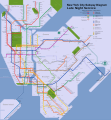 심야 지하철 운행 지도
 -
 지면에 대한 선 고도 지도입니다. 지하 부분은 주황색으로 되어 있습니다. 지상 세그먼트는 파란색으로 표시되며, 높이, 제방, 등급 또는 개방형 절단 여부에 관계없이 표시됩니다.


측점
472개 역 중 467개 역이 24시간 운행됩니다.[note 9] 뉴욕 지하철의 지하역은 일반적으로 거리 층에서 내려가는 계단으로 접근합니다. 이러한 계단 중 많은 부분은 디자인에 약간 또는 상당한 변화가 있는 녹색의 일반적인 음영으로 칠해져 있습니다.[146] 다른 역에는 위치나 건설 날짜를 반영한 독특한 출입구가 있습니다. 예를 들어, 여러 개의 역 입구 계단이 인접한 건물에 지어집니다.[146] 거의 모든 역 출입구에는 출입구로서의 지위를 나타내는 색상으로 구분된 지구형 또는 사각형 램프가 있습니다.[147] 현재 스테이션 수가 시스템의 피크보다 적습니다. 백 개가 넘는 역들이 집단적으로 철거되는 결과를 가져온 이전의 고가선들의 철거 외에도, 다른 폐쇄된 역들과 기존 역들의 사용되지 않은 부분들이 시스템의 일부에 남아 있습니다.[148]

콩코스

지하철의 많은 역에는 메자닌이 있습니다.[149] 메자닌은 교차로의 여러 위치에서 승객이 진입하기 전에 길을 건널 필요 없이 올바른 플랫폼으로 진행할 수 있도록 합니다. 메자닌 내부에는 요금 통제 구역이 있는데, 승객들이 지하철 시스템에 들어가기 위해 요금을 물리적으로 지불합니다.[149][150] 많은 오래된 역에서 요금 통제 구역은 플랫폼 수준이며 메자닌 크로스오버가 없습니다.[151] 또한 많은 고가역은 승강장 수준의 요금 통제가 가능하며, 운행 방향 간에는 공동 역택이 없습니다.[37]
역에 들어서자마자 승객들은 역 부스(이전에는 토큰 부스로 알려짐)[152] 또는 자동판매기를 이용하여 요금을 구매할 수 있으며, 이 요금은 현재 메트로 카드에 보관되어 있습니다. 각 역에는 최소 하나의 부스가 있으며, 일반적으로 가장 붐비는 입구에 있습니다.[153] 개찰구에서 카드를 스와이프한 후, 고객들은 역의 요금 통제 구역으로 들어가 승강장으로 계속 이동합니다.[17] 요금 통제 내부에는 벤치로 구성된 "시간외 대기 구역"이 있으며 노란색 표지판으로 식별됩니다.[17][154][155]
플랫폼
_by_David_Shankbone.jpg)
일반적인 지하철역에는 480에서 600피트(150에서 180m) 길이의 대기 승강장이 있습니다. 일부는 더 깁니다.[48][156] IND Rockaway Line과 같은 이전 통근 철도역의 승강장은 훨씬 더 깁니다. 시스템의 다양한 라인을 사용하면 하나의 플랫폼에서 하나 이상의 서비스를 제공하는 경우가 많습니다. 승객들은 머리 위 표지판을 보고 어떤 열차가 언제 정차하는지, 도착하는 열차에서 그것을 확인해야 합니다.[17]
몇 가지 일반적인 플랫폼 구성이 있습니다. 복선상에서 역은 양방향으로 열차에 사용되는 중앙 섬식 승강장을 1개, 또는 각 방향으로 1개씩 2개의 측면식 승강장을 가질 수 있습니다. 급행 운행이 가능한 3개 또는 4개 선로가 있는 노선의 경우, 지역 정류장에는 측면 승강장이 있고 중간 1개 또는 2개 선로는 역에 정차하지 않습니다. 이 노선에서 고속역에는 일반적으로 방향별로 하나씩 두 개의 섬식 승강장이 있습니다. 각 섬 플랫폼은 로컬 서비스와 익스프레스 서비스 간의 교차 플랫폼 교환을 제공합니다. 급행이 운행되는 일부 4선은 2개 층에 각각 2개의 선로가 있으며 섬식 승강장과 측면식 승강장을 모두 사용합니다.[17]
접근성

대부분의 시스템이 미국 장애인법(ADA)이 시행된 1990년 이전에 지어졌기 때문에, 많은 뉴욕 지하철 역들은 모두가 접근할 수 있도록 설계되지 않았습니다.[157] 그 이후로 엘리베이터는 ADA를 준수하기 위해 새로 건설된 역에 건설되었습니다. (대부분의 등급 수준의 역은 ADA 표준을 충족시키기 위해 거의 수정이 필요하지 않았습니다.) 접근 가능한 많은 역에는 AutoGate가 있습니다.[17][158] 또한 MTA는 "주요 스테이션", 교통량이 많은 스테이션 및/또는 지리적으로 중요한 스테이션을 식별했으며, 이 스테이션은 광범위하게 개조할 때 ADA를 준수해야 합니다. 2016년 MTA의 계획에 따르면 2020년까지 ADA 접근 가능한 스테이션의 수는 144개로 [159]증가하지만 2021년 9월 현재 ADA 접근 가능한 스테이션은 142개에 불과합니다.[160]
수년간 MTA는 방송국 내 접근성 부족으로 인해 여러 소송에 휘말렸습니다. 동부 마비 재향군인회는 주법에 근거하여 1979년에 이 소송 중 첫 번째 소송이었을지도 모르는 소송을 제기했습니다.[161] 소송은 여러 가지 다른 법적 근거에 의존해 왔지만, 대부분은 MTA가 다양한 역을 리모델링하기 위한 계획의 일부로 접근성을 포함하지 못한 것에 중점을 두었습니다.[162] 2022년[update] 1월 현재 ADA 접근성 프로젝트는 2020-2024년 자본 프로그램의 일환으로 51개 방송국에서 시작되거나 완료될 예정입니다.[163][164] 이렇게 하면 모든 노선의 2~4개 역 중 1개 역에 접근할 수 있으므로 모든 비접근 정류장은 접근 가능한 역에서 최대 2정거장입니다.[165]: 39
2022년 MTA는 2055년까지 지하철과 스태튼 아일랜드 철도역의 95%를 이용할 수 있도록 합의했습니다.[166] 이에 비해 보스턴의 MBTA 지하철역 중 한 곳을 제외한 모든 역이 이용 가능하며, 시카고 "L"은 2030년대에 모든 역이 이용 가능하도록 계획하고 있으며,[167] 토론토 지하철은 2025년까지 완전히 이용 가능하며,[168] 몬트리올 메트로는 2038년까지 모든 역이 이용 가능하도록 계획하고 있습니다.[169] 보스턴과 시카고 시스템 모두 뉴욕 지하철과 마찬가지로 오래되거나 오래된 시스템이지만, 이 모든 시스템은 뉴욕 지하철보다 역 수가 적습니다.[170][171] 워싱턴 메트로와 베이 에어리어 래피드 트랜짓과 같은 새로운 시스템은 1970년대에 개통될 때부터 완전히 접근할 수 있었습니다.[172]
압연주


2016년[update] 11월 현재, 뉴욕 지하철은 6418대의 차량이 등록되어 있습니다.[note 10] 일반적인 뉴욕 지하철 열차는 8량에서 11량으로 구성되어 있지만 셔틀은 2량 정도로 적을 수 있고, 열차의 길이는 150에서 600피트(46에서 183m)에 이를 수 있습니다.[173]
이 시스템은 두 대의 개별 차량을 유지하고 있는데, 하나는 A 디비전 노선용이고 다른 하나는 B 디비전 노선용입니다.[174] A Division 장비는 가로 8피트 9인치(2.67m), 세로 51피트 4인치(15.65m) 정도인 반면, B Division 장비는 가로 10피트(3.05m), 세로 60피트 6인치(18.44m), 세로 75피트(22.86m) 정도입니다.[175] B Division 차량은 BMT Eastern Division보다 75피트 길이의 차량을 사용할 수 없기 때문에 B Division 차량의 길이가 다릅니다.[176][177][dubious ]
IND가 시작된 이래로 뉴욕시에서 구입한 자동차와 1948년부터 시작된 다른 부서들은 숫자 "R"[174] 다음에 숫자 "R32"로 식별됩니다. 이 번호는 자동차를 구입한 계약 번호입니다.[178] 인근 계약 번호(예: R1 ~ R9 또는 R26 ~ R29 또는 R143 ~ R179)를 가진 자동차는 다른 계약 조건에서 구매하고 다른 제조업체에서 제작할 수 있음에도 불구하고 비교적 동일할 수 있습니다.[179]
1999년부터 2019년까지 R142, R142A, R143, R160, R179 및 R188이 운행되었습니다.[180][181] 이 자동차들은 LED 및 LCD 경로 표시 및 정보 화면과 같은 현대적인 혁신과 기록된 열차 안내 방송 및 통신 기반 열차 제어(CBTC)를 용이하게 하는 기능으로 인해 총칭하여 신기술 열차(NTT)로 알려져 있습니다.[181][182]
2017~2020 MTA 금융계획의 일환으로 지하철 600량에 전광판을 설치하여 고객경험을 향상시킬 계획입니다.[183]
요금
승객은 지하철에 진입하기 위해 단일 요금을 지불하고 역 개찰구를 통해 나갈 때까지 별도의 비용 없이 열차 간에 환승할 수 있습니다. 요금은 승객이 얼마나 멀리 또는 얼마나 오래 이동하는지에 관계없이 정액 요금입니다. 따라서 지하철에 탑승할 때 승객은 지하철 카드를 스와이프하거나 OMNY 리더기에 비접촉식 결제 카드나 스마트폰을 눌러야 하지만, 출발할 때는 두 번이 아닙니다.[184]
2023년[update] 8월 현재 거의 모든 요금이 메트로카드 또는 OMNY에서 지불됩니다.[185] 2023년 8월 현재 기본 요금은 $2.90입니다. 요금은 OMNY 리더기, 재사용 가능한 메트로 카드 [184]또는 일회용 티켓을 사용하여 대부분의 신용 카드 또는 직불 카드로 지불할 수 있습니다. MTA는 7일 및 30일 무제한 승차 프로그램을 제공하여 승차당 유효 요금을 크게 낮출 수 있습니다.[186] 노인과 장애인을 위해 할인된 요금을 사용할 수 있습니다.[17][187]
요금은 1951년 뉴욕시 교통위원회의 본부로 건물이 문을 연 것을 시작으로 브루클린 시내 제이 스트리트 370번지에 있는 머니 룸에 보관되었습니다.[188] 이 건물은 지하철 3개 부문(IRT, BMT, IND)의 노선과 가깝기 때문에 돈 기차를 통해 토큰과 현금을 포함한 요금을 모으기에 편리한 장소였습니다. 제이 스트리트 IND역에 있는 보이는 문을 포함하여 지하철역에서 나오는 통로는 건물 지하에 있는 돈 분류실로 이어집니다.[189][190] 돈 기차는 2006년에 장갑차로 대체되었습니다.[189][190][191]
메트로카드

1993년 6월, 지하철역 부스 점원이나 자동판매기에 지불되는 금액과 동일한 가치를 저장하는 마그네틱 스트라이프 카드를 사용할 수 있는 메트로 카드(MetroCard)라는 요금 시스템이 도입되었습니다.[192] 메트로카드는 1997년에 승객들이 2시간 이내에 지하철과 버스 사이에서 무료 환승을 할 수 있도록 개선되었고, 2001년에 지하철역 사이에 메트로카드 전용 환승이 몇 개 추가되었습니다.[193][194] 1998년 무제한 승차 메트로 카드가 추가되면서, 뉴욕 시 교통 시스템은 샌프란시스코의 BART를 제외하고 미국에서 버스와 고속 교통을 위한 패스를 도입한 마지막 주요 교통 시스템이었습니다.[195] 2023년[update] 현재 메트로카드는 확정되지 않은 날짜에 해지될 예정입니다.[196]
옴니

2017년 10월 23일, 메트로카드는 단계적으로 폐지되고 샌디에이고에 본사를 둔 Cubic Transportation Systems에 의해 비접촉식 요금 결제 시스템인 OMNY로 대체될 것이라고 발표되었으며, 요금 결제는 애플 페이, 구글 페이, 근거리 통신 기술이 적용된 직불/신용 카드 또는 무선 식별 카드를 사용하여 이루어집니다.[197][198] 2020년 12월 31일부로 모든 MTA 버스와 모든 지하철역에서 OMNY를 이용할 수 있습니다.[199]
현대화
.jpg)
20세기 후반부터 MTA는 지하철을 유지하고 개선하기 위한 여러 프로젝트를 시작했습니다. 1990년대에 BMT 카나시 라인을 통신 기반 열차 제어를 사용하도록 전환하기 시작했으며, 더 많은 열차가 선로를 사용할 수 있도록 이동 블록 신호 시스템을 사용하여 승객 수용 능력을 높였습니다.[200] Canarsie Line 테스트가 성공한 후, MTA는 2000년대와 2010년대에 자동화 프로그램을 확장하여 다른 라인을 포함시켰습니다.[201][202] 교통안전공단은 패스트랙(FASTRACK)이라는 또 다른 프로그램의 일환으로 2012년부터 평일 야간에 노선을 폐쇄하기 시작했는데, 이는 근로자들이 열차 이동에 방해받지 않고 노선을 청소할 수 있도록 하기 위함입니다.[203] 이 회사는 FASTRACK 프로그램이 이전 서비스 전환에 비해 얼마나 효율적인지를 파악한 다음 해에 이 프로그램을 맨해튼을 넘어 확장했습니다.[204] 2015년, MTA는 2015-2019 자본 프로그램의 일환으로 광범위한 개선 프로그램을 발표했습니다. 30개의 역이 강화된 역 계획에 따라 광범위하게 재건될 것이고, 새로운 R211 지하철은 더 많은 승객을 수용할 수 있을 것입니다.[205][206]
MTA는 또한 승객 편의 시설을 개선하기 위한 몇 가지 프로젝트를 시작했습니다. 2011년 말까지 대부분의 A 디비전 역(IRT 플러싱 라인 제외, 7번과 <7번> 열차 운행)과 BMT 카나르시 라인(L 열차)에 열차 도착 "카운트다운 시계"를 추가하여 이 노선의 승객들이 실시간 데이터를 사용하여 열차 도착 시간을 볼 수 있도록 했습니다.[207] B 디비전과 플러싱 라인에 대한 유사한 카운트다운 시계 프로젝트는 블루투스 기반의 새로운 시계 시스템이 성공적으로 테스트된 2016년까지 연기되었습니다[208].[209] 2011년부터 MTA는 긴급 전화나 역무원 지원을 지원하는 "Help Point"를 시작했습니다.[210] Help Point 프로젝트는 성공적인 것으로 간주되었으며, 이후 MTA는 모든 스테이션에 Help Point를 설치했습니다.[211] 인터랙티브 터치스크린 "On The Go! 역 안내, 일정, 시간표 등을 알려주는 '트래블 스테이션' 키오스크는 2011년부터 설치되었으며,[212] 시범 운영 후 프로그램도 확대되었습니다.[213] 2011년 또 다른 파일럿 프로그램의 일환으로 처음 설치된 방송국의 휴대전화 및 무선 데이터도 긍정적인 승객 피드백으로 인해 시스템 전체로 확대되었습니다.[214][211] 마침내, 2006년과 2010년에[215][216] 여러 지하철역에서 신용카드 시험을 통해 노후화된 메트로카드를 대체할 비접촉식 결제에 대한 제안이 이루어졌습니다.[217]
안전 및 보안
시그널링
신호 전달은 100년 동안 운영되는 동안 발전해 왔으며 MTA는 기존 시스템과 새로운 시스템을 혼합하여 사용합니다. 대부분의 노선은 블록 신호를 사용하지만 일부 노선에는 통신 기반 열차 제어(CBTC)가 설치되어 있어 도체 입력 없이 열차를 운행할 수 있습니다.[218][219]
웨이사이드 블록 신호
.jpg)
이 시스템은 현재 고정된 도로변 신호와 자동 열차 정지 기능을 갖춘 자동 블록 신호를 사용하여 전체 시스템에서 안전한 열차 운행을 제공합니다.[219] 뉴욕 시 지하철은 첫 노선이 개통된 이후 대부분 블록 신호를 사용해 왔으며, 1930년대에서 1960년대 사이에 현재 신호 시스템의 많은 부분이 설치되었습니다. 이 신호는 열차가 다른 열차가 차지하는 "블록"에 들어가는 것을 막음으로써 작동합니다. 일반적으로 블록의 길이는 1,000피트(300m)입니다.[220] 빨간색과 녹색 조명은 블록이 점유되었는지 비어 있는지 여부를 보여줍니다. 열차의 최고 속도는 앞에 얼마나 많은 블록이 열려 있는지에 따라 달라집니다. 신호는 열차의 속도를 등록하지 않으며, 블록 내 어디에 열차가 있는지도 등록하지 않습니다.[221][222]
지하철 열차는 "정지"를 나타내는 모든 신호에서 기계적으로 정지됩니다. 열차 정지를 안전하고 효과적으로 하려면 열차가 완전히 지나갈 때까지 노변 트리퍼를 트립("정지") 위치로 이동시켜서는 안 됩니다.[220][223]
통신 기반 열차 제어
1990년대 후반과 2000년대 초반, MTA는 고정 블록 신호 시스템을 대체하는 대신 보완하는 CBTC를 설치함으로써 지하철을 자동화하기 시작했습니다. 그것은 열차가 낮은 헤드웨이와 함께 더 가깝게 운행할 수 있도록 해줍니다. L 열차가 운행하는 BMT 카나시 라인은 타 노선과 연계 운행하지 않는 자립형 라인이기 때문에 파일럿 테스트를 위해 선택되었습니다. CBTC는 2009년 2월에 운영되기 시작했습니다.[224] 예상치 못한 승객 증가로 인해 MTA는 추가 차량을 주문하고, 시간당 15량에서 26량으로 서비스를 늘려 블록 시스템의 성능을 넘어서는 성과를 거두었습니다.[225] 프로젝트의 총 비용은 3억 4천만 달러였습니다.[220]
BMT Canarsie Line 자동화가 성공한 후, 7번과 <7번> 열차를 실은 IRT 플러싱 라인이 CBTC를 받기 위해 다음으로 선택되었습니다.[226] 14억 달러가 소요될 것으로 예상되는 [227]이 프로젝트는 2018년 11월에 완료되었습니다.[228]: 11–12 2018년까지 CBTC는 다른 여러 노선, 특히 IND 퀸즈 대로선(E, F, <F>, R 열차)과 IND 컬버선(F, <F>, G 열차)에 설치되는 과정에 있었습니다.[228] 퀸즈 블러바드 라인 전체의 총 비용은 9억 달러 이상으로 추정되며 [229]퀸즈 블러바드 CBTC 프로젝트는 2022년에 완료되었습니다.[183] 2015-2019년 자본 계획에서도 IND 에이트 애비뉴 라인의 CBTC에 대한 자금이 제공되며,[230] 2022년[update] 현재 IND 크로스타운 라인과[231] IND 풀턴 스트리트 라인에도 CBTC가 장착되어 있습니다.[232] CBTC의 광범위한 설치에는 많은 새로운 지하철 차량을 개조하고 오래된 차량을 교체하는 것이 포함됩니다.[233]
결국 MTA는 CBTC와 함께 1인 열차 운영(OPTO)을 사용하여 훨씬 더 많은 부분을 자동화할 계획입니다. 현재 설치 속도라면 CBTC가 200억 달러를 들여 설치되려면 175년이 걸릴 것입니다.[220] 플러싱선은 노선이 건설될 때 설치된 신호 시스템을 이용해 시간당 거의 30대의 열차로 운행했지만 CBTC가 설치된 후에는 시간당 2대의 열차가 추가로 운행될 가능성이 있습니다.[234] 2018년 3월, 앤디 바이포드 뉴욕시 교통국 사장은 지하철을 CBTC로 사임하는 새로운 계획을 발표했는데, 이 계획은 이전의 40년 추정치와 비교하여 10년에서 15년밖에 걸리지 않을 것입니다. 이것은 80억에서 150억 달러가 들 것입니다.[235][236]
뉴욕 지하철은 자동 열차 감독(ATS)으로 알려진 시스템을 사용하여 A 부문의[237] 배차 및 열차 경로를 확인합니다( 플러싱 라인과 <7> 및 <7> 서비스에 사용되는 열차에는 ATS가 없습니다).[237] ATS를 사용하면 운영 제어 센터(OCC)의 배차원이 열차가 어디에 있는지 실시간으로 확인할 수 있습니다. 그리고 각 열차가 일찍 운행하는지 늦게 운행하는지 여부.[237] 배차원은 운행 중단으로 지연이 발생할 때 더 나은 서비스를 제공하기 위해 연결, 재경로 열차 또는 급회전 열차를 보유할 수 있습니다.[237]
열차사고
신호 시스템에도 불구하고 1918년 이후 최소 64건의 대형 열차 사고가 발생했는데, 이 사고로 사우스 페리로 향하던 열차가 브롱크스의 IRT 화이트 플레인스 로드 라인 잭슨 애비뉴 근처에 정차한 열차 두 대와 충돌했습니다.[238] 열차 운영자가 빨간 신호를 통과하여 앞에 있는 지하철을 역주행하면서 여러 사고가 발생했는데, 이는 열차 운영자가 빨간 신호를 우회할 수 있게 하는 "키핑 바이"(keying by) 신호 관행에서 비롯되었습니다. 1918년 11월 1일에 발생한 가장 치명적인 사고인 말본 스트리트 난파 사고는 당시 브루클린 BRT 브라이튼 선 프로스펙트 파크 역 근처 플랫부시 애비뉴, 오션 애비뉴, 말본 스트리트 교차로 아래에서 발생하여 93명의 사망자를 냈습니다.[239] 사고, 특히 1995년 윌리엄스버그 다리 추락 사고와 같은 최근의 사고의 결과로 타이머 신호가 설치되었습니다. 이러한 신호로 인해 시스템 전체에서 속도가 감소했습니다. 탈선과 같은 사고는 레일과 열차 자체와 같은 장비가 고장 난 것도 원인입니다.[238]
승객안전

안전 및 자살 추적
뉴욕의 지하철 관련 사망자 중 일부는 다가오는 열차 앞에서 뛰어내려 자살한 사람들로 구성되어 있습니다. 1990년에서 2003년 사이에 전체 자살자 수가 감소했음에도 불구하고 도시 전체 7,394명(4.6%) 중 343명의 지하철 관련 자살자가 등록되었고 지하철 관련 자살자는 30% 증가했습니다.[240]
2013년 열차에 치이는 사람들의 증가로 인해,[241] 2013년 말과 2014년 초에 MTA는 열차에 치이는 사람들의 수를 줄이기 위한 4가지 시스템과 전략으로 한 개의 공개되지 않은 역에서 시험 프로그램을 시작했습니다. 그 역에는 폐쇄회로 텔레비전 카메라, 선로를 가로지르는 레이저 빔의 그물, 선로를 가로질러 전송되는 무선 주파수, 그리고 역의 선로에 초점을 맞춘 열화상 카메라가 설치될 예정이었습니다.[242] 미공개 스테이션에서는 테스트가 매우 잘 진행되어 이러한 선로 보호 시스템이 2015-2019 자본 프로그램의 일부로 시스템 전체에 설치될 예정입니다.[243]
MTA는 또한 플랫폼 에지 도어를 설치하는 파일럿 프로그램을 시작하는 것에 관심을 표명했습니다.[244] 뉴욕 지하철의 몇몇 계획된 역들은 2번가 지하철과 같은 미래의 역들을 포함하여 승강장 스크린 도어를 특징으로 할 수 있습니다.[245] 2017년 10월, 시범 프로그램의 일환으로 2019-2020년 14번가 터널 폐쇄 기간 동안 3번가 역에 승강장 스크린 도어가 설치될 것이라고 발표했습니다.[246] 플랫폼 엣지도어 시범 프로그램을 위한 3천만 달러는 2018년에 다른 프로젝트로 전용되었습니다.[247] MTA는 2022년 2월 타임스퀘어에 위치한 7번과 <7번> 열차의 승강장, 서틴 대로-아처 애비뉴에 위치한 E 열차의 승강장 등 3개 역에서 또 다른 PSD 시범 프로그램을 발표했습니다.JFK 공항; 그리고 3번가 역.[248] 플랫폼 도어에는 수많은 과제가 수반됩니다. 일부 지하철 노선은 여러 지하철 차량 모델을 운행하며, 문이 정렬되지 않습니다.[249] 많은 플랫폼이 플랫폼 장벽의 추가 무게를 감당할 만큼 강하지 않으므로 설치하려면 광범위한 개조가 필요합니다.[249]
범죄
범죄율은 다양하게 나타났지만, 1990년대부터 2014년까지 감소 추세를 보였습니다.[250] 범죄와 싸우기 위해, "If You See Something, Say Something" 캠페인을[251] 포함하여, 2016년부터, 지하철에서 범죄를 저지르는 사람들이 일정 기간 동안 지하철에 들어가는 것을 금지하는 등, 다양한 접근법이 사용되어 왔습니다.[252]
1985년 7월, 뉴욕시 시민범죄위원회는 잦은 강도와 일반적으로 나쁜 환경을 두려워하며 지하철을 버리는 승객들을 보여주는 연구를 발표했습니다.[253] 지하철과 도시의 범죄율은 1993년에 떨어졌는데, 이는 도시 전체의 범죄 감소의 일부입니다.[254] 마이클 블룸버그(Michael Bloomberg)는 2004년 11월 보도 자료에서 다음과 같이 말했습니다: "오늘날, 우리가 거의 40년 전에 지하철 범죄 통계를 작성하기 시작한 이래로 어느 때보다도 지하철 시스템이 안전합니다."[255] 2019년부터 2022년까지 라이더 수가 40% 감소했지만, 시스템 내 범죄 건수는 거의 동일하게 유지되어 라이더들은 범죄 증가에 대한 우려를 표명했습니다.[256][257] 지하철은 2021년에 8건의 살인을 기록했는데, 이는 25년 만에 가장 높은 연간 총 사망 건수입니다.[258] 2022년 10월까지 그 해에만 9명이 살해되었습니다.[259][260]
지하철은 일부 집단 공격의 표적이 되어 왔지만, 그러한 공격은 상대적으로 드뭅니다.[261] 2017년 12월 11일 타임스퀘어-42번가 역에서 폭탄 테러가 발생하여 공격자를 포함한 4명이 부상을 입었습니다.[262] 2022년 4월 12일, N 열차에서 총격 사건이 발생해 총에 맞은 10명을 포함해 29명이 다쳤습니다.[263]
사진
2001년 9월 11일 공격 이후, MTA는 시스템 내부에서 사진을 찍거나 비디오를 녹화하는 모든 사람들에게 극도의 주의를 기울였고, 2004년 6월경 회의에서 모든 사진과 녹화를 금지할 것을 제안했습니다.[264] 국민과 민권단체 모두의 강력한 호응으로 행동수칙이 떨어졌습니다. 2004년 11월, MTA는 다시 이 규칙을 승인받았지만, 많은 경찰관들과 교통 직원들이 여전히 사진이나 비디오를 찍는 사람들과 대면하거나 괴롭히고 있지만,[265] 다시 한번 거부당했습니다.[266] 2009년 4월 3일, NYPD는 의심스러운 활동을 수반하지 않는 한 지하철 내에서 사진을 찍는 것이 합법이라는 지시를 경찰관들에게 내렸습니다.[267]
2021년[update] 현재 MTA 행동, 제한 지역 및 활동 규칙 섹션에서는 조명, 반사경 또는 삼각대의 세 가지 도구 중 어느 것도 사용하지 않는 한 누구나 사진을 찍거나 비디오를 녹화할 수 있다고 명시하고 있습니다. 이 세 가지 도구는 NYPD가 발급한 신분증을 소지한 언론사 회원들만 사용할 수 있습니다.[268]
테러방지
2005년 7월 22일, 런던의 폭탄 테러에 대응하여, 뉴욕시 경찰국은 승객들이 개찰구에 접근할 때 무작위로 가방을 수색하는 새로운 정책을 도입했습니다. NYPD는 이런 수색이 실제로 이뤄졌을 때 어떤 형태의 인종 프로파일링도 실시되지 않을 것이라고 주장했습니다. NYPD는 어떤 형태의 위협 평가도 없이 순수하게 무작위로 검색하는 것은 효과가 없을 것이라고 주장하는 일부 단체들로부터 비난을 받고 있습니다. NYCLU의 도나 리버만 전무는 "이번 NYPD 가방 수색 정책은 전례가 없고 불법이며 효과가 없다. 경찰이 대중 교통에서 보안을 유지하는 데 적극적으로 나서는 것이 필수적입니다. 그러나 테러에 대한 우리의 진정한 우려는 테러 활동에 참여하려는 사람을 식별하지 못하고 테러 활동에 의미 있는 억제 효과를 가져올 것 같지 않은 방식으로 수백만 명의 무고한 사람들에게 혐의 없는 수색을 받게 하는 NYPD를 정당화하지는 못합니다."[269] 이번 수색은 맥와데브 켈리의 제2순회항소법원에 의해 유지되었습니다.[270]
2008년 4월 11일, MTA는 페라라 소방기구 유해물질 대응 트럭을 받았으며, 3일 후에 운행을 시작했습니다. 화학 또는 생물 테러 공격의 경우 사용됩니다.[271]
나지불라 자자 등은 2009년 9월 체포됐으며 2010년 알카에다의 뉴욕 지하철 자살폭탄 테러 계획의 일환으로 유죄를 인정했습니다.[272][273]
과제들
2009~2010년 예산 삭감

MTA는 2009년 12억 달러의 예산 적자에 직면했습니다.[274] 이로 인해 요금 인상([275]2008년부터 2010년까지 3회)과 서비스 절감(2개의 지하철 시간제 서비스인 V와 W의 폐지 포함)이 이루어졌습니다. 적자로 인해 다른 여러 노선이 수정되었습니다. N은 맨해튼에서 전일제로 운행되었으며(2010년 이전에는 주말 특급/평일 특급과 대조적으로), Q는 평일 9개 역에서 아스토리아-디트마르스 대로까지 연장되어 운행이 중단된 W를 커버했습니다. M은 V와 결합되어 평일에 BMT 4번가 선과 BMT 웨스트 엔드 선을 통해 베이 파크웨이로 가는 대신 크리스티 스트리트 커넥션, IND 6번가 선, IND 퀸즈 대로 선을 통해 포레스트 힐스-71번가로 연결되었습니다. G는 풀타임으로 코트 스퀘어로 잘렸습니다. 11개 노선의 건설 고속도로가 길어지고, 7개 노선의 비성수 운행이 길어졌습니다.[276]
2017~2021 비상사태
2017년 6월 앤드루 쿠오모 주지사는 탈선,[278][279] 선로 화재,[280][281] 과밀화 사건이 잇따르자 뉴욕 지하철[277] 비상사태를 선포하는 행정명령에 서명했습니다.[280][282] 2017년 6월 27일 125번가에서 A 열차가 탈선해 선로와 신호기가[278] 파손된 [283][284]뒤 불이 나 39명이 다쳤습니다.[278][285] 2017년 7월 21일, 남쪽행 Q 열차의 두 번째 바퀴 세트가 브라이튼 비치 근처에서 선로를 뛰어내렸고, 문제의 차량을 부적절하게 정비하여 9명이 부상을[279] 입었습니다.[286][287] 시스템의 문제를 해결하기 위해, MTA는 6월 28일에 참가자들이 신호, 통신 기반 시설 또는 롤링 스톡을 개선하기 위한 아이디어를 제출할 수 있는 Genius Transit Challenge를 공식적으로 발표했습니다.[288][289]
2017년 7월 25일, 조 로타 회장은 지하철 시스템을 안정화하고 시스템의 지속적인 쇠퇴를 막기 위해 2단계, 90억 달러 규모의 뉴욕시 지하철 행동 계획을 발표했습니다.[290][291][292][293] 8억 3천 6백만 달러가 소요된 1단계는 신호 및 선로 유지, 자동차 신뢰성, 시스템 안전 및 청결성, 고객 커뮤니케이션 및 중요 관리 그룹의 5가지 항목으로 구성되었습니다. 80억 달러 규모의 2단계 사업은 지니어스 트랜짓 챌린지의 우승 제안을 실행하고 보다 광범위한 문제를 해결할 것입니다.[291][292][293] 2018년 3월, Genius Transit Challenge에서 6개의 수상작이 발표되었습니다.[294]
2017년 10월, 도시 감사관 Scott Stringer는 지하철 지연이 지연 기간에 따라 연간 3억 8,900만 달러 또는 2억 4,310만 달러 또는 1억 7,020만 달러의 비용이 들 수 있다는 분석을 발표했습니다.[295] 2017년 11월, 뉴욕 타임즈는 위기에 대한 조사를 실었습니다. 민주당과 공화당의 지방 정치인들과 주 정치인들이 재정적으로 건전하지 못한 결정을 내린 결과 위기가 발생했다는 것을 발견했습니다. 타임즈에 따르면, 이러한 결정에는 과도한 지출, 노조와 이익 집단에 대한 과도한 지불, 더 중요한 사회 기반 시설을 무시한 채 표면적인 개선 프로젝트를 광고하는 것, 그리고 이러한 정치인들의 다른 개입이 없었다면 불필요했을 고금리 대출에 동의하는 것이 포함되었습니다. 이 무렵 지하철의 평균 정시 운행률 65%는 모든 주요 도시의 교통 시스템 중 가장 낮았으며, 지난 10년 동안 모든 비셔틀 지하철 노선의 정시 운행률은 하락했습니다.[296] 비상사태는 기존에 49차례 갱신된 후 2021년 6월 30일 종료되었습니다.[297] 2021년[update] 10월 기준 전 노선 정시 실적은 80.6%입니다.[298] 2020년대 초 지하철 신뢰성 악화와 서비스 삭감은 기관의 만성적인 관리 부실과 앤드류 쿠오모 전 주지사 시절 시행된 부실한 구조조정 계획에 기인한 것으로 분석됩니다.[299]
용량 제약

교통국이 발표한 자료에 따르면, 몇몇 지하철 노선들은 열차 운행 횟수와 승객 측면에서 그들의 운행 한계에 도달했습니다. 2007년까지 42번가 셔틀을 제외한 모든 E, L 및 A 디비전 서비스는 N 열차의 일부뿐만 아니라 수용 능력을 초과했습니다.[300][301] 2013년 4월, 뉴욕 잡지는 이 시스템이 지난 66년 동안 보다 더 붐볐다고 보도했습니다.[302] 지하철은 2014년 29일 동안 하루 600만 명의 승객 수를 기록했고, 2015년에는 55일 동안 비슷한 수준의 승객 수를 기록할 것으로 예상되었으며, 이에 비해 2013년에는 하루 승객 수가 600만 명에 달한 적이 없었습니다.[303] 특히 IRT 렉싱턴 애비뉴 라인과 IND 퀸즈 블러바드 라인의 급행 선로는 피크 시간대에 최대 용량으로 운행되는 것으로 알려져 있습니다.[300][304] 2023년 1월에 개장한 롱아일랜드 레일로드 이스트 사이드 액세스 프로젝트는 [305]렉싱턴 애비뉴 라인으로 더 많은 통근자를 불러들일 것으로 예상되었습니다.[306][307] 2번가 지하철은 225,000명으로 추정되는 승객을 이동시킴으로써 렉싱턴 애비뉴 라인(4, 5, 6, <6> 열차)의 압력을 완화하기 위해 지어졌습니다.[233] 2020년 뉴욕시에서 COVID-19 팬데믹이 시작된 후, 승객 감소가 충분히 발생하여 이 노선들은 여전히 약간의 혼잡을 겪었지만, 출퇴근 시간에는 더 이상 혼잡하지 않았습니다.[308]
2016년 초까지 과밀화로 인한 지연은 2012년의 4배에 달하는 월 최대 20,000건 이상이었습니다. 과밀한 열차로 인해 폭행이 증가했습니다. 승강장 공간이 적어지면 더 많은 승객이 승강장 가장자리에 있을 수밖에 없어 승객이 선로에 떨어질 가능성이 높아집니다. MTA는 승객들이 선로로 떨어지는 것을 방지하기 위해 에어트레인 JFK에 존재하는 플랫폼 스크린 도어를 고려하고 있습니다.[309] 2022년[update] 2월부터 선로로 밀려드는 사람들이 늘어남에 따라 승강장 스크린도어가 3개 역에 설치될 계획이었습니다.[248][310]
CBTC를 통한 서비스 주파수 확대
MTA는 통신 기반 열차 제어를 사용하기 위해 일부 노선의 신호 시스템을 업그레이드하여 과밀화를 완화하려고 노력했습니다.[311] 플러싱 라인에 CBTC가 설치되면 7호선과 <7>열차의 시간당 열차 운행률이 높아질 것으로 예상되지만, 이후까지 혼잡한 다른 노선들은 거의 해소되지 않을 것입니다.[183] 러시아워에 초만원인 L열차는 이미 CBTC가 운행되고 있습니다.[312] CBTC 설치로 L의 실행 시간이 3%[233] 단축되었습니다. CBTC를 사용하더라도 잠재적인 서비스 증가에는 한계가 있습니다. L 서비스가 더 늘어나려면 전력 업그레이드는 물론 맨해튼 종착역인 8번가에서 L이 돌아설 수 있는 추가 공간이 필요합니다.[127]
운행횟수 및 차용량
승객 수가 증가함에 따라 MTA는 특히 저녁 시간대에 더 자주 서비스를 추가함으로써 가능한 한 용량을 늘리기 위해 노력했습니다. 이러한 증가는 지하철 승객 증가를 따라가지 못할 것으로 보입니다.[309][313][314] 일부 노선은 피크 시간대에 추가 열차를 운행할 수 있는 용량이 있지만, 이 추가 서비스를 운영하기에는 지하철 차량이 너무 적습니다.[127]

MTA는 R211 지하철 차량 수주의 일환으로 10량의 개방형 시험용 시제품 차량을 시험 운행할 예정인데, 차량 간 공간을 활용해 최대 10%까지 용량을 늘릴 수 있습니다. 최대 750대의 오픈 갱도 차량으로 주문을 확대할 수 있습니다.[315][316][317]
플랫폼 군중 제어
MTA는 또한 일부 서비스에 대한 소규모 아이디어를 테스트하고 있습니다. 2015년 말부터 F, 6, 7호 열차에 100대의 "역 승강장 관제사"를 배치하여 아침 러시아워에 혼잡한 열차를 타고 내리는 승객들의 흐름을 관리했습니다. 총 129명의 그러한 직원들이 있었는데, 그들은 지하철 방향에 대한 승객들의 질문에 차장들이 대답하게 해서 기차를 지연시키는 것이 아니라, 승객들의 질문에 대답하기도 했습니다.[318][319][320][321] 2017년 초에는 35명의 플랫폼 도체를 증원하여 오후 피크 시간대까지 테스트를 확대했습니다.[183][322] 같은 해 11월, 140개의 플랫폼 컨트롤러와 90개의 컨덕터가 아이폰 6S 기기를 구입하여 지하철 운행 중단에 대한 알림을 받고 승객에게 알릴 수 있었습니다.[323] 플랫폼 컨트롤러의 전신인 지하철 가드는 대공황과 제2차 세계대전 동안 처음 사용되었습니다.[309]
열차의 단축된 "다음 정거장" 안내방송이 2, 5호 열차에서 시험 운행되고 있었습니다. 승강장의 "스텝 사이드" 표지판은 승객들에게 출발하는 승객들을 먼저 열차에서 내리게 할 것을 상기시키며, 렉싱턴 애비뉴 라인의 그랜드 센트럴-42번가, 51번가, 86번가에서 테스트되었습니다.[321][324] MTA가 승객 과밀을 관찰할 수 있도록 카메라도 설치됩니다.[233][325][326]
런던 지하철(London Underground)과 같은 시스템에서는 역들이 사람들로 붐빌 때 단순히 폐쇄됩니다. 뉴욕 지하철에서는 아직 그러한 유형의 제한이 필요하지 않다고 MTA 대변인 케빈 오르티즈(Kevin Ortiz)는 말합니다.[309]
지하철 침수

비바람으로 인한 홍수, 심지어 작은 것들로 인해 지하철의 운행이 때때로 중단됩니다.[327] 빗물은 지하 신호를 방해할 수 있으며 전기화된 제3의 레일을 차단해야 합니다. 매일, MTA는 비가 오지 않을 때 1300만 갤런의 물을 옮깁니다.[328] 펌프 및 배수 시스템은 시간당 1.75인치(44mm)의 강우율을 처리할 수 있습니다.[328][329]: 10 1992년부터 3억 5,700만 달러를 사용하여 269개의 펌프실을 개선했습니다. 2007년 8월까지 나머지 18개 펌프실을 업그레이드하기 위해 1억 1,500만 달러가 배정되었습니다.[330]
이러한 개선에도 불구하고 교통 시스템은 계속해서 침수 문제를 겪고 있습니다. 2007년 8월 8일, 1시간 만에 3인치(76mm) 이상의 비가 내린 후, 지하철 시스템이 침수되어 거의 모든 지하철 운행이 중단되거나 심각하게 중단되어 아침 출근길이 사실상 중단되었습니다.[331] 2021년 9월 1일, 허리케인 아이다로 시간당 3~5인치(76~127mm)의 비가 내리면서 지하철 전체의 운행이 중단되었습니다.[332]
1억 3천만 달러의 프로젝트와 18개월로 추정되는 프로젝트의 일환으로, MTA는 비가 지하철 시스템으로 넘쳐나는 것을 막기 위해 2008년 9월부터 새로운 지하철 격자를 설치하기 시작했습니다. 건축 회사의 도움을 받아 설계된 이 금속 구조물은 공공 예술품으로 의미가 있으며, 기존 격자 위에 배치되어 있지만 지하철에 파편과 비가 쏟아지는 것을 방지하기 위해 3~4인치(76~102mm) 슬리브가 있습니다. 이 랙들은 수문학자들에 의해 결정된 대로, 자메이카, 트라이베카, 어퍼 웨스트 사이드 등 홍수가 가장 많이 발생하는 세 지역에 처음으로 설치될 예정입니다. 각 지역은 고유한 디자인을 가지고 있으며, 일부 지역은 높이가 높아지고 좌석이 특징인 파도와 같은 데크가 있으며(자메이카처럼), 다른 지역은 좌석과 자전거 랙이 포함된 더 평평한 데크가 있습니다.[333][334][335]
2012년 10월, 허리케인 샌디가 뉴욕시에 큰 피해를 입혔고, 많은 지하철 터널들이 홍수로 물에 잠겼습니다. 지하철은 폭풍우가 몰아친 지 이틀 만에 제한된 운행으로 개통되었으며, 5일 만에 80%의 운행률을 기록했습니다. 일부 인프라는 수리하는 데 몇 년이 걸렸습니다. 폭풍우가 몰아친 지 1년 후, MTA의 케빈 오르티스 대변인은 "이것은 우리가 시스템 전체에서 보고 있는 피해의 양으로 볼 때 전례가 없는 것이었습니다."라고 말했습니다.[336][337] 폭풍으로 인해 시스템의 14개 수중 터널 중 9개, 많은 지하철 노선 및 여러 지하철 야드가 침수되었을 뿐만 아니라 IND 로커웨이 라인의 일부와 사우스 페리 터미널 역의 많은 부분이 완전히 파괴되었습니다. 재건을 위해서는 여러 라인과 터널에서 많은 부분 또는 전체 폐쇄가 필요했습니다.[338] 2021년 9월 허리케인 아이다[339] 때와 2023년 9월 열대성 폭풍 오필리아 여파 때도 대홍수가 발생했습니다.[340]
-
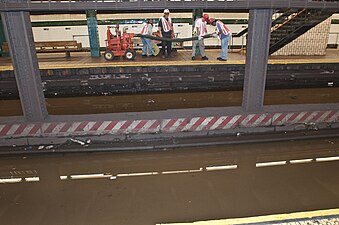 수도 본가 터 125번가 침수 피해
 -

-
 허리케인 샌디 이후 사우스 페리
 -
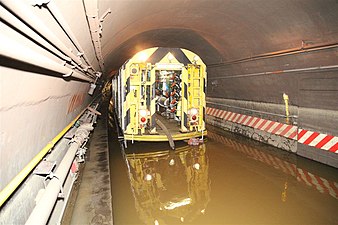 허리케인 샌디 이후 크랜베리 스트리트 튜브에서 펌프 열차 운행


지하철 전체 및 부분 폐쇄
.jpg)
2011년 이전에는 지하철 전면 폐쇄(1966년 1월 1일 ~ 13일,[341] 1980년 4월 1일 ~ 11일,[342] 2005년 12월 20일 ~ 22일)[343]와 정전(1965년 11월 9일 ~ 10일,[344] 1977년 7월 13일 ~ 14일,[345] 2003년[346] 8월 14일 ~ 16일)이 있었습니다.
2011년 8월 27일, 허리케인 아이린의 접근으로 인해, MTA는 선로와 터널에 많은 홍수가 발생할 것으로 예상하여 정오에 지하철 운행을 중단했습니다. 시스템 역사상 첫 날씨로 인한 셧다운이었습니다.[347] 8월 29일까지 서비스가 복구되었습니다.[348][349]
2012년 10월 29일, 허리케인 샌디가 도착하기 전에 전면 폐쇄 명령이 내려졌습니다.[337] 다가오는 폭풍으로부터 승객, 직원, 장비를 보호하기 위해 지하철, 롱아일랜드 철도, 메트로-노스의 모든 운행이 오후 7시까지 점진적으로 중단되었습니다.[350] 폭풍으로 인해 시스템, 특히 하워드 비치 사이의 많은 구간이 IND 로커웨이 라인에 심각한 손상을 입었습니다.록어웨이 반도의 JFK 공항과 해멀스 와이 공항은 큰 피해를 입었고, 이로 인해 시스템의 나머지 부분과 근본적으로 격리되었습니다.[351][352] 이로 인해 뉴욕 교통국은 임시 서비스를 제공하기 위해 20대의 R32 지하철을 트럭에 실어 운행해야 했습니다(임시로 H로 지정됨).[353][354][355] 또한, 동강 아래에 있는 시스템의 터널들 중 몇몇은 폭풍 해일로 인해 침수되었습니다.[356] 사우스 페리는 심각한 물 피해를 입었고 2009년에 교체된 더 오래된 루프 구성 역으로 서비스를 복구하여 2013년 4월 4일까지 재개장하지 않았습니다.[357][358][359][360][361][362]
2015년부터 눈보라와 관련된 지하철 운행 중단이 여러 차례 있었습니다. 2015년 1월 26일 앤드루 쿠오모 뉴욕 주지사는 원래 20~30인치(51~76cm)의 눈과 함께 뉴욕시를 떠날 것으로 예상되는 2015년 1월 동절기로 인해 또 다른 전면 폐쇄를 명령했습니다. 이는 시스템 역사상 처음으로 눈으로 인해 명령된 폐쇄였습니다.[363] 다음날, 지하철 시스템이 부분적으로 다시 개통되었습니다.[364][365] 몇몇 주민들은 눈 때문에 지하철을 폐쇄하기로 한 결정을 비난했는데, 이는 동절기로 인해 도시에 원래 예상보다 훨씬 적은 눈이 내려 센트럴 파크에 총 9.8인치(25cm)에 불과했기 때문입니다.[366][367] 이후 눈보라가 몰아칠 것을 대비해 MTA는 겨울 지하 전용 지하철 운행 계획을 발표했습니다. 이 계획이 시행되면, 125번가와 브로드웨이를 제외한 모든 지상역이 폐쇄되고 모든 지상 서비스가 중단됩니다. 단, 열차 1대가 지상으로 운행하지만 역은 생략됩니다. 지하 서비스는 시스템의 지상 부분과 가깝기 때문에 폐쇄되는 소수의 역을 제외하고는 계속 운영될 것입니다.[368] 이 계획은 2016년 1월 미국 눈보라가 몰아칠 때인 2016년 1월 23일에 처음 사용되었으며,[369] 2017년 3월에도 3월 14일에 사용되었으며, 2017년 3월에도 부활절이 없기 때문에 사용되었습니다.[370] 2020년 8월 4일, 열대성 폭풍 이사이아스가 몰고 온 강풍으로 인해 지상역의 운행이 중단되었습니다.[371]
2020년 5월 6일부터 뉴욕시의 COVID-19 대유행으로 인해 새벽 1시부터 5시 사이에 청소 및 소독을 위해 역이 폐쇄되었습니다.[372][373] 그럼에도 새벽 1시부터 5시 사이에도 열차 500여 대가 20분 간격으로 운행을 이어가며 환승요원과 응급요원만 태웠습니다. 모든 열차를 동시에 보관할 수 있는 공간이 부족하여 열차가 계속 운행되었고, 또한 오전 5시에 출근 시간 시작과 동시에 쉽게 운행을 재개할 수 있었습니다.[374] 2021년 2월, 야간 휴무는 새벽 2시에서 4시 사이로 단축되었고,[375][376] 2021년 5월, 쿠오모는 5월 17일부터 24시간 서비스를 재개한다고 발표했습니다.[377][378] 이는 지하철 역사상 가장 긴 셧다운이었습니다.[379]
-
 2014년 눈폭풍 때 제설작업
 -
 COVID-19 범유행 기간 중 폐쇄된 개찰구
 -
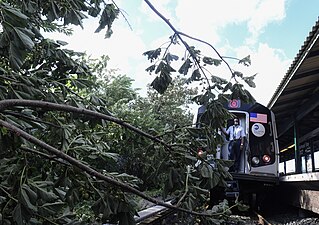 허리케인 이사이아스 때 쓰러진 나무
.jpg)
.jpg)

쓰레기와 설치류
지하철의 쓰레기 축적은 다년생입니다. 1970년대와 1980년대에는 지저분한 기차와 승강장은 물론 낙서가 심각한 문제였습니다. 그 이후 상황은 나아졌지만, 청소 직원 100여 명이 일자리를 잃은 2010년 예산 위기는 쓰레기 제거를 줄이겠다고 위협했습니다.[380][381] MTA는 매일 3,500개의 쓰레기 용기에서 40톤의 쓰레기를 제거합니다.[382]
뉴욕 시 지하철은 쥐들로 가득 차 있습니다.[383] 쥐는 가끔 플랫폼에서 볼 수 있으며,[384] 트랙에 버려진 쓰레기를 통해 먹이를 찾는 것이 일반적으로 목격됩니다. 그들은 건강상의 위험을 초래하는 것으로 여겨지며, 드물게 사람을 물리는 것으로 알려져 있습니다.[385] 쥐가 들끓는 것으로 악명 높은 지하철역으로는 챔버스 스트리트, 제이 스트리트-메트로테크, 웨스트 4번가, 스프링 스트리트, 145번가 등이 있습니다.[386]
시스템 내 쥐 개체수를 근절하거나 단순히 줄이기 위한 수십 년간의 노력은 실패로 돌아갔습니다. 2009년 3월 교통국은 새로운 독극물 공식과 실험 트랩 설계를 포함한 해충 방제 전략에 대한 일련의 변경 사항을 발표했습니다.[387] 2011년 10월, 그들은 쓰레기 방과 함께 25개의 지하철역에서 쥐의 침입을 청소하는 새로운 계획을 발표했습니다.[388] 같은 달, MTA는 지하철 승강장에서 모든 쓰레기통을 제거함으로써 지하철의 쓰레기 수준을 줄이는 것을 목표로 하는 시범 프로그램을 발표했습니다. 이 계획은 8번가–뉴욕 대학교 및 플러싱–메인 스트리트 역에서 테스트되었습니다.[389] 2016년 3월 현재, BMT 자메이카 선, BMT 머틀 애비뉴 선 및 기타 다양한 역들은 프로그램의 성공으로 인해 쓰레기통이 제거되었습니다.[390] 2017년 3월 프로그램은 실패로 끝났습니다.[391]
선로에서 쓰레기를 제거하도록 설계된 오래된 진공 열차는 효과가 없고 종종 고장이 납니다.[390] Travel Math의 2016년 연구에 따르면 뉴욕 지하철은 생존 가능한 박테리아 세포 수를 기준으로 미국에서 가장 더러운 지하철로 선정되었습니다.[392] 2016년 8월, MTA는 선로와 지하철 환경의 쓰레기 양을 극적으로 줄이기 위한 적극적인 계획인 트랙 스위프 작전을 시작했다고 발표했습니다. 이를 통해 선로 화재와 열차 지연을 줄일 수 있을 것으로 기대했습니다. 계획의 일환으로, 역 선로 청소 횟수를 늘리고, 2주 간격으로 94개 역을 청소할 계획이며, 이는 이전의 34개 역에서 2주 간격으로 증가한 것입니다.[382] MTA는 2016년 9월 12일 2주간의 집중적인 시스템 전체 청소를 시작했습니다.[393] 진공열차는 2018년과 2019년에 여러 대 납품되었습니다.[394] 이 작전에는 27대의 새로운 폐기물 자동차도 포함될 계획이었습니다.[395]
-
 1970년대 후반의 전형적인 지하철 외관
 -
 쥐에 대한 대책
 -
 스테이션에서 쓰레기통을 제거하기 위한 프로그램


소음
뉴욕 지하철의 롤링 스톡은 세계 보건 기구와 미국 환경 보호국이 정한 지침을 초과하는 높은 수준의 소음을 발생시킵니다.[396] 2006년에 콜롬비아 대학교의 메일맨 공중 보건 대학은 지하철 안에서 소음 수준이 평균 95데시벨, 승강장에서 94데시벨이라는 것을 발견했습니다.[396] 이러한 수준의 소음에 매일 30분 정도 노출되면 청력 손실이 발생할 수 있습니다.[396] 플랫폼 10개 중 1개의 소음이 100dB를 초과했습니다.[396] WHO 및 EPA 지침에 따라 해당 수준의 소음 노출은 1.5분으로 제한됩니다.[396] 콜롬비아와 워싱턴 대학의 후속 연구에서는 항만공사 트랜스 허드슨 (PATH) (79.4 dB), 메트로 노스 (75.1 dB) 및 롱 아일랜드 철도 (LIRR) (74.9 dB)를 포함한 통근 열차보다 지하철 (80.4 dB)에서 더 높은 평균 소음 수준을 발견했습니다.[397] 데시벨 음계가 로그 음계이기 때문에 95dB에서의 소리는 85dB에서의 소리보다 10배, 75dB에서의 소리보다 100배 더 강렬합니다.[397] 두 번째 연구에서는 피크 지하철 소음이 102.1dB로 등록되었습니다.[397]
2번가 지하철 건설을 위해 MTA는 엔지니어링 회사인 Arup과 함께 역의 소음 수준을 줄이기 위해 노력했습니다. MTA는 2번가 지하철을 시작으로 향후 모든 역의 소음을 줄이기 위해 콘크리트로 덮인 고무와 네오프렌 패드에 둘러싸인 넥타이를 사용하여 저진동 선로에 투자하고 있습니다. 또한 설치 중인 연속 용접 레일은 열차 바퀴에서 발생하는 소음을 줄여줍니다. 가장 큰 변화는 역의 디자인입니다. 현재의 역들은 타일과 돌로 지어졌는데, 이것들은 어디에서나 소리를 튕겨내는 반면, 새로운 역들은 플랫폼이 아닌 열차를 향해 소리를 전달할 흡수성 섬유 유리 또는 미네랄 울로 천장이 줄지어 있을 것입니다. 열차의 소음을 줄여 승강장 안내 방송을 더 선명하게 들을 수 있었습니다. 플랫폼에서 스피커가 주기적으로 간격을 두고 각도를 맞춰 더 선명하게 표시되어 승객이 안내 방송을 들을 수 있습니다. 2번가 지하철은 이 기술을 시험할 수 있는 최초의 역들을 가지고 있습니다.[398]
홍보 및 문화적 영향
오락.
.jpg)
지하철은 버스킹의 인기 장소입니다. 수행하려면 허가증이 필요하지 않지만 특정 행동 강령이 필요합니다.[399] 일부 버스커들은 MTA의 Arts & Design 프로그램의 일부인 MUNY(Music Under New York)에 소속되어 있습니다. 1987년부터 MTA는 길거리 음악가들이 선호하는 교통량이 많은 장소에 배정되기 위해 경쟁 경연에 참가하는 MUNY 프로그램을[400] 후원해 왔습니다. 매년 지원서를 검토하고 약 70명의 자격을 갖춘 연주자를 선정하여 연락하여 하루 동안 진행되는 라이브 오디션에 참가합니다.[401][402][403][404]
미스 서브웨이

1941년부터 1976년까지 뉴욕 시 교통국(Board of Transportation/New York City Transit Authority)은 "미스 서브웨이(Miss Subways)" 홍보 캠페인을 후원했습니다.[405] 뮤지컬 On the Town에서, Miss Turnstiles라는 캐릭터는 Miss Subways 캠페인을 기반으로 합니다.[406][407] 이 캠페인은 2004년, 1년 동안 "Ms. Subways"로 부활했습니다. 100주년 기념행사의 일부였습니다. 지하철 안 플래카드에 당첨자들의 사진과 전기적 흐림이 포함된 이 월간 캠페인에는 모나 프리먼과 뉴욕시의 유명 레스토랑 경영자 엘렌 굿맨과 같은 당첨자들이 참여했습니다. 이 대회의 우승자는 모닝사이드 하이츠의 여배우 캐롤라인 산체스-버나트였습니다.[408]
지하철 시리즈
서브웨이 시리즈는 상대팀이 지하철을 이용하는 것만으로도 경쟁하기 위해 이동할 수 있기 때문에 뉴욕시 팀 간의 모든 야구 경기에 적용되는 용어입니다. 서브웨이 시리즈는 1940년대와 1950년대에 브루클린 다저스 또는 뉴욕 자이언츠와 뉴욕 양키스 사이의 시리즈로 거슬러 올라가는 뉴욕에서 오랫동안 사용된 용어입니다. 오늘날 이 용어는 양키스와 뉴욕 메츠의 라이벌 관계를 묘사하는 데 사용됩니다. 2000년 월드 시리즈 동안 4번 열차(양키 스타디움에 정차)의 차량은 양키 색으로 칠해진 반면, 7번 열차(시어 스타디움에 정차)의 차량은 메츠 색으로 칠해졌습니다.[409]
명절 향수 열차

MTA는 2003년부터 일요일이 아닌 토요일에 열차가 운행된 2011년과 2023년을 [410]제외하고 11월과 12월 일요일에 추수감사절 이후 첫 일요일부터 성탄절 이전 일요일까지 명절 향수 열차를 운행해 왔습니다.[411] 이 열차는 철도보존공사와 뉴욕 교통박물관이 보존해온 R1~R9 시리즈의 빈티지 차량으로 제작됐습니다. 2017년까지 이 열차는 IND 6번가 라인과 IND 퀸즈 블러바드 라인을 통해 맨해튼 2번가와 퀸즈 퀸즈 플라자 사이에 모든 역을 정차했습니다. 2017년 이 열차는 새로 개통된 2번가 지하철을 통해 2번가와 96번가 사이를 운행했습니다.[412] 2018년부터 북쪽 터미널은 현재 145번가에 위치해 있습니다.
사용된 계약, 차량 번호(및 제작 연도)는 아르닌으로, 구체적으로 R1 100(1930년 제작), R1 103(1930년 제작), R1381(1931년 제작), R401(1932년 제작), R4 484(1932년 제작), 불스 아이 조명 및 테스트 P였습니다.A. 1946년에 추가된 시스템, R6-3 1000(1935), R6-1 1300(1937), R7A 1575(1938)[413] – 1947년에 R10 지하철 차량의 프로토타입으로 재건됨, R9 1802(1940).
풀 트레인 랩
MTA는 2008년부터 42번가 셔틀 전동차의 완전한 랩을 시험해 왔습니다. 전체 열차 랩에서 광고는 일반적으로 열차 내부 플래카드에만 광고를 표시하는 다른 노선과 달리 열차 내부와 외부를 완전히 커버합니다.[414][415] 대부분의 광고는 좋은 반응을 얻고 있지만 몇 가지 광고는 논란이 되고 있습니다. 철회된 더 논쟁의 여지가 있는 랩들 중에는 나치 깃발이 등장한 TV 쇼 The Man in the High Castle의 2015년 광고와 [416][417]셔틀 열차와 좌석의 절반이 도시의 NBA 팀 중 하나인 뉴욕 닉스에 대한 부정적인 인용문으로 도배된 폭스 스포츠 1의 광고가 있습니다.[418][419]
다른 노선에서는 완전한 열차 랩의 구현이 제한적입니다. 예를 들어, 2010년에는 6개 노선에 설정된 R142A 열차 1대에 Target 광고가 래핑되었습니다.[420] 2014년, 재규어 F-Type은 F 노선을 운행하는 열차 세트에 광고되었습니다.[421][422] 이러한 랩 중 일부는 2015년 레인 브라이언트 랩이 기차의 외관에 란제리 모델을 전시한 것과 같이 논란이 되기도 했습니다.[423]
LGBT 프라이드를 테마로 한 열차와 메트로 카드

뉴욕 지하철은 프라이드를 주제로 한 포스터로 6월의 프라이드의 달을 기념합니다.[424] MTA는 2019년 6월에 지하철 기차에 무지개를 주제로 한 프라이드 로고와 프라이드를 주제로 한 메트로 카드로 스톤월 50 - 월드 프라이드 NYC 2019를 기념했습니다.[425]
게릴라 아트
뉴욕 시 지하철 시스템은 1970년대부터 그라피티와 태깅을 시작으로 무단 또는 "게릴라" 예술의 표적이 되어 왔습니다. 원래 반달리즘으로 생각되었던 예술 형식은 1980년대, 특히 1983년 다큐멘터리 스타일 워즈가 출시되면서 결국 권위 있는 유형론으로 등장했습니다. 저명한 팝 아티스트 키스 해링(Keith Haring)은 지하철 승강장의 빈 광고판에 분필 아트를 붙여 태깅을 시작했습니다.[426] 2019-2020년 브롱크스 박물관은 그래피티 태그가 부착된 지하철 차량 전시회를 열었습니다.[427]
더 많은 현대적인 설치도 이루어졌습니다. 2014년, 예술가 London Kaye는 금속 핸드폴을 니트 원단으로 감싸며 L 트레인을 원사로 폭격했습니다.[428] 2019년, 예술가 이안 칼렌더(Ian Callender)는 프로젝터를 사용하여 전체 자동차 천장에서 6개의 열차를 움직이는 도시 경관의 정확한 모습을 보여주었습니다.[429] 2021년 일러스트레이터 데본 로드리게스(Devon Rodriguez)는 동료 통근자들의 그림으로 유명해졌습니다.[430]
노팬츠 라이드
2002년, 뉴욕 지하철은 사람들이 바지 없이 지하철을 타는 노팬츠 서브웨이 라이드(No Pants Subway Ride)라는 행사를 개최하기 시작했습니다. 이 행사는 일반적으로 매년 1월에 개최되지만 COVID-19 팬데믹으로 인해 2020년 이후 개최되지 않았습니다.[431]
참고 항목
메모들
- ^ 이것들은 열차 "서비스"가 운행하는 물리적 트랙입니다. 자세한 내용은 뉴욕 지하철 명명법을 참조하십시오.
- ^ 이러한 "서비스"는 물리적 트랙에서 실행됩니다. 자세한 내용은 뉴욕 지하철 명명법을 참조하십시오.
- ^ a b IND 2번가 선에는 13개 역이 있고 IRT 플러싱 선에는 1개 역이 계획되어 있습니다.
- ^ a b
- 영구 폐쇄된 역은 계산되지 않습니다.[5]
- MTA는 체임버스 스트리트-월드 트레이드 센터 역(IND 8번가 선)과 캐널 스트리트 역(BMT 브로드웨이 선)을 각각 2개 역으로 간주합니다.[5] 두 곳을 모두 하나의 역으로 계산하면, 뉴욕 지하철의 역 수는 470개(또는 국제 기준으로 423개)가 됩니다.
- ^ a b 이 수치는 승객이 차량에 탑승할 때마다 한 번의 승차가 계산되는 비연동 승차를 나타냅니다. MTA는 연결된 탑승자 수를 기준으로 2022년 탑승자 수를 1,013,425,465명으로 보고하며, 이는 처음부터 끝까지 각 완전한 여정이 사용된 차량의 수에 관계없이 하나의 탑승자로 계산된다는 것을 의미합니다.[19]
- ^ 최초의 뉴욕시 "subway" 노선으로 여겨지는 IRT 본선은 1904년에 개통되었고, 뉴욕시 교통국이 발간한 팩트 앤 피겨스 1979-80에 따르면, 이전 고가 철도 노선인 9번가 선은 1868년 7월 3일에 첫 시범 운행을 시작했습니다. nycsubway.org 아카이브 2008년 10월 7일, Wayback Machine에서; 그리고 1863년에 개통된 West End Line에서. 1864년에 개통된 연장의 일부인 후자 노선의 원래 통행권의 일부는 아직도 코니 아일랜드 근처에서 일상적으로 사용되고 있습니다. thethirdrail.net Wayback Machine에서 2006년 5월 23일 보관
- ^ 미래의 인필 스테이션으로 계획되어 있는 스테이션(10번가)이 하나 있습니다. 새로운 7개 노선의 41번째 세인트 스톱을 위해 아웃크라이가 등장합니다.
- ^ FASTRACK 참조
- ^ IRT 42번가 셔틀의 타임스퀘어역과 그랜드 센트럴역은 심야시간대에 영업을 중단합니다. 또한 63번가 셔틀이 운행하는 2개 역은 2024년까지 심야시간대에, M이 운행하는 57번가 역은 심야시간대와 주말에 각각 폐쇄됩니다.
- ^ 참조:
- Korman, Joe (December 4, 2017). "IRT Car Assignments". JoeKorNer.
- Korman, Joe (January 12, 2018). "BMT-IND Car Assignments". JoeKorNer.
참고문헌
- ^ a b c "Introduction to Subway Ridership". Metropolitan Transportation Authority. Archived from the original on September 12, 2014. Retrieved July 12, 2018.
- ^ "web.mta.info/capital/sas_docs/final_summary_report.pdf" (PDF). Archived (PDF) from the original on November 7, 2016. Retrieved April 17, 2014.
- ^ "MTA releases Second Avenue subway images". New York Daily News. November 5, 2013. Archived from the original on November 24, 2021. Retrieved April 17, 2014.
- ^ "새로운 7선 41번째 세인트 스톱에 대한 아우성이 나타남"
- ^ a b "Station Developers' Information". Metropolitan Transportation Authority. Retrieved June 13, 2017.
- ^ a b "Transit Ridership Report Fourth Quarter 2022" (PDF). American Public Transportation Association. March 1, 2023. Retrieved March 29, 2023.
- ^ "Fifty Years of Rapid Transit (1918)". Archived from the original on February 5, 2023. Retrieved January 5, 2018.
- ^ "The MTA Network". Metropolitan Transportation Authority. Archived from the original on June 3, 2019. Retrieved February 22, 2018.
- ^ a b "MTA A Subway Timetable". MTA. Archived from the original on December 12, 2021. Retrieved June 26, 2022.
- ^ a b c d "Comprehensive Annual Financial Report for the Years Ended December 31, 2018 and 2017" (PDF). Metropolitan Transportation Authority (MTA). June 26, 2019. p. 156. Archived (PDF) from the original on October 23, 2021. Retrieved January 15, 2021.
- ^ a b c d e "Facts & Figures – Subways". www.nycsubway.org. Archived from the original on June 18, 2012. Retrieved March 9, 2014.
- ^ "The Railway Power Stations of New York City". Engineering and Technology History. Archived from the original on March 11, 2022. Retrieved September 13, 2016.
- ^ a b "Average schedule speed: How does Metro compare?". Archived from the original on December 8, 2015. Retrieved July 16, 2015.
- ^ a b Hood, Clifton (2004). 722 Miles: The Building of the Subways and How They Transformed New York. Johns Hopkins University Press. ISBN 978-0801880544.
- ^ "Metropolitan Transportation Authority Description and Board Structure Covering Fiscal Year 2009" (PDF). mta.info. Metropolitan Transportation Authority. 2009. Archived (PDF) from the original on December 7, 2015. Retrieved March 13, 2016.
- ^ "What is the largest metro system in the world?". CityMetric. Archived from the original on September 6, 2015. Retrieved March 13, 2016.
- ^ a b c d e f g h i j "How to Ride the Subway". Archived from the original on July 5, 2022. Retrieved May 12, 2013.
- ^ "Subways". Metropolitan Transportation Authority (MTA). April 2, 2013. Archived from the original on June 22, 2013. Retrieved April 26, 2015.
- ^ "Subway and bus ridership for 2022". mta.info. Metropolitan Transportation Authority. 2023. Archived from the original on August 3, 2023. Retrieved August 3, 2023.
- ^ "NYC Subway Broke Its Single-Day Ridership Record In October". ny.curbed.com. December 11, 2015. Archived from the original on February 25, 2024. Retrieved October 30, 2021.
- ^ Goldstein, Jack (2013). 101 Amazing Facts About New York. Andrews UK Limited. ISBN 978-1783333059.
- ^ Rivoli, Dan (February 13, 2018). "MTA Budget: Where does the money go?". NY Daily News. Archived from the original on November 3, 2018. Retrieved November 3, 2018.
- ^ a b Brennan, Joseph (2005). "They found the tube in excellent condition". Beach Pneumatic. Archived from the original on October 6, 2007. Retrieved January 17, 2008.
- ^ "Inventor of the Week: Archive". March 6, 2014. Archived from the original on March 6, 2014. Retrieved March 18, 2016.
- ^ "The Pneumatic Tunnel Under Broadway (1870)". nycsubway.org. Archived from the original on May 5, 2008. Retrieved July 7, 2008. (Scientific American 1870년 3월 5일자 발췌)
- ^ nycsubway.org – 2021년 4월 24일 Wayback Machine에서 비치 공압 교통편 보관
- ^ Blankinger, Kari (March 1, 2016). "NYC's first subway was luxurious, pneumatic and built illegally". New York Daily News. Archived from the original on November 24, 2021. Retrieved March 13, 2016.
- ^ Martin, Douglas (November 17, 1996). "Subway Planners' Lofty Ambitions Are Buried as Dead-End Curiosities". The New York Times. Archived from the original on August 7, 2017. Retrieved June 27, 2015.
- ^ Santora, Marc (August 14, 2013). "When the New York City Subway Ran Without Rails". The New York Times. Archived from the original on June 26, 2022. Retrieved February 11, 2017.
- ^ Christiano, G. J. "The Blizzard of 1888; the Impact of this Devastating Storm on New York Transit". nycsubway.org. Archived from the original on May 4, 2022. Retrieved February 9, 2016.
- ^ a b "American Experience. Technology . New York Underground. About the Program". PBS. Archived from the original on August 29, 2016. Retrieved March 13, 2016.
- ^ "Done at Last". Brooklyn Daily Eagle. Brooklyn, NY. May 13, 1885. p. 1.
- ^ "Halsey Street Station Opened". Brooklyn Daily Eagle. Brooklyn, NY. August 19, 1885. p. 4.
- ^ "A New Station Opened". Brooklyn Daily Eagle. Brooklyn, NY. July 18, 1885. p. 4.
- ^ "East New York". Brooklyn Daily Eagle. Brooklyn, NY. June 13, 1885. p. 6.
- ^ "Still Extending Its Lines". Brooklyn Daily Eagle. Brooklyn, NY. September 5, 1885. p. 6.
- ^ a b "www.nycsubway.org: BMT Nassau Street-Jamaica Line". www.nycsubway.org. Archived from the original on September 25, 2022. Retrieved February 25, 2016.
- ^ "Opening of a New Railroad". Brooklyn Daily Eagle. Brooklyn, NY. October 5, 1863. p. 2.
- ^ "Railroads". Brooklyn Daily Eagle. Brooklyn, NY. October 9, 1863. p. 1.
- ^ "The Third Rail – Gunther and his Railroad – page 1". www.thethirdrail.net. Archived from the original on February 29, 2016. Retrieved February 14, 2016.
- ^ a b c James Blain Walker, Rapid Transit 50년, 1864-1917 Archive, the Wayback Machine, 1918, pp. 162-191
- ^ "The 9th Avenue Elevated-Polo Grounds Shuttle". nycsubway.org. 2012. Archived from the original on September 26, 2013. Retrieved July 3, 2014.
- ^ "Our Subway Open, 150,000 Try It – Mayor McClellan Runs the First Official Train" (PDF). The New York Times. October 28, 1904. Archived (PDF) from the original on September 18, 2018. Retrieved February 24, 2016.
- ^ a b 1634–1699: 1700–1799: 1800–현재:
- ^ "Specter of the 5¢ fare haunts the current fare hike debate". Second Ave. Sagas. November 21, 2007. Archived from the original on November 24, 2021. Retrieved February 25, 2016.
- ^ "www.nycsubway.org: New Subways for New York: The Dual System of Rapid Transit (1913)". www.nycsubway.org. Archived from the original on August 24, 2012. Retrieved February 26, 2016.
- ^ "Gay Midnight Crowd Rides First Trains in New Subway". The New York Times. September 10, 1932. p. 1. Archived from the original on September 12, 2012. Retrieved February 11, 2017.
- ^ a b Feinman, Mark S. (2000). "History of the Independent Subway". nycsubway.org. Archived from the original on December 25, 2017. Retrieved February 10, 2016.
- ^ Cudahy, Brian J. (1995). Under the Sidewalks of New York: The Story of the Greatest Subway System in the World. Fordham University Press. p. 118. ISBN 978-0823216185. Archived from the original on February 25, 2024. Retrieved November 18, 2020.
- ^ "Straphangers Sit As Tunnel Opens". The New York Times. December 2, 1955. p. 29. Archived from the original on November 2, 2012. Retrieved February 13, 2010.
- ^ Perlmutter, Emanuel (November 16, 1967). "Subway Changes to Speed Service: Major Alterations in Maps, Routes and Signs Will Take Effect Nov. 26" (PDF). The New York Times. Archived from the original on October 30, 2021. Retrieved July 7, 2015.
- ^ a b Raskin, Joseph B. (2013). The Routes Not Taken: A Trip Through New York City's Unbuilt Subway System. New York, New York: Fordham University Press. doi:10.5422/fordham/9780823253692.001.0001. ISBN 978-0-82325-369-2.
- ^ "A Division". August 6, 2011. Archived from the original on August 6, 2011. Retrieved February 14, 2016.
- ^ a b Sparberg, Andrew J. (2014). From a Nickel to a Token: The Journey from Board of Transportation to MTA. Fordham University Press. ISBN 978-0823261901.
- ^ Cunningham, Joseph; DeHart, Leonard O. (1993). A History of the New York City Subway System. J. Schmidt, R. Giglio, and K. Lang. Archived from the original on February 25, 2024. Retrieved November 18, 2020.
- ^ "mta.info Facts and Figures". web.mta.info. Archived from the original on January 6, 2010. Retrieved March 11, 2016.
- ^ "Transport Workers Union Our History". www.twu.org. Archived from the original on February 9, 2016. Retrieved February 16, 2016.
- ^ B. Freeman, Joshua (1989). In Transit:The Transport Workers Union In New York City, 1933–1966. Temple University Press. ISBN 978-1592138159. Archived from the original on August 5, 2023. Retrieved February 28, 2016.
- ^ "A Short History of Recent American Transit Strikes". The Transport Politic. August 14, 2009. Archived from the original on January 22, 2022. Retrieved February 16, 2016.
- ^ "A look back at the historic 1966 transit strike: Photos and more". am New York. January 7, 2016. Archived from the original on November 24, 2021. Retrieved February 16, 2016.
- ^ "N. Y. Transit Strike on (January 1, 1966)". Archived from the original on January 5, 2016. Retrieved February 16, 2016.
- ^ "35 Years Ago This Week, the MTA Strikes for 11 Days in NYC Bringing Transit to a Halt". Untapped Cities. April 7, 2015. Archived from the original on February 20, 2016. Retrieved February 16, 2016.
- ^ Steinhauer, Jennifer (December 21, 2005). "Citywide Strike Halts New York Subways and Buses". The New York Times. ISSN 0362-4331. Archived from the original on July 4, 2022. Retrieved February 16, 2016.
- ^ "NYC Transit Workers On Strike". CBS News. December 19, 2005. Archived from the original on November 24, 2021. Retrieved February 16, 2016.
- ^ nycsubway.org – 1970년대 뉴욕 교통국, 2022년 7월 6일 Wayback Machine에 보관
- ^ a b nycsubway.org – 1980년대 뉴욕 교통국, 2022년 7월 6일 Wayback Machine에 보관
- ^ Lorch, Donatella (October 29, 1989). "The 'Subway to Nowhere' Now Goes Somewhere". The New York Times. Archived from the original on March 19, 2011. Retrieved October 20, 2011.
- ^ Johnson, Kirk (December 9, 1988). "Big Changes For Subways Are to Begin". The New York Times. Archived from the original on March 8, 2021. Retrieved July 5, 2009.
- ^ Lentz, Phillip (May 18, 1989). "Graffiti Cleanup A Shiny Symbol Of Subway System's Turnaround". Chicago Tribune. Archived from the original on March 12, 2016. Retrieved March 11, 2016.
- ^ U.S. Department of Transportation Research and Special Programs Administration, Volpe National Transportation Systems Center (April 2002). "Effects of Catastrophic Events on Transportation System Management and Operations: New York City – September 11". Archived from the original on March 5, 2013. Retrieved November 5, 2013.
- ^ 케네디, 랜디. "터널 비전; 역이 다시 문을 열면서 통근자들도 미소 짓는다" 2020년 11월 1일 뉴욕 타임즈, 2002년 9월 17일 웨이백 머신에서 아카이브되었습니다. 2007년 10월 6일 접속.
- ^ "1 9 2 3 Service Restored" (PDF). mta.info. September 15, 2002. Archived from the original (PDF) on July 16, 2003. Retrieved December 25, 2017.
- ^ "September 11: Three Years Later". Brian Abbott. September 11, 2004. Archived from the original on March 14, 2016. Retrieved March 25, 2016.
- ^ Fitzsimmons, Emma G.; Hu, Winnie (September 8, 2018). "Cortlandt Street Station, Damaged on Sept. 11, Reopens 17 Years Later". The New York Times. Archived from the original on September 8, 2018. Retrieved September 8, 2018.
- ^ "WTC Cortlandt Subway Station Reopens for 1st Time Since 9/11 Attacks". NBC 4 New York. Associated Press. September 8, 2018. Archived from the original on September 9, 2018. Retrieved September 8, 2018.
- ^ "mta.info: Superstorm Sandy Timeline". Archived from the original on November 14, 2018.
- ^ Brachfeld, Ben (December 27, 2022). "MTA surpasses 1 billion subway riders in 2022, a first in COVID era". amNewYork. Archived from the original on October 17, 2023. Retrieved October 3, 2023.
- ^ a b c d "The New York Subway: Chapter 02, Types and Methods of Construction". nycsubway.org. Archived from the original on February 17, 2022. Retrieved November 1, 2015.
- ^ "Why It Was Faster To Build Subways in 1900". Atlas Obscura. October 22, 2015. Archived from the original on May 17, 2022. Retrieved April 15, 2016.
- ^ "www.nycsubway.org: Design and Construction of the IRT: Civil Engineering (Scott)". www.nycsubway.org. Archived from the original on August 5, 2022. Retrieved April 15, 2016.
- ^ "Subway Construction: Then and Now". The New York Public Library. Archived from the original on June 11, 2022. Retrieved April 15, 2016.
- ^ "Subway FAQ: Facts and Figures". nycsubway.org. Archived from the original on June 21, 2013. Retrieved February 26, 2016.
- ^ "MTA has been leaving dangerous debris exposed for years: conductor". New York Post. February 23, 2019. Archived from the original on February 23, 2019. Retrieved February 23, 2019.
- ^ "www.nycsubway.org: IRT White Plains Road Line". www.nycsubway.org. Archived from the original on May 14, 2021. Retrieved February 26, 2016.
- ^ Cox, Jeremiah. "Myrtle Av-Broadway (J, M, Z) – The SubwayNut". www.subwaynut.com. Archived from the original on March 12, 2018. Retrieved February 26, 2016.
- ^ Dougherty, Peter (2006) [2002]. Tracks of the New York City Subway 2006 (3rd ed.). Dougherty. OCLC 49777633 – via Google Books.
- ^ DuTemple, Lesley A. (2002). The New York Subways. Twenty-First Century Books. ISBN 978-0822503781. Archived from the original on February 25, 2024. Retrieved January 28, 2016.
- ^ MacKechnie, Christopher. "The Two Methods of Subway Construction". about.com. Archived from the original on December 10, 2016. Retrieved May 7, 2014.
In exchange for these advantages are two major disadvantages. One is financial: "deep bore" construction costs significantly more than 'cut and cover'
- ^ "No. 7 Subway Line Extension". Richard Dattner & Partners Architects. Archived from the original on March 15, 2012. Retrieved February 28, 2010.
- ^ "West Side Development Project Gets The Green Light". NY1. December 21, 2009. Archived from the original on April 7, 2012. Retrieved February 28, 2010.
- ^ Cuza, Bobby (February 19, 2009). "Crews Lower Giant Drill Into 7 Line Tunnel". NY1. Archived from the original on May 5, 2009. Retrieved February 28, 2010.
- ^ "New York State Society of Professional Engineers Recognizes No. 7 Line Project". Tunnel Business Magazine. July 3, 2013. Archived from the original on April 24, 2021. Retrieved August 20, 2013.
- ^ Siff, Andrew (May 14, 2010). "2nd Ave. Subway Tunnel Dig Begins". WNBC. Archived from the original on August 5, 2023. Retrieved May 14, 2010.
- ^ "MTA news Tunneling Begins Under Second Avenue". www.mta.info. Archived from the original on June 6, 2011. Retrieved February 10, 2016.
- ^ Various (September 23, 2011). "Second Avenue Subway has a breakthrough moment; several billion more are all the M.T.A. wants". Capital New York. Archived from the original on March 31, 2014. Retrieved March 31, 2014.
- ^ a b Duffus, R.L. (September 22, 1929). "Our Great Subway Network Spreads Wider – New Plans of Board of Transportation Involve the Building of More Than One Hundred Miles of Additional Rapid Transit Routes for New York". The New York Times. Archived from the original on September 27, 2015. Retrieved August 19, 2015.
- ^ "100 Miles of Subway in New City Project; 52 of them in Queens" (PDF). The New York Times. September 16, 1929. Archived (PDF) from the original on June 27, 2022. Retrieved March 25, 2016.
- ^ "The futureNYCSubway: The IND Second System". vanshnookenraggen. February 2010. Archived from the original on March 30, 2016. Retrieved March 13, 2016.
- ^ nycsubway.org – Wayback Machine에서 2017년 12월 25일 보관된 독립 지하철의 역사
- ^ O'Grade, Jim (January 3, 2012). "Lost Subways: Abandoned Stations and Unbuilt Lines". wnyc.org. Archived from the original on August 9, 2013. Retrieved February 10, 2016.
- ^ "New Subway Line on 6th Ave. Opens at Midnight Fete". The New York Times. December 15, 1940. p. 1. Archived from the original on December 13, 2021. Retrieved October 7, 2011.
- ^ "Rail Line is Added to Subway System". The New York Times. May 16, 1941. p. 25. Archived from the original on August 2, 2022. Retrieved October 4, 2011.
- ^ Freeman, Ira Henry (June 28, 1956). "Rockaway Trains to Operate Today" (PDF). The New York Times. Archived from the original on May 20, 2022. Retrieved June 29, 2015.
- ^ "Rapid Transit Service Coming Brochure". www.thejoekorner.com. New York City Transit Authority. July 1, 1968. Archived from the original on December 8, 2015. Retrieved January 24, 2016.
- ^ "KK a new service". www.thejoekorner.com. New York City Transit Authority. July 1, 1968. Archived from the original on December 8, 2015. Retrieved January 24, 2016.
- ^ "IRT Passengers Get New 148th St. Station". The New York Times. May 14, 1968. p. 95. Archived from the original on December 21, 2021. Retrieved October 4, 2011.
- ^ Johnson, Kirk (December 9, 1988). "Big Changes For Subways Are to Begin". The New York Times. Archived from the original on March 8, 2021. Retrieved July 5, 2009.
- ^ Lorch, Donatella (October 29, 1989). "The 'Subway to Nowhere' Now Goes Somewhere". The New York Times. Archived from the original on March 19, 2011. Retrieved October 20, 2011.
- ^ Donohue, Pete (March 17, 2009). "MTA opens new $530M South Ferry station". New York Daily News. Archived from the original on August 17, 2016. Retrieved July 21, 2016.
- ^ Fitzsimmons, Emma G. (September 10, 2015). "Subway Station for 7 Line Opens on Far West Side". The New York Times. Archived from the original on September 14, 2015. Retrieved September 13, 2015.
- ^ "Capital Programs 7 Line Extension". mta.info. September 13, 2015. Archived from the original on March 4, 2016. Retrieved March 25, 2016.
- ^ Ingram, David (December 31, 2016). "New York tale: a century-old subway dream becomes reality". Yahoo. Archived from the original on June 8, 2022. Retrieved January 1, 2017.
- ^ "Annual Information Statement 2001 Appendix A The Related Entities" (PDF). Metropolitan Transportation Authority (MTA). 2001. Retrieved April 26, 2015.
- ^ 미래로의 터널링: 뉴욕을 구한 지하철 대확장 이야기 (2001).
- ^ "Introduction to Subway Ridership". Metropolitan Transportation Authority (MTA). Retrieved April 18, 2016.
- ^ "Annual Subway Ridership (2017–2022)". Metropolitan Transportation Authority. 2022. Retrieved November 8, 2023.
- ^ "Subway and bus ridership for 2021". Metropolitan Transportation Authority (MTA). Retrieved October 28, 2022.
- ^ "Subway and bus ridership for 2022". Metropolitan Transportation Authority (MTA). Retrieved November 15, 2023.
- ^ Goldman, Ari (October 23, 1982). "RIDERSHIP OF SUBWAYS SINCE 1917". The New York Times. Retrieved June 5, 2017.
- ^ 유튜브 MTA 유튜브 웹페이지의 지하철 색상과 이름 2010년 7월 15일 제작. 2010년 7월 17일 회수.
- ^ a b c "Subway Service Guide" (PDF). Metropolitan Transportation Authority. September 2019. Retrieved September 22, 2019.
- ^ Cox, Bobby. "New York City Subway". Deaf Echo. Archived from the original on November 2, 2014. Retrieved February 10, 2016.
- ^ "Rules of The Subway". Fodors. Archived from the original on July 4, 2017. Retrieved September 21, 2013.
- ^ a b "Subway Map" (PDF). Metropolitan Transportation Authority. September 2021. Retrieved September 17, 2021.
- ^ "Late Night Subway Service September 2015" (PDF). mta.info. Metropolitan Transportation Authority. September 2015. Archived (PDF) from the original on April 22, 2022. Retrieved February 29, 2016.
- ^ Haberman, Clyde (April 4, 2008). "Train Skip Your Stop? It's No Mistake, It's Just the Weekend". The New York Times. Archived from the original on July 7, 2022. Retrieved March 25, 2016.
- ^ a b c Tangel, Andrew. "New York's Subway System Can't Keep Pace With Growing Number of Riders". The Wall Street Journal. ISSN 0099-9660. Archived from the original on August 20, 2022. Retrieved March 25, 2016.
- ^ 피니건, 잭, 벨든 메림스, 제니퍼 세실 (2007). 뉴욕시로 이사와 거주를 위한 신참자 핸드북: 맨해튼, 브루클린, 브롱크스, 퀸즈, 스태튼 아일랜드 및 북부 뉴저지를 포함합니다. 오리건주 포틀랜드: 퍼스트 북스 주식회사 ISBN 978-0912301723. p. 336.
- ^ "NYCT – Service Advisory". travel.mtanyct.info. Archived from the original on October 6, 2021. Retrieved February 10, 2016.
- ^ "MTA/New York City Transit – Subway Service Information". December 20, 2010. Archived from the original on December 20, 2010. Retrieved February 10, 2016.
- ^ "NYCT Subway (@NYCTSubway) – Twitter". Archived from the original on October 1, 2022. Retrieved February 13, 2014.
- ^ 1979년 색상이 수정된 이후 공식 페인트 모니커:
- ^ 공식 MTA 비디오는 G 라인에 대해 "라임 그린"을 언급합니다.
- ^ MTA 개발자 리소스 다운로드, CSV 파일
- ^ Taylor Romine; Laura Ly (February 27, 2020). "Michael Hertz, who helped design New York City's subway map, dies at 87". CNN. New York. Archived from the original on March 1, 2020. Retrieved March 1, 2020.
- ^ "New Subway Map is Here" (Press release). New York: Metropolitan Transportation Authority. Archived from the original on September 26, 2012. Retrieved June 18, 2010.
- ^ "The (Mostly) True Story of Helvetica and the New York City Subway". AIGA. aiga.org. November 18, 2008. Archived from the original on April 21, 2011. Retrieved February 4, 2009.
- ^ Hogarty, Dave (August 3, 2007). "Michael Hertz, Designer of the NYC Subway Map". Gothamist. Archived from the original on August 18, 2009. Retrieved July 4, 2009.
- ^ "Late Night Subway Service" (PDF). Metropolitan Transportation Authority. March 23, 2023. Retrieved June 2, 2023.
- ^ "Introducing The Weekender". MTA.info (YouTube). September 30, 2011. Archived from the original on October 29, 2021. Retrieved October 1, 2011.
- ^ "The Weekender". New York: Metropolitan Transportation Authority. Archived from the original on June 18, 2020. Retrieved October 12, 2013.
- ^ Grynbaum, Michael (September 15, 2011). "Aid for Baffled Weekend Subway Riders". The New York Times. New York. Archived from the original on June 26, 2022. Retrieved September 30, 2011.
- ^ "Introducing 'The Weekender'". MTA.info. September 16, 2011. Archived from the original on September 23, 2011. Retrieved May 12, 2023.
- ^ "MTA Launches Interactive Online Map Ahead Of Difficult Weekend For Subways". NY1. September 16, 2011. Archived from the original on June 28, 2014. Retrieved September 18, 2011.
- ^ 지하철 노선도가 뉴욕1 지역 뉴스 채널로 변신합니다. 2010년 5월 28일 회수.
- ^ a b "Subway Entrance Stylings". Forgotten New York. February 14, 2005. Archived from the original on July 15, 2022. Retrieved December 6, 2015.
- ^ Kennedy, Randy (August 13, 2002). "Tunnel Vision; The Light at the Top of the Subway Stairs". The New York Times. Archived from the original on August 5, 2023. Retrieved July 7, 2008.
- ^ "Explore the Abandoned Subway Stations of NYC". Untapped New York. February 23, 2021. Archived from the original on March 11, 2021. Retrieved March 19, 2021.
- ^ a b "Reopening Closed Subway Entrances" (PDF). pcac.org. New York City Transit Riders Council. November 2001. Archived from the original (PDF) on December 22, 2015. Retrieved December 6, 2015.
- ^ "MTA New York City Transit Jay Street / Lawrence Street Stations Contract A-35913 / A-35914 / A-35927 / A-35978" (PDF). Metropolitan Transportation Authority. Archived (PDF) from the original on June 28, 2022. Retrieved December 6, 2015.
- ^ "www.nycsubway.org: IRT West Side Line". www.nycsubway.org. Archived from the original on January 6, 2017. Retrieved February 24, 2016.
- ^ "MTA/New York City Transit – Subway Station Booth". web.mta.info. Archived from the original on November 24, 2021. Retrieved March 13, 2016.
- ^ Grynbaum, Michael M. (October 8, 2009). "M.T.A. Station Agent Cuts Leave Riders Lost". The New York Times. Archived from the original on June 21, 2022. Retrieved March 13, 2016.
- ^ "Riding Safely". Metropolitan Transportation Authority. Archived from the original on November 21, 2018. Retrieved December 6, 2015.
- ^ Goldman, Ari L. (March 8, 1982). "For Off-Hours, Subway Zones for Safer Wait". The New York Times. ISSN 0362-4331. Archived from the original on November 24, 2021. Retrieved April 15, 2016.
- ^ "IND STation Lengths". August 6, 2011. Archived from the original on August 6, 2011. Retrieved February 14, 2016.
- ^ "Map Reveals Shortage of Wheelchair-Accessible NYC Subway Stations". DNAinfo New York. Archived from the original on March 6, 2016. Retrieved February 28, 2016.
- ^ "mta.info Accessibility". new.mta.info. Archived from the original on December 10, 2021. Retrieved February 10, 2016.
- ^ "NYC Subway Needs $1.7 Billion In New Elevators, Feds Say". Curbed NY. February 2016. Archived from the original on November 24, 2021. Retrieved February 29, 2016.
- ^ Sequeira, Robbie (September 22, 2021). "Six Bronx subway stations could be ADA-accessible under MTA proposal". Bronx Times. Archived from the original on February 24, 2022. Retrieved February 23, 2022.
- ^ Maitland, Leslie (October 1, 1979). "Suit Asserts M.T.A. Fails To Provide for Disabled". The New York Times. ISSN 0362-4331. Archived from the original on January 10, 2021. Retrieved February 24, 2022.
- ^ Rosenberg, Eli (April 25, 2017). "New York City's Subway System Violates Local and Federal Laws, Disability Groups Say". The New York Times. ISSN 0362-4331. Archived from the original on January 10, 2021. Retrieved April 26, 2017.
- ^ Notice of Public Hearing and Description of Projects (Report). New York: Metropolitan Transportation Authority. January 2022. p. 53. Archived from the original on January 6, 2022. Retrieved January 20, 2022.
- ^ "A Sweeping Plan to Fix the Subways Comes With a $19 Billion Price Tag". The New York Times. May 22, 2018. ISSN 0362-4331. Archived from the original on January 10, 2021. Retrieved May 23, 2018.
- ^ "Transform the Subway" (PDF). Fast Forward. Metropolitan Transportation Authority. May 23, 2018. Archived (PDF) from the original on January 10, 2021. Retrieved May 23, 2018.
- ^ Gold, Michael (June 22, 2022). "New York's Subway System Vows to Be 95 Percent Accessible by 2055". The New York Times. ISSN 0362-4331. Archived from the original on June 22, 2022. Retrieved June 22, 2022.
- ^ "All Stations Accessibility Program (ASAP)". CTA. Archived from the original on July 27, 2023. Retrieved July 27, 2023.
In July 2018, we reached an important milestone in our commitment towards making the rail system accessible to everyone by releasing the All Stations Accessibility Program (ASAP) Strategic Plan – our blueprint for making the remaining 42 rail stations fully accessible over the next two decades.
- ^ "2022 Accessibility Plan Status Update" (PDF). Toronto Transit Commission. June 23, 2022. Archived (PDF) from the original on July 26, 2022. Retrieved June 23, 2022.
The TTC continues to plan for all of its subway stations to be accessible by 2025.
- ^ "STM Metro accessibility plan will mean more elevators, ramps". Canadian Broadcasting Corporation. March 7, 2017. Archived from the original on January 11, 2021. Retrieved August 4, 2020.
Schnobb said at that time the entire underground network should be accessible by 2038.
- ^ Ross, Barbara; Gregorian, Dareh (June 29, 2016). "Disability rights groups sue MTA over inaccessible subway station". New York Daily News. Archived from the original on February 2, 2017. Retrieved September 11, 2016.
- ^ "Service Denied: Accessibility and the New York City Subway System". Office of the New York City Comptroller Scott M. Stringer. July 17, 2018. Archived from the original on January 10, 2021. Retrieved July 21, 2018.
- ^ Chang, Sophia (March 3, 2020). "MTA's Long History Of Being Sued Over Subway Accessibility". Gothamist. Archived from the original on July 27, 2023. Retrieved July 27, 2023.
- ^ "BMT-IND Car Assignments – December 6, 2015". www.thejoekorner.com. Archived from the original on March 8, 2021. Retrieved February 14, 2016.
- ^ a b "R-Type Cars 1932 to 1987". www.thejoekorner.com. Archived from the original on August 17, 2021. Retrieved March 13, 2016.
- ^ 2019년 4월 19일 Wayback Machine에서 보관된 2번가 지하철 환경영향 보고서 초안(45.6KB)
- ^ "3.3.3 A, C (Fulton Street) Line Services and Structural Issues" (PDF). New York: New York City Department of City Planning. 2007. Archived from the original (PDF) on June 6, 2010. Retrieved February 9, 2016.
- ^ "Car History". www.erictb.info. Archived from the original on March 16, 2022. Retrieved March 13, 2016.
- ^ "R-Type Cars 1932 to 1987". thejoekorner.com. Archived from the original on August 17, 2021. Retrieved February 28, 2016.
- ^ Chan, Sewell (November 30, 2005). "New Subway Cars Promise All Kinds of Information". The New York Times. Archived from the original on March 15, 2023. Retrieved October 27, 2007.
- ^ *R142/A: Siegal, Nina (October 1, 2000). "Neighborhood Report: New York Underground; 2 New Trains in the Subways: Catch Them if You Can". The New York Times. Archived from the original on February 3, 2016. Retrieved January 24, 2016.
- R143: "Kawasaki completes NYCT R143 order. (Market).(New York City Transit)(subway cars contract)". Railway Age. March 1, 2003. Archived from the original on February 20, 2016. Retrieved July 29, 2018.
- R160: Lueck, Thomas J. (August 18, 2006). "City Subways Put New Cars Into Service as a Test Run". The New York Times. Archived from the original on May 10, 2017. Retrieved January 24, 2016.
- R179: Barone, Vincent (September 6, 2016). "New MTA subway cars to arrive for testing, will replace oldest fleet". AM New York. Archived from the original on September 7, 2016. Retrieved September 8, 2016.
- R188: "MTA news New Subway Cars Being Put to the Test". New.mta.info. November 18, 2013. Archived from the original on May 15, 2014. Retrieved August 24, 2014.
- ^ a b "New Technology Train Rolled Out This Morning Along the E Line". Metropolitan Transportation Authority. December 22, 2008. Archived from the original on October 26, 2021. Retrieved December 7, 2015.
- ^ "The voice behind the closing doors would like to clear something up". nypress.com. Straus News. March 18, 2003. Archived from the original on September 20, 2018. Retrieved December 7, 2015.
- ^ a b c d "MTA 2017 Final Proposed Budget November Financial Plan 2017–2020, Volume 2" (PDF). mta.info. Metropolitan Transportation Authority. November 16, 2016. Archived (PDF) from the original on May 17, 2017. Retrieved November 17, 2016.
- ^ a b "MTA/New York City Transit – Fares and MetroCard". web.mta.info. Archived from the original on September 15, 2015. Retrieved February 10, 2016.
- ^ Hallum, Mark (August 12, 2020). "OMNY payment system now at turnstiles in most subway stations: MTA". amNewYork. Archived from the original on September 28, 2020. Retrieved September 23, 2020.
- ^ "MTA/New York City Transit – Fares and MetroCard". mta.info. Archived from the original on September 15, 2015. Retrieved April 10, 2014.
- ^ "mta.info – Reduced-Fare". mta.info. Archived from the original on May 6, 2019. Retrieved April 10, 2014.
- ^ *"New Home Ready for Transit Board" (PDF). The New York Times. March 25, 1951. Archived from the original on May 13, 2022. Retrieved October 14, 2016.
"City Board Rushes Move to New Site: Transportation Unit Receives U.S. Order to Vacate and Speeds to Brooklyn" (PDF). The New York Times. March 31, 1951. Archived from the original on May 13, 2022. Retrieved October 14, 2016.
"Transit Board Now In Its New Building" (PDF). The New York Times. April 3, 1951. Retrieved October 14, 2016. - ^ a b Young, Michelle (February 12, 2016). "The MTA's Special Armored Money Train that Ran from 1951 to 2006 in NYC". Untapped cities. Archived from the original on November 9, 2020. Retrieved October 14, 2016.
- ^ a b Zimmerman, Alex (November 30, 2015). "Inside the Brooklyn Building that Held the Subway's Secrets". Atlas Obscura. Archived from the original on October 18, 2016. Retrieved October 14, 2016.
- ^ Chung, Jen (January 16, 2006). "Money Train Retires". Gothamist. Archived from the original on December 4, 2015. Retrieved October 14, 2016.
- ^ Faison, Seth (June 2, 1993). "3,000 Subway Riders, Cards in Hand, Test New Fare System". The New York Times. Archived from the original on August 5, 2023. Retrieved April 25, 2010.
- ^ Donohue, Pete (August 26, 2014). "With work on Greenpoint Tube set to end, advocates want free G-to-J/M transfer to be permanent". New York Daily News. Archived from the original on January 20, 2022. Retrieved February 28, 2016.
- ^ "NYC Transit G Line Review" (PDF). mta.info. Metropolitan Transportation Authority. July 10, 2013. Archived (PDF) from the original on December 24, 2019. Retrieved February 28, 2016.
- ^ Newman, Andy (July 3, 1998). "Hop On, Hop Off: The Unlimited Metrocard Arrives". The New York Times. Archived from the original on August 31, 2022. Retrieved January 8, 2010.
- ^ Brachfeld, Ben (April 24, 2023). "OMNY machines rolling out at subway stations this summer as phase-out of MetroCard delayed indefinitely". amNewYork. Archived from the original on October 10, 2023. Retrieved July 27, 2023.
- ^ Rivoli, Dan (October 23, 2017). "MTA approves plan to scrap MetroCards for 'tap' payment system". NY Daily News. Archived from the original on October 24, 2017. Retrieved October 24, 2017.
- ^ Barron, James (October 23, 2017). "New York to Replace MetroCard With Modern Way to Pay Transit Fares". The New York Times. ISSN 0362-4331. Archived from the original on October 23, 2017. Retrieved October 24, 2017.
- ^ "MTA: Every NYC Subway Station Now Equipped With OMNY Contactless Payment System". CBS New York – Breaking News, Sports, Weather, Traffic And The Best of NY. December 31, 2020. Archived from the original on January 1, 2021. Retrieved January 1, 2021.
- ^ Chan, Sewell (January 14, 2005). "Subways Run by Computers Start on L Line This Summer". The New York Times. Archived from the original on August 5, 2023. Retrieved May 24, 2007.
- ^ "Twenty-Year Capital Needs Assessment" (PDF). mta.info. Metropolitan Transportation Authority. August 2009. Archived (PDF) from the original on September 4, 2022. Retrieved September 12, 2016.
- ^ "Chapter 2: Project Alternatives" (PDF). mta.info. Metropolitan Transportation Authority. p. 4. Archived (PDF) from the original on October 5, 2018. Retrieved September 12, 2015.
- ^ "'FASTRACK' Repairs Mean Service Disruptions On 4, 5 And 6 Subway". CBS New York. January 1, 2012. Archived from the original on November 24, 2021. Retrieved September 8, 2017.
- ^ "MTA Fastrack To Expand To Beyond Manhattan". WNYC. May 14, 2012. Archived from the original on September 12, 2017. Retrieved September 8, 2017.
- ^ Rivoli, Dan (July 18, 2016). "Cuomo unveils new designs aimed to fix MTA subway crowding". NY Daily News. Archived from the original on July 19, 2016. Retrieved July 19, 2016.
- ^ Schmidt, Samantha (July 18, 2016). "Cuomo Details Redesigned Subway Cars and Major Station Renovations". The New York Times. Archived from the original on July 21, 2016. Retrieved July 19, 2016.
- ^ "Innovation". Metropolitan Transportation Authority. Archived from the original on July 14, 2014. Retrieved September 11, 2017.
- ^ Tangel, Andrew (October 28, 2015). "More NYC Subway Countdown Clocks Won't Arrive Anytime Soon". The Wall Street Journal. Archived from the original on September 4, 2022. Retrieved October 29, 2015.
- ^ Wolfe, Jonathan (August 7, 2017). "New York Today: New Subway Clocks". The New York Times. Archived from the original on September 12, 2017. Retrieved September 11, 2017.
- ^ "New 'Help Point' Intercoms Head from MoMa to the Subway". DNAinfo. April 5, 2011. Archived from the original on September 12, 2017.
- ^ a b Smith, Dave (January 11, 2016). "All New York City subway stations will have WiFi by the end of this year". Business Insider. Archived from the original on September 12, 2017. Retrieved September 11, 2017.
- ^ Nelson, Sarah. "MTA Unveils New "On The Go" Touch-Screen Plaything At Bowling Green Subway Station". Gothamist. Archived from the original on February 16, 2016. Retrieved February 10, 2016.
- ^ "MTA 2017 Final Proposed Budget November Financial Plan 2017–2020, Volume 2" (PDF). mta.info. Metropolitan Transportation Authority. November 16, 2016. Archived (PDF) from the original on May 17, 2017. Retrieved November 17, 2016.
- ^ Barone, Vincent (December 8, 2016). "Source: MTA on track with subway station Wi-Fi goal". am New York. Archived from the original on December 7, 2016. Retrieved December 8, 2016.
- ^ Chan, Sewell (January 31, 2006). "A Test at 25 Stations Subway Riding Without the Swiping". The New York Times. ISSN 0362-4331. Archived from the original on October 23, 2015. Retrieved February 10, 2016.
- ^ Kaminer, Ariel (June 11, 2010). "Testing PayPass on New York's Buses and Trains". The New York Times. Archived from the original on January 9, 2017. Retrieved March 25, 2016.
- ^ Rivoli, Dan; Gregorian, Dareh (April 12, 2016). "MTA to solicit proposals for 'New Fare Payment System,' taking first step in finding MetroCard replacement". New York Daily News. Archived from the original on December 1, 2016. Retrieved November 30, 2016.
- ^ Metropolitan Transportation Authority (July 20, 2015). CBTC: Communications-Based Train Control (video). YouTube. Archived from the original on October 29, 2021. Retrieved April 30, 2018.
- ^ a b "Moving Forward: Accelerating the Transition to Communications-Based Train Control for New York City's Subways" (PDF). rpa.org. Regional Plan Association. May 2014. Archived from the original (PDF) on March 4, 2016. Retrieved September 12, 2016.
- ^ a b c d Somers, James (November 13, 2015). "Why New York Subway Lines Are Missing Countdown Clocks". The Atlantic. Archived from the original on March 4, 2016. Retrieved February 28, 2016.
- ^ "Moving Forward Accelerating the Transition to Communications-Based Train Control for New York City's Subways" (PDF). Regional Plan Association. May 2014. Archived from the original (PDF) on March 4, 2016. Retrieved March 25, 2016.
- ^ "The JoeKorNer – Looking out the Front – Signals". www.thejoekorner.com. Archived from the original on March 5, 2016. Retrieved February 28, 2016.
- ^ "www.nycsubway.org: Subway Signals: Train Stops". www.nycsubway.org. October 21, 2015. Archived from the original on October 19, 2015. Retrieved October 21, 2015.
- ^ Vantuono, William C. (February 24, 2009). "MTA L Line trains go to full CBTC". www.railwayage.com. Archived from the original on March 14, 2016. Retrieved March 13, 2016.
- ^ Neuman, William (May 22, 2007). "For Less Crowding on L Train, Think 2010, Report Says". The New York Times. Archived from the original on November 14, 2013. Retrieved May 24, 2007.
- ^ Szende, Josef; Komanoff, Charles (October 13, 2011). "New Tech Promises Less Subway Crowding, If Albany Doesn't Beggar the MTA". Streetsblog New York City. Archived from the original on February 15, 2016. Retrieved February 10, 2016.
- ^ "2008–2013 MTA Capital Program Accelerated Program Presentation to the Board" (PPT). Metropolitan Transportation Authority. February 27, 2008. pp. 15–16. Archived from the original on August 15, 2014. Retrieved February 28, 2008.
- ^ a b "Capital Program Oversight Committee Meeting November 2018" (PDF). Metropolitan Transportation Authority. November 13, 2018. Archived (PDF) from the original on July 17, 2019. Retrieved April 20, 2018.
- ^ "MTA 2010–2014 Capital Program Questions and Answers" (PDF). mta.info. Metropolitan Transportation Authority. Archived from the original (PDF) on March 2, 2012. Retrieved March 16, 2016.
- ^ MTA Twenty-Year Capital Needs Assessment 2015–2034 (PDF) (Report). New York: Metropolitan Transportation Authority. Archived (PDF) from the original on March 29, 2016. Retrieved March 18, 2016.
- ^ "MTA 2022 Adopted Budget February Financial Plan 2022 – 2025 February 2022". mta.info. Metropolitan Transportation Authority. February 18, 2022. p. V-3. Archived from the original on July 14, 2022. Retrieved July 14, 2022.
- ^ "Solicitation Title: S48019 Design-Build Services for Communication Based Train Control Fulton Line in Brooklyn". mta.info. Metropolitan Transportation Authority. November 9, 2022. Archived from the original on November 9, 2022. Retrieved November 9, 2022.
- ^ a b c d "How a Single Mechanical Failure Sparked 625 MTA Delays". Daily Intelligencer. February 23, 2016. Archived from the original on March 1, 2016. Retrieved February 29, 2016.
- ^ Parkinson, Tom; Fisher, Ian (1996). Rail Transit Capacity. Transportation Research Board. ISBN 978-0309057189.
- ^ Berger, Paul (March 29, 2018). "New York City Transit Chief: Subway Signal Overhaul Could Be Done in 10 to 15 Years". The Wall Street Journal. ISSN 0099-9660. Archived from the original on March 29, 2018. Retrieved March 30, 2018.
- ^ Rosenberg, Zoe (March 29, 2018). "NYC subway's aging signals could be fixed in 10–15 years, says transit head". Curbed NY. Archived from the original on March 29, 2018. Retrieved March 30, 2018.
- ^ a b c d "MTA news Know Before You Go with MTA Subway Time™". Mta.info. December 28, 2012. Archived from the original on March 12, 2015. Retrieved April 11, 2014.
- ^ a b "NYC Subway accidents". nycsubway.org. 2009. Archived from the original on August 12, 2006. Retrieved December 12, 2009.
- ^ "The Mayor to Begin B.R.T Inquiry Today" (PDF). The New York Times. November 1, 1918. p. 24. Archived (PDF) from the original on September 18, 2018. Retrieved December 12, 2009.
- ^ Galea, Sandro; Tracy, M; Piper, T.M.; Bucciarelli, A.M.; Tardiff, K.; Gershon, R; Vlahov, D (November 4, 2009). "Epidemiology of suicide in the New York City subway system". American Public Health Association. Archived from the original on August 11, 2011. Retrieved November 27, 2009.
- ^ "Deaths by New York subway train strikes shrank slightly for 2013, MTA says". NY Daily News. December 31, 2013. Archived from the original on April 14, 2014. Retrieved April 13, 2014.
- ^ Sozzi, Brian (April 21, 2014). "Sozzi: The Boring Old Subway is Now Digital, and That's Pretty Awesome". TheStreet. Archived from the original on January 21, 2015. Retrieved March 25, 2016.
- ^ Donohhue, Pete (August 11, 2014). "MTA is testing sensors, video systems that would save people who fall on subway tracks". NY Daily News. Archived from the original on August 18, 2014. Retrieved August 18, 2014.
- ^ "MTA tests motion sensing lasers, thermal image cameras to save fallen straphangers from subway trains". NY Daily News. December 12, 2013. Archived from the original on June 20, 2014. Retrieved April 13, 2014.
- ^ Neuman, William (April 5, 2007). "2nd Ave. Subway Platforms May Get Glass Walls and Sliding Doors". The New York Times. Archived from the original on April 22, 2017. Retrieved February 10, 2016.
- ^ Barone, Vin (October 24, 2017). "Platform door pilot heads to L train station". am New York. Archived from the original on October 25, 2017. Retrieved October 25, 2017.
- ^ Berger, Paul (June 26, 2018). "MTA Postpones Platform-Safety Pilot Program". The Wall Street Journal. ISSN 0099-9660. Archived from the original on January 10, 2021. Retrieved June 26, 2018.
- ^ a b Gold, Michael (February 23, 2022). "Subway Will Test Platform Doors at 3 Stations". The New York Times. ISSN 0362-4331. Archived from the original on February 23, 2022. Retrieved February 23, 2022.
- ^ a b Honan, Katie (April 22, 2019). "Subway Train Drags Woman to Death". The Wall Street Journal. ISSN 0099-9660. Archived from the original on April 29, 2019. Retrieved April 28, 2019.
- ^ "Safest and riskiest areas of New York's subway system revealed in Daily News investigation". New York Daily News. June 22, 2014. Archived from the original on March 27, 2016. Retrieved March 18, 2016.
- ^ "If You See Something, Say Something – Subway – Spring 2011". MTA.info (YouTube). April 19, 2011. Archived from the original on October 29, 2021. Retrieved April 19, 2011.
- ^ Yakas, Ben. "NYPD Reportedly Wants To Ban "Career Criminals" From Subways". Gothamist. Archived from the original on March 3, 2016. Retrieved March 18, 2016.
- ^ City, Citizens Crime Commission of New York; NY, Regional Plan Association (1985). Downtown safety, security, and economic development: a joint report. Downtown Research & Development Center. ISBN 978-0915910229.
- ^ Wolff, Craig (November 12, 1993). "Subway Crime Declining, New Transit Figures Show". The New York Times. Archived from the original on April 29, 2014. Retrieved November 26, 2009.
- ^ "Mayor Michael R. Bloomberg testifies before the Metropolitan Transportation Authority Board" (Press release). New York: NYC Department of Records and Information Services. November 9, 2004. Archived from the original on June 28, 2011. Retrieved November 26, 2009.
- ^ Watkins, Ali (August 8, 2022). "Along a Subway Line's 31 Miles, Nagging Crime Fears Test Riders' Resolve". The New York Times. ISSN 0362-4331. Archived from the original on October 19, 2022. Retrieved October 19, 2022.
- ^ Gura, David (August 14, 2022). "A spate of horrific attacks in New York has people fearful of returning to work". NPR. Archived from the original on October 19, 2022. Retrieved October 19, 2022.
- ^ Guse, Clayton (January 22, 2022). "NYC ends 2021 with uptick in violent crime in subways – assault and homicide numbers not seen in 25 years". New York Daily News. Archived from the original on October 24, 2022. Retrieved October 24, 2022.
- ^ Miller, John (October 23, 2022). "New York subway crime: What is perception, what is real, and how to fix it". CNN. New York: Warner Bros. Discovery. Archived from the original on October 24, 2022. Retrieved October 24, 2022.
- ^ Fitzsimmons, Emma G. (October 23, 2022). "New York City Will Increase Police Presence in Subways to Combat Crime". The New York Times. ISSN 0362-4331. Archived from the original on October 24, 2022. Retrieved October 24, 2022.
- ^ Chang, Sophia (April 12, 2022). "NYC Subway system's history as a rare target of mass violence". Gothamist. Archived from the original on April 12, 2022. Retrieved April 12, 2022.
- ^ "Four Injured, Including Attacker in NYC Subway Bombing". msn.com. Archived from the original on July 21, 2018. Retrieved April 12, 2022.
- ^ Shapiro, Emily; Katersky, Aaron (April 12, 2022). "NYC subway shootings updates: Multiple shot, suspect at large". ABC News. New York. Archived from the original on April 12, 2022. Retrieved April 12, 2022.
- ^ "village voice > nyclife > Forbidden Photos, Anyone? by Matt Haber". February 28, 2005. Archived from the original on February 28, 2005. Retrieved March 18, 2016.
- ^ "Threat Of Subway Photo Ban Riseth Again". Gothamist. November 30, 2004. Archived from the original on April 20, 2008. Retrieved July 7, 2008.
- ^ Kabak, Benjamin (February 10, 2010). "Unlawful arrest for subway photography costs city $30K". Second Ave. Sagas. Archived from the original on November 25, 2015. Retrieved November 24, 2015.
- ^ "Investigation of Individuals engaged in suspicious photography and video surveillance". New York City Police Department. April 3, 2009. Archived from the original on March 4, 2016. Retrieved March 25, 2016.
- ^ "Rules of Conduct Section 1050.9(c) Restricted areas and activities" (PDF). Metropolitan Transportation Authority. April 5, 2021. Archived from the original on June 6, 2021. Retrieved June 6, 2021.
- ^ "American Civil Liberties Union : NYCLU Sues New York City Over Subway Bag Search Policy". November 1, 2009. Archived from the original on November 1, 2009. Retrieved March 18, 2016.
- ^ "MacWade v. Kelly (Challenging the NYPD's subway bag-search program)". New York Civil Liberties Union. July 6, 2007. Archived from the original on June 11, 2013. Retrieved November 24, 2015.
- ^ "MTA NYC Transit Introduces New Hazmat Response Vehicle". April 11, 2008. Archived from the original on May 9, 2008. Retrieved April 14, 2008.
- ^ Zraick, Karen; Johnston, David (September 15, 2009). "Man in Queens Raids Denies Any Terrorist Link". The New York Times. Archived from the original on March 6, 2014. Retrieved January 30, 2014.
- ^ "N.Y.C. bomb plot suspect Zazi pleads guilty". CBC. Associated Press News. February 20, 2010. Archived from the original on February 3, 2014. Retrieved January 30, 2014.
- ^ Neuman, Sewell Chan and William (November 10, 2008). "M.T.A. Faces $1.2 Billion Deficit". City Room. Archived from the original on April 24, 2021. Retrieved February 9, 2016.
- ^ "City straphangers feel sting as fares hiked again". NY Daily News. March 23, 2015. Archived from the original on November 24, 2021. Retrieved March 13, 2016.
- ^ "MTA/New York City Transit – NYC Transit 2010 Service Reduction Proposals". MTA. March 19, 2010. Archived from the original on April 6, 2022. Retrieved March 25, 2016.
- ^ Fitzsimmons, Emma G. (June 29, 2017). "Cuomo Declares a State of Emergency for New York City Subways". The New York Times. ISSN 0362-4331. Archived from the original on November 19, 2021. Retrieved July 25, 2017.
- ^ a b c Santora, Marc; Fitzsimmons, Emma G. (June 27, 2017). "Subway Derailment in Manhattan Injures Dozens". The New York Times. ISSN 0362-4331. Archived from the original on November 20, 2021. Retrieved July 25, 2017.
- ^ a b Fitzsimmons, Emma G. (July 21, 2017). "Subway Train Derails in Brooklyn, Disrupting Morning Commute". The New York Times. ISSN 0362-4331. Archived from the original on April 15, 2021. Retrieved July 26, 2017.
- ^ a b Fitzsimmons, Emma G. (July 17, 2017). "Subway Track Fire Sends 9 to Hospital and Snarls Morning Commute". The New York Times. ISSN 0362-4331. Archived from the original on April 15, 2021. Retrieved July 26, 2017.
- ^ Kirby, Jen (July 17, 2017). "Track Fire Is the Latest Subway Disaster". Daily Intelligencer. Archived from the original on July 22, 2017. Retrieved July 26, 2017.
- ^ Muoio, Danielle (July 16, 2017). "These photos sum up just how bad New York's commuter nightmare has gotten". Business Insider. Archived from the original on April 24, 2021. Retrieved July 26, 2017.
- ^ "MTA: Unsecure Rail Stored on Tracks Caused Harlem Subway Derailment". NY1. June 28, 2017. Archived from the original on June 28, 2017. Retrieved June 29, 2017.
- ^ Armstrong, Kiley; Eltman, Frank (June 28, 2017). "l Supervisors suspended amid NYC subway derailment probe". The Washington Post. Archived from the original on June 28, 2017. Retrieved June 29, 2017.
- ^ Santora, Marc; Ferré-sadurní, Luis (June 27, 2017). "Subway Derailment in Manhattan Injures Dozens". The New York Times. ISSN 0362-4331. Archived from the original on November 20, 2021. Retrieved June 27, 2017.
- ^ Honan, Katie (July 24, 2017). "'Abnormal Condition' on Car Caused Q Train Derailment, MTA Official Says". DNAinfo New York. Archived from the original on August 15, 2017. Retrieved July 26, 2017.
- ^ Cook, Lauren (July 24, 2017). "Q train derailment caused by improper maintenance: MTA". am New York. Archived from the original on July 25, 2017. Retrieved July 26, 2017.
- ^ Barron, James (June 29, 2017). "M.T.A. Asks Transit Fans, 'Who Wants to Be a Subway-Saving Millionaire?'". The New York Times. ISSN 0362-4331. Archived from the original on April 15, 2021. Retrieved July 26, 2017.
- ^ Gabrielli, Sarah; McShane, Larry (June 29, 2017). "MTA seeks 'genius' to fix subways for $1M prize". NY Daily News. Archived from the original on April 24, 2021. Retrieved July 26, 2017.
- ^ Fitzsimmons, Emma G. (July 25, 2017). "Rescue Plan to Improve Subways Includes Removing Seats". The New York Times. ISSN 0362-4331. Archived from the original on April 15, 2021. Retrieved July 25, 2017.
- ^ a b "MTA Press Release MTA Headquarters MTA Chairman Joseph Lhota Unveils New York City Subway Action Plan". www.mta.info. Archived from the original on April 24, 2021. Retrieved July 25, 2017.
- 참고 항목:
- ^ a b "MTA Chair Unveils $836 Million Subway Stabilization Plan". NBC New York. July 25, 2017. Archived from the original on June 21, 2019. Retrieved July 26, 2017.
- ^ a b Clark, Dray (July 25, 2017). "MTA chairman unveils plan to fix NYC subway system". ABC7 New York. Archived from the original on April 24, 2021. Retrieved July 26, 2017.
- ^ Vantuono, William (March 12, 2018). "MTA Genius Transit Challenge winners announced". Railway Track & Structures. Archived from the original on March 15, 2018. Retrieved March 14, 2018.
- ^ Stringer, Scott M. (October 1, 2017). The Economic Cost of Subway Delays (Report). New York: Office of the New York City Comptroller. Archived from the original on April 15, 2021. Retrieved October 4, 2017.
- ^ Rosenthal, Brian M.; Fitzsimmons, Emma G.; LaForgia, Michael (November 18, 2017). "How Politics and Bad Decisions Starved New York's Subways". The New York Times. ISSN 0362-4331. Archived from the original on March 5, 2021. Retrieved November 18, 2017.
- ^ Nessen, Stephen (July 9, 2021). "MTA Is No Longer In A "State of Emergency," But Cuomo Seeks Greater Control Of Top Positions". Gothamist. Archived from the original on July 18, 2021. Retrieved July 17, 2021.
- ^ Duggan, Kevin (October 17, 2021). "'C' you later! This subway line had one in five trips canceled last month". The Villager. Archived from the original on October 20, 2021. Retrieved October 21, 2021.
- ^ "How the MTA Spent Millions on a Cuomo Cost-Cutting Effort That Spurred a Worker Shortage". The City. October 20, 2021. Archived from the original on July 25, 2022. Retrieved July 25, 2022.
- ^ a b Neuman, William (June 26, 2007). "Some Subways Found Packed Past Capacity". The New York Times. Archived from the original on August 17, 2012. Retrieved July 7, 2008.
- ^ Appendix A: Service Needs Assessment Methodology MTA New York City Transit New York City Department of Transportation April 2009 (PDF) (Report). New York: Department of Transportation. April 2009. Archived from the original (PDF) on March 11, 2014. Retrieved March 25, 2016.
- ^ "The Approval Matrix, bottom left quadrant". New York. April 22, 2013. Archived from the original on December 24, 2019. Retrieved February 21, 2020.
- ^ Harshbarger, Rebecca (September 21, 2015). "Ridership below prediction at new 7 train station". AM New York. Archived from the original on September 23, 2015. Retrieved September 23, 2015.
- ^ "MTA – news – $205.8M in Contracts Approved to Install Communications-Based Train Control System". Metropolitan Transportation Authority. July 20, 2015. Archived from the original on July 28, 2016. Retrieved January 28, 2016.
- ^ Brachfeld, Ben (January 24, 2023). "FINALLY! Grand Central Madison station opens after decades of planning and construction". amNewYork. Archived from the original on January 26, 2023. Retrieved January 27, 2023.
- ^ "MTR 124, Whose Mega-Project ? – Planners Say LIRR-Grand Central Project Folly Without Better East Side Transit". www.tstc.org. Archived from the original on February 15, 2016. Retrieved February 9, 2016.
- ^ Yates, Laura. "East Side Access Draws Opponents". New York: New York Sun. Archived from the original on October 31, 2010. Retrieved April 15, 2016.
- ^ Bonanos, Christopher (September 16, 2022). "The Era of the Not-Too-Empty, Not-Too-Crowded Subway". Curbed. Retrieved October 3, 2023.
- ^ a b c d Fitzsimmons, Emma G. (May 3, 2016). "Surge in Ridership Pushes New York Subway to Limit". The New York Times. ISSN 0362-4331. Retrieved May 3, 2016.
- ^ Brosnan, Erica (February 23, 2022). "MTA: Platform barrier pilot program to launch in three stations". NY1. New York: Charter Communications. Retrieved February 23, 2022.
- ^ Fitzsimmons, Emma G. (May 1, 2017). "Key to Improving Subway Service in New York? Modern Signals". The New York Times. ISSN 0362-4331. Retrieved October 3, 2023.
- ^ Chan, Sewell (January 14, 2005). "Subways Run by Computers Start on L Line This Summer". The New York Times. Retrieved May 24, 2007.
- ^ "MTA Service Bump Next June Won't Keep Up With Growth in Subway Trips". Streetsblog New York City. October 26, 2015. Retrieved March 13, 2016.
- ^ Whitford, Emma. "MTA Announces More Frequent Service On 11 Subway Lines, Plus The Times Square Shuttle". Gothamist. Archived from the original on March 1, 2016. Retrieved March 13, 2016.
- ^ "MTA Capital Program 2015–2019" (PDF). mta.info. Metropolitan Transportation Authority. October 28, 2015. Retrieved October 28, 2015.
- ^ "MTA Capital Program Oversight Committee Meeting: January 2016" (PDF). mta.info. Metropolitan Transportation Authority. January 2016. Archived from the original (PDF) on January 29, 2016. Retrieved January 23, 2016.
- ^ "NYC: Look Forward to Finally Riding the Subway Car of the Future". Bloomberg.com. February 2016. Retrieved February 29, 2016.
- ^ mtainfo (November 16, 2015), Platform Controller Program, archived from the original on October 29, 2021, retrieved December 13, 2016
- ^ "Your Ride Matters Platform Controllers". web.mta.info. Metropolitan Transportation Authority. 2015. Retrieved March 13, 2016.
- ^ "Your Ride Matters Working to Improve Your Ride". web.mta.info. Metropolitan Transportation Authority. 2015. Retrieved March 13, 2016.
- ^ a b Harshbarger, Rebecca (May 18, 2015). "MTA to fight overcrowding by getting trains out of stations faster". New York Post. Retrieved December 13, 2016.
- ^ "MTA 2017 Budget and 2017–2020 Financial Plan Adoption Materials" (PDF). mta.info. Metropolitan Transportation Authority. December 12, 2016. Retrieved December 13, 2016.
- ^ Rivoli, Dan (November 7, 2017). "MTA workers to get iPhones to keep riders informed during delays". New York Daily News. Retrieved November 8, 2017.
- ^ "mta.info Your Ride Matters". web.mta.info. Retrieved March 13, 2016.
- ^ Rivoli, Dan (May 19, 2015). "NYC subway overcrowding plan to be tested out on some lines". AM New York. Retrieved May 19, 2015.
- ^ "Subway Delay Presentation". Scribd. May 18, 2015. Retrieved March 25, 2016.
- ^ Mancini, John (October 2, 2010). "Search Results". TWC News. Archived from the original on March 6, 2016. Retrieved March 25, 2016.
- ^ a b Chan, Sewell (August 8, 2007). "Why the Subways Flood". City Room. Retrieved February 28, 2016.
- ^ "August 8, 2007 Storm Report" (PDF). Metropolitan Transportation Authority. September 20, 2007. Archived from the original (PDF) on October 29, 2007. Retrieved October 27, 2007.
- ^ Donohue, Pete (August 9, 2007). "Downpour swamps subways, stranding thousands of riders". New York Daily News. Archived from the original on September 30, 2007. Retrieved August 23, 2007.
- ^ "MTA Evening Update". www.nyc.gov. August 8, 2007. Retrieved March 13, 2016.
- ^ Kriegstein, Brittany; Parisienne, Theodore; Parnell, Wes; Tracy, Thomas; Gartland, Michael (September 2, 2021). "At least nine dead, including 2-year-old boy, after record rains from Hurricane Ida remnants flood NYC". New York Daily News. Retrieved September 2, 2021.
- ^ Dunlap, David W. (September 19, 2008). "New Subway Grates Add Aesthetics to Flood Protection". The New York Times. Retrieved October 7, 2008.
- ^ Lee, Jennifer (October 1, 2008). "Three in One – Flood Protection, Benches and Bike Parking". The New York Times. Retrieved October 7, 2008.
- ^ "New raised storm grates earn architectural praise". Second Ave. Sagas. April 16, 2010. Retrieved March 13, 2016.
- ^ Boissoneault, Lorraine. "Superstorm Sandy Anniversary – How the Subway Survived". The Weather Channel. Retrieved November 24, 2015.
- ^ a b Cox, Jeremiah. "Hurricane Sandy: Effects on Subway & Rail Service". subwaynut.com. Archived from the original on March 9, 2016. Retrieved March 13, 2016.
- ^ "mta.info Superstorm Sandy: One Year Later". web.mta.info. Metropolitan Transportation Authority. Archived from the original on August 3, 2016. Retrieved July 23, 2016.
- ^ "NYC's Subway Flooding Isn't A Fluke. It's The Reality For Cities In A Warming World". NPR. September 2, 2021. Retrieved October 3, 2023.
- ^ Ley, Ana (September 29, 2023). "Rain Wreaks Havoc on New York's Mass Transit System". The New York Times. ISSN 0362-4331. Retrieved October 3, 2023.
- ^ "A look back at the 1966 transit strike that shut down NYC". amNewYork. January 7, 2016. Retrieved May 8, 2020.
- ^ "Transit System Rolls Amid Debate On Contract and Fate of 50 Fare; Fare Outlook Is Gloomy CITY TRANSIT ROLLS AS PACT IS DEBATED Union Is Deeply Divided Hearing on New Penalties Put Off Savings in 'Break' Time" (PDF). The New York Times. April 13, 1980. ISSN 0362-4331. Retrieved February 11, 2018.
- ^ "Buses, subways on the move again in New York – Dec 23, 2005". CNN. December 23, 2005. Retrieved May 8, 2020.
- ^ Pressman, Gabe (November 8, 2011). "Remembering When the Lights Went Out in 1965". NBC New York. Retrieved May 8, 2020.
- ^ Norman, Derek M. (July 14, 2019). "The 1977 Blackout in New York City Happened Exactly 42 Years Ago". The New York Times. ISSN 0362-4331. Retrieved May 8, 2020.
- ^ Scott, Janny (August 15, 2003). "THE BLACKOUT OF 2003: THE STRANDED; In Subways, in Traffic In Elevators: All Stuck". The New York Times. ISSN 0362-4331. Retrieved May 8, 2020.
- ^ Aaron Feis, Sabrina Ford & Jennifer Fermino (August 27, 2011). "Hurricane Irene halts NY, NJ mass transit". The New York Post. News Corp. Retrieved August 28, 2011.
- ^ "NYC's subway service running OK Monday after Irene". The Washington Post. August 29, 2011. Archived from the original on July 14, 2019. Retrieved August 29, 2011.
- ^ Clark, Roger (August 29, 2011). "Straphangers Have Relatively Easy Monday Morning Rush". NY1. New York: Charter Communications. Archived from the original on October 5, 2012. Retrieved August 30, 2011.
- ^ "MTA Shuts Down Sunday Night, As Hurricane Nears". Huffington Post. October 28, 2012. Retrieved February 28, 2016.
- ^ "Rebuilding the Rockaways After Hurricane Sandy". mta.info. Metropolitan Transportation Authority. Archived from the original on November 11, 2012. Retrieved November 18, 2012.
- ^ "Cuomo: MTA To Restore A Train Subway Service To The Rockaways". CBS News. New York. May 16, 2013.
- ^ @MTAInsider (November 19, 2012). ".@NYGovCuomo: Tomorrow at 4am, the MTA will begin providing a free subway shuttle between Far Rockaway & Beach 90th St. It's the #H train" (Tweet) – via Twitter.
- ^ "Hurricane Sandy Recovery Service As of November 20" (PDF). Metropolitan Transportation Authority. November 20, 2012. Archived from the original (PDF) on January 23, 2013. Retrieved March 25, 2016.
- ^ "MTA News". mta.info. Archived from the original on November 22, 2012.
- ^ 날것: 샌디가 뉴욕 지하철을 유투브에 범람시킵니다.
- ^ Mann, Ted (March 8, 2013). "Downtown, Old Stop on Subway to Reopen". The Wall Street Journal & Company. New York. Retrieved March 25, 2016.
- ^ Flegenheimer, Matt (March 8, 2013). "Storm Damage Prompts Return of Old Subway Stop". The New York Times. New York.
- ^ "mta.info – Restoring South Ferry Station". mta.info.
- ^ "mta.info – Old South Ferry Station to Reopen for Service". mta.info.
- ^ Donohue, Peter (December 8, 2014). "$194 million contract awarded to upgrade South Ferry subway station". Daily News. New York Daily News. Retrieved February 7, 2015.
- ^ Furfaro, Danielle (October 29, 2015). "Sandy-ravaged subway entrance to be closed 9 months". New York Post. Retrieved October 31, 2015.
- ^ Marc Santora (January 26, 2015). "Snowstorm Barrels Into Northeast; New York City Subways and Buses Are Halted". NY Times. Retrieved January 26, 2015.
- ^ "[Update] NYC Travel Ban Lifted, MTA Service Will Resume This Morning". Gothamist. Archived from the original on January 29, 2015.
- ^ "Blizzard 2015: New England Gets Walloped by More Than 2 Feet of Snow". ABC News. January 28, 2015.
- ^ Flegenheimer, Matt (January 27, 2015). "Leaders in New York and New Jersey Defend Shutdown for a Blizzard That Wasn't". The New York Times. New York. Retrieved January 28, 2015.
- ^ Dolce, Chris; Lam, Linda; Wiltgen, Nick. "Juno: Heavy Snow Continues in New England". New York: The Weather Channel. Retrieved January 28, 2015.
- ^ "Late Night Subway Service" (PDF). Metropolitan Transportation Authority. December 2020. Retrieved January 26, 2021.
- ^ McCoy, Kevin (January 23, 2016). "NYC grinds to a halt amid deadly East Coast blizzard". USA Today. New York.
- ^ Gardiner, Aidan; Honan, Katie (March 13, 2017). "Above-Ground Subway Service Shuts Down at 4 a.m. Tuesday, Cuomo Says". DNAinfo New York. Archived from the original on March 14, 2017. Retrieved March 14, 2017.
- ^ Troutman, Matt (August 4, 2020). "MTA Suspends Outdoor Train Service Over Isaias High Winds". New York: Patch. Retrieved August 5, 2020.
- ^ Goldbaum, Christina (April 30, 2020). "N.Y.C.'s Subway, a 24/7 Mainstay, Will Close for Overnight Disinfection". The New York Times. New York. ISSN 0362-4331. Retrieved April 30, 2020.
- ^ "MTA service during the coronavirus pandemic".
- ^ Meyer, David (May 6, 2020). "Why 'ghost trains' still run during nightly coronavirus subway shutdowns". New York Post. New York: News Corp. Retrieved December 6, 2020.
- ^ Goldbaum, Christina; Rosenthal, Brian M. (February 15, 2021). "N.Y.C.'s Subway Will Run Longer Into Night Next Week". The New York Times. ISSN 0362-4331. Retrieved February 16, 2021.
- ^ Guse, Clayton. "Overnight closure of NYC subway to scale back to 2 a.m. to 4 a.m. starting Feb. 22". New York Daily News. Retrieved February 16, 2021.
- ^ Slattery, Denis; Sommerfeldt, Chris; Guse, Clayton (May 3, 2021). "MTA to restore NYC's 24-hour subway service on May 17". New York Daily News. Retrieved May 5, 2021.
- ^ Hu, Winnie; Ferré-Sadurní, Luis (May 3, 2021). "New York Region to Accelerate Reopening, Raising Hopes and Anxiety". The New York Times. ISSN 0362-4331. Retrieved May 5, 2021.
- ^ Hu, Winnie; Schweber, Nate; Piccoli, Sean (May 17, 2021). "N.Y.C. Subway Returns to 24-Hour Service After More Than a Year". The New York Times. ISSN 0362-4331. Retrieved May 17, 2021.
- ^ Kabak, Benjamin (June 22, 2009). "Less Transit money leads to dirtier stations". Second Ave. Sagas. Retrieved November 24, 2015.
- ^ Kabak, Benjamin (September 30, 2010). "ABC 7: MTA cleaners slacking on the job". Second Ave. Sagas. Retrieved November 24, 2015.
- ^ a b Barone, Vincent (March 28, 2017). "MTA trashes pilot program that removed bins from stations". am New York. Retrieved April 2, 2017.
- ^ "NYC takes aim at subway rats". United Press International. March 24, 2009. Retrieved June 27, 2009.
- ^ "쥐가 지하철 레일, 승강장을 지배합니다", 매튜 스위니, 뉴스데이, 2008년 8월 13일
- ^ Beja, Marc (September 8, 2011). "Rat bites woman in subway station as she waits for train". amNewYork. Archived from the original on November 28, 2011. Retrieved September 12, 2011.
- ^ "Rats in subway are health hazard for New Yorkers". Brooklyn Today – The Brooklyn News Network. January 12, 2010. Archived from the original on March 13, 2010.
- ^ Namako, Tom (March 24, 2009). "You Dirty Rats! New Traps Target Subway Vermin". New York Post. Retrieved June 27, 2009.
- ^ Redwine, Tina (October 5, 2011). "MTA To Launch New Cleaning Initiative To Combat Rat Infestations". NY1. Archived from the original on October 8, 2011. Retrieved October 5, 2011.
- ^ Epstein, Emily (October 24, 2011). "MTA removes bins hoping to reduce trash". Metro. Archived from the original on October 27, 2011. Retrieved December 13, 2011.
- ^ a b "MTA news MTA New York City Transit: Trash Can Free Stations Pilot Yields Positive Results". www.mta.info. Retrieved March 11, 2016.
- ^ "MTA trashes pilot program that removed bins from stations". am New York. March 28, 2017. Retrieved December 24, 2018.
- ^ "New York City Has Dirtiest Subway System". 247wallst.com. Retrieved March 13, 2016.
- ^ "NYC Transit – MTA Launches Phase 2 of Operation Track Sweep: A Two-Week Track Cleaning Blitz". MTA. September 12, 2016. Retrieved December 21, 2018.
- ^ "New Vacuum Trains Aim to Suck Trash Right in its Tracks". www.ny1.com. Retrieved December 21, 2018.
- ^ "MTA news Sustained MTA Effort to Keep the Tracks Clean Includes Two-Week Track Cleaning Blitz at All 469 Subway Stations and New Cleaning Equipment". www.mta.info. Retrieved August 10, 2016.
- ^ a b c d e "New York Subway Noise Levels Can Result In Hearing Loss For Daily Riders". ScienceDaily. March 25, 2016. Retrieved March 25, 2016.
- ^ a b c "Got Ear Plugs? You May Want to Sport Them on the Subway and Other.... – News – Mailman School of Public Health". Internet Archive. June 24, 2010. Archived from the original on June 24, 2010. Retrieved March 25, 2016.
- ^ Marshall, Aarian (June 16, 2016). "Get Ready for Quieter NYC Subway Stations (Yes, It's Possible)". WIRED. Retrieved June 19, 2016.
- ^ "Performer Rules". Metropolitan Transportation Authority. Retrieved May 10, 2020.
- ^ MTA's Arts for Transit's Music Under New York (MUNY) 섹션 MTA.info 웹사이트.
- ^ "2010 Music Under New York Auditions". MTA.info (YouTube). May 27, 2010. Archived from the original on October 29, 2021. Retrieved May 29, 2010.
- ^ "2011 Music Under New York Auditions". MTA.info (YouTube). May 27, 2011. Archived from the original on October 29, 2021. Retrieved May 28, 2011.
- ^ "2012 Music Under New York Auditions". MTA.info (YouTube). May 16, 2012. Archived from the original on October 29, 2021. Retrieved May 16, 2012.
- ^ Ramey, Corinne (May 17, 2015). "Musicians Try Out for Coveted Spots to Play in the Subway". The Wall Street Journal. ISSN 0099-9660. Retrieved February 10, 2016.
- ^ "Miss Subways through the years: The iconic NYC beauty queens then and now". NY Daily News. Retrieved February 28, 2016.
- ^ Bayen, Ann (March 29, 1976). "Token Women". New York Magazine. p. 46.
- ^ Klein, Alvin (June 6, 1993). "'On the Town' in Revival at Goodspeed Opera". The New York Times.
- ^ "Ms. Subway 2004 Crowned". Gothamist. Archived from the original on October 26, 2013.
- ^ "Mets/Yankees Metrocard". June 14, 1997. Archived from the original on June 14, 1997. Retrieved February 15, 2016.
- ^ "Press Releases". mta.info. May 19, 2023.[영구 데드링크]
- ^ "Watch: MTA Adds A Dose Of 'Nostalgia' With Vintage Trains". Huffington Post. November 28, 2011. Retrieved February 10, 2016.
- ^ "Ride into the past with the MTA Holiday Nostalgia Train". Metro US. November 20, 2017. Retrieved December 22, 2017.
- ^ "Holiday Subway". forgotten-ny.com. Forgotten New York. December 19, 2011. Retrieved March 25, 2016.
- ^ "Untapped Mailbag: Advertising Takeovers on the Shuttle to Times Square". Untapped Cities. March 11, 2014. Retrieved May 2, 2016.
- ^ Lee, Jennifer (October 2, 2008). "A 'Full Body Wrap' for Times Sq. Shuttle". The New York Times. ISSN 0362-4331. Retrieved January 15, 2017.
- ^ "Nazi-inspired ads for The Man in the High Castle pulled from New York subway". The Guardian. Reuters. November 25, 2015. ISSN 0261-3077. Retrieved October 4, 2017.
- ^ Robertson, Adi (November 24, 2015). "Amazon pulls Nazi symbols from New York subway ad campaign". The Verge. Retrieved October 4, 2017.
- ^ Bodner, Brett; Becker, Jake (October 3, 2017). "'Hopeless' Knicks greet NYC subway riders due to FS1 ad campaign". NY Daily News. Retrieved October 4, 2017.
- ^ Bonesteel, Matt; Bieler, Des (October 3, 2017). "Knicks owner James Dolan reportedly 'furious' at Fox Sports 'hopeless' ads". The Washington Post. ISSN 0190-8286. Retrieved October 4, 2017.
- ^ Associated Press (June 28, 2010). "MTA Wraps Subway in Train-Length Ad". NBC New York. Retrieved June 18, 2019.
- ^ Vranica, Suzanne (January 28, 2014). "And Now, Ads for the Super Bowl Ads – WSJ". Online.wsj.com. Retrieved June 28, 2015.
- ^ "Dastardly, British and Brand New to the Super Bowl". The New York Times. January 14, 2014. Retrieved June 18, 2019.
- ^ Jennings, Rebecca (April 15, 2015). "Lane Bryant's #ImNoAngel Subway Ads Causing Controversy in Brooklyn Orthodox Communities". Racked NY. Retrieved June 18, 2019.
- ^ Emily Bass; Julia Jones (June 16, 2019). "PRIDE + PROGRESS New York subways celebrate Pride Month with new 'Pride Trains' and MetroCards". CNN. Retrieved June 17, 2019.
- ^ Clayton Guse; Thomas Tracy (June 14, 2019). "Everyone on board the Pride train! MTA celebrates LGBTQ culture with Pride-themed trains, MetroCards". New York Daily News. Retrieved June 17, 2019.
- ^ "Keith Haring Biography, Art, and Analysis of Works". The Art Story. Retrieved October 28, 2017.
- ^ Michelle Young (2019). "SEE AN INCREDIBLE EXHIBIT OF GRAFFITI-TAGGED NYC SUBWAY TRAINS FROM THE '70S AND '80S". Untapped NY. Retrieved August 21, 2021.
- ^ Animal New York (February 19, 2014). "Watch London Kaye Yarn-Bomb the L Train". YouTube. Archived from the original on October 29, 2021. Retrieved August 21, 2021.
- ^ Myrto Katsikopoulou (July 19, 2021). "Ian Callender Projects New York Cityscape on the Ceiling of Moving Subway Trains". Designboom. Retrieved August 21, 2021.
- ^ Will Gleason (February 19, 2021). "The NYC artist that's gone super viral drawing strangers on the subway". TimeOut. Archived from the original on August 21, 2021. Retrieved August 21, 2021.
- ^ Wassef, Mira (January 11, 2023). "No Pants Subway Ride canceled for second consecutive year". The Hill. Retrieved June 8, 2023.
추가읽기
- 뉴욕시가 지하철 건설을 중단한 이유, 조나단 잉글리쉬, 2018년 4월 16일.
- 영어, 조나단. "지연됨: 뉴욕시 지하철 확장의 전후 종말." 도시 역사 저널. 2021;47(4):832–848.
- 후드, 클리프턴 722 마일: 지하철의 건설과 그들이 어떻게 뉴욕을 변화시켰는지. 볼티모어: 존스 홉킨스 대학 출판부, 2004.
외부 링크


| 현재의 역무 |
| ||||||||||||
|---|---|---|---|---|---|---|---|---|---|---|---|---|---|
| 소멸 역무 |
| ||||||||||||
| 측점(목록) |
| ||||||||||||
| 사단 | |||||||||||||
| 기타 목록 | |||||||||||||
| 역사 |
| ||||||||||||
| 사회 기반 시설 | |||||||||||||
| 예술과 문화 | |||||||||||||
| 여러가지 종류의 | |||||||||||||
| 기타급속 뉴욕의 교통편 |
| ||||||||||||


| 국제 | |
|---|---|
| 국가의 | |