
아스파라긴산
Aspartic acid L-아스파르트산의 골격식 | |||
| |||
| 이름 | |||
|---|---|---|---|
IUPAC 이름
| |||
기타 이름
| |||
| 식별자 | |||
3D 모델(JSmol) | |||
| 체비 |
| ||
| 첸블 |
| ||
| 켐스파이더 | |||
| 드러그뱅크 |
| ||
| ECHA 정보 카드 | 100.000.265 | ||
| EC 번호 |
| ||
| 케그 |
| ||
PubChem CID | |||
| 유니 |
| ||
CompTox 대시보드 (EPA ) | |||
| |||
| 특성. | |||
| C4H7NO4 | |||
| 몰 질량 | 133.165g/140−1 | ||
| 외모 | 무채색 결정 | ||
| 밀도 | 1.7 g/cm3 | ||
| 녹는점 | 270 °C (518 °F, 543 K) | ||
| 비등점 | 324 °C (615 °F, 597 K) (분해) | ||
| 4.5 g/L[2] | |||
| 산도(pKa) |
| ||
| 켤레 기저 | 아스파르트 | ||
자화율(δ) | - 64.2 · 10−6 cm3 / 세로 | ||
| 위험 요소 | |||
| NFPA 704(파이어 다이아몬드) | |||
| 보충 데이터 페이지 | |||
| 아스파라긴산(데이터 페이지) | |||
달리 명시되지 않은 한 표준 상태(25°C[77°F], 100kPa)의 재료에 대한 데이터가 제공됩니다. | |||


아스파르트산(Aspartic acid, 기호 Asp 또는 [4]D; 이온 형태는 아스파르트산)은 단백질 [5]생합성에 사용되는 α-아미노산이다.다른 모든 아미노산들처럼, 그것은 아미노기와 카르본산을 포함합니다.α-아미노기는 생리적 조건에서 양성자화 –NH+
3 형태이고, α-카르본산기는 생리적 조건에서 탈양성자화 -COO 형태이다.아스파라긴산은 [5]체내의 다른 아미노산, 효소, 단백질과 반응하는 산성 측쇄(CHCOH2)를 가지고 있다.단백질의 생리적 조건(pH 7.4)에서 측쇄는 일반적으로 음전하 아스파르트산염 형태인 -COO로 −[5]발생한다.그것은 인간의 필수 아미노산이고, 인체가 필요에 따라 합성할 수 있다는 것을 의미한다.코돈 GAU 및 GAC에 의해 부호화됩니다.
D-아스파르트산은 포유류에서 [3]흔히 발견되는 두 개의 D-아미노산 중 하나이다.
단백질에서 아스파르트산 측쇄는 종종 수소 결합되어 asx 턴 또는 asx 모티브를 형성하며, α 나선의 N 말단에서 자주 발생한다.
Asp의 L-이성체는 22개의 단백질 생성 아미노산, 즉 단백질의 구성 요소 중 하나입니다.아스파라긴산은 글루탐산과 마찬가지로 pK가a 3.9인 산성 아미노산으로 분류되지만, 펩타이드에서 이는 국소 환경에 크게 의존하며 14까지 높을 수 있다.ASP는 생합성에 널리 퍼져있다.
검출
아스파라긴산은 1806년 [7]아스파라거스 주스에서 분리된 아스파라긴의 가수분해로 1827년 오귀스트-아더 플리슨과 에티엔 오시안[6] 앙리에 의해 처음 발견되었다.그들의 원래 방법은 수산화납을 사용했지만, 현재는 다양한 다른 산이나 염기가 [citation needed]더 일반적으로 사용된다.
양식 및 명명법
아스파라긴산에는 두 가지 형태 또는 에난티오머가 있다."아스파르트산"이라는 이름은 에난티오머 또는 [8]두 가지 혼합물을 나타낼 수 있습니다.이 두 가지 형태 중 오직 한 가지, "L-aspartic acid"만이 단백질에 직접 결합된다.D-아스파르트산의 생물학적 역할은 더 제한적이다.효소 합성이 하나 또는 다른 하나를 생성하는 경우, 대부분의 화학 합성은 라세믹 [citation needed]혼합물로 알려진 "DL-아스파르트산"이라는 두 가지 형태를 모두 생성합니다.
합성
생합성
인체에서 아스파르트산은 옥살로아세테이트의 트랜스아미네이션에 의해 가장 자주 합성된다.아스파르트산 생합성은 아미노전달효소(아미노전달효소)에 의해 촉진된다. 즉, 알라닌이나 글루타민과 같은 다른 분자로부터의 아민기 전달은 아스파르트산 [5]및 α-케토산을 산출한다.
아스파르트산염은 또한 요소 [citation needed]순환에서 중요한 역할을 한다.
화학 합성
산업적으로는 L-아스파르트산암모니아분해효소에 [9]의해 촉매되는 푸마르산염의 아미노화에 의해 아스파르트산이 생성된다.
디에틸나트륨 프탈리미도말론산(CH64(CO)2NC(COET2))2[10]에서 라세믹 아스파라긴산을 합성할 수 있다.
대사
식물과 미생물에서 아스파르트산은 인간에게 필수적인 4가지 아미노산의 전구체이다: 메티오닌, 트레오닌, 이소류신, 그리고 리신.아스파르트산이 다른 아미노산으로 변환되는 것은 아스파르트산이 "세미알데히드"인2 OCCH([11]NH2)CHO로2 환원되면서 시작됩니다.아스파라긴은 트랜스아미드화를 통해 아스파르트산염에서 유래한다.
- - OCCH22(NH22) CHCO- + GC(O)NH3+OCH2(NH2)CHCONH23++GC(O)o
(여기서 GC(O)NH2 및 GC(O)OH는 글루타민과 글루탐산이다.)
요소 사이클 참여
요소회로에서는 아스파르트산염과 암모니아가 아미노기를 공여하여 [12]요소를 형성한다.
기타 생화학적 역할
아스파르트산염은 다른 많은 생화학적 역할을 한다.그것은 요소 순환의 대사물이며 포도당 합성에 관여한다.말산-아스파르트산 셔틀에서 환원 당량을 운반하며, 이는 말산의 산화(탈수소) 유도체인 아스파르트산과 옥살아세트산의 즉시 상호 변환을 이용합니다.아스파르트산염은 퓨린 염기의 전구체인 이노신의 생합성 과정에서 질소 원자를 기증한다.또한 아스파라긴산은 ATP 합성효소 사슬에서 수소 수용체 역할을 한다.식이 L-아스파르트산은 빌리루빈과 [13]담즙산의 장간 순환을 조절하는 역할을 하는 베타 글루쿠로니다아제 억제제로 작용한다.
인터랙티브 패스 맵
아래의 유전자, 단백질 및 대사물을 클릭하여 각각의 기사와 연결하세요.[§ 1]
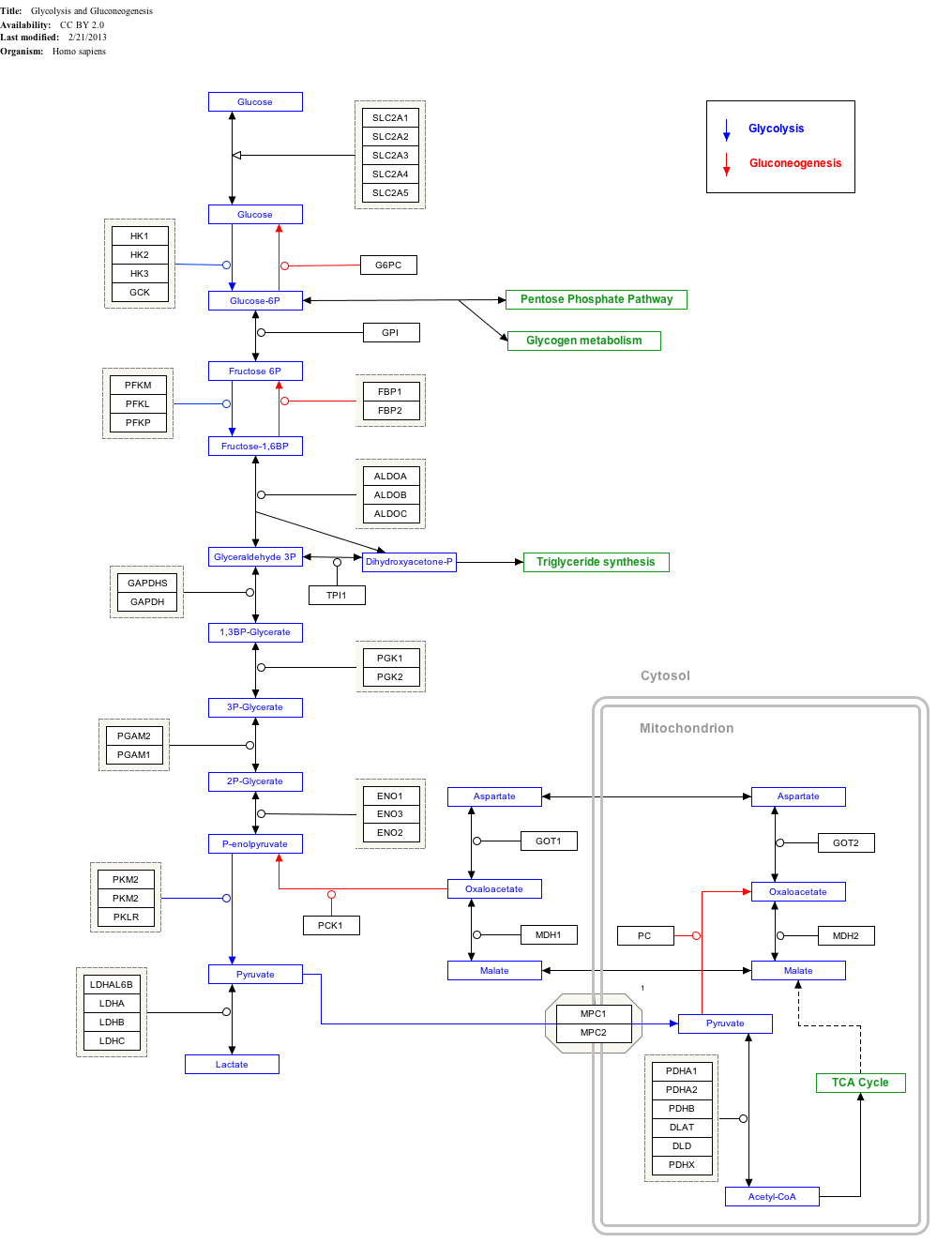
- ^ 대화형 경로 맵은 WikiPathways에서 편집할 수 있습니다."GlycolysisGluconeogenesis_WP534".
신경전달물질
아스파르트산(아스파르트산의 켤레 염기)은 아미노산 신경전달물질 L-글루탐산만큼 [14]강하지는 않지만 NMDA 수용체를 자극한다.
응용 프로그램 및 시장
2014년 세계 아스파라긴산 시장은 39.3만 쇼트톤(35.7만톤)[15]으로 연간 약 1억1700만달러였으며[16] 성장 잠재 영역은 87억8000만달러(Bn)[17]에[clarification needed] 달했다.3대 시장 부문은 미국, 서유럽, 중국을 포함한다.현재 적용 분야에는 생분해성 고분자(폴리아스파르트산), 저칼로리 감미료(아스파탐), 스케일 및 부식 억제제 및 [citation needed]레진이 포함됩니다.
초흡수성 폴리머
아스파라긴산 시장 성장의 한 영역은 생분해성 초흡수성 폴리머(SAP)와 하이드로겔이다.[18] 초흡수성 폴리머 시장은 2014년부터 2019년까지 복합 연간 5.5%의 성장률로 전 세계적으로 [17]87억 8천만 달러에 이를 것으로 예상됩니다.약 75%의 초흡수성 고분자가 일회용 기저귀에 사용되고 20%는 성인 요실금 및 여성 위생용품에 사용됩니다.아스파르트산의 중합물인 폴리아스파르트산은 폴리아크릴산염의 [18][19][20]생분해성 대체물이다.폴리아스파르트산염 시장은 전체 SAP [citation needed]시장의 극히 일부(추정: 1% 미만)를 차지하고 있습니다.
추가 사용
SAP외에, 아스파라긴산이 polyaspartate은 수분 유지와 질소 섭취 그 호전달러 19Bn 비료 산업에서;[22]과가 마지막으로 사용하는 곳 polyaspartic은 낮은 VOC, 전통적인 에폭시 수지에 낮은 에너지 대안은달러 1.1Bn(2020년)콘크리트 바닥 코팅 시장,[21]달러 5Bn 규모와 부식 방지제 이용해 응용됩니다.arket.[23]
원천
 | 이 섹션은 확인을 위해 추가 인용문이 필요합니다. 2021년 1월 (이를 에 대해 설명합니다) |
식사원
아스파라긴산은 필수 아미노산이 아니며, 이것은 인간의 중심 대사 경로 중간체로부터 합성될 수 있다는 것을 의미한다.그러나 아스파라긴산은 다음 성분에서 발견된다.
- 동물원 : 굴, 런천고기, 소시지고기, 야생게임
- 야채 소스: 싹이 트는 씨앗, 귀리 플레이크, 아보카도,[24] 아스파라거스,[25] 어린 사탕수수,[1] 그리고 사탕무에서 나오는 당밀.
- 아스파라긴산 자체 또는 소금(아스파르트산 마그네슘 등)을 포함한 식이 보충제
- 감미료 아스파탐, 아스파라긴산, 페닐알라닌, 포름알데히드 삼량체(브랜드:NutraSweet, Equal, 캔더렐 등)
「 」를 참조해 주세요.
레퍼런스
- ^ a b Budavari, Susan; Co, Merck (1989). "862. Aspartic acid". The Merck Index (11th ed.). p. 132. ISBN 978-0-911910-28-5.
- ^ "ICSC 1439 - L-ASPARTIC ACID". inchem.org.
- ^ Haynes, William M., ed. (2016). CRC Handbook of Chemistry and Physics (97th ed.). CRC Press. pp. 5–89. ISBN 978-1498754286.
- ^ "Nomenclature and Symbolism for Amino Acids and Peptides". IUPAC-IUB Joint Commission on Biochemical Nomenclature. 1983. Archived from the original on 9 October 2008. Retrieved 5 March 2018.
- ^ a b c d G., Voet, Judith; W., Pratt, Charlotte (2016-02-29). Fundamentals of biochemistry : life at the molecular level. ISBN 9781118918401. OCLC 910538334.
- ^ Berzelius JJ, Öngren OG (1839). Traité de chimie (in French). Vol. 3. Brussels: A. Wahlen et Cie. p. 81. Retrieved 25 August 2015.
- ^ Plimmer R (1912) [1908]. Plimmer R, Hopkins F (eds.). The chemical composition of the proteins. Monographs on Biochemistry. Vol. Part I. Analysis (2nd ed.). London: Longmans, Green and Co. p. 112. Retrieved January 18, 2010.
- ^ 를 클릭합니다"Nomenclature and symbolism for amino acids and peptides (IUPAC-IUB Recommendations 1983)", Pure Appl. Chem., 56 (5): 595–624, 1984, doi:10.1351/pac198456050595.
- ^ Karlheinz Drauz, Ian Grayson, Axel Kleemann, Hans-Peter Krimmer, Wolfgang Leuchtenberger, Christoph Weckbecker (2006). Ullmann's Encyclopedia of Industrial Chemistry. Weinheim: Wiley-VCH. doi:10.1002/14356007.a02_057.pub2.
{{cite encyclopedia}}: CS1 maint: 여러 이름: 작성자 목록(링크) - ^ Dunn MS, Smart BW (1950). "DL-Aspartic Acid". Organic Syntheses. 30: 7.; 를 참조해 주세요.
- ^ Lehninger AL, Nelson DL, Cox MM (2000). Principles of Biochemistry (3rd ed.). New York: W. H. Freeman. ISBN 1-57259-153-6.
- ^ "Biochemistry - Biochemistry". www.varsitytutors.com. Retrieved 2022-02-18.
- ^ Kreamer, Siegel, & Gourley (Oct 2001). "A novel inhibitor of beta-glucuronidase: L-aspartic acid". Pediatric Research. 50 (4): 460–466. doi:10.1203/00006450-200110000-00007. PMID 11568288.
{{cite journal}}: CS1 maint: 여러 이름: 작성자 목록(링크) - ^ Chen PE, Geballe MT, Stansfeld PJ, Johnston AR, Yuan H, Jacob AL, Snyder JP, Traynelis SF, Wyllie DJ (May 2005). "Structural features of the glutamate binding site in recombinant NR1/NR2A N-methyl-D-aspartate receptors determined by site-directed mutagenesis and molecular modeling". Molecular Pharmacology. 67 (5): 1470–84. doi:10.1124/mol.104.008185. PMID 15703381. S2CID 13505187.
- ^ "Global Aspartic Acid Market By Application". Grand View Research. Retrieved November 30, 2019.
- ^ Evans J (2014). Commercial Amino Acids. BCC Research. pp. 101–103.
- ^ a b 투명성 시장 조사.초흡수성 폴리머 시장 - 전 세계 산업 분석, 규모, 점유율, 성장, 동향 및 예측, 2014. (2014.)
- ^ a b Adelnia, Hossein; Blakey, Idriss; Little, Peter J.; Ta, Hang T. (2019). "Hydrogels Based on Poly(aspartic acid): Synthesis and Applications". Frontiers in Chemistry. 7: 755. Bibcode:2019FrCh....7..755A. doi:10.3389/fchem.2019.00755. ISSN 2296-2646. PMC 6861526. PMID 31799235.
- ^ Adelnia, Hossein; Tran, Huong D.N.; Little, Peter J.; Blakey, Idriss; Ta, Hang T. (2021-06-14). "Poly(aspartic acid) in Biomedical Applications: From Polymerization, Modification, Properties, Degradation, and Biocompatibility to Applications". ACS Biomaterials Science & Engineering. 7 (6): 2083–2105. doi:10.1021/acsbiomaterials.1c00150. hdl:10072/404497. PMID 33797239. S2CID 232761877.
- ^ Alford DD, Wheeler AP, Pettigrew CA (1994). "Biodegradation of thermally synthesized polyaspartate". J Environ Polym Degr. 2 (4): 225–236. doi:10.1007/BF02071970.
- ^ Kelling K (2001). Crop Responses to Amisorb in the North Central Region. University of Wisconsin-Madison.
- ^ 2020년까지 전 세계 콘크리트 바닥 코팅 시장은 11억 달러 규모로 성장할 것입니다.투명성 시장 조사(2015).
- ^ 부식 억제는 제품별, 용도별, 최종 사용 산업별 시장 분석 및 2020년까지의 세그먼트 예측을 방해합니다.그랜드뷰 리서치 (2014)
- ^ Salunkhe DK, Kadam S (18 August 1995). Handbook of Fruit Science and Technology: Production, Composition, Storage, and Processing. CRC Press. pp. 368–. ISBN 978-0-8247-9643-3.
- ^ Considine DM (6 December 2012). Foods and Food Production Encyclopedia. Springer Science & Business Media. pp. 114–. ISBN 978-1-4684-8511-0.
외부 링크
- GMD MS 스펙트럼
- American Chemical Society (21 April 2010). "Ancestral Eve' Crystal May Explain Origin of Life's Left-Handedness". ScienceDaily. Archived from the original on 23 April 2010. Retrieved 2010-04-21.


