로저 셰퍼드
Roger Shepard로저 셰퍼드 | |
|---|---|
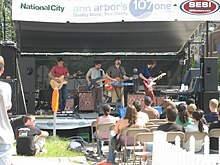
 2019년 3월 ASU SciAPP 컨퍼런스에서 셰퍼드 | |
| 태어난 | 로저 뉴랜드 셰퍼드 ( 1929년 1월 30일 ( 팰로앨토, 캘리포니아, 미국 |
| 죽은 | 2022년 5월 30일 미국 애리조나 주 투싼 |
| 국적. | 아메리칸 |
| 직종. | 인지 과학자 |
주목할 만한 일 | 셰퍼드 코끼리, 셰퍼드 톤즈 |
로저 뉴랜드 셰퍼드(Roger Newland Shepard, 1929년 1월 30일 ~ 2022년[1] 5월 30일)는 미국의 인지과학자로 "일반화의 보편적 법칙"(1987년)의 저자이다.그는 공간 관계 연구의 아버지로 여겨졌다.그는 정신 회전을 연구했고, 인간이 이해할 수 있는 특정 종류의 통계 데이터를 그래픽 형태로 표현하는 방법인 비메트릭 다차원 스케일링의 발명가였다.셰퍼드 테이블이라고 불리는 착시현상과 셰퍼드 톤이라고 불리는 청각현상은 그의 이름을 딴 것이다.
전기
셰퍼드는 1929년 1월 30일 캘리포니아 팔로 알토에서 태어났다.그의 아버지는 [2]스탠포드 소재과학 교수였다.어린 시절과 10대였을 때, 그는 오래된 시계공예품을 만지작거리고, 로봇을 만들고, 일반 [3]다면체의 모형을 만드는 것을 즐겼다.
그는 스탠포드에 학부생으로 입학하여 마침내 심리학을[3] 전공하고 [4]1951년에 졸업하였다.
셰퍼드는 1955년 칼 호브랜드 밑에서 예일대 심리학 박사학위를 취득하고 하버드대에서 조지 아미티지 밀러와 박사 후 훈련을 마쳤다.그 후, Shepard는 스탠포드 대학의 교수에 들어가기 전에 Bell Labs에 있었고, 그 후 하버드 대학의 교수였습니다.Shepard는 Stanford [5]대학의 Ray Lyman Wilbur 명예 사회과학 교수입니다.
그의 학생으로는 린 쿠퍼, 레다 코스미데스, 롭 피쉬, 제니퍼 프레이드, 조지 퍼나스, 캐롤 L. 크룸한슬, 다니엘 레비틴, 마이클 맥비드, 제프리 [citation needed]밀러가 있다.
1997년, 셰퍼드는 키라 [6]연구소의 설립자 중 한 명이었다.
조사.
일반화 및 정신적 표현
.jpg)
셰퍼드는 [3]예일대 대학원생일 때 일반화 메커니즘을 연구하기 시작했습니다.
나는 이제 일반화의 문제가 학습이론에 직면한 가장 근본적인 문제라고 확신했다.우리는 정확히 동일한 총체적 상황을 두 번 마주하지 않기 때문에, 어떤 상황에서 학습된 것이 다른 상황에 어떻게 일반화되는지를 지배하는 법칙 없이는 어떤 학습 이론도 완성될 수 없다.
셰퍼드와 협력자들은 사람이나 유기체가 자극 A에 대한 반응을 일반화하고 자극 B에 동일한 반응을 줄 가능성이 높은 순위를 사용하여 큰 자극 세트를 "매핑"했다.셰퍼드가 1987년에 발표한 "범용 일반화의 법칙"을 제안하는 논문의 예를 들자면, 새가 먹을 [7]수 있는 것으로 발견된 이전의 벌레와 약간 다른 벌레를 먹을 수 있다고 "일반화"할 것인가?
셰퍼드는 기하학적, 공간적 은유를 사용하여 자극이 각각 [8]덜 비슷한지 더 작은지에 따라 다른 자극들 사이의 "격차"가 더 크거나 더 작은 심리적 공간을 지도화했다.이러한 상상의 거리는 수학적 추론을 가능하게 하기 때문에 흥미롭습니다: 거리에 기초한 자극에 대한 "지수적 붕괴"는 인간과 다른 [9]유기체와의 광범위한 실험에 유효합니다.
비메트릭 다차원 스케일링
1958년, Shepard는 Bell Labs에 취직했습니다.그들의 컴퓨터 설비는 그가 일반화에 관한 초기 작업을 확장할 수 있게 되었습니다.그는 다음과 같이 말합니다. "이로 인해 현재 비메트릭 다차원 스케일링으로 알려진 방법이 개발되었습니다. 처음에는 저(Shepard, 1962a, 1962b)에 의해, 그 다음에는 Bell 연구소의 수학 동료 Joseph Kruskal(1964a, 1964b)에 의해 개선되었습니다."[3]
미국 심리학 협회에 따르면, "비메트릭 다차원 척도..는 유사성에 대한 순서형 데이터에서 미터법 구조를 밝혀낼 수 있는 엄청난 힘을 가진 도구를 사회과학에 제공했다."[10]
2006년 Shepard에게 Rumelhart 상을 수여하면서 인지과학회는 비메트릭 다차원 스케일을 "매우 영향력 있는 초기 기여"라고 칭하며 다음과 [5]같이 설명했습니다.
이 방법은 유사성의 질적 측정에서 정신적 표현의 내부 구조를 회복하는 새로운 수단을 제공했다.이는 데이터의 절대적 정량적 타당성에 대한 가정을 하지 않고 유사성 판단에 대한 재현 가능한 순서에 대한 가정에 기초해 이루어졌다.
멘탈 로테이션
.jpg)
우주에서 회전하는 3차원 물체의 꿈에서 영감을 얻은 셰퍼드는 1968년 정신 회전을 측정하는 실험을 설계하기[3] 시작했다.(정신적 회전은 "원래의 직립 위치에서 벗어나 회전할 경우 2차원 또는 3차원 물체가 어떻게 보일지 상상하는 것"을 포함한다.)[11]
초기 실험은 재클린 메츨러와 협력하여 매우 추상적인 물체의 투시도를 사용했다: "10개의 단단한 입방체가 얼굴을 맞대고 정확히 세 개의 직각 '엘보우'를 가진 단단한 팔 모양의 구조를 형성하기 위해" 이 연구의 [12]첫 번째 보고서인 1971년 논문을 인용했다.
셰퍼드와 메츨러는 피실험자들이 이 복잡한 물체를 회전시키는 것을 상상할 수 있는 속도를 측정할 수 있었다.나중에 셰퍼드와 린 A의 작품. 쿠퍼는 정신 회전의 과정을 더욱 [13]조명했다.쉐퍼드와 쿠퍼는 또한 1982년 개정된 책(1986년 개정)에서 정신 회전과 정신 [14]이미지의 다른 변형에 대한 과거 연구를 요약했습니다.
1983년에 이 작품을 검토하면서 마이클 쿠보비는 [15]그 중요성을 평가했다.
1968년 그날까지 [회전하는 물체에 대한 셰퍼드의 꿈] 정신적인 변화는 다른 어떤 소위 사적인 경험보다 심리적인 실험에 더 가까이 다가갈 수 없었다.Shepard는 정확하고 오답이 가능한 문제 태스크에 주입함으로써 설득력 있고 익숙한 경험을 실험적으로 다루기 쉬운 문제로 변화시켰다.
착시 및 청각

1990년, 셰퍼드는 지각과 [16]예술에서의 정신의 놀이에 대한 해설과 함께 마인드 시즈: 독창적인 시각적 환상, 모호성, 그리고 다른 변칙이라고 불리는 그의 그림들을 모았습니다.이러한 환상들 중 하나("역전" (p.48)는 "양치기 탁상 착각" 또는 "양치기 탁상 착각"으로 널리 논의되고 연구되어 왔다.그가 "L'egs-isstial quandary"라고 부르는 인물-배경을 혼동하는 코끼리와 같은 다른 코끼리들도 널리 [17]알려져 있다.
셰퍼드는 또한 셰퍼드 톤으로 알려진 음악적 환상을 발명한 것으로도 유명하다.그는 벨 연구소에서 그의 동료 맥스 매튜스가 컴퓨터 음악 합성을 실험하던 시절 청각 환상에 대한 연구를 시작했습니다 (마인드 시즈, 30페이지).셰퍼드 톤은 [18]음정이 끊임없이 높아지는 착각을 일으킵니다.음악가들과 음향 효과 디자이너들은 특수 [19][20]효과를 만들기 위해 셰퍼드 톤을 사용합니다.
인식
일반 심리학 리뷰는 셰퍼드를 "20세기의 가장 뛰어난 심리학자" 중 한 명으로 선정했습니다.[21]이 목록의 순위는 학술지 인용, 초등 교과서 언급, 미국 심리학회 [22]회원들의 지명을 바탕으로 이루어졌다.
셰퍼드는 1977년[23] 국립과학아카데미와 1999년 [24]미국철학회 회원으로 선출되었다.1995년에 [5]그는 국립과학훈장을 받았다.인용문에는 다음과 같이 [25]기재되어 있습니다.
"물리 세계에 대한 인간의 마음의 인식과 인간의 정신이 왜 사물을 그대로 표현하도록 진화해왔는지 설명하는 이론적이고 실험적인 그의 업적과 인지과학 분야에 목적을 부여하고 많은 과학 분야의 통찰력을 과학 문제 해결에서 지니는 가치를 증명하기 위한 것입니다.g."
「 」를 참조해 주세요.
레퍼런스
- ^ "Remember Roger Newland Shepard Together On Obit". www.joinobit.com. Retrieved June 8, 2022.
- ^ Seckel, Al (2004). Masters of Deception: Escher, Dalí & the Artists of Optical Illusion. Sterling Publishing Company. p. 285. ISBN 9781402705779.
Roger Shepard was born in Palo Alto, California. His father, a professor in materials science at Stanford, greatly encouraged and stimulated his son’s interest in science…
- ^ a b c d e Shepard, Roger (2004). "How a cognitive psychologist came to seek universal laws" (PDF). Psychonomic Bulletin & Review. 11 (1): 1–23. doi:10.3758/BF03206455. PMID 15116981. S2CID 39226280. Retrieved February 5, 2019.
I was now convinced that the problem of generalization was the most fundamental problem confronting learning theory. Because we never encounter exactly the same total situation twice, no theory of learning can be complete without a law governing how what is learned in one situation generalizes to another."
- ^ "University of California Hitchcock Lectures". UCSB. 1999. Retrieved February 15, 2019.
Shepard graduated from Stanford in 1951, and received his doctorate from Yale. He then held positions at Bell Labs and at Harvard University before going to Stanford, where he has been a member of the faculty for over 30 years.
- ^ a b c d "2006 Recipient: Roger Shepard". Cognitive Science Society. 2006. Retrieved February 5, 2019.
Roger N. Shepard is a fellow of the American Association for the Advancement of Science and the American Academy of Arts and Sciences, and is the William James Fellow of the American Psychological Association. In 1977 he was elected to the National Academy of Sciences. In 1995 he received United States’ highest scientific award, the National Medal of Science.
- ^ 키라 학원의 역사
- ^ Shepard, RN (September 11, 1987). "Toward a universal law of generalization for psychological science". Science. 237 (4820): 1317–1323. Bibcode:1987Sci...237.1317S. doi:10.1126/science.3629243. PMID 3629243.
A psychological space is established for any set of stimuli by determining metric distances between the stimuli such that the probability that a response learned to any stimulus will generalize to any other is an invariant monotonic function of the distance between them. To a good approximation, this probability of generalization (i) decays exponentially with this distance, and (ii) does so in accordance with one of two metrics, depending on the relation between the dimensions along which the stimuli vary.
- ^ Jones, Matt; Zhang, Jun (December 22, 2016). "Duality Between Feature and Similarity Models, Based on the Reproducing-Kernel Hilbert Space" (PDF). S2CID 34620390. Archived from the original (PDF) on February 14, 2019. Retrieved February 12, 2019.
Shepard’s (1957, 1987) influential model of similarity and generalization holds that stimuli are represented in a multidimensional Cartesian space, x = (x1, . . . , xm) and that similarity is an exponential function of distance in that space
{{cite journal}}:Cite 저널 요구 사항journal=(도움말) - ^ "What your cell phone camera tells you about your brain". ScienceDaily.com. September 19, 2018. Retrieved February 5, 2019.
A canonical law of cognitive science -- the Universal Law of Generalization, introduced in a 1987 article also published in Science -- tells us that your brain makes perceptual decisions based on how similar the new stimulus is to previous experience. Specifically, the law states that the probability you will extend a past experience to new stimulus depends on the similarity between the two experiences, with an exponential decay in probability as similarity decreases. This empirical pattern has proven correct in hundreds of experiments across species including humans, pigeons, and even honeybees.
- ^ No Authorship Indicated (1977). "Roger N. Shepard: Distinguished Scientific Contribution Award". American Psychologist. 32 (1`): 62–67. doi:10.1037/h0078482.
Recognizes the receipt of the American Psychological Association's 1976 Distinguished Scientific Contribution Award by Roger N. Shepard. The award citation reads: 'For his pioneering work in cognitive structures, especially his invention of nonmetric multidimensional scaling, which has provided the social sciences with a tool of enormous power for uncovering metric structures from ordinal data on similarities. In addition, his novel studies in recognition memory and pitch perception, and his latest innovative work on mental rotations--operations that may well underlie our ability to read and to recognize objects--have all contributed materially to our understanding of cognitive processes. His style of research exhibits a beautiful combination of depth and simplicity.'
- ^ Kaltner, Sandra; Jansen, Petra (2016). "Developmental Changes in Mental Rotation: A Dissociation Between Object-Based and Egocentric Transformations". Adv Cog Psych. 12 (2): 67–78. doi:10.5709/acp-0187-y. PMC 4974058. PMID 27512525.
Mental rotation (MR) is a specific visuo-spatial ability which involves the process of imagining how a two- or three-dimensional object would look if rotated away from its original upright position (Shepard & Metzler, 1971). In the classic paradigm of Cooper and Shepard (1973) two stimuli are presented simultaneously next to each other on a screen and the participant has to decide as fast and accurately as possible if the right stimulus, presented under a certain angle of rotation, is the same or a mirror-reversed image of the left stimulus, the so called comparison figure.
- ^ Shepard, RN; Metzler, J (1971). "Mental rotation of three-dimensional objects". Science. 171 (3972): 701–703. Bibcode:1971Sci...171..701S. CiteSeerX 10.1.1.610.4345. doi:10.1126/science.171.3972.701. PMID 5540314. S2CID 16357397.
Each object consisted of ten solid cubes attached face-to-face to form a rigid armlike structure with exactly three right-angled "elbows"
- ^ Shepard, Shenna; Metzler, Douglas (1988). "Mental Rotation: Effects of Dimensionality of Objects and Type of Task" (PDF). Journal of Experimental Psychology. 14 (1): 3–11. doi:10.1037/0096-1523.14.1.3. PMID 2964504. Retrieved February 13, 2019.
The initial studies of mental rotation were of two types: (a) those by Roger Shepard and Jacqueline Metzler using perspective views of three-dimensional objects and measuring the time to determine whether two simultaneously presented objects, though differing in their orientations, were of the same three-dimensional shape (J. Metzler. 1973; J. Metzler & R. Shepard, 1974; R. Shepard & J. Metzler, 1971) and (b) those by Lynn Cooper and her associates (including R. Shepard) using two-dimensional shapes (alphanumeric characters or random polygons) and measuring the time to determine whether a single object, though differing in orientation from a previously learned object, had the same intrinsic shape as that previously learned object (Cooper, 1975, 1976; Cooper & Podgorny, 1976; Cooper & R. Shepard, 1973).
- ^ Shepard, RN; Cooper, L (1982). Mental Images and their Transformations. MIT Press. ISBN 978-0262690997.
- ^ Kubovy, Michael (1983). "Mental Imagery Majestically Transforming Cognitive Psychology". Contemporary Psychology: A Journal of Reviews. 28 (9): 661–663. doi:10.1037/022300. Retrieved February 13, 2019.
Up to that day in 1968, mental transformations were no more accessible to psychological experimentation than were any other so-called private experiences. Shepard transformed a compelling and familiar experience into an experimentally tractable problem by injecting it into a problem-task that admits of a correct and incorrect answer (this problem is discussed in some depth by Pomerantz & Kubovy, 1981, pp. 426-427). I do not wish to claim that this methodological insight had no precursors, only that in this case its application had far-reaching consequences for the purview of cognitive psychology.
- ^ Shepard, RN (1990). Mind Sights: Original visual illusions, ambiguities, and other anomalies, with a commentary on the play of mind in perception and art. W.H. Freeman and Company. p. 3. ISBN 978-0716721345.
Visual illusions, ambiguous figures, and depictions of impossible objects are inherently fascinating. Their violations of our most ingrained and immediate interpretations of external reality grab us at a deep, unarticulated level.
- ^ Gifford, Clive (November 17, 2014). "The best optical illusions to bend your eyes and blow your mind – in pictures". The Guardian. Retrieved February 5, 2019.
Famous impossible images include the Penrose staircase and this little beauty, courtesy of renowned cognitive scientist and author of ‘’Mind Sights’’, Roger Newland Shepard. With his usual love of a quick joke, Shepard entitled the illusion L’egs-istential Quandary. It is impossible to isolate the elephant’s legs from the background.
- ^ Stephin Merritt: Two Days, 'A Million Faces' (video). NPR. November 4, 2007. Retrieved October 9, 2015.
It turns out I was thinking about a Shepard tone, the illusion of ever-ascending pitches.
- ^ Haubursin, Christopher (July 26, 2017). "The sound illusion that makes Dunkirk so intense". Vox. Retrieved February 14, 2019.
Named after cognitive scientist Roger Shepard, the sound consists of several tones separated by an octave layered on top of each other. As the lowest bass tone starts to fade in, the higher treble tone fades out. When the bass completely fades in and the treble completely fades out, the sequence loops back again. Because you can always hear at least two tones rising in pitch at the same time, your brain gets tricked into thinking that the sound is constantly ascending in pitch. It’s a creepy, anxiety-inducing sound.
- ^ King, Richard (February 4, 2009). "'The Dark Knight' sound effects". Los Angeles Times. Retrieved February 14, 2019.
I used the concept of the Shepard tone to make the sound appear to continually rise in pitch. The basic idea is to slightly overlap a sound with a distinct pitch (a large A/C electric motor, in this case) in different octaves. When played on a keyboard, it gives the illusion of greater and greater speed; the pod appears unstoppable.
- ^ Haggbloom, Steven J.; Warnick, Renee; Warnick, Jason E.; Jones, Vinessa K.; Yarbrough, Gary L.; Russell, Tenea M.; Borecky, Chris M.; McGahhey, Reagan; et al. (2002). "The 100 most eminent psychologists of the 20th century". Review of General Psychology. 6 (2): 139–152. doi:10.1037/1089-2680.6.2.139. S2CID 145668721.
- ^ "Study ranks the top 20th century psychologists". APA Monitor. 2002. Retrieved February 15, 2019.
The rankings were based on the frequency of three variables: journal citation, introductory psychology textbook citation and survey response. Surveys were sent to 1,725 members of the American Psychological Society, asking them to list the top psychologists of the century.
- ^ "Roger N Shepard". National Academy of Sciences. Retrieved February 5, 2019.
Election Year: 1977
- ^ "American Philosophical Society Member History". American Philosophical Society. Retrieved February 5, 2019.
He is the recipient of the James McKeen Cattell Fund Award, the Howard Crosby Warren Medal from the Society of Experimental Psychologists, the Award in the Behavioral Sciences from the New York Academy of Sciences, the Distinguished Scientific Contribution Award of the American Psychological Association, the Gold Medal Award for Life Achievement in the Science of Psychology from the American Psychological Foundation, the Wilbur Lucius Cross medal of the Yale Graduate School Alumni Association, the Rumelhart Prize in Cognitive Science, and the National Medal of Science. He has also received honorary degrees from Harvard, Rutgers, and the University of Arizona.
- ^ "The President's National Medal of Science: Recipient Details Roger N. Shepard". National Science Foundation. 2005. Retrieved February 5, 2019.
For his theoretical and experimental work elucidating the human mind's perception of the physical world and why the human mind has evolved to represent objects as it does; and for giving purpose to the field of cognitive science and demonstrating the value of bringing the insights of many scientific disciplines to bear in scientific problem solving.
외부 링크


- 스탠퍼드 대학교 웹 페이지
- Roger Shepard 연구 전기
- 캘리포니아 대학교 히치콕 강의
- 전기(rr0.org) (프랑스어)
| 과정 | |||||||||||
|---|---|---|---|---|---|---|---|---|---|---|---|
| 지역들 | |||||||||||
| 사람 |
| ||||||||||
| 연구소/ 단체들 | |||||||||||
| 출판물 | |||||||||||
| 관련 과목 | |||||||||||