위상 벡터 공간
Topological vector space수학에서 위상 벡터 공간(선형 위상학적 공간이라고도 하며 일반적으로 줄여서 TVS 또는 t.v.s라고도 한다)은 기능 분석에서 조사된 기본 구조 중 하나이다. 위상 벡터 공간은 위상 공간이기도 한 벡터 공간(대수학적 구조)으로, 이는 벡터 공간 연산이 연속 함수임을 암시한다. 좀 더 구체적으로 말하면, 그것의 위상학적 공간은 균일한 위상학적 구조를 가지고 있어서 균일한 수렴 개념을 허용한다.
위상 벡터 공간의 요소는 전형적으로 위상 벡터 공간에 작용하는 함수나 선형 연산자로, 위상은 함수 순서의 융합이라는 특정 개념을 포착하기 위해 정의되는 경우가 많다.
바나흐 공간, 힐버트 공간, 소볼레프 공간은 잘 알려진 예들이다.
달리 명시되지 않은 한 위상 벡터 공간의 기본 필드는 복잡한 C 또는 실제 숫자 가정한다.

동기
정규 공간
모든 규범 벡터 공간은 자연적인 위상학적 구조를 가지고 있다: 규범은 메트릭스를 유도하고 미터법은 위상을 유도한다. 위상 벡터 공간은 다음과 같은 이유로 사용된다.
- 벡터 덧셈 + : × → 은 이 위상과 관련하여 공동으로 연속적이다. 이것은 규범이 따르는 삼각 불평등에서 바로 뒤따른다.
- 스칼라 곱셈 : → X, X 서 K {\displaystyle {은 X의 기본 스칼라 필드 와 공동으로 연속된다. 이것은 규범의 삼각 불평등과 동질성에서 비롯된다.


 X의 기본 스칼라 필드
따라서 모든 바나흐 공간과 힐버트 공간은 위상학적 벡터 공간의 예다.
비정규 공간
위상이 규범에 의해 유도되지 않지만 분석에 여전히 관심이 있는 위상학적 벡터 공간이 있다. 그러한 공간의 예로는 개방된 영역의 홀로모르픽 함수의 공간, 무한히 다른 함수의 공간, 슈워츠 공간, 그리고 시험함수의 공간과 그 위에 분포된 공간이 있다. 이것들은 몽텔 공간의 모든 예들이다. 무한대의 몬텔 공간은 결코 규범화될 수 없다. 주어진 위상 벡터 공간에 대한 규범의 존재는 콜모고로프의 규범성 기준으로 특징지어진다.
위상학적 영역은 각각의 하위 영역에 걸친 위상학적 벡터 공간이다.
정의

A topological vector space (TVS) is a vector space over a topological field (most often the real or complex numbers with their standard topologies) that is endowed with a topology such that vector addition 및 곱셈 : K X→ 은(이러한 함수의 에는 제품 토폴로지가 부여되어 있음) 연속 함수다. 위상은 X. 에서 벡터 위상 또는 TVS 위상이라고 한다.

 (이러한 함수의
 모든 위상 벡터 공간은 또한 추가되고 있는 상호 교환 위상 그룹이다.
하우스도르프 가정
일부 작가들(예: Walter Rudin)은 X{\}의 위상은 T로1 하고, 그 다음에는 공간이 하우스도르프(Hausdorff), 심지어 타이코노프(Tychonoff)라는 것을 따른다. 위상 벡터 공간은 하우스도르프일 경우 분리된다고 하는데, 중요한 것은 "분리된" 공간은 분리할 수 있는 것을 의미하지 않는다. 위상학적 및 선형 대수학적 구조는 추가적인 가정으로 더욱 밀접하게 결합될 수 있으며, 그 중 가장 일반적인 것은 다음과 같다.
범주 및 형태론
주어진 위상학 필드 에 대한 위상학 벡터 공간의 범주는 일반적으로 TVS 또는 TVect로 표시된다. 개체는 에 대한 위상 벡터 공간이며, 형태는 연속 - 한 개체에서 다른 개체로의 선형 맵이다.
A위상 벡터 공간 불완전 변태(약식 터널 비전 시스템 불완전 변태)또는 위상 homomorphism[1][2]이 지속 선형 사상 u:X위상 벡터 사이의 공간(TVSs)Y→{\displaystyle u:X\to Y}은 유도 지도 u:X→ 나는 u(u}은 개방되어 매핑 때 나는 너 :\u등.X),, 의 범위 또는인 {\displaystyle u}에 Y가 유도하는 아공간 위상이 주어진다.
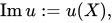 {\displaystyle u}
위상학적 벡터 공간 내장(약칭 TVS 내장) 또는 위상학적 단형성은 주입 위상동형성이다. 마찬가지로 TVS 임베딩은 위상학적으로 임베딩된 선형 지도다.[1]
위상학적 벡터 공간 이형성(약칭 TVS 이형성)은 위상학적 벡터 이형성 또는 TVS 범주 내 이형성이라고도 하며, 이형성이라고도 하는, 비주상적 선형 동형성이다. 마찬가지로, 그것은 허탈한 TV를 내장하고[1] 있다.
국소 볼록성, 메트리저성, 완전성, 정규성 등 TVS의 많은 특성은 TVS 이형성 하에서 불변한다.
벡터 위상에 필요한 조건
A collection of subsets of a vector space is called additive[4] if for every there exists some such that


X에서 덧셈의 연속성의 0{0\displaystyle}[4]—에 특성화가 만약(X,+){\displaystyle(X,+)}은 그룹(모든 벡터 공간들은),τ{\displaystyle \tau}은 위상 기하학{X\displaystyle,}및 X×X{\displaystyle X\times X}은 제품 위상과, 타고난 다음 추가 지도 X× (defined by ) is continuous at the origin of if and only if the set of neighborhoods of the origin in is additive. 이웃이라는 말을 '열린 동네'로 바꾸면 이 말은 그대로 유지된다.

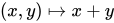


위의 모든 조건은 결과적으로 위상이 벡터 위상을 형성하기 위한 필수 조건이다.
오리진 영역을 사용하여 토폴로지 정의
Since every vector topology is translation invariant (which means that for all the map defined by is a homeomorphism), to define a vector topology it suffices to define a neighborhood basis (or subbasis) fo원점에서 그것을 발견하다.


정리[5](원점의 인접 필터) — 이(가) 실제 또는 복잡한 벡터 공간이라고 가정한다. 이(가) X{\X}의 균형 잡히고 흡수되는 하위 집합의 비어 있지 않은 첨가물 집합이라면, {은() X.의 벡터 위상에 대한 0의 근린 근거지점이다. 은(는) 다음 조건을 만족하는 필터 베이스다.
 (가) X
(가) X

 (는)
(는)  같은
같은 이(가) 위의 두 조건을 충족하지만 필터 기반이 아닌 경우, .{\의 벡터 토폴로지에 0 {\ 0}(동네 기반이 아닌)에서 근린 하위 기준을 형성한다.
일반적으로 벡터 공간의 모든 균형잡히고 흡수되는 하위 집합은 이 정리의 조건을 만족시키지 못하며 어떤 벡터 위상에 대해서도 원점에서 근린적인 기초를 형성하지 않는다.[4]
문자열을 사용하여 토폴로지 정의
Let be a vector space and let be a sequence of subsets of Each set in the sequence is called a knot of 불릿}}과 모든 인덱스에 나는,{\displaystyle 나는,}U나는}{\displaystyle U_{나는}i.}그 정해진 U1{\displaystyle U_{1}}U∙.{\displaystyle U_{\bullet}의 초기이다.}라고 불린다 U∙.{\displaystyle U_{\bullet}이 매듭{\displaystyle 나는}순서는 U∙라고 불린다.은(는) 다음과 같다.[6][7][8]
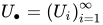

- 모든 인덱스 . 에 U 을를 합친 경우.
- 모든 에 대한 경우 균형(resp. 흡수, 닫힘,[note 1] 볼록, 개방, 대칭, 바레인, 절대 볼록/디스크 등)
- 이(가) 종합, 흡수, 균형인 경우 문자열.
- 이(가) 이고 각 노트가 X. X의 원점 부근인 경우 TVS X의 위상 문자열 또는 주변 문자열.



만약 U{U\displaystyle}은 벡터 공간 X{X\displaystyle}에absorbingdisk가 시퀀스 U나에 의해 정의되:=2대 1− 나는 U{\displaystyle U_{나는}:=2^{1-i}U}문자열 U1U.{\displaystyle U_{1}=U)시작과 함께 형성하고 있다.}이것은라는 자연적인 문자열의 U{U\displaystyle}[6]게다가, 만약 av엑터 스페이스 은(는) 계산 가능한 치수를 가지며, 모든 문자열은 절대 볼록 문자열을 포함한다.
집합의 종합 시퀀스는 음이 아닌 연속 실제 값 하위 부가 함수를 정의하는 특히 좋은 특성을 가지고 있다. 이 기능들은 위상학적 벡터 공간의 많은 기본 특성을 입증하는 데 사용될 수 있다.
Theorem (-valued function induced by a string) — Let be a collection of subsets of a vector space such that and 0 0 모든 에 대해 다음 명령을 따르십시오.

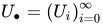


 대해 다음 명령을 따르십시오.
: →[ , {\ by ( )= }을를) 정의하고 그렇지 다음이(가) 되도록 하십시오.
![{\displaystyle f:X\to [0,1]}](https://wikimedia.org/api/rest_v1/media/math/render/svg/fbce99d737c06662e393d2d3dba7505a1e6c6eb6)



Then is subadditive (meaning for all ) and on so in particular If all are symmetric sets then and if all are balanced then for all scalars such that and all If is a topological vector space and if all are neighborhoods of the origin then is continuous, where if in addition is Hausdorff and 은(는) X 에 d( x, ) ( 은 X.{\ X에서 벡터 위상을 정의하는 메트릭이다.




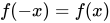
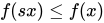


 X
X위의 정리에 대한 증거는 측정 가능한 TVS에 관한 기사에 제시되어 있다.
If and are two collections of subsets of a vector space and if is a scalar(알라르)를 정의하면 다음과 같다.[6]
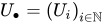
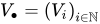
- contains : if and only if for every index
- 집합: 매듭 { I: .
- 커널: i . {\\ker U_i\\mathb }
- 스칼라 배수: ( U )
- 합계: + (+ ) . \
- 교차로:



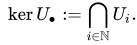

If is a collection sequences of subsets of then is said to be directed (downwards) under inclusion or simply directed if is not empty and for all there exists some such that and (said differently, if and only if }은(는) 원자로 건물 와 관련된 프리필터임. 위에서 정의한 \,\


표기법: Let be the set of all knots of all strings in
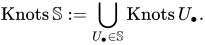

문자열 컬렉션을 사용하여 벡터 위상을 정의하는 것은 국소적으로 볼록할 필요가 없는 TVS 클래스를 정의하는 데 특히 유용하다.
Theorem[6](위상에는 줄로 유도)— 만약(X, τ){\displaystyle(X,\tau)}은 위상 벡터 공간이 존재하는 세트 S{\displaystyle \mathbb{S}}[증거 1]동네 문자열에 X{X\displaystyle}는 감독 아래쪽 등은 세트의 모든 노트의 모든 문자열에 S{\displaysty.르 \mathbb{은 X ,). ) 의 원점에 있는 근린 근거다. 이러한 문자열 모음은 기본이라고 한다.

 한다.
한다. Conversely, if is a vector space and if is a collection of strings in that is directed downward, then the set of all knots of all strings in 의 벡터 위상에 대한 원점에서 근린 기반을 형성함 이 경우 이 위상은 S{\에 의해 표시되며, {\에 의해 생성된 위상이라고 한다.


If is the set of all topological strings in a TVS then [6] A Hausdorff TVS is metrizable if and only if its topology can be induced by a single topological string.[9]

위상구조
벡터 공간은 덧셈의 연산에 관한 아벨 그룹이며, 위상 벡터 공간에서는 역 연산이 항상 연속적이다(-1에 의한 곱셈과 같기 때문에). 따라서 모든 위상 벡터 공간은 아벨의 위상적 집단이다. 모든 TVS는 완전히 규칙적이지만 TVS가 정상일 필요는 없다.[10]
을(를) 위상 벡터 공간이 되도록 한다. 하위 공간 ⊆ X, 일반적인 몫 위상이 있는 몫 공간 X은 이(가) 닫힌 경우에만 Hausdorff 위상 벡터 공간이다.[note 2] This permits the following construction: given a topological vector space (that is probably not Hausdorff), form the quotient space where is the closure of is then a Hausdorff topol . 대신 연구할 수 있는 oargical 벡터 공간


 (가) 닫힌 경우에만 Hausdorff 위상 벡터 공간이다.
벡터 위상의 불변성
벡터 위상의 가장 많이 사용되는 특성 중 하나는 모든 벡터 위상은 번역 불변성이라는 것이다.
- for all the map defined by is a homeomorphism, but if then it is not linear and so not a TVS-isomorphism.

0이 아닌 스칼라에 의한 스칼라 곱셈은 TVS-이형성이다. 즉, 0일 경우 에 의해 정의된 선형 X→ 이(가) 동형상임을 의미한다. =- 1 을 사용하면 using - , x로 정의된 부정 지도 → X이(가) 생성되며, 결과적으로 선형 동형성이며, 따라서 TVS 이형성이다.

 (가) 동형상임을 의미한다.

만약 X⊆ x∈ X{\displaystyle Xx\in}과 어떤 부분 집합 S, x 다음cl X(x+S)={\displaystyle S\subseteq X,}+cl X S{\displaystyle \operatorname{개}_ᆮ(x+S)=x+\operatorname{개}_{X}S}[5], 0S∈{0\in S\displaystyle} 다음 x+S{\displaystyle x+S}은 이웃(resp.ope.nneighborhood, 닫힌 근린) 에 x{\displaystyle X의 eighborhood. 원점에서 이(가) 동일한 경우에만 해당됨.


로컬 개념
벡터 공간 의 부분 E 은(는) 다음과 같다고 한다.
 부분
부분 - 흡수( X, x X에 대해 r . 을를) 충족하는 모든 스칼라 c}에 실제 r >0 r이 있다
- 균형 잡히거나 동그라미를 친 경우: 모든 t 1. {\의 경우 t
- E + (- t) 모든 실제 1
- 디스크 또는 절대 볼록: E 이(가) 볼록하고 균형 잡힌 경우.
- 대칭: 만일 - , 또는 동등하게 - = E .


 경우
경우


0의 모든 이웃은 흡수 집합이며 의열린 균형 을 포함하고 있으므로[5] 모든 위상 벡터 공간은 흡수되고 균형 잡힌 집합의 국부적 기반을 가지고 있다 기원은 심지어 밀폐된 균형된 동네가 0이고, 그 공간이 지역적으로 볼록하면 밀폐된 볼록 균형된 동네가 0인 동네가 있다.
경계 하위 집합
토폴로지 벡터 X{\X}의 부분 E{\이(가 충분히 큰 원점의 모든 {\E\에[11] 대해 된다.
 (가
(가

경계의 정의는 약간 약해질 수 있다. 은(는) 경계의 모든 부분 집합이 경계가 되는 경우에만 경계가 된다. 집합은 각각의 반복이 경계 집합인 경우에만 경계로 한다.[12] Also, is bounded if and only if for every balanced neighborhood of 0, there exists such that Moreover, when is locally convex, the boundedness can be characterized by seminorms: the subse 은(는) 모든 연속 세미노름 이(가) . 에 대한 경계인 경우에만 경계로 지정됨

 (가)
(가) 모든 완전 경계선 집합은 경계선이다.[12] 이(가) X, X의 벡터 하위 공간인 경우, 의 하위 은X .{\로 경계된 경우에만 M 으로 경계된다.
메트리저빌리티
Birkhoff-Kakutani 정리 ( , ) {\X,\tau )}이(가 위상학적 벡터 공간이라면 다음 세 가지 조건이 동등하다.[13][note 3]
- 원본{ 은(는) , 에서 닫히고, 0에 대한 주변 은 X. X에서 계산할 수 있다.
- ,) 은(위상학적 공간으로서) 메트리징 가능하다.
- 에 된 X. {\ 토폴로지 을(를) 유도하는 변환 불변 메트릭이 있다
- ,) 은 측정 가능한 위상 벡터 공간이다.[note 4]

 X
X비르코프-카쿠타니 정리에는 번역-반환성인 등가 측정기준이 있다는 것을 따른다.
TVS는 F-세미놈에 의해 위상이 생성되는 경우에만 원점에 카운트 가능한 근린 기반이 있는 경우 및 동등한 경우에만 유사하게 계산할 수 있다. TVS는 Hausdorff와 가성측정 가능한 경우에만 판독이 가능하다.
보다 강하게 말하자면 위상 벡터 공간은 그 위상이 규범에 의해 유도될 수 있다면 규범성이 있다고 한다. 위상 벡터 공간은 하우스도르프이고 볼록한 주변이 인 경우에만 규범할 수 있다 0
를) 비구체 로컬 소형 위상학 필드(예: 실제 또는 복잡한 숫자)로 두십시오. 위에 있는 Hausdorff 위상 벡터 공간은 일부 .에 대해 유한 , 즉 K n {에 이형인 경우에만 로컬로 압축된다.
 대해
대해 완전성과 균일한 구조
TVS, ) 의 표준 균일성은[15] X. 의 토폴로지 {\을(를) 유도하는 고유한 변환 변이성 균일성이다.
모든 TVS는 모든 TVS를 균일한 공간으로 만드는 이 표준적인 균일성을 부여받은 것으로 가정한다. 이를 통해 완성도, 균일한 수렴성, 코시 그물, 균일한 연속성 등 관련 개념에 대해 생각할[clarification needed] 수 있다. 기타(다른 것으로 표시되지 않는 한) 이 균일성에 대해 항상 있다고 가정한다. 이는 모든 하우스도르프 위상 벡터 공간이 타이코노프임을 암시한다.[16] TVS의 하위 공간은 완전하고 완전한 경계가 있는 경우에만 컴팩트하다(하우스도르프 TVS의 경우, 완전히 경계가 되는 세트는 사전 컴팩트와 동일하다). 그러나 TVS가 하우스도르프가 아니라면 닫히지 않은 컴팩트 서브셋이 존재한다. 그러나 Hausdorff가 아닌 TVS의 컴팩트 서브셋의 폐쇄는 다시 컴팩트하다(그래서 컴팩트 서브셋은 상대적으로 컴팩트하다).
With respect to this uniformity, a net (or sequence) is Cauchy if and only if for every neighborhood of there exists some index such that 및 n


모든 카우치 순서는 경계되지만, 코치 그물과 카우치 필터는 경계되지 않을 수 있다. 모든 Cauchy 시퀀스가 수렴되는 위상 벡터 공간을 순차적으로 완료라고 부른다. 일반적으로 완전하지 않을 수 있다(모든 Cauchy 필터들이 수렴한다는 의미에서).
덧셈의 벡터 공간 연산은 균일하게 연속적이며 개방된 맵이다. 스칼라 곱셈은 Cauchy 연속이지만 일반적으로 거의 균일하게 연속되지 않는다. 이 때문에 모든 위상 벡터 공간은 완성될 수 있으며 따라서 완전한 위상 벡터 공간의 밀도 있는 선형 하위 공간이다.
- 모든 TVS에는 완성이 있고 모든 Hausdorff TVS에는 후스도르프 완성이 있다.[5] 모든 TVS(Hausdorff 및/또는 완전한 TV도)에는 무한히 많은 비이성형 비이성형 비호스도르프 완성이 있다.
- TVS의 컴팩트 서브셋(필수적으로 Hausdorff는 아님)이 완성된다.[17] Hausdorff TVS의 전체 하위 집합이 닫힌다.[17]
- 이(가) TVS의 전체 하위 집합이면 C C}에서 C C의 하위 집합이 완료된다.[17]
- Hausdorff TVS {\ X의 Cauchy 시퀀스가 반드시 비교적 컴팩트하지는 않다(, X{\ X의 폐쇄가 반드시 컴팩트하지는 않다.
- TVS의 Cauchy 필터에 x x이(가) x. x으)로 수렴한다.
- 시리즈 = x 이(가) TVS X 에서 수렴되는[note 5] 경우 X∙→ → 0{\에수렴.
 (가) TVS의 전체 하위 집합이면 C
  수렴되는
수렴되는
예
가장 미세하고 가장 강한 벡터 위상
을(를) 실제 또는 복잡한 벡터 공간으로 두십시오.
사소한 위상
사소한 이나 불분명한 위상 {X, {\,\\}}은(는)벡터 X {\ X에서 항상 TVS 위상이며 가능한 가장 강력한 TV 위상이다. 이것의 중요한 결과는 에 있는 TVS 토폴로지의 모든 집합의 교차점에 항상 TVS 토폴로지가 포함되어 있다는 것이다. 사소한 위상과 함께 부여된 벡터 공간(무한 치수 포함)은 소형(따라서 국소적으로 압축된) 완전한 가성계수성 정맥상 국소 볼록한 위상 벡터 공간은 국소적으로 볼록한 지역적 볼록한 위상 벡터 공간이다. = X인 경우에만 하우스도르프다


미세 벡터 위상
There exists a TVS topology on called the finest vector topology on that is finer than every other TVS-topology on (that is, any TVS-topology on is necessarily a subset of [19][20] , )에서 다른 TVS로 가는 모든 선형 지도는 반드시 연속적이다. 에 계산할 수 없는 Hamel 기반이 있는 경우 는 로컬 볼록하지 않고 미터링되지 않는다.[20]


제품 벡터 공간
위상 벡터 공간 계열의 데카르트 제품은 위상적 벡터 공간과 함께 부여될 때 위상적 벡터 공간이다. 를 들어 모든 함수 : → \R \to \mathb {R} \mathb {R을(를 설정한 경우 R {\displaysty 에 일반적인 유클리드 토폴로지가 전달된다. 이 세트 은(는) 자연산 토폴로지를 운반하는 데카르트 제품 ,, , 과(와) 식별할 수 있는 실제 벡터 공간(추가 및 스칼라 곱은 보통 때와 같이 점으로 정의된다)이다. With this product topology, becomes a topological vector space whose topology is called the topology of pointwise convergence on . The reason for this name is the following: if is a sequence (or more generally, a net) of elements in and if then converges to in if and only if for every real number ) 은(는) 의 ( 에 수렴합니다 이 TVS는 완료, 하우스도르프 및 로컬 볼록하지만 결과적으로 규범성이 없으며, 제품 위상의 모든 주변은 선(즉 1차원 벡터를 포함한다.bspaces는 형식 f { : f\의 하위 집합이며, 0{\ 0
 들어 모든 함수


 (는)
(는) 

 하위 집합이며,
Finite-dimensional spaces
By F. Riesz's theorem, a Hausdorff topological vector space is finite-dimensional if and only if it is locally compact, which happens if and only if it has a compact neighborhood of the origin.
Let denote or and endow with its usual Hausdorff normed Euclidean topology. Let be a vector space over of finite dimension and so that is vector space isomorphic to (explicitly, this means that there exists a linear isomorphism between the vector spaces and ). This finite-dimensional vector space always has a unique Hausdorff vector topology, which makes it TVS-isomorphic to where is endowed with the usual Euclidean topology (which is the same as the product topology). This Hausdorff vector topology is also the (unique) finest vector topology on has a unique vector topology if and only if If then although does not have a unique vector topology, it does have a unique Hausdorff vector topology.


- If then has exactly one vector topology: the trivial topology, which in this case (and only in this case) is Hausdorff. The trivial topology on a vector space is Hausdorff if and only if the vector space has dimension
- If then has two vector topologies: the usual Euclidean topology and the (non-Hausdorff) trivial topology.
- Since the field is itself a 1-dimensional topological vector space over and since it plays an important role in the definition of topological vector spaces, this dichotomy plays an important role in the definition of an absorbing set and has consequences that reverberate throughout functional analysis.


Proof outline |
|---|
| The proof of this dichotomy is straightforward so only an outline with the important observations is given. As usual, is assumed have the (normed) Euclidean topology. Let for all Let be a 1-dimensional vector space over If and is a ball centered at 0 then whenever contains an "unbounded sequence", by which it is meant a sequence of the form where and is unbounded in normed space (in the usual sense). Any vector topology on will be translation invariant and invariant under non-zero scalar multiplication, and for every the map given by is a continuous linear bijection. Because for any such every subset of can be written as for some unique subset And if this vector topology on has a neighborhood of the origin that is not equal to all of then the continuity of scalar multiplication at the origin guarantees the existence of an open ball centered at and an open neighborhood of the origin in such that which implies that does not contain any "unbounded sequence". This implies that for every there exists some positive integer such that From this, it can be deduced that if does not carry the trivial topology and if then for any ball center at 0 in contains an open neighborhood of the origin in which then proves that is a linear homeomorphism. |




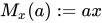

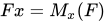





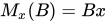


- If then has infinitely many distinct vector topologies:
- Some of these topologies are now described: Every linear functional on which is vector space isomorphic to induces a seminorm defined by where Every seminorm induces a (pseudometrizable locally convex) vector topology on and seminorms with distinct kernels induce distinct topologies so that in particular, seminorms on that are induced by linear functionals with distinct kernel will induces distinct vector topologies on
- However, while there are infinitely many vector topologies on when there are, up to TVS-isomorphism only vector topologies on For instance, if then the vector topologies on consist of the trivial topology, the Hausdorff Euclidean topology, and then the infinitely many remaining non-trivial non-Euclidean vector topologies on are all TVS-isomorphic to one another.








Non-vector topologies
Discrete and cofinite topologies
If is a non-trivial vector space (that is, of non-zero dimension) then the discrete topology on (which is always metrizable) is not a TVS topology because despite making addition and negation continuous (which makes it into a topological group under addition), it fails to make scalar multiplication continuous. The cofinite topology on (where a subset is open if and only if its complement is finite) is also not a TVS topology on
Linear maps
A linear operator between two topological vector spaces which is continuous at one point is continuous on the whole domain. Moreover, a linear operator is continuous if is bounded (as defined below) for some neighborhood of the origin.

A hyperplane on a topological vector space is either dense or closed. A linear functional on a topological vector space has either dense or closed kernel. Moreover, is continuous if and only if its kernel is closed.
Types
Depending on the application additional constraints are usually enforced on the topological structure of the space. In fact, several principal results in functional analysis fail to hold in general for topological vector spaces: the closed graph theorem, the open mapping theorem, and the fact that the dual space of the space separates points in the space.
Below are some common topological vector spaces, roughly in order of increasing "niceness."
- F-spaces are complete topological vector spaces with a translation-invariant metric. These include spaces for all
- Locally convex topological vector spaces: here each point has a local base consisting of convex sets. By a technique known as Minkowski functionals it can be shown that a space is locally convex if and only if its topology can be defined by a family of seminorms. Local convexity is the minimum requirement for "geometrical" arguments like the Hahn–Banach theorem. The spaces are locally convex (in fact, Banach spaces) for all but not for
- Barrelled spaces: locally convex spaces where the Banach–Steinhaus theorem holds.
- Bornological space: a locally convex space where the continuous linear operators to any locally convex space are exactly the bounded linear operators.
- Stereotype space: a locally convex space satisfying a variant of reflexivity condition, where the dual space is endowed with the topology of uniform convergence on totally bounded sets.
- Montel space: a barrelled space where every closed and bounded set is compact
- Fréchet spaces: these are complete locally convex spaces where the topology comes from a translation-invariant metric, or equivalently: from a countable family of seminorms. Many interesting spaces of functions fall into this class -- is a Fréchet space under the seminorms . A locally convex F-space is a Fréchet space.
- LF-spaces are limits of Fréchet spaces. ILH spaces are inverse limits of Hilbert spaces.
- Nuclear spaces: these are locally convex spaces with the property that every bounded map from the nuclear space to an arbitrary Banach space is a nuclear operator.
- Normed spaces and seminormed spaces: locally convex spaces where the topology can be described by a single norm or seminorm. In normed spaces a linear operator is continuous if and only if it is bounded.
- Banach spaces: Complete normed vector spaces. Most of functional analysis is formulated for Banach spaces. This class includes the spaces with , the space of functions of bounded variation, and certain spaces of measures.
- Reflexive Banach spaces: Banach spaces naturally isomorphic to their double dual (see below), which ensures that some geometrical arguments can be carried out. An important example which is not reflexive is , whose dual is but is strictly contained in the dual of
- Hilbert spaces: these have an inner product; even though these spaces may be infinite-dimensional, most geometrical reasoning familiar from finite dimensions can be carried out in them. These include spaces, the Sobolev spaces , and Hardy spaces.
- Euclidean spaces: or with the topology induced by the standard inner product. As pointed out in the preceding section, for a given finite there is only one -dimensional topological vector space, up to isomorphism. It follows from this that any finite-dimensional subspace of a TVS is closed. A characterization of finite dimensionality is that a Hausdorff TVS is locally compact if and only if it is finite-dimensional (therefore isomorphic to some Euclidean space).


![{\textstyle \|f\|_{k,\ell }=\sup _{x\in [-k,k]}|f^{(\ell )}(x)|}](https://wikimedia.org/api/rest_v1/media/math/render/svg/f99085ff3a16ad689d55e969a64af5f07378d5a4)


Dual space
Every topological vector space has a continuous dual space—the set of all continuous linear functionals, that is, continuous linear maps from the space into the base field A topology on the dual can be defined to be the coarsest topology such that the dual pairing each point evaluation is continuous. This turns the dual into a locally convex topological vector space. This topology is called the weak-* topology. This may not be the only natural topology on the dual space; for instance, the dual of a normed space has a natural norm defined on it. However, it is very important in applications because of its compactness properties (see Banach–Alaoglu theorem). Caution: Whenever is a non-normable locally convex space, then the pairing map is never continuous, no matter which vector space topology one chooses on A topological vector space has a non-trivial continuous dual space if and only if it has a proper convex neighborhood of the origin.[21]




Properties
For any of a TVS the convex (resp. balanced, disked, closed convex, closed balanced, closed disked') hull of is the smallest subset of that has this property and contains The closure (respectively, interior, convex hull, balanced hull, disked hull) of a set is sometimes denoted by (respectively, ).



The convex hull of a subset is equal to the set of all convex combinations of elements in which are finite linear combinations of the form where is an integer, and sum to [22] The intersection of any family of convex sets is convex and the convex hull of a subset is equal to the intersection of all convex sets that contain it.[22]





![{\displaystyle t_{1},\ldots ,t_{n}\in [0,1]}](https://wikimedia.org/api/rest_v1/media/math/render/svg/985ff0e2b88aad029f13c1c1fa8f609f98788066)

Neighborhoods and open sets
Properties of neighborhoods and open sets
Every TVS is connected[5] and locally connected[23] and any connected open subset of a TVS is arcwise connected. If and is an open subset of then is an open set in [5] and if has non-empty interior then is a neighborhood of the origin.[5]


The open convex subsets of a TVS (not necessarily Hausdorff or locally convex) are exactly those that are of the form


If is an absorbing disk in a TVS and if is the Minkowski functional of then[24]



Let and be two vector topologies on Then if and only if whenever a net in converges in then in [25]


Let be a neighborhood basis of the origin in let and let Then if and only if there exists a net in (indexed by ) such that in [26] This shows, in particular, that it will often suffice to consider nets indexed by a neighborhood basis of the origin rather than nets on arbitrary directed sets.


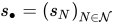

If is a TVS that is of the second category in itself (that is, a nonmeager space) then any closed convex absorbing subset of is a neighborhood of the origin.[27] This is no longer guaranteed if the set is not convex (a counter-example exists even in ) or if is not of the second category in itself.[27]

Interior
If and has non-empty interior then



If is a disk in that has non-empty interior then the origin belongs to the interior of [28] However, a closed balanced subset of with non-empty interior may fail to contain the origin in its interior.[28]
If is a balanced subset of with non-empty interior then is balanced; in particular, if the interior of a balanced set contains the origin then is balanced.[5][note 6]
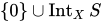

If is convex and then[29]


If is any balanced neighborhood of the origin in then where is the set of all scalars such that




If belongs to the interior of a convex set and then the half-open line segment and [30] If is a balanced neighborhood of in and then by considering intersections of the form (which are convex symmetric neighborhoods of in the real TVS ) it follows that: and furthermore, if then and if then












Non-Hausdorff spaces and the closure of the origin
A topological vector space is Hausdorff if and only if is a closed subset of or equivalently, if and only if Because is a vector subspace of the same is true of its closure which is referred to as the closure of the origin in This vector space satisfies
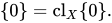

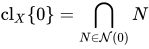


If is compact, then and this set is compact. Thus the closure of a compact subset of a TVS is compact (said differently, all compact sets are relatively compact),[32] which is not guaranteed for arbitrary non-Hausdorff topological spaces.[note 7]

For every subset


- is totally bounded.
- is totally bounded.[33]
- is totally bounded.[34][35]
- The image if under the canonical quotient map is totally bounded.[33]


If is a vector subspace of a TVS then is Hausdorff if and only if is closed in Moreover, the quotient map is always a closed map onto the (necessarily) Hausdorff TVS.[36]

Every vector subspace of that is an algebraic complement of (that is, a vector subspace that satisfies and ) is a topological complement of Consequently, if is an algebraic complement of in then the addition map defined by is a TVS-isomorphism, where is necessarily Hausdorff and has the indiscrete topology.[37] Moreover, if is a Hausdorff completion of then is a completion of [33]







Closed and compact sets
Compact and totally bounded sets
A subset of a TVS is compact if and only if it is complete and totally bounded.[31] Thus, in a complete topological vector space, a closed and totally bounded subset is compact.[31] A subset of a TVS is totally bounded if and only if is totally bounded,[34][35] if and only if its image under the canonical quotient map
Every relatively compact set is totally bounded[31] and the closure of a totally bounded set is totally bounded.[31] The image of a totally bounded set under a uniformly continuous map (such as a continuous linear map for instance) is totally bounded.[31] If is a subset of a TVS such that every sequence in has a cluster point in then is totally bounded.[33]
If is a compact subset of a TVS and is an open subset of containing then there exists a neighborhood of 0 such that [38]


Closure and closed set
The closure of any convex (respectively, any balanced, any absorbing) subset of any TVS has this same property. In particular, the closure of any convex, balanced, and absorbing subset is a barrel.
The closure of a vector subspace of a TVS is a vector subspace. Every finite dimensional vector subspace of a Hausdorff TVS is closed. The sum of a closed vector subspace and a finite-dimensional vector subspace is closed.[5] If is a vector subspace of and is a closed neighborhood of the origin in such that is closed in then is closed in [38] The sum of a compact set and a closed set is closed. However, the sum of two closed subsets may fail to be closed[5] (see this footnote[note 8] for examples).

If and is a scalar then






If then is convex.[39]

If then[5]
![{\displaystyle \operatorname {cl} _{X}(R)+\operatorname {cl} _{X}(S)~\subseteq ~\operatorname {cl} _{X}(R+S)~{\text{ and }}~\operatorname {cl} _{X}\left[\operatorname {cl} _{X}(R)+\operatorname {cl} _{X}(S)\right]~=~\operatorname {cl} _{X}(R+S)}](https://wikimedia.org/api/rest_v1/media/math/render/svg/796f38a799f8ecde14d825ebfb3c0ac0a61b77c8)


If is a real TVS and then
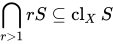

For any subset
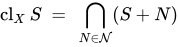



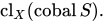
Closed hulls
In a locally convex space, convex hulls of bounded sets are bounded. This is not true for TVSs in general.[12]
- The closed convex hull of a set is equal to the closure of the convex hull of that set; that is, equal to [5]
- The closed balanced hull of a set is equal to the closure of the balanced hull of that set; that is, equal to [5]
- The closed disked hull of a set is equal to the closure of the disked hull of that set; that is, equal to [5]


If and the closed convex hull of one of the sets or is compact then[5]




![{\displaystyle \operatorname {cl} _{X}(\operatorname {co} (R\cup S))~=~\operatorname {co} \left[\operatorname {cl} _{X}(\operatorname {co} R)\cup \operatorname {cl} _{X}(\operatorname {co} S)\right].}](https://wikimedia.org/api/rest_v1/media/math/render/svg/1e41b11bfc0ed54d2de2503e9df59ee85e3ce25d)
Hulls and compactness
In a general TVS, the closed convex hull of a compact set may fail to be compact. The balanced hull of a compact (resp. totally bounded) set has that same property.[5] The convex hull of a finite union of compact convex sets is again compact and convex.[5]
Other properties
Meager, nowhere dense, and Baire
A disk in a TVS is not nowhere dense if and only if its closure is a neighborhood of the origin.[8] A vector subspace of a TVS that is closed but not open is nowhere dense.[8]
Suppose is a TVS that does not carry the indiscrete topology. Then is a Baire space if and only if has no balanced absorbing nowhere dense subset.[8]
A TVS is a Baire space if and only if is nonmeager, which happens if and only if there does not exist a nowhere dense set such that [8] Every nonmeager locally convex TVS is a barrelled space.[8]

Important algebraic facts and common misconceptions
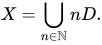
If then ; if is convex then equality holds. For an example where equality does not hold, let be non-zero and set also works.

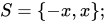

A subset is convex if and only if for all positive real [22] or equivalently, if and only if for all [43]




The convex balanced hull of a set is equal to the convex hull of the balanced hull of that is, it is equal to But in general,




If and is a scalar then[5]



In any non-trivial vector space there exist two disjoint non-empty convex subsets whose union is
Other properties
Every TVS topology can be generated by a family of F-seminorms.[44]
If is some unary predicate (a true or false statement dependent on ) then for any [proof 4] So for example, if denotes "" then for any Similarly, if is a scalar then The elements of these sets must range over a vector space (that is, over ) rather than not just a subset or else these equalities are no longer guaranteed; similarly, must belong to this vector space (that is, ).







Properties preserved by set operators
- The balanced hull of a compact (respectively, totally bounded, open) set has that same property.[5]
- The (Minkowski) sum of two compact (respectively, bounded, balanced, convex) sets has that same property.[5] But the sum of two closed sets need not be closed.
- The convex hull of a balanced (resp. open) set is balanced (respectively, open). However, the convex hull of a closed set need not be closed.[5] And the convex hull of a bounded set need not be bounded.
The following table, the color of each cell indicates whether or not a given property of subsets of (indicated by the column name, "convex" for instance) is preserved under the set operator (indicated by the row's name, "closure" for instance). If in every TVS, a property is preserved under the indicated set operator then that cell will be colored green; otherwise, it will be colored red.
So for instance, since the union of two absorbing sets is again absorbing, the cell in row "" and column "Absorbing" is colored green. But since the arbitrary intersection of absorbing sets need not be absorbing, the cell in row "Arbitrary intersections (of at least 1 set)" and column "Absorbing" is colored red. If a cell is not colored then that information has yet to be filled in.

| Operation | Property of and any other subsets of that is considered | |||||||||||||||||||||||||||||||||||||||||||||||||||||||||||||||||||||||||||||||||||||||||||||||||||
|---|---|---|---|---|---|---|---|---|---|---|---|---|---|---|---|---|---|---|---|---|---|---|---|---|---|---|---|---|---|---|---|---|---|---|---|---|---|---|---|---|---|---|---|---|---|---|---|---|---|---|---|---|---|---|---|---|---|---|---|---|---|---|---|---|---|---|---|---|---|---|---|---|---|---|---|---|---|---|---|---|---|---|---|---|---|---|---|---|---|---|---|---|---|---|---|---|---|---|---|---|
| Absorbing | Balanced | Convex | Symmetric | Convex Balanced | Vector subspace | Open | Neighborhood of 0 | Closed | Closed Balanced | Closed Convex | Closed Convex Balanced | Barrel | Closed Vector subspace | Totally bounded | Compact | Compact Convex | Relatively compact | Complete | Sequentially Complete | Banach disk | Bounded | Bornivorous | Infrabornivorous | Nowhere dense (in ) | Meager | Separable | Pseudometrizable | Operation | ||||||||||||||||||||||||||||||||||||||||||||||||||||||||||||||||||||||||
 | |  | | | | | | | | | | | | | | | | | | | | | | | ||||||||||||||||||||||||||||||||||||||||||||||||||||||||||||||||||||||||||||
| of increasing nonempty chain | | | | | | | | | | | | | | | | | | | | | | | | | | of increasing nonempty chain | ||||||||||||||||||||||||||||||||||||||||||||||||||||||||||||||||||||||||||
| Arbitrary unions (of at least 1 set) | | | | | | | | | | | | | | | | | | | | | | | | | | Arbitrary unions (of at least 1 set) | ||||||||||||||||||||||||||||||||||||||||||||||||||||||||||||||||||||||||||
| | | | | | | | | | | | | | | | | | | | | | | |||||||||||||||||||||||||||||||||||||||||||||||||||||||||||||||||||||||||||||||
| of decreasing nonempty chain | | | | | | | | | | | | | | | | | | | of decreasing nonempty chain | |||||||||||||||||||||||||||||||||||||||||||||||||||||||||||||||||||||||||||||||||
| Arbitrary intersections (of at least 1 set) | | | | | | | | | | | | | | | | | | | Arbitrary intersections (of at least 1 set) | |||||||||||||||||||||||||||||||||||||||||||||||||||||||||||||||||||||||||||||||||
| | | | | | | | | | | | | | ||||||||||||||||||||||||||||||||||||||||||||||||||||||||||||||||||||||||||||||||||||||||
| Scalar multiple | | | | | | | | | | | | | | | | | | | | | | | | | | | | Scalar multiple | ||||||||||||||||||||||||||||||||||||||||||||||||||||||||||||||||||||||||
| Non-0 scalar multiple | | | | | | | | | | | | | | | | | | | | | | | | | | | | | Non-0 scalar multiple | |||||||||||||||||||||||||||||||||||||||||||||||||||||||||||||||||||||||
| Positive scalar multiple | | | | | | | | | | | | | | | | | | | | | | | | | | | Positive scalar multiple | |||||||||||||||||||||||||||||||||||||||||||||||||||||||||||||||||||||||||
| Closure | | | | | | | | | | | | | | | | | | | | | | | Closure | |||||||||||||||||||||||||||||||||||||||||||||||||||||||||||||||||||||||||||||
| Interior | | | | | | | | | | | | | | | | | | | Interior | |||||||||||||||||||||||||||||||||||||||||||||||||||||||||||||||||||||||||||||||||
| Balanced core | | | | | | | | | | | | | | | | | | | Balanced core | |||||||||||||||||||||||||||||||||||||||||||||||||||||||||||||||||||||||||||||||||
| Balanced hull | | | | | | | | | | | | | | | | | | | | | | | Balanced hull | |||||||||||||||||||||||||||||||||||||||||||||||||||||||||||||||||||||||||||||
| Convex hull | | | | | | | | | | | | | | | | | | | | | Convex hull | |||||||||||||||||||||||||||||||||||||||||||||||||||||||||||||||||||||||||||||||
| Convex balanced hull | | | | | | | | | | | | | | | | | | | | Convex balanced hull | ||||||||||||||||||||||||||||||||||||||||||||||||||||||||||||||||||||||||||||||||
| Closed balanced hull | | | | | | | | | | | | | | | | | | | | Closed balanced hull | ||||||||||||||||||||||||||||||||||||||||||||||||||||||||||||||||||||||||||||||||
| Closed convex hull | | | | | | | | | | | | | | | | | | | | Closed convex hull | ||||||||||||||||||||||||||||||||||||||||||||||||||||||||||||||||||||||||||||||||
| Closed convex balanced hull | | | | | | | | | | | | | | | | | | | | Closed convex balanced hull | ||||||||||||||||||||||||||||||||||||||||||||||||||||||||||||||||||||||||||||||||
| Linear span | | | | | | | | | | | | | | | | | | | | | Linear span | |||||||||||||||||||||||||||||||||||||||||||||||||||||||||||||||||||||||||||||||
| Pre-image under a continuous linear map | | | | | | | | | | | | | | | | | | | | | | Pre-image under a continuous linear map | ||||||||||||||||||||||||||||||||||||||||||||||||||||||||||||||||||||||||||||||
| Image under a continuous linear map | | | | | | | | | | | | | | | | | | | | | Image under a continuous linear map | |||||||||||||||||||||||||||||||||||||||||||||||||||||||||||||||||||||||||||||||
| Image under a continuous linear surjection | | | | | | | | | | | | | Image under a continuous linear surjection | |||||||||||||||||||||||||||||||||||||||||||||||||||||||||||||||||||||||||||||||||||||||
| Non-empty subset of | | | | | | | | | | | | | | | | | | | | | | | | | | Non-empty subset of | ||||||||||||||||||||||||||||||||||||||||||||||||||||||||||||||||||||||||||
| Operation | Absorbing | Balanced | Convex | Symmetric | Convex Balanced | Vector subspace | Open | Neighborhood of 0 | Closed | Closed Balanced | Closed Convex | Closed Convex Balanced | Barrel | Closed Vector subspace | Totally bounded | Compact | Compact Convex | Relatively compact | Complete | Sequentially Complete | Banach disk | Bounded | Bornivorous | Infrabornivorous | Nowhere dense (in ) | Meager | Separable | Pseudometrizable | Operation | |||||||||||||||||||||||||||||||||||||||||||||||||||||||||||||||||||||||


See also
- Banach space – Normed vector space that is complete
- Complete field
- Hilbert space – Generalization of Euclidean space allowing infinite dimensions
- Normed space
- Locally compact field
- Locally compact group
- Locally compact quantum group
- Locally convex topological vector space – A vector space with a topology defined by convex open sets
- Ordered topological vector space
- Topological abelian group
- Topological field
- Topological group – Group that is a topological space with continuous group action
- Topological module
- Topological ring
- Topological semigroup
- Topological vector lattice
Notes
- ^ The topological properties of course also require that be a TVS.
- ^ In particular, is Hausdorff if and only if the set is closed (that is, is a T1 space).
- ^ In fact, this is true for topological group, since the proof does not use the scalar multiplications.
- ^ Also called a metric linear space, which means that it is a real or complex vector space together with a translation-invariant metric for which addition and scalar multiplication are continuous.
- ^ A series is said to converge in a TVS if the sequence of partial sums converges.
- ^ If the interior of a balanced set is non-empty but does not contain the origin (such sets exists even in and ) then the interior of this set can not be a balanced set.
- ^ In general topology, the closure of a compact subset of a non-Hausdorff space may fail to be compact (for example, the particular point topology on an infinite set). This result shows that this does not happen in non-Hausdorff TVSs. is compact because it is the image of the compact set under the continuous addition map Recall also that the sum of a compact set (i.e. ) and a closed set is closed so is closed in
- ^ In the the sum of the -axis and the graph of which is the complement of the -axis, is open in In the Minkowski sum is a countable dense subset of so not closed in


Proofs
- ^ This condition is satisfied if denotes the set of all topological strings in
- ^ Since has the trivial topology, so does each of its subsets, which makes them all compact. It is known that a subset of any uniform space is compact if and only if it is complete and totally bounded.
- ^ If then Because if is closed then equality holds. Using the fact that is a vector space, it is readily verified that the complement in of any set satisfying the equality must also satisfy this equality (when is substituted for ).
- ^ and so using and the fact that this is equal to








Citations
- ^ a b c Köthe 1983, p. 91.
- ^ Schaefer & Wolff 1999, pp. 74–78.
- ^ Grothendieck 1973, pp. 34–36.
- ^ a b c Wilansky 2013, pp. 40–47.
- ^ a b c d e f g h i j k l m n o p q r s t u Narici & Beckenstein 2011, pp. 67–113.
- ^ a b c d e Adasch, Ernst & Keim 1978, pp. 5–9.
- ^ Schechter 1996, pp. 721–751.
- ^ a b c d e f Narici & Beckenstein 2011, pp. 371–423.
- ^ Adasch, Ernst & Keim 1978, pp. 10–15.
- ^ Wilansky 2013, p. 53.
- ^ Rudin 1991, p. 8.
- ^ a b c d e Narici & Beckenstein 2011, pp. 155–176.
- ^ Köthe 1983, section 15.11.
- ^ "Topological vector space", Encyclopedia of Mathematics, EMS Press, 2001 [1994], retrieved 26 February 2021
- ^ Schaefer & Wolff 1999, pp. 12–19.
- ^ Schaefer & Wolff 1999, p. 16.
- ^ a b c Narici & Beckenstein 2011, pp. 115–154.
- ^ Swartz 1992, pp. 27–29.
- ^ "A quick application of the closed graph theorem". What's new. 2016-04-22. Retrieved 2020-10-07.
- ^ a b Narici & Beckenstein 2011, p. 111.
- ^ a b Narici & Beckenstein 2011, pp. 177–220.
- ^ a b c Rudin 1991, p. 38.
- ^ Schaefer & Wolff 1999, p. 35.
- ^ Narici & Beckenstein 2011, p. 119-120.
- ^ Wilansky 2013, p. 43.
- ^ Wilansky 2013, p. 42.
- ^ a b Rudin 1991, p. 55.
- ^ a b Narici & Beckenstein 2011, p. 108.
- ^ Jarchow 1981, pp. 101–104.
- ^ Schaefer & Wolff 1999, p. 38.
- ^ a b c d e f Narici & Beckenstein 2011, pp. 47–66.
- ^ Narici & Beckenstein 2011, p. 156.
- ^ a b c d e Schaefer & Wolff 1999, pp. 12–35.
- ^ a b Schaefer & Wolff 1999, p. 25.
- ^ a b Jarchow 1981, pp. 56–73.
- ^ Narici & Beckenstein 2011, pp. 107–112.
- ^ Wilansky 2013, p. 63.
- ^ a b Narici & Beckenstein 2011, pp. 19–45.
- ^ a b c Wilansky 2013, pp. 43–44.
- ^ Narici & Beckenstein 2011, pp. 80.
- ^ Narici & Beckenstein 2011, pp. 108–109.
- ^ Jarchow 1981, pp. 30–32.
- ^ Rudin 1991, p. 6.
- ^ Swartz 1992, p. 35.
Bibliography
- Adasch, Norbert; Ernst, Bruno; Keim, Dieter (1978). Topological Vector Spaces: The Theory Without Convexity Conditions. Lecture Notes in Mathematics. Vol. 639. Berlin New York: Springer-Verlag. ISBN 978-3-540-08662-8. OCLC 297140003.
- Jarchow, Hans (1981). Locally convex spaces. Stuttgart: B.G. Teubner. ISBN 978-3-519-02224-4. OCLC 8210342.
- Köthe, Gottfried (1983) [1969]. Topological Vector Spaces I. Grundlehren der mathematischen Wissenschaften. Vol. 159. Translated by Garling, D.J.H. New York: Springer Science & Business Media. ISBN 978-3-642-64988-2. MR 0248498. OCLC 840293704.
- Narici, Lawrence; Beckenstein, Edward (2011). Topological Vector Spaces. Pure and applied mathematics (Second ed.). Boca Raton, FL: CRC Press. ISBN 978-1584888666. OCLC 144216834.
- Rudin, Walter (1991). Functional Analysis. International Series in Pure and Applied Mathematics. Vol. 8 (Second ed.). New York, NY: McGraw-Hill Science/Engineering/Math. ISBN 978-0-07-054236-5. OCLC 21163277.
- Schaefer, Helmut H.; Wolff, Manfred P. (1999). Topological Vector Spaces. GTM. Vol. 8 (Second ed.). New York, NY: Springer New York Imprint Springer. ISBN 978-1-4612-7155-0. OCLC 840278135.
- Schechter, Eric (1996). Handbook of Analysis and Its Foundations. San Diego, CA: Academic Press. ISBN 978-0-12-622760-4. OCLC 175294365.
- Swartz, Charles (1992). An introduction to Functional Analysis. New York: M. Dekker. ISBN 978-0-8247-8643-4. OCLC 24909067.
- Wilansky, Albert (2013). Modern Methods in Topological Vector Spaces. Mineola, New York: Dover Publications, Inc. ISBN 978-0-486-49353-4. OCLC 849801114.
Further reading
- Bierstedt, Klaus-Dieter (1988). An Introduction to Locally Convex Inductive Limits. Functional Analysis and Applications. Singapore-New Jersey-Hong Kong: Universitätsbibliothek. pp. 35–133. MR 0046004. Retrieved 20 September 2020.
- Bourbaki, Nicolas (1987) [1981]. Sur certains espaces vectoriels topologiques [Topological Vector Spaces: Chapters 1–5]. Annales de l'Institut Fourier. Éléments de mathématique. Vol. 2. Translated by Eggleston, H.G.; Madan, S. Berlin New York: Springer-Verlag. ISBN 978-3-540-42338-6. OCLC 17499190.
- Conway, John B. (1990). A Course in Functional Analysis. Graduate Texts in Mathematics. Vol. 96 (2nd ed.). New York: Springer-Verlag. ISBN 978-0-387-97245-9. OCLC 21195908.
- Dunford, Nelson; Schwartz, Jacob T. (1988). Linear Operators. Pure and applied mathematics. Vol. 1. New York: Wiley-Interscience. ISBN 978-0-471-60848-6. OCLC 18412261.
- Edwards, Robert E. (1995). Functional Analysis: Theory and Applications. New York: Dover Publications. ISBN 978-0-486-68143-6. OCLC 30593138.
- Grothendieck, Alexander (1973). Topological Vector Spaces. Translated by Chaljub, Orlando. New York: Gordon and Breach Science Publishers. ISBN 978-0-677-30020-7. OCLC 886098.
- Horváth, John (1966). Topological Vector Spaces and Distributions. Addison-Wesley series in mathematics. Vol. 1. Reading, MA: Addison-Wesley Publishing Company. ISBN 978-0201029857.
- Köthe, Gottfried (1979). Topological Vector Spaces II. Grundlehren der mathematischen Wissenschaften. Vol. 237. New York: Springer Science & Business Media. ISBN 978-0-387-90400-9. OCLC 180577972.
- Lang, Serge (1972). Differential manifolds. Reading, Mass.–London–Don Mills, Ont.: Addison-Wesley Publishing Co., Inc. ISBN 0-201-04166-9.
- Robertson, Alex P.; Robertson, Wendy J. (1980). Topological Vector Spaces. Cambridge Tracts in Mathematics. Vol. 53. Cambridge England: Cambridge University Press. ISBN 978-0-521-29882-7. OCLC 589250.
- Trèves, François (2006) [1967]. Topological Vector Spaces, Distributions and Kernels. Mineola, N.Y.: Dover Publications. ISBN 978-0-486-45352-1. OCLC 853623322.
- Valdivia, Manuel (1982). Nachbin, Leopoldo (ed.). Topics in Locally Convex Spaces. Vol. 67. Amsterdam New York, N.Y.: Elsevier Science Pub. Co. ISBN 978-0-08-087178-3. OCLC 316568534.
- Voigt, Jürgen (2020). A Course on Topological Vector Spaces. Compact Textbooks in Mathematics. Cham: Birkhäuser Basel. ISBN 978-3-030-32945-7. OCLC 1145563701.
External links
 Media related to Topological vector spaces at Wikimedia Commons

| General | |
|---|---|
| National libraries | |