
생태계 모델
Ecosystem model
생태계 모델은 실제 시스템을 [2]더 잘 이해하기 위해 연구되는 (개별 개체군, 생태 공동체, 또는 전체 생물군에 이르는 규모의) 생태계를 추상적으로, 보통 수학적으로 표현한 것입니다.
현장에서 수집된 데이터를 사용하여 광합성 속도에 대한 햇빛과 물의 이용 가능성의 관계 또는 포식자와 먹이 개체 사이의 관계와 같은 생태학적 관계를 도출하고, 이러한 관계를 결합하여 생태계 모델을 형성한다.이러한 모델 시스템은 실제 시스템의 역학에 대한 예측을 하기 위해 연구됩니다.종종 모형의 부정확성에 대한 연구(경험적 관측치와 비교했을 때)는 아직 알려지지 않았거나 잘 이해되지 않은 가능한 생태 관계에 대한 가설을 생성하게 됩니다.모델을 사용하면 실제 생태계에서 수행하기에는 비용이 너무 많이 들거나 비윤리적인 대규모 실험을 시뮬레이션할 수 있습니다.또한 매우 긴 시간에 걸친 생태학적 프로세스의 시뮬레이션을 가능하게 합니다(즉,[3] 실제로 수 세기가 걸리는 프로세스를 시뮬레이트하는 것은 컴퓨터 모델에서 몇 분 안에 완료할 수 있습니다).
생태계 모델은 천연자원 관리,[4] 생태독성학, 환경보건,[5][6] 농업,[7] 야생동물 [8]보호 등 다양한 분야에서 응용되고 있습니다.생태학적 모델링은 석기의 [9]다양성과 이동성을 설명하기 위해 고고학적 모형과 결합하는 등 다양한 성공 정도를 가진 고고학에도 적용되어 왔다.
모델의 종류
생태 모델에는 (1) 분석 모델과 (2) 시뮬레이션/계산 모델의 두 가지 주요 유형이 있으며, 이는 일반적으로 다른 유형의 문제에 적용된다.해석 모델은 일반적으로 비교적 단순한(종종 선형) 시스템으로, 잘 알려진 일련의 수학 방정식으로 정확하게 설명할 수 있습니다.반면 시뮬레이션 모델에서는 수치 기법을 사용하여 분석 솔루션이 실용적이지 않거나 불가능한 문제를 해결합니다.시뮬레이션 모델은 더 널리 사용되는 경향이 있고 일반적으로 생태학적으로 더 현실적인 것으로 간주되는 반면, 분석 모델은 수학적 우아함과 [10][11][12]설명력으로 평가됩니다.Ecopath는 해양 생태계를 모델링하기 위해 시뮬레이션과 계산 방법을 사용하는 강력한 소프트웨어 시스템입니다.이것은 해양 및 수산 과학자들에 의해 실제 [13][14][15][16][17][18][19]해양 생태계에 존재하는 복잡한 관계를 모델링하고 시각화하기 위한 도구로 널리 사용되고 있습니다.
모델 설계

모형 설계 프로세스는 해결할 문제의 사양과 [21]모형의 목적에서 시작됩니다.
생태계는 종종 예측할 수 없거나 계산 가능한 모델에 통합이 불가능할 정도로 복잡한 방식으로 서로 상호작용하는 엄청난 수의 생물 및 비생물학적 요소들로 구성되어 있습니다.이러한 복잡성 때문에 에코시스템 모델은 일반적으로 연구 중인 시스템을 잘 이해되고 모델이 [22][23]해결하려는 문제와 관련이 있다고 간주되는 제한된 수의 구성요소로 단순화합니다.
단순화 프로세스는 일반적으로 생태계를 소수의 상태 변수와 이들 [24]사이의 관계의 특성을 설명하는 수학적 함수로 축소합니다.모델에 통합되는 생태계 구성요소의 수는 유사한 프로세스와 엔티티를 하나의 [25][26]단위로 취급하는 기능 그룹으로 집계함으로써 제한됩니다.
모델링 대상 컴포넌트와 이들 간의 관계를 확립한 후 생태계 모델 구조의 또 다른 중요한 요소는 사용된 공간의 표현이다.역사적으로, 모델들은 종종 혼란스러운 공간 문제를 무시해 왔다.그러나, 많은 생태학적 문제에서 공간 역학은 매우 다른 결과로 이어지는 다른 공간 환경과 함께 문제의 중요한 부분이다.공간적 명시적 모델("공간적 분산" 또는 "경관" 모델이라고도 함)은 이기종 공간 환경을 [27][28][29]모델에 통합하려고 시도합니다.공간 모델은 공간의 함수이거나 다른 공간 [30]변수와 관련될 수 있는 하나 이상의 상태 변수를 가진 모델입니다.
확인
건설 후에는 결과가 허용 가능한 정확성 또는 사실성을 보장하기 위해 모델을 검증합니다.한 가지 방법은 연구 중인 실제 시스템과 독립적인 여러 데이터 집합을 사용하여 모형을 테스트하는 것입니다.특정 입력으로 인해 결함이 있는 모델이 올바른 결과를 출력할 수 있으므로 이는 중요합니다.또 다른 검증 방법은 모형의 출력을 현장 관찰에서 수집된 데이터와 비교하는 것입니다.연구자들은 종종 모델에 의해 출력되는 파라미터와 필드 [31][32][33][34][35]데이터에서 계산된 파라미터 사이에 어느 정도의 차이가 있는지 미리 명시한다.
예
로트카-볼테라 방정식

가장 [36]오래되고 가장 잘 알려진 생태 모델 중 하나는 알프레드 [37]로트카와 [38]비토 볼테라의 포식자-사료 모델이다.이 모형은 한 쌍의 일반 미분 방정식의 형태를 취합니다. 하나는 먹잇감을 나타내고 다른 하나는 포식자를 나타냅니다.
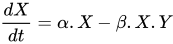

어디에,
|
|
 먹이 종의 수/농도입니다.
 포식자 종의 수/농도입니다.
 먹이 종의 성장률입니다.
 X
X

볼테라는 원래 1차 세계대전 이후 아드리아해에서 관찰된 물고기와 상어 개체수의 변동을 설명하기 위해 이 모델을 고안했다.그러나, 그 방정식은 그 후에 [39]더 일반적으로 적용되었다.단순하지만, 그들은 생태학적 모델의 주요 특징 중 일부를 설명한다: 모델화된 생물 개체군은 성장을 경험하고, 다른 개체군( 포식자, 먹이 또는 경쟁자)과 상호작용하며,[citation needed] 사망률을 겪는다.
로트카-볼테라 포식자-사료 모델과 그 일반적인 먹잇감의존적 일반화에 대한 신뢰할 수 있는 간단한 대안은 비율 의존형 또는 아르디티-긴츠부르크 [40]모델이다.이 두 가지는 포식자 간섭 모델의 스펙트럼의 극치입니다.대안적 견해의 저자들에 따르면, 데이터는 자연에서 진정한 상호작용이 간섭 스펙트럼의 로카-볼테라 극단에서 너무 멀리 떨어져 있기 때문에 모델이 단순히 잘못된 것으로 간주될 수 있다는 것을 보여준다.이들은 비율 의존 극단값에 훨씬 더 가깝기 때문에 단순 모델이 필요한 경우 첫 번째 [41]근사치로 Arditi-Ginzburg 모델을 사용할 수 있다.
다른이들
이론 생태학자 Robert Ulanowicz는 연구된 시스템의 상호 정보(상관)를 강조하면서 생태계의 구조를 설명하기 위해 정보 이론 도구를 사용했습니다.Ulanowicz는 이 방법론과 복잡한 생태계의 이전 관찰 결과를 바탕으로 생태계의 스트레스 수준을 결정하고 환경(에너지 흐름 증가 또는 감소, 부영양화 [42]등)의 정의된 변경 유형에 대한 시스템 반응을 예측하는 접근방식을 묘사한다.
Conway's Game of Life와 그 변형은 인구 증가의 요인이 되는 인구 구성원의 근접성이 있는 생태계를 모델링합니다.
「 」를 참조해 주세요.


레퍼런스
- ^ Fasham, M. J. R.; Ducklow, H. W.; McKelvie, S. M. (1990). "A nitrogen-based model of plankton dynamics in the oceanic mixed layer". Journal of Marine Research. 48 (3): 591–639. doi:10.1357/002224090784984678.
- ^ Hall, Charles A.S. & Day, John W. (1990). Ecosystem Modeling in Theory and Practice: An Introduction with Case Histories. University Press of Colorado. pp. 7–8. ISBN 978-0-87081-216-3.
- ^ 홀&데이, 1990: 13-14페이지
- ^ Dale, Virginia H. (2003). "Opportunities for Using Ecological Models for Resource Management". Ecological Modeling for Resource Management. pp. 3–19. doi:10.1007/0-387-21563-8_1. ISBN 978-0-387-95493-6.
- ^ Pastorok, Robert A. (2002). "Introduction". Ecological modeling in risk assessment: chemical effects on populations, ecosystems, and landscapes. CRC Press. p. 7. ISBN 978-1-56670-574-5.
- ^ Forbes, Valery E. (2009). "The Role of Ecological Modeling in Risk Assessments Seen From an Academic's Point of View". In Thorbek, Pernille (ed.). Ecological Models for Regulatory Risk Assessments of Pesticides: Developing a Strategy for the Future. CRC Press. p. 89. ISBN 978-1-4398-0511-4.
- ^ Palladino, Paolo (1996). "Ecological Modeling and Integrated Pest Management". Entomology, ecology and agriculture: the making of scientific careers in North America, 1885-1985. Psychology Press. p. 153. ISBN 978-3-7186-5907-4.
- ^ Millspaugh, Joshua J.; et al. (2008). "General Principles for Developing Landscape Models for Wildlife Conservation". Models for planning wildlife conservation in large landscapes. Academic Press. p. 1. ISBN 978-0-12-373631-4.
- ^ Marwick, Ben (2013). "Multiple Optima in Hoabinhian flaked stone artefact palaeoeconomics and palaeoecology at two archaeological sites in Northwest Thailand". Journal of Anthropological Archaeology. 32 (4): 553–564. doi:10.1016/j.jaa.2013.08.004.
- ^ Jørgensen, Sven Erik (1996). Handbook of environmental and ecological modeling. CRC Press. pp. 403–404. ISBN 978-1-56670-202-7.
- ^ Grant, William Edward & Swannack, Todd M. (2008). Ecological modeling: a common-sense approach to theory and practice. John Wiley & Sons. p. 74. ISBN 978-1-4051-6168-8.
- ^ 홀&데이, 1990년, 9페이지
- ^ Pauly, D. (2000). "Ecopath, Ecosim, and Ecospace as tools for evaluating ecosystem impact of fisheries". ICES Journal of Marine Science. 57 (3): 697–706. doi:10.1006/jmsc.2000.0726.
- ^ Christensen, Villy; Walters, Carl J. (2004). "Ecopath with Ecosim: Methods, capabilities and limitations". Ecological Modelling. 172 (2–4): 109–139. doi:10.1016/j.ecolmodel.2003.09.003.
- ^ Christensen V (2009) "에코패스의 [permanent dead link]
- ^ Khan, M. F.; Preetha, P.; Sharma, A. P. (2015). "Modelling the food web for assessment of the impact of stock supplementation in a reservoir ecosystem in India". Fisheries Management and Ecology. 22 (5): 359–370. doi:10.1111/fme.12134.
- ^ Panikkar, Preetha; Khan, M. Feroz; Desai, V. R.; Shrivastava, N. P.; Sharma, A. P. (2014). "Characterizing trophic interactions of a catfish dominated tropical reservoir ecosystem to assess the effects of management practices". Environmental Biology of Fishes. 98: 237–247. doi:10.1007/s10641-014-0255-6. S2CID 16992082.
- ^ Panikkar, Preetha; Khan, M. Feroz (2008). "Comparative mass-balanced trophic models to assess the impact of environmental management measures in a tropical reservoir ecosystem". Ecological Modelling. 212 (3–4): 280–291. doi:10.1016/j.ecolmodel.2007.10.029.
- ^ Feroz Khan, M.; Panikkar, Preetha (2009). "Assessment of impacts of invasive fishes on the food web structure and ecosystem properties of a tropical reservoir in India". Ecological Modelling. 220 (18): 2281–2290. doi:10.1016/j.ecolmodel.2009.05.020.
- ^ 오덤, 에이치티(1971년)환경, 권력, 사회.뉴욕 주, 와일리 인터사이언스
- ^ Soetaert, Karline & Herman, Peter M.J. (2009). A practical guide to ecological modelling: using R as a simulation platform. Springer. p. 11. ISBN 978-1-4020-8623-6.
- ^ Gillman, Michael & Hails, Rosemary (1997). An introduction to ecological modelling: putting practice into theory. Wiley-Blackwell. p. 4. ISBN 978-0-632-03634-9.
- ^ Müller, Felix; et al. (2011). "What are the General Conditions Under Which Ecological Models Can Be Applied". In Jopp, Fred; et al. (eds.). Modeling Complex Ecological Dynamics. Springer. pp. 13–14. ISBN 978-3-642-05028-2.
- ^ 홀&데이, 1990: 21페이지
- ^ 홀&데이, 1990: 19페이지
- ^ Buschke, Falko T.; Seaman, Maitland T. (2011). "Functional Feeding Groups as a Taxonomic Surrogate for a Grassland Arthropod Assemblage". African Invertebrates. 52: 217–228. doi:10.5733/afin.052.0112.
- ^ McCallum, Hamish (2000). "Spatial Parameters". Population parameters: estimation for ecological models. Wiley-Blackwell. p. 184. ISBN 978-0-86542-740-2.
- ^ Tenhunen, John D.; et al., eds. (2001). Ecosystem approaches to landscape management in Central Europe. Springer. pp. 586–587. ISBN 978-3-540-67267-8.
- ^ Ball, George L. (1999). "Ecological modeling". Encyclopedia of environmental science. Springer. p. 154. ISBN 978-0-412-74050-3.
- ^ Sklar, Fred H. & Hunsaker, Carolyn T. (2001). "The Use and Uncertainties of Spatial Data for Landscape Models: An Overview with Examples from the Florida Everglades". In Hunsaker, Carolyn T. (ed.). Spatial uncertainty in ecology: implications for remote sensing and GIS applications. Springer. p. 15. ISBN 978-0-387-95129-4.
- ^ Jørgensen, Sven Erik & Bendoricchio, G. (2001). Fundamentals of ecological modelling. Gulf Professional Publishing. p. 79. ISBN 978-0-08-044028-6.
- ^ Pastorok, Robert A. (2002). "Introduction". Ecological modeling in risk assessment: chemical effects on populations, ecosystems, and landscapes. CRC Press. p. 22. ISBN 978-1-56670-574-5.
- ^ Shifley, S.R. (2008). "Validation of Landscape-Scale Decision Support Models That Predict Vegetation and Wildlife Dynamics". In Millspaugh, Joshua J.; Thompson, Frank Richard (eds.). Models for planning wildlife conservation in large landscapes. Academic Press. p. 419. ISBN 978-0-12-373631-4.
- ^ Voinov, Alexey (2008). Systems Science and Modeling for Ecological Economics. Academic Press. p. 131. ISBN 978-0-12-372583-7.
- ^ Reuter, Hauke; et al. (2011). "How Valid Are Model Results? Assumptions, Validity Range and Documentation". In Jopp, Fred; et al. (eds.). Modeling Complex Ecological Dynamics. Springer. p. 325. ISBN 978-3-642-05028-2.
- ^ 대니얼 베르누이의 천연두와 토마스 맬서스의 인구 과잉에 대한 초기 연구는 로트카와 볼테라의 인구 과잉보다 앞서지만, 자연적으로는 엄밀하게 생태학적이지 않다.
- ^ Lotka, A. J. (1925). The Elements of Physical Biology. Williams & Williams Co., Baltimore, USA.
- ^ Volterra, Vito (1926). "Fluctuations in the Abundance of a Species considered Mathematically". Nature. 118 (2972): 558–560. Bibcode:1926Natur.118..558V. doi:10.1038/118558a0.
- ^ Begon, M.; Harper, J. L.; Townsend, C. R. (1988). Ecology: Individuals, Populations and Communities. Blackwell Scientific Publications Inc., Oxford, UK.
- ^ Arditi, Roger; Ginzburg, Lev R. (1989). "Coupling in predator-prey dynamics: Ratio-Dependence". Journal of Theoretical Biology. 139 (3): 311–326. Bibcode:1989JThBi.139..311A. doi:10.1016/S0022-5193(89)80211-5.
- ^ Arditi, R. 및 L.R. 긴츠부르크(2012) 종이 상호작용하는 방법: 영양생태학 표준관 변경 옥스퍼드 대학 출판부.ISBN 9780199913831.
- ^ Ulanowicz, Robert E. (1997). Ecology, the Ascendent Perspective. Columbia University Press. ISBN 978-0-231-10829-4.
추가 정보
- Khan, M. F.; Preetha, P.; Sharma, A. P. (2015). "Modelling the food web for assessment of the impact of stock supplementation in a reservoir ecosystem in India". Fisheries Management and Ecology. 22 (5): 359–370. doi:10.1111/fme.12134.
- Panikkar, Preetha; Khan, M. Feroz; Desai, V. R.; Shrivastava, N. P.; Sharma, A. P. (2014). "Characterizing trophic interactions of a catfish dominated tropical reservoir ecosystem to assess the effects of management practices". Environmental Biology of Fishes. 98: 237–247. doi:10.1007/s10641-014-0255-6. S2CID 16992082.
- Panikkar, Preetha; Khan, M. Feroz (2008). "Comparative mass-balanced trophic models to assess the impact of environmental management measures in a tropical reservoir ecosystem". Ecological Modelling. 212 (3–4): 280–291. doi:10.1016/j.ecolmodel.2007.10.029.
- Feroz Khan, M.; Panikkar, Preetha (2009). "Assessment of impacts of invasive fishes on the food web structure and ecosystem properties of a tropical reservoir in India". Ecological Modelling. 220 (18): 2281–2290. doi:10.1016/j.ecolmodel.2009.05.020.


