
All-pay auction
.jpg)
In economics and game theory, an all-pay auction is an auction in which every bidder must pay regardless of whether they win the prize, which is awarded to the highest bidder as in a conventional auction.
In an all-pay auction, the Nash equilibrium is such that each bidder plays a mixed strategy and their expected pay-off is zero.[1] The seller's expected revenue is equal to the value of the prize. However, some economic experiments have shown that over-bidding is common. That is, the seller's revenue frequently exceeds that of the value of the prize, and in repeated games even bidders that win the prize frequently will most likely take a loss in the long run.[2]
Forms of all-pay auctions
The most straightforward form of an all-pay auction is a Tullock auction, sometimes called a Tullock lottery after Gordon Tullock, in which everyone submits a bid but both the losers and the winners pay their submitted bids.[3] This is instrumental in describing certain ideas in public choice economics.[citation needed] The dollar auction is a two player Tullock auction, or a multiplayer game in which only the two highest bidders pay their bids.
기존의 복권이나 복권 추첨도 관련 과정으로 볼 수 있는데, 모든 복권 소지자가 돈을 냈지만 한 명만 당첨되기 때문이다. 모든 지불 경매를 하는 일반적인 예는 여러 "페니 경매"/입찰 수수료 경매 웹사이트에서 찾아볼 수 있다.
최고 입찰자가 승리하는 소모전(생물학적[4] 경매라고도 함)과 같은 다른 형태의 올페이 경매는 존재하지만, 모든(또는 더 일반적으로, 두 가지 모두) 입찰자는 낮은 입찰가만 지불한다. 소모전은 생물학자들이 물리적 공격성에 의지하지 않고 해결한 재래식 경연대회, 또는 작용적 상호작용을 모형화하는 데 사용된다.
규칙.
다음의 분석은 몇 가지 기본적인 규칙을 따른다.[5]
- 각 입찰자는 입찰서를 제출한다. 입찰은 오직 그들의 가치에 달려있다.
- 입찰자들은 다른 입찰자들의 가치를 알지 못한다.
- 이 분석은 각 입찰자의 가치평가가 균일한 분포로부터 독립적으로 도출되는 독립적 사적 가치(IPV) 환경에 기초한다[0,1]. IPV 환경에서 내 값이 0.6이면 다른 입찰자가 더 낮은 값을 가질 확률도 0.6이다. 따라서 다른 두 입찰자가 더 낮은 값을 가질 확률은 2= 0이다

대칭 가정
IPV에서는 동일한 분포로부터 평가되기 때문에 입찰자가 대칭적이다. 이러한 분석은 대칭 및 단조로운 입찰 전략에 초점을 맞춘다. 이는 동일한 평가를 받은 두 입찰자가 동일한 입찰서를 제출하게 됨을 의미한다. 결과적으로 대칭 아래에서는 가장 높은 가치를 지닌 입찰자가 항상 승리하게 된다.[5]
수입 등가치를 사용하여 입찰 함수 예측
2인승 버전의 올페이 경매와 i 을(를) 독립적이고 [0,1]부터 균일한 분포로 동일하게 분배되는 개인 평가라고 간주한다. 대칭 Nash Balance를 구성하는 monotone 증가 입찰 함수 b() 를 찾고 싶다.


Note that if player bids , he wins the auction only if his bid is larger than player 's bid . The probability for this to happen is


, since is monotone and Unif[0,1]
![{\displaystyle \mathbb {P} [b(x)>b(v_{j})]=\mathbb {P} [x>v_{j}]=x}](https://wikimedia.org/api/rest_v1/media/math/render/svg/9677bd1c5f9ce37f79dd964f8efccf6a7a0cba7c)


Thus, the probability of allocation of good to is . Thus, 's expected utility when he bids as if his private value is is given by

.

For to be a Bayesian-Nash Equilibrium, should have its maximum at so that has no incentive to deviate given sticks with his bid of .



Upon integrating, we get .
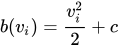
We know that if player has private valuation , then they will bid 0; . We can use this to show that the constant of integration is also 0.


Thus, we get .

Since this function is indeed monotone increasing, this bidding strategy constitutes a Bayesian-Nash Equilibrium. The revenue from the all-pay auction in this example is

Since are drawn iid from Unif[0,1], the expected revenue is

.
![{\displaystyle \mathbb {E} [R]=\mathbb {E} [{\frac {v_{1}^{2}}{2}}+{\frac {v_{2}^{2}}{2}}]=\mathbb {E} [v^{2}]=\int \limits _{0}^{1}v^{2}dv={\frac {1}{3}}}](https://wikimedia.org/api/rest_v1/media/math/render/svg/8a69b7e2229b277e72bccf4808e61c7dadce1f5c)
Due to the revenue equivalence theorem, all auctions with 2 players will have an expected revenue of when the private valuations are iid from Unif[0,1].[6]

Examples
Consider a corrupt official who is dealing with campaign donors: Each wants him to do a favor that is worth somewhere between $0 and $1000 to them (uniformly distributed). Their actual valuations are $250, $500 and $750. They can only observe their own valuations. They each treat the official to an expensive present - if they spend X Dollars on the present then this is worth X dollars to the official. The official can only do one favor and will do the favor to the donor who is giving him the most expensive present.
This is a typical model for all-pay auction. To calculate the optimal bid for each donor, we need to normalize the valuations {250, 500, 750} to {0.25, 0.5, 0.75} so that IPV may apply.
According to the formula for optimal bid:

The optimal bids for three donors under IPV are:



To get the real optimal amount that each of the three donors should give, simply multiplied the IPV values by 1000:



This example implies that the official will finally get $375 but only the third donor, who donated $281.3 will win the official's favor. Note that the other two donors know their valuations are not high enough (low chance of winning), so they do not donate much, thus balancing the possible huge winning profit and the low chance of winning.
References
- ^ Jehiel P, Moldovanu B (2006) Allocative and informational externalities in auctions and related mechanisms. In: Blundell R, Newey WK, Persson T (eds) Advances in Economics and Econometrics: Volume 1: Theory and Applications, Ninth World Congress, vol 1, Cambridge University Press, chap 3
- ^ Gneezy, Uri; Smorodinsky, Rann (2006). "All-pay auctions—an experimental study". Journal of Economic Behavior & Organization. 61 (2): 255–275. doi:10.1016/j.jebo.2004.09.013.
- ^ Dimitri, Nicola (29 November 2011). "MIRROR REVELATION" IN SECOND-PRICE TULLOCK AUCTIONS. SIDE - ISLE 2011 - Seventh Annual Conference.
- ^ Chatterjee, Krishnendu; Reiter, Johannes G.; Nowak, Martin A. (2012). "Evolutionary dynamics of biological auctions". Theoretical Population Biology. 81 (1): 69–80. doi:10.1016/j.tpb.2011.11.003. PMC 3279759. PMID 22120126.
- ^ a b 경매: 이론 및 실습: 툴루즈 경제학 강의; 폴 클렘페러; 누필드 칼리지, 옥스퍼드 대학교, 프린스턴 대학교 출판부, 2004
- ^ 알고리즘 게임 이론. 바지라니, 비제이 5세; 니산, 노암; 러프가든, 팀; 타도스, 에바; 영국 케임브리지: 케임브리지 대학 출판부, 2007. http://www.cs.cmu.edu/~sandholm/cs15-892F13/알고리즘 게임 이론.pdf에서 사전 인쇄 완료


