백악기 전기 메가랍토라스 수각류 공룡속
후쿠이랍토르 후쿠이 의 도끼)는 백악기 전기 ([1] 바레미아 또는 압티안)의 중형 수각류 공룡이다.후쿠이랍토르 는 기타다니층 [2] [3] 세바야시층 으로도 알려져 있다.
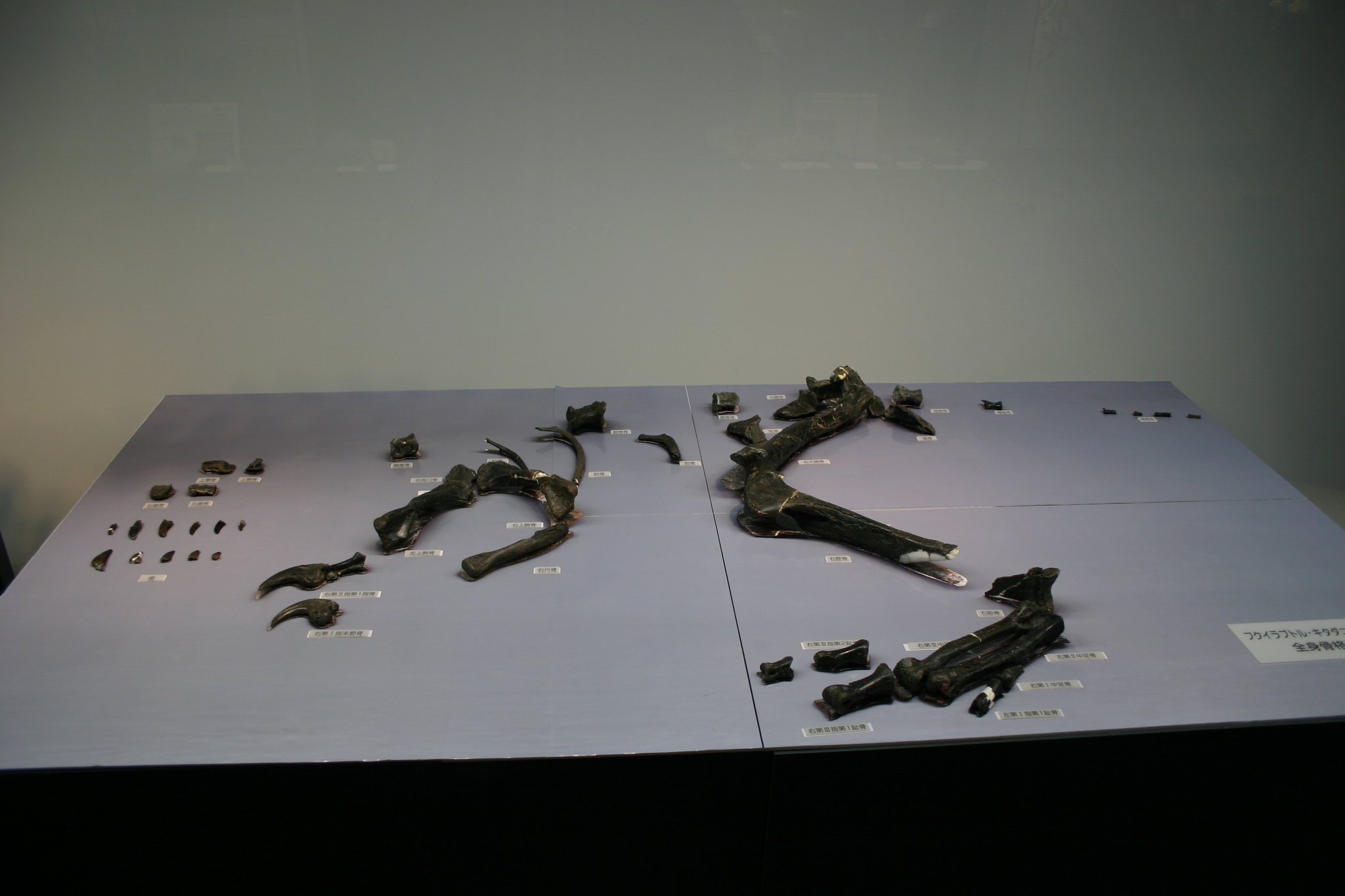
설명 및 이력 모식표본 은 후쿠이현 가쓰야마 부근의 기타다니 채석장에서 발견된 부분골격(FPDM-V97122 )이다.이 표본은 성숙하지 않았고 성체가 더 컸을 것으로 생각된다. 많은 다른 개체들의 유해가 채석장에서 발견되었고, 수많은 상완골, 대퇴골, 이빨이 이 [2] 그러나 같은 지역에서 발견된 다른 개체들은 대부분 완모식표본보다 작은 어린 개체들이다(Currie & Azuma, 2006). 완모식표본 크기의 4분의 1도 안 되는 가장 작은 경우이다. 세바야시 층 의 대기업 블록에서 발견된 치아(NDC-P0001)도 [4] 후쿠이랍토르 에 언급되었다.가느다란 지골에서 알 수 있듯이,[1] 후쿠이랩터 는 성숙함에 상관없이 비교적 가벼운 체격의 동물이었다. 2010년에 Gregory Paul은 길이 5m(16피트)와 무게 300kg(660파운드)[5] Molina-Pérez와 Larramendi는 [6]
후쿠이랍토르 의 독특한 이빨은 카르카로돈토사우루스과 (매우 압축되어 있고 칼날처럼 생겼으며, 에나멜이 주름져 있음)와 티라노사우루스과([2] 완모식표본은 또한 매우 크고 평평한 수동 웅얼(손발톱)을 가지고 있었는데, 이것은 초기 분류에서 드로마에오사우루스과([7]
분류 처음 발견되었을 때 드로마에사우루스과 의 일종으로 여겨졌던 초기 기술자들은 알로사우루스와 관련 카르노사우루스 로 간주했다. 더 최근의 연구들은 이것을 네오베나토르과 의 [7] 하지만, 더 최근에, 또 다른 분석 은 모든 메가랩토란들이 실제로 티라노사우루스류라고 제안했는데, 이것은 후쿠이랍토르 를 티라노사우루스류 실루로사우루스 로 [8] 최근 수각류 후쿠이랍토르 와 다른 메가랍토란류는 알로사우로이드 또는 비티라노사우로이드 기저 실루로사우루스류이다.[9]
아래는 2018년 [10]
메가랍토라 후쿠이랍토르
메가랍토리과
고생태학 일본 기타다니층 공룡의 비-아바리아 공룡의 지층학적 위치. 후쿠이랍토르 의 화석이 [1] 기타다니층 에서는 다른 척추동물의 화석이 보존되고 있다.제대로 이름을 설명한 것 종류로는 Fukuisaurus tetoriensis,[11]styracostern 조반류의, Fukuititan nipponensis,[12] titanosauriform인 용각류 동물, Koshisaurus katsuyama,[13]hadrosauroid ornithischian, Fukuivenator paradoxus,[14] maniraptoriform theropod, Fukuipteryx prima,[15]avialan로 정한.작가들.
외부 링크 레퍼런스 ^ a b c Azuma, Yoichi; Philip J., Currie (2000). "A new carnosaur (Dinosauria: Theropoda) from the Lower Cretaceous of Japan". Canadian Journal of Earth Sciences . 37 (12): 1735–1753. Bibcode :2000CaJES..37.1735A . doi :10.1139/e00-064 . ^ a b c Currie, P.J.; Azuma, Y. (2006). "New specimens, including a growth series, of Fukuiraptor (Dinosauria, Theropoda) from the Lower Cretaceous Kitadani Quarry of Japan" . J. Paleont. Soc. Korea . 22 (1): 173–193 – via ResearchGate. ^ "A tooth of Fukuiraptor aff. F. kitadaniensis from the Lower Cretaceous Sebayashi Formation, Sanchu Cretaceous, Japan: 東京学芸大学リポジトリ" . ir.u-gakugei.ac.jp . Retrieved 9 October 2020 .^ Molnar, Ralph E.; Obata, Ikuwo; Tanimoto, Masahiro; Matsukawa, Masaki (2009). "A tooth of Fukuiraptor aff. F. kitadaniensis from the Lower Cretaceous Sebayashi Formation, Sanchu Cretaceous, Japan" . Bulletin of Tokyo Gakugei University, Division of Natural Sciences . 61 : 105–117 – via ResearchGate. ^ Paul, Gregory S. (2010). The Princeton Field Guide to Dinosaurs . New Jersey: Princeton University Press. p. 98. ^ Molina-Pérez & Larramendi (2016). Récords y curiosidades de los dinosaurios Terópodos y otros dinosauromorfos . Barcelona, Spain: Larousse. p. 263. ^ a b Benson, R. B. J.; Carrano, M. T.; Brusatte, S. L. (2010). "A new clade of archaic large-bodied predatory dinosaurs (Theropoda: Allosauroidea) that survived to the latest Mesozoic" . Naturwissenschaften . 97 (1): 71–78. Bibcode :2010NW.....97...71B . doi :10.1007/s00114-009-0614-x . PMID 19826771 . S2CID 22646156 . ^ Novas, F. E.; Agnolín, F. L.; Ezcurra, M. D.; Canale, J. I.; Porfiri, J. D. (2012). "Megaraptorans as members of an unexpected evolutionary radiation of tyrant-reptiles in Gondwana" . Ameghiniana 49 (4(R): Suplemento Resúmenes [Abstracts]): R33. ^ Apesteguía, Sebastián; Smith, Nathan D.; Valieri, Rubén Juárez; Makovicky, Peter J. (13 July 2016). "An Unusual New Theropod with a Didactyl Manus from the Upper Cretaceous of Patagonia, Argentina" . PLOS ONE . 11 (7): e0157793. Bibcode :2016PLoSO..1157793A . doi :10.1371/journal.pone.0157793 ISSN 1932-6203 . PMC 4943716 PMID 27410683 . ^ Delcourt, Rafael; Grillo, Orlando Nelson (15 December 2018). "Tyrannosauroids from the Southern Hemisphere: Implications for biogeography, evolution, and taxonomy" . Palaeogeography, Palaeoclimatology, Palaeoecology . 511 : 379–387. doi :10.1016/j.palaeo.2018.09.003 . ISSN 0031-0182 . ^ Kobayashi, Yoshitsugu; Azuma, Yoichi (11 April 2003). "A new iguanodontian (Dinosauria: Ornithopoda) from the Lower Cretaceous Kitadani Formation of Fukui Prefecture, Japan" . Journal of Vertebrate Paleontology . 23 (1): 166–175. doi :10.1671/0272-4634(2003)23[166:anidof]2.0.co;2 . ISSN 0272-4634 . ^ Azuma, Yoichi; Shibata, Masateru (2010). "Fukuititan nipponensis, A New Titanosauriform Sauropod from the Early Cretaceous Tetori Group of Fukui Prefecture, Japan" . Acta Geologica Sinica - English Edition . 84 (3): 454–462. doi :10.1111/j.1755-6724.2010.00268.x . ISSN 1755-6724 . ^ "New basal hadrosauroid (Dinosauria: Ornithopoda) from the Lower Cretaceous Kitadani Formation, Fukui, central Japan" (PDF) . Zootaxa .^ Azuma, Yoichi; Xu, Xing; Shibata, Masateru; Kawabe, Soichiro; Miyata, Kazunori; Imai, Takuya (23 February 2016). "A bizarre theropod from the Early Cretaceous of Japan highlighting mosaic evolution among coelurosaurians" . Scientific Reports . 6 (1): 20478. doi :10.1038/srep20478 . ISSN 2045-2322 . PMC 4763874 ^ Imai, Takuya; Azuma, Yoichi; Kawabe, Soichiro; Shibata, Masateru; Miyata, Kazunori; Wang, Min; Zhou, Zhonghe (14 November 2019). "An unusual bird (Theropoda, Avialae) from the Early Cretaceous of Japan suggests complex evolutionary history of basal birds" . Communications Biology . 2 (1): 1–11. doi :10.1038/s42003-019-0639-4 . ISSN 2399-3642 .


.jpg)


.jpg)


.png)


.jpg)