
홀리 랜스
Holy Lance
롱기누스의 창(성 롱기누스의 이름에서 따온 것), 운명의 창, 또는 성창은 예수가 십자가에 못박히는 동안 십자가에 매달려 옆구리를 찔렀다고 주장되는 창입니다. 예수 수난곡의 다른 악기들과 마찬가지로, 창은 기독교 성경에서 잠깐 언급될 뿐이지만, 나중에 중세 교회에서 성경 외 전통의 주제가 되었습니다. 랜스로 추정되는 유물들은 6세기에, 원래 예루살렘에서 나타나기 시작했습니다. 중세 후기까지 유럽 전역에서 성 랑스의 선봉장으로 확인된 유물(또는 그 조각들)이 묘사되었습니다. 이 유물들 중 몇몇은 지금까지도 보존되어 있습니다.
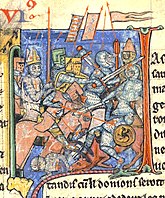
성스러운 랜스 유물은 일반적으로 종교 의식에 사용되었지만 때로는 전투에서 승리하는 것을 보장하는 것으로 간주되기도 했습니다. 예를 들어, 파울러의 랜스는 리아드 전투에서 승리한 것으로 인정받았으며, 십자군은 그들이 발견한 홀리 랜스가 안티오키아 공성전에서 유리한 결말을 가져왔다고 믿었습니다. 그러나 많은 분쟁에서 창 유물을 보유한 군대나 정부는 대신에 사산의 예루살렘 정복, 콘스탄티노플 약탈, 뮐도르프 전투, 프랑스 혁명과 같이 패배했습니다.
현대 시대에 가장 눈에 띄는 성 랑스 유물은 독특한 금으로 된 커프로 장식된 비엔나의 유물이었습니다. 이 랜스 버전은 호프부르크에 있는 제국 레갈리아의 나머지 지역과 함께 공개 전시되고 있습니다. "운명의 창"이라는 제목의 1960년 신문 기사는 나치 독일이 1938년 제국 레갈리아를 점령하여 아돌프 히틀러가 신비한 의식에서 성 랜스를 사용할 수 있도록 했다고 주장했습니다.[1] 그 이후로 호프버그 창은 대중문화에서 선과 악을 위해 그 힘이 사용될 수 있는 마법의 부적으로 재창조되었습니다.[2]
성서참고문헌
창(그리스어: λόγχη, 롱크 ē)은 요한 복음서에 언급되어 있지만 시놉틱 복음서에는 언급되어 있지 않습니다. 복음서에는 로마인들이 예수님의 다리를 부러뜨리려고 계획했다고 쓰여 있는데, 이 관행은 십자가에 못박히는 동안 죽음을 재촉하는 방법이었습니다. 안식일 전날(금요일 해가 지고 토요일 해가 지는 날)이었기 때문에 예수님의 추종자들은 안식일 율법 때문에 예수님을 '죽여야' 했습니다. 그들이 그렇게 하기 바로 전에, 그들은 예수님이 이미 돌아가셨고, 그의 다리를 부러뜨릴 이유가 없다는 것을 알아차렸습니다. "그리고 어떠한 뼈도 부러지지 않을 것입니다."[4][a] 그가 죽었는지 확인하기 위해 로마 병사(성경 외 전통에서 롱기누스로 명명됨)가 그의 옆구리를 찔렀습니다.
병사 중 한 명이 창(λόγχη)으로 옆구리를 뚫었고, 곧바로 피와 물이 나왔습니다.
롱기누스

외톨이 ē로 그리스도의 옆구리를 뚫은 병사의 이름은 요한복음에 없지만, 전설에 대한 가장 오래된 알려진 언급인, 4세기 빌라도 율법의 후기 사본에 첨부된 니코데무스 복음서, 이 병사는 백부장으로 밝혀져 롱기누스(창의 라틴어 이름인 란사 롱기니)라고 불립니다.[5]: 6–8 [6]: 73
롱기누스라는 이름의 한 형태는 586년 라불라 복음서에서 나타납니다. 한 미니어처에 λ ο γ ι ν ο ς ς(LoginOS)이라는 이름이 창을 그리스도 옆으로 내밀고 있는 군인의 머리 위에 쓰여져 있습니다. 비문이 나중에 추가된 것이 아니라면, 이것은 이름에 대한 가장 초기의 기록 중 하나입니다.[7]
유물
적어도 네 개의 주요 유물은 성 랜스 또는 그 일부라고 주장됩니다. 그들은 로마, 비엔나, 바자르샤파트, 안티오키아에 위치해 있습니다.
로마

바티칸 시국의 성 베드로 대성전에 성 롱기누스 상 위 기둥에 새겨진 로고 속에 성 랑스 유물이 보존되어 있습니다.[8][9]
홀리 랜스 유물에 대한 가장 초기의 언급은 6세기로 거슬러 올라갑니다. 예루살렘 수도회(약 530년)는 성묘교회에 전시된 랜스에 대해 설명하고 있습니다.[10]: 14 [5]: 57 카시오도루스는 그의 전시회 살모룸([11]: xv, 131–136 약 540-548)에서 예루살렘에 창이 계속 존재한다고 주장합니다.[12] 피아첸차 순례자(ca. 570년경)의 보고서에 따르면 창은 시온 교회에 있습니다.[13]: 18 [14] 투르의 그레고리우스는 그의 Libri Miraculorum (약 574-594)에서 열정의 창과 다른 유물들을 묘사했습니다.[15][16]: 24
614년, 예루살렘은 사산 장군 샤흐르바라즈에게 함락되었습니다.[17]: 156 크로니콘 파스칼레는 성 랜스가 포획된 유물 중 하나라고 말하지만, 샤흐르바라즈의 동료 중 한 명이 니케타스에게 주었고 그 해 말 콘스탄티노플의 하기아 소피아 성당으로 가져갔습니다.[17]: 157 [18]: 56 그러나 670년 아르쿨프의 성지순례를 묘사한 성녀성전은 예루살렘에 있는 창을 성묘교회에 배치합니다.[19]: 12 중세 순례자들 중 마지막으로 예루살렘에서 랜스를 보고한 사람이 아르컬프인데, 윌리발드와 베르나르가 랜스에 대해 언급하지 않았기 때문입니다.[20]: 39
10세기 중반까지 콘스탄티노플의 파로스 처녀 교회에서 창 유물이 숭배되었습니다.[21]: cols. 421-423 [18]: 58 [22]: 35 이 유물은 제1차 십자군 전쟁에 참가한 군인과 성직자들 중 일부가 본 것으로 보이며, 1098년 안티오키아에서 또 다른 신성한 랜스가 출현한 것을 둘러싼 혼란을 가중시켰습니다.[23]: 200 트리폴리 공성전에서 툴로스의 레이몽은 안티오키아의 랜스를 콘스탄티노플로 데려왔고, 그것을 알렉시오스 1세 콤네노스 황제에게 바쳤다고 합니다.[24]: 185 [18]: 59–60 학자들은 이 어색한 상황이 어떻게 해결되었는지에 대해 의견이 다릅니다. 스티븐 룬시만은 비잔티움 궁정이 안티오키아 유물을 못(ἧλος)으로 간주해 레이먼드가 그리스어를 모르는 것을 이용해 그에게 불쾌감을 주지 않았다고 주장했습니다. 또는 에드가 로버트 애쉬튼 세터는 알렉시오스가 십자군의 창을 사기극으로 비난하려 한다고 믿었고,[25]: 526 이는 1108년[18]: 58 안티오키아의 보헤몽 1세 왕자가 다른 창에서 그에게 맹세를 강요했을 때 이루어졌다고 생각했습니다.[25]: 397 알렉시오스가 안티오키아 랜스를 보관했는지 아니면 레이먼드에게 돌려주었는지는 확실하지 않습니다.[23]: 205–206 여러 12세기 문서에는 콘스탄티노플의 유물 중 하나가 십자군의 발견물이나 비잔틴 창으로 식별할 수 있는 세부 정보 없이 하나의 성 랑스였다고 나와 있습니다.[26][27][28][29]: 381 [30]: 97–98
트로이 폰테인의 알베리크에 따르면, 1204년 알렉시오스 5세 두카스가 플랑드르의 헨리와 전투에서 패배한 아이콘에 신성한 랜스의 조각이 새겨져 있다고 합니다.[31]: 302–303 헨리의 군대에 의한 이 아이콘의 포획은 제4차 십자군에 관한 많은 현대 자료들에게 중요한 것으로 여겨졌습니다.[32]: 90, n.89 In addition to the crusaders' report to Pope Innocent III,[33]: 103 the incident was documented by Geoffrey of Villehardouin,[34]: 85–86 the Devastatio Constantinopolitana,[35]: 220 Niketas Choniates,[36]: 312 Robert de Clari,[32]: 88–91 Ralph of Coggeshall,[37]: 285 and Robert of Auxerre.[38]: 270 그러나 이 자료들 중 어떤 것도 유물이 들어있는 도상에 대해 언급하지 않는 반면, 알베리크는 그것이 창 조각, 예수의 낙엽이 지는 치아 중 하나인 성 슈라우드의 일부, 그리고 30명의 순교자들의 다른 유물로 장식되었다고 주장했습니다.[31]: 302 현대 역사학자들은 알버릭의 이야기를 "화려하고"[39]: 122, n.3 "순수한 발명품"이라고 특징 지으면서 다소 회의적인 시각을 갖고 있습니다.[40]: 278–279, n.128 어쨌든 전투가 끝난 후 십자군은 이 아이콘을 î 수도원에 보냈지만, 그 목적지에 도달했는지에 대한 기록은 없습니다.

콘스탄티노플의 함락 이후, 로베르 드 클라리는 파로스의 처녀 교회에서 "우리 주님이 옆구리를 뚫은 창의 쇠"를 포함하여 새로 설립된 라틴 제국이 획득한 전리품에 대해 설명했습니다.[32]: 103 그러나 1230년대에 이르러 라틴 제국의 재정 상태는 절망적이었습니다.[41]: 307 [42]: 134 1239년 볼드윈 2세는 콘스탄티노플의 면류관 유물을 프랑스 왕 루이 9세에게 팔 것을 주선했습니다.[41]: 307-308 그 후 몇 년 동안 볼드윈은 총 22점의 유물을 루이에게 팔았습니다.[18]: 62 [42] 성 랑스호는 최종 구역에 포함되었는데, 아마도 1242년에 파리에 도착했을 것입니다.[41]: 307 [43]: 108 이 모든 유물들은 나중에 생트 샤펠에 안치되었습니다. 프랑스 혁명 기간 동안 그들은 Bibliothèque Nationale로 옮겨졌지만, 그 후 창은 사라졌습니다.[7]
Despite the transfer of the Holy Lance to Paris, various travelers continued to report its presence in Constantinople throughout the late Byzantine period.[44]: 88 [45]: 10–11 [46]: 132 [47]: 160 [48]: 43 [49]: 86 [50]: col. 701 [51]: 11 [52]: 140 [53]: 222 특히 존 맨드빌은 파리와 콘스탄티노플의 랜스 유물을 묘사하면서, 후자가 전자보다 훨씬 더 컸다고 말했습니다.[45]: 10–11 만데빌의 여행기의 진위는 의심스럽지만,[54] 이 작품의 광범위한 인기는 다수의 홀리 랜스 유물의 존재가 대중의 지식이었음을 보여줍니다.[55]: 75

창을 포함한 콘스탄티노플에 남아있는 유물은 1453년 술탄 메흐메드 2세가 이 도시를 정복했을 때 탈취한 것으로 추정됩니다. 1492년, 그의 아들 바예지드 2세는 교황 인노첸시오 8세에게 자신의 형제이자 경쟁자인 쳄을 계속 죄수로 두도록 격려하기 위해 창을 보냈습니다.[56]: 311–318 [7] 요한 부르샤르가 기록한 바와 같이, 그 진위에 대한 커다란 의심이 로마에서 느껴졌는데,[57] 이는 파리, 뉘른베르크, 아르메니아(아래 빈의 성 랑스 참조)에 다른 경쟁 랑스가 존재했기 때문입니다.[7] 이 유적은 그 이후로 로마를 떠난 적이 없으며, 그곳의 안식처는 성 베드로입니다.[7] 안토니오 델 폴라이우올로(Antonio del Pollaiuolo)가 만든 인노첸시오의 무덤에는 교황이 바예지드(Bayezid)로부터 받은 창날을 들고 있는 청동 조각상이 있습니다.[56]: 321
18세기 중반 교황 베네딕토 14세는 성 샤펠 랑스를 성(聖)의 창과 비교하기 위해 정확한 그림을 얻었다고 말했습니다. 피터의 것. 그는 전자의 유물이 후자에서 빠진 부서진 지점이며, 두 조각이 원래 하나의 칼날을 형성했다고 결론 내렸습니다.[58]: 323
-
-
 1898년 로마의 성 랑스 그림


비엔나
비엔나의 성 랑스는 제국 재무부 또는 Weltliche Schatzkammer(불이 켜진)에 전시되어 있습니다. 오스트리아 빈의 호프부르크 궁전에 있는 세속 보물실).[59] 카롤링거 왕조의 전형적인 날개 달린 창입니다.[59] 다른 시대에는 성 모리스의 창이나 콘스탄티누스 대제의 창이라고 했습니다.[60]: 177, 181 [59] 오토 1세 (912–973) 시대의 소식통에 따르면, 10세기에 신성 로마 황제들이 창을 소유하게 되었다고 합니다.[60]: 178 1000년에 오토 3세는 폴란드의 볼레스와프 1세에게 그니에즈노 회의에서 신성한 랑스의 복제품을 주었습니다.[61]: 351 [62][60]: 178 f.7 1084년 헨리 4세는 은빛 띠에 "우리 주님의 못"이라는 글씨가 추가되었습니다. 이것은 창끝에 박힌 못이 예수의 십자가 처형에 사용되었던 못이라는 믿음에 근거한 것입니다.[60]: 181 13세기에 이르러서야 랜스는 그리스도의 옆구리를 뚫는 데 사용되어 그리스도의 피와 물에 흠뻑 젖은 롱기누스의 것과 동일시되었습니다.[59]
1273년, 성 랑스는 대관식에 처음으로 사용되었습니다. 1350년경, 찰스 4세는 은색 소매 위에 Lanca et clavus Domini (주님의 랜스와 못)이라고 새겨진 금색 소매를 입었습니다.[63]: 5 1424년 지기스문트는 창을 포함한 유물 소장품을 프라하의 수도에서 그의 생가인 뉘른베르크로 옮겼고, 그것들을 그곳에 영원히 보관할 것을 명령했습니다.[63]: 7–8 이 컬렉션은 임페리얼 레갈리아(Reichskleinodien)라고 불렸습니다.[63]
1796년 봄, 프랑스 혁명군이 뉘른베르크에 접근했을 때, 지방 당국은 제국의 레갈리아를 제국의회 의장 요한 알로이스 폰 휘겔에게 넘겼습니다.[64]: 18–19 [65]: 732 폰 휘겔 남작은 레갈리아를 안전하게 지키기 위해 라티스본으로 데려갔지만, 1800년에 그 도시도 침략의 위협을 받고 있었기 때문에 그들을 다시 파사우, 린츠, 빈으로 옮겼습니다.[64] 1805년 프랑스인들이 비엔나에 들어섰을 때, 컬렉션은 헝가리로 다시 옮겨졌고, 결국 비엔나로 돌아갔습니다.[65]: 732 [64]: 19 신성 로마 제국의 해체 계획 속에서 레갈리아의 지위가 해결되지 않았기 때문에 이러한 운동은 비밀리에 진행되었습니다. 뉘른베르크가 나중에 리갈리아의 반환을 호소했을 때, 오스트리아 제국은 이 도시의 요청을 쉽게 일축했습니다.[65]: 732
쿤스트히스토리시스 박물관은 랜스의 연대를 8세기로 추정하고 있습니다.[59] 영국의 야금학자이자 기술 공학 작가인 로버트 페더는 2003년 1월 다큐멘터리를 위해 그것을 시험했습니다.[66][67] 그는 X선 회절, 형광 검사 및 기타 비침습적인 절차를 기반으로 창 본체의 연대를 빨라도 7세기로 추정했습니다.[67] 페더는 같은 다큐멘터리에서 오랫동안 십자가에 못박혀 칼날에 망치질을 하고 작은 놋쇠 십자가에 의해 부러진 쇠 핀이 서기 1세기 로마 시대의 못과 길이와 모양이 "일관적"이라고 말했습니다.[67]
얼마 지나지 않아, 비엔나 고고학을 위한 학제간 연구소의 연구원들은 엑스레이와 다른 기술을 사용하여 다양한 랜스를 조사했고, 비엔나 랜스의 연대는 8세기경부터 9세기 초까지이며, 손톱은 분명히 같은 금속으로 되어 있다고 결정했습니다. 서기 1세기로 거슬러 올라갈 가능성을 배제했습니다.[68]
-

-

-
 성스러운 랜스에 새겨진 글
-3-2.jpg)


Vagharshapat

성 랑스는 아르메니아의 종교 수도인 바하르샤파트(이전에는 에흐미아딘으로 알려져 있음)에 보존되어 있습니다. 그것은 이전에 게하르트 수도원에서 열렸습니다.그것을 언급하는 첫 번째 자료는 13세기 아르메니아 사본에 있는 우리 주 예수 그리스도의 성스러운 유물입니다. 이 본문에 따르면 예수를 찌른 창은 사도 타데우스가 아르메니아로 가져왔다고 합니다. 필사본에는 보관 장소가 정확히 명시되어 있지 않지만, 성유물에는 랜스, 수도원 문(정확히는 13세기 이후), 게하라방크(성란의 수도원)의 이름과 정확히 일치하는 설명이 나와 있습니다.[69]: 254–256
1655년, 프랑스 여행가 장 밥티스트 타베르니에는 아르메니아에서 이 유물을 본 최초의 서양인이었습니다. 1805년, 러시아인들은 그 수도원을 점령했고 그 유적은 조지아 트빌리시의 치차노프 게하르트로 옮겨졌습니다.[70]
그것은 나중에 아르메니아로 돌아왔고, 지금도 17세기 유물에 안치된 바자르샤파트에 있는 마누기안 박물관에 전시되고 있습니다. 매년 사도성전 기념일에. 타데우스와 성 바르톨로메우는 그 유물을 예배를 위해 가지고 나옵니다.[71]
안티오키아

1098년 6월 안티오키아 공성전에서 피터 바르톨로뮤라는 승려가 자신이 성자의 환영을 받았다고 보고했습니다. 앤드류는 그에게 성 랜스가 성 교회에 묻혔다고 말했습니다. 안티오키아의 피터.[72]: 241–243 바르톨로뮤는 성당을 한참 파다가 창을 발견했다고 합니다.[72]: 243–245 르 푸이의 교황 특사 아드메마르를 포함한 많은 사람들의 의심에도 불구하고, 많은 십자군은 창을 발견한 것이 포위망을 깨고 도시를 확보한 안티오키아 전투에서 승리한 것이라고 생각했습니다.[72]: 247–249, 253–254 [22]: 34–35
총대주교 크리스토퍼의 전기와 같은 그리스 정교회 자료에 따르면 성 랑스로 생각되는 유적이 성 교회의 보물 중 하나였다고 합니다. 빠르면 10세기에 피터.[73] 역사학자 클라우스-피터 토트는 이 유물이 1084년 셀주크 세력으로부터 감추기 위해 묻혔을 수도 있다고 주장했고, 1098년 십자군이 이 유물을 찾을 수 있도록 했습니다.[74]: 99
문학
.jpg)
성스러운 랜스는 크레티엔 드 트로이의 성배 이야기인 12세기 미완성 로맨스 퍼셉트에 묘사된 피 흘리는 랜스와 혼동되었습니다.[75]: 1–2 이 이야기는 또한 피 흘리는 창과 같은 것을 의도할 수도 있고 의도하지 않을 수도 있는 피셔 킹을 다치게 한 자벨로트를 언급합니다.[75]: 3 [76] 크레티엔은 어떤 기독교 전통과도 일치하지 않는 피 흘리는 창에 초자연적으로 파괴적인 힘을 부여합니다.[75]: 2, 6–7, 11–13, 17 그럼에도 불구하고 크레티앵의 시의 연속은 피 흘리는 창을 요한 19:34의 창과 동일시함으로써 피 흘리는 창의 신비를 설명하고자 했습니다.[75]: 14–15 [5]: 166 [77]: 79
볼프람 폰 에셴바흐는 크레티엔의 지각을 독일 서사시 파르지발로 각색했습니다.[78][79] 볼프람은 크레티앵과 마찬가지로 피 흘리는 창을 롱기누스의 창과는 쉽게 화해할 수 없는 방식으로 묘사합니다.[75]: 5 파르지발은 1882년 리하르트 바그너의 오페라 파르시팔의 주요 소스가 되었는데, 이 오페라에서 피셔 킹은 예수의 옆구리를 관통한 창에 의해 부상을 당합니다.[80]: 1, 16–20
참고 항목
- 성찬 – 예수님께서 마지막 만찬에서 포도주를 대접할 때 사용하신 그릇
- 성스러운 스폰지 – 예수 그리스도의 열정의 도구
- 에데사의 이미지 – 예수 그리스도의 얼굴을 그린 그림
- 예수님의 이음새 없는 법복 – 예수님이 십자가에 못박히기 직전에 입었다고 전해지는 법복
- 진정한 십자가 – 예수가 십자가에 못박힌 십자가
설명주
- ^ 이 구절은 의인에 관한 시편 34장 20절과 출애굽기 12장 46절과 숫자 9장 12절에 나오는 파스칼 양에 관한 계명을 언급한 것입니다.
인용문
- ^ Caulfield, Max (6 November 1960). "The Spear of Destiny: How Hitler lived by the weapon thrust into Christ". Sunday Dispatch. London. Retrieved 4 March 2024 – via Newspapers.com.
- ^ Schier, Volker; Schleif, Corine (2005). "Die heilige und die unheilige Lanze. Von Richard Wagner bis zum World Wide Web" [The Holy and the Unholy Lance. From Richard Wagner to the World Wide Web]. Die Heilige Lanze in Wien: Insignie, Reliquie, "Schicksalsspeer" [The Holy Lance in Vienna: Insignia, Relic, "Spear of Destiny"] (in German). Vienna: Kunsthistorisches Museum. pp. 110–143. Retrieved 27 July 2023 – via Academia.edu.
- ^ 요한 19:31-37
- ^ 요한복음 19장 36절
- ^ a b c Peebles, Rose Jeffries (1911). The Legend of Longinus in Ecclesiastical Tradition and in English Literature, and its connection with the Grail. Baltimore: J. H. Furst. Retrieved 29 July 2023 – via The Internet Archive.
- ^ Hone, William (1926). The Lost Books of the Bible: being all the gospels, epistles, and other pieces now extant attributed in the first four centuries to Jesus Christ, His apostles and their companions, not included, by its compilers, in the authorized New Testament; and, the recently discovered Syriac mss. of Pilate's letters to Tiberius, etc. New York: Alpha House. Retrieved 27 July 2023 – via Internet Archive.
- ^ a b c d e Thurston, Herbert (1910). . Catholic Encyclopedia. Vol. 8.
- ^ Olivié, Antonio (2017). "In the Footsteps of Christ in Rome". Jerusalem Cross: Annales Ordinis Equestris Sancti Sepulchri Hierosolymitani. Vatican City: Grand Magisterium of the Equestrian Order of the Holy Sepulchre of Jerusalem. pp. 64–65. Archived (PDF) from the original on 4 May 2022. Retrieved 8 August 2023.
- ^ Kuhn, Albert (1916). Roma: Ancient, Subterranean, and Modern Rome. New York: Benziger Brothers. Retrieved 8 August 2023 – via Google Books.
- ^ "The 'Breviary'; or, Short Description of Jerusalem". The Epitome of S. Eucherius about Certain Holy Places (circ. A.D.440), and the Breviary or Short Description of Jerusalem (circ. A.D. 530). The Library of the Palestine Pilgrims' Text Society. Vol. II. Translated by Stewart, Aubrey. London: Palestine Pilgrims' Text Society. 1897. pp. 13–16. Retrieved 3 February 2024 – via Internet Archive.
- ^ O'Donnell, James J. Cassiodorus. Berkeley: University of California. ISBN 0-520-03646-8. Retrieved 3 February 2024 – via Internet Archive.
- ^ Cassiodorus, Magnus Aurelius (1865). "Expositio Psalmum LXXXVI" [Explanation of Psalm 86]. In Migne, Jacques Paul (ed.). Patrologia Latina (in Latin). Vol. LXX. Paris: Jacques Paul Migne. col. 621 – via Internet Archive.
Ibi manet lancea, quae latus Domini transforavit, ut nobis illius medicina succurreret.
[There [Jerusalem] remains the lance which pierced the Lord's side, that his medicine might help us.] - ^ Piacenza pilgrim (1887). Wilson, C. W. (ed.). Of the Holy Places Visited by Antoninus Martyr (Circ. 560–570 A.D.). Library of the Palestine Pilgrims' Text Society. Translated by Stewart, Aubrey. London: Palestine Pilgrim's Text Society. Retrieved 3 February 2024.
- ^ "The Piacenza Pilgrim". Andrew S. Jacobs, Ph.D. Translated by Jacobs, Andrew S. Archived from the original on 6 January 2024. Retrieved 3 February 2024.
- ^ Gregory of Tours (1879). "Libri Miraculorum" [Book of Miracles]. In Migne, Jacques Paul (ed.). Patrologia Latina (in Latin). Vol. LXXI. Paris: Jacques Paul Migne. col. 712 – via Internet Archive.
De lancea vero, arundine, spongia, corona spinea et columna, ad quam verberatus est Dominus et Redemptor Hierosolymis, dicendum.
[Let us speak about the lance, the reed, the sponge, the crown of thorns, and the pillar where our Lord and Redeemer was lashed, in Jerusalem.] - ^ Shanzer, Danuta (2003). "So Many Saints--So Little Time...the "Libri Miraculorum" of Gregory of Tours". The Journal of Medieval Latin. Brepols. 13: 19–60. JSTOR 45019571.
- ^ a b Chronicon Paschale 284-628 AD. Translated by Whitby, Michael; Whitby, Mary. 2007. Retrieved 4 August 2023 – via Internet Archive.
- ^ a b c d e Gastgeber, Christian (2005). "Die Heilige Lanze im byzantinischen Osten" [The Holy Lance in the Byzantine East]. In Kirchweger, Franz (ed.). Die Heilige Lanze in Wien: Insignie, Reliquie, "Schicksalsspeer" [The Holy Lance in Vienna: Insignia, Relic, "Spear of Destiny"] (in German). Vienna: Kunsthistorisches Museum. pp. 52–69.
- ^ Adomnán of Iona (1889). The Pilgrimage of Arculfus in the Holy Land (About the Year A.D. 670). Translated by MacPherson, James Rose. London: Palestine Pilgrims' Text Society. Retrieved 17 February 2024 – via Internet Archive.
- ^ De Mély, Fernand (1904). Exuviae sacrae constantinopolitanae: la croix des premiers croisés, la Sainte Lance, la Sainte Couronne [The Holy Relics of Constantinople: The Cross of the First Crusaders, The Holy Lance, The Holy Crown] (in French). Paris: Ernest LeRoux. Retrieved 17 February 2024 – via Google Books.
- ^ Constantine VII Porphyrogenitus (1897). "De cerimoniis aulae Byzantinae, Lib. I, cap. XXXIV". In Migne, Jacques Paul (ed.). Patrologiae Graeca, Vol. CXII (in Latin and Greek). Paris: Garnier. cols. 419-424. Retrieved 17 February 2024 – via Internet Archive.
- ^ a b Morris, Colin (1984). "Policy and vision: The case of the Holy Lance found at Antioch". In Gillingham, John; Holt, J. C. (eds.). War and Government in the Middle Ages: Essays in honour of J. O. Prestwich. Totowa, NJ: Boydell. pp. 33–45. Retrieved 27 July 2023 – via Internet Archive.
- ^ a b c Runicman, Steven (1950). "The Holy Lance Found at Antioch". Analecta Bollandiana. 68: 197–209. doi:10.1484/J.ABOL.4.01033. ISSN 0003-2468.
- ^ Keightley, Thomas (1852). The Crusaders; or, Scenes, Events, and Characters from the Times of the Crusades (4th ed.). London: John W. Parker. Retrieved 17 February 2024 – via Google Books.
- ^ a b Anna Comnena (2009). The Alexiad. Translated by Sewter, E. R. A. London: Penguin. Retrieved 17 February 2024 – via Internet Archive.
- ^ Riant, Paul, ed. (1878) [c. 1150]. "Relliquae Constantinopolitanae" [Relics of Constantinople]. Exuvia sacrae constantinopolitanae: fasciculus documentorum ecclesiasticorum, ad byzantina lipsana in Occidentem saeculo XIII translata, spectantium, & historiam quarti belli sacri [The Holy Relics of Constantinople: A Collection of Ecclesiastical Documents, Relating to the Byzantine Relics Transferred to the West in the 13th Century, and the History of the Fourth Crusade] (in Latin). Vol. II. Geneva. pp. 211–212. Retrieved 18 February 2024 – via Google Books.
{{cite book}}: CS1 maint: 위치 누락 게시자(링크) - ^ Nicholas of Thingeyre (1878) [1157]. "Catalogus reliquiarium C.P.". In Riant, Paul (ed.). Exuvia sacrae constantinopolitanae: fasciculus documentorum ecclesiasticorum, ad byzantina lipsana in Occidentem saeculo XIII translata, spectantium, & historiam quarti belli sacri [The Holy Relics of Constantinople: A Collection of Ecclesiastical Documents, Relating to the Byzantine Relics Transferred to the West in the 13th Century, and the History of the Fourth Crusade] (in Latin). Vol. II. Geneva. pp. 213–216. Retrieved 18 February 2024 – via Google Books.
{{cite book}}: CS1 maint: 위치 누락 게시자(링크) - ^ William of Tyre (1878) [1171]. "Historia belli sacri, XX, cap. 23." [History of the Crusade, book 20, chapter 23]. In Riant, Paul (ed.). Exuvia sacrae constantinopolitanae: fasciculus documentorum ecclesiasticorum, ad byzantina lipsana in Occidentem saeculo XIII translata, spectantium, & historiam quarti belli sacri [The Holy Relics of Constantinople: A Collection of Ecclesiastical Documents, Relating to the Byzantine Relics Transferred to the West in the 13th Century, and the History of the Fourth Crusade] (in Latin). Vol. II. Geneva. p. 216. Retrieved 18 February 2024 – via Google Books.
{{cite book}}: CS1 maint: 위치 누락 게시자(링크) - ^ William of Tyre (1943). A History of Deeds Done Beyond the Sea. Vol. II. Translated by Babcock, Emily Atwater; Krey, A. C. New York: Columbia University. Retrieved 18 February 2024 – via Internet Archive.
- ^ Anthony of Novgorod (1889). "Le Livre du Pèlerin" [The Pilgrim's Book]. In de Khitrowo, B. (ed.). Itinéraires Russes en Orient [Russian itineraries in the East] (in French). Geneva: Fick. pp. 88–111. Retrieved 21 February 2024 – via Internet Archive.
- ^ a b Alberic of Trois-Fontaines (2008). "Chronicle". In Andrea, Alfred J. (ed.). Contemporary Sources for the Fourth Crusade. Translated by Andrea, Alfred J. (Revised ed.). Leiden: Brill. pp. 291–309.
- ^ a b c d Robert de Clari (2005). The Conquest of Constantinople. Translated by McNeal, Edgar Holmes. New York: Columbia University. Retrieved 21 February 2024 – via Internet Archive.
- ^ a b c Baldwin I (2008). "The Registers of Innocent III: Reg 7:152". In Andrea, Alfred J. (ed.). Contemporary Sources for the Fourth Crusade. Translated by Andrea, Alfred J. (Revised ed.). Leiden: Brill. pp. 98–112.
- ^ Geoffrey of Villehardouin (1985). "The Conquest of Constantinople". In Shaw, M.R.B. (ed.). Chronicles of the Crusades. New York: Dorset. Retrieved 21 February 2021 – via Internet Archive.
- ^ Andrea, Alfred J., ed. (2008). "Devastatio of Constantinopolitana". Contemporary Sources for the Fourth Crusade. Translated by Andrea, Alfred J. (Revised ed.). Leiden: Brill. pp. 212–221.
- ^ Niketas Choniates (1984). O City of Byzantium, Annals of Niketas Choniates. Translated by Magoulias, Harry J. Detroit: Wayne State University. Retrieved 21 February 2024 – via Internet Archive.
- ^ Ralph of Coggeshall (2008). "Chronicle". In Andrea, Alfred J. (ed.). Contemporary Sources for the Fourth Crusade. Translated by Andrea, Alfred J. (Revised ed.). Leiden: Brill. pp. 277–290.
- ^ Robert of Auxerre (1822). "Ex Chronologia Roberti Altissiodorensis, praemonstratensis ad S. Marianum canonici". In Bouquet, Martin (ed.). Rerum Gallicarum et Francicarum Scriptores (in Latin). Vol. XVIII. Paris: De L'Imprimerie Royale. pp. 247–290. Retrieved 21 February 2024 – via Bibliothèque nationale de France.
- ^ Hendrickx, Benjamin; Matzukis, Corinna (1979). "Alexios V Doukas Mourtzouphlos: His Life, Reign, and Death (?-1204)" (PDF). Ελληνικά [Hellenika]. 31: 108–132. Retrieved 21 February 2024 – via Society for Macedonian Studies.
- ^ Queller, Donald E.; Madden, Thomas F. (1997). The Fourth Crusade: The Conquest of Constantinople (2 ed.). Philadelphia: University of Pennsylvania. Retrieved 21 February 2024 – via Internet Archive.
- ^ a b c Klein, Holger A. (2004). "Eastern Objects and Western Desires: Relics and Reliquaries between Byzantium and the West". Dumberton Oaks Papers. Dumberton Oakes. 58: 283–314. doi:10.2307/3591389. JSTOR 3591389.
- ^ a b Baldwin II (1878) [June 1247]. "Balduinus II Ludovico IX reliquas omnes S. Capella in perpetuum concedit" [Baldwin II grants to Louis IX all the relics of the Saint-Chapelle in perpetuity]. In Riant, Paul (ed.). Exuvia sacrae constantinopolitanae [Holy relics of Constantinople] (in Latin). Vol. II. Geneva. pp. 133–135. Retrieved 25 February 2024 – via Internet Archive.
{{cite book}}: CS1 maint: 위치 누락 게시자(링크) - ^ Gerard de St. Quentin (1904) [1241]. "Translatio sancte corone Domini nostri Ihesu Christi a Constantinopolitana urbe ad civitatem Parisiensem, facta anno Domini Mº CCº XLlº" [The transfer of the holy crown of our Lord Jesus Christ from the city of Constantinople to the city of Paris, made in the year of the Lord 1241]. Exuviae sacrae constantinopolitanae: la croix des premiers croisés, la Sainte Lance, la Sainte Couronne [The Holy Relics of Constantinople: The Cross of the First Crusaders, The Holy Lance, The Holy Crown]. By De Mély, Fernand (in Latin). Paris: Ernest LeRoux. pp. 102–112. Retrieved 17 February 2024 – via Google Books.
- ^ Brock, Sebastian P. (1967). "A Medieval Armenian Pilgrim's Description of Constantinople" (PDF). Revue des Etudes Armeniennes, Nouvelle Serie [Review of Armenian Studies, New Series]. 4: 81–102. Retrieved 25 February 2024 – via Union Catalog of Armenian Continuing Resources.
- ^ a b John Mandeville (1900) [ca. 1357-1371]. The Travels of John Mandeville: The version of the Cotton Manuscript in modern spelling. London: Macmillan. Retrieved 26 February 2024 – via Internet Archive.
- ^ Majeska, George P., ed. (1984). "Anonymous Description of Constantinople". Russian Travelers to Constantinople in the Fourteenth and Fifteenth Centuries. Washington, DC: Dumbarton Oaks. pp. 114–154. Retrieved 25 February 2024 – via Internet Archive.
- ^ Alexander the Clerk (1984) [1394-1395]. "Alexander the Clerk: On Constantinople". In Majeska, George P. (ed.). Russian Travelers to Constantinople in the Fourteenth and Fifteenth Centuries. Washington, DC: Dumbarton Oaks. pp. 156–165. Retrieved 25 February 2024 – via Internet Archive.
- ^ Clavijo, Ruy González de (1859) [1403-1406]. Narrative of the Embassy of Ruy Gonzalez de Clavijo to the Court of Timour at Samarcand, A.D. 1403-6. Translated by Markham, Clements R. London: Hakluyt Society – via Google Books.
- ^ Zosima the Deacon [in Russian]. "The Xenos of Zosima the Deacon". In Majeska, George P. (ed.). Russian Travelers to Constantinople in the Fourteenth and Fifteenth Centuries. Washington, DC: Dumbarton Oaks. pp. 166–195. Retrieved 25 February 2024 – via Internet Archive.
- ^ Buondelmonti, Cristoforo (1864) [ca. 1420s]. "Descriptio Urbis Constantinopoleos". In Migne, Jacques Paul (ed.). Patrologiae Graeci, Vol. CXXXIII (in Latin). cols. 695-708. Retrieved 26 February 2024 – via Google Books.
- ^ Lannoy, Ghillebert de (1878). Potvin, Charles (ed.). Oeuvres de Ghillebert de Lannoy (in French). Louvain: Lefever. Retrieved 26 February 2024 – via Bibliothèque nationale de France.
- ^ Tafur, Pedro (1926). Letts, Malcom (ed.). Travels and Adventures 1435-1439. London: George Routledge. Retrieved 26 February 2024 – via Internet Archive.
- ^ Bertrandon de la Broquière (1807) [1453]. The Travels of Bertrandon de la Broquiere, counsellor & first esquire-carver to Philippe le Bon, Duke of Burgundy, to Palestine, and his return from Jerusalem overland to France, during the years 1432 & 1433. Translated by Johnes, Thomas. Hafod Press. Retrieved 26 February 2024 – via Internet Archive.
- ^ John Mandeville. "Introduction". In Kohanski, Tamarah; Benson, C. David (eds.). The Book of John Mandeville. Kalamazoo: Medieval Institute Publications. Retrieved 27 February 2024 – via University of Rochester.
- ^ Kirchweger, Franz (2005). "Die Geschichte der Heiligen Lanze vom späteren Mittelalter bis zum Ende des Heiligen Römischen Reiches (1806)" [The History of the Holy Lance from the Late Middle Ages to the End of the Holy Roman Empire (1806)]. In Kirchweger, Franz (ed.). Die Heilige Lanze in Wien: Insignie, Reliquie, "Schicksalsspeer" [The Holy Lance in Vienna: Insignia, Relic, "Spear of Destiny"] (in German). Vienna: Kunsthistorisches Museum. pp. 71–109.
- ^ a b von Pastor, Ludwig (1901). Antrobus, Frederick Ignatius (ed.). The History of the Popes, from the Close of the Middle Ages. Vol. V (2 ed.). London: Kegan Paul, Trench, Trübner, & Co. Retrieved 4 August 2023 – via Internet Archive.
- ^ Burchard, Johann (1910). The Diary of John Burchard of Strasburg Vol. I: A.D. 1483-1492. Translated by Matthew, Arnold Harris. London: Francis Griffiths. pp. 337–339. Retrieved 7 August 2023 – via Internet Archive.
- ^ Benedict XIV (1840). "Book IV, Part II, Chapter XXXI". Doctrina de Servorum Dei Beatificatione et Beatorum Canonizatione (in Latin). Brussels: Societatis Belgicae. pp. 322–325. Retrieved 3 August 2023 – via Internet Archive.
- ^ a b c d e "Die Heilige Lanze" [The Holy Lance]. Kunsthistorisches Museum. Archived from the original on 6 August 2023. Retrieved 5 August 2023.
- ^ a b c d Adelson, Howard L. (June 1966). "The Holy Lance and the Hereditary German Monarchy". The Art Bulletin. College Art Association. 48 (2): 177–192. doi:10.2307/3048362. JSTOR 3048362.
- ^ Czajkowski, Anthony F. (July 1949). "The Congress of Gniezno in the Year 1000". Speculum. The University of Chicago Press. 24 (3): 339–356. doi:10.2307/2848012. JSTOR 2848012. S2CID 162927768.
- ^ Gallus Anonymus (1851). "Chronicae Polonorum". In Pertz, Georg Heinrich (ed.). Scriptores (in Folio) 9: Chronica et annales aevi Salici. Monumenta Germaniae Historica (in Latin). Hanover. p. 429 – via dMGH.
{{cite book}}: CS1 maint: 위치 누락 게시자(링크) - ^ a b c Schleif, Corine; Schier, Volker (20 November 2018). "How was the Geese Book made?" (PDF). Opening the Geese Book. Arizona State University.
- ^ a b c Holzhausen, Adolf (1910). Guide to the Treasury of the Imperial House of Austria in the Imperial and Royal Palace in Vienna. Vienna. Retrieved 7 August 2023 – via Google Books.
{{cite book}}: CS1 maint: 위치 누락 게시자(링크) - ^ a b c Wilson, Peter H. (December 2006). "Bolstering the Prestige of the Habsburgs: The End of the Holy Roman Empire in 1806". The International History Review. Taylor & Francis, Ltd. 28 (4): 709–736. doi:10.1080/07075332.2006.9641109. JSTOR 40109811. S2CID 154316830.
- ^ Lunghi, Cheri (narrator), Spear of Christ, BBC/Discovery Channel, Atlantic Productions, 2003, archived from the original on 12 December 2004, retrieved 1 January 2007
- ^ a b c Bird, Maryann (8 June 2003). "Piercing An Ancient Tale: Solving the mystery of a Christian relic". Time. Archived from the original on 3 August 2003. Retrieved 25 June 2018.
- ^ "Der geheimnisvolle Kreuznagel". ZDF. 4 September 2004. Archived from the original on 12 November 2004. Retrieved 25 June 2018.
- ^ Ballian, Anna (2018). "Liturgical Objects from Holy Etchmiadzin". In Evans, Helen C. (ed.). Armenia: Art, Religion, and Trade in the Middle Ages. New York: Metropolitan Museum of Art. pp. 250–259. ISBN 9781588396600. Retrieved 4 August 2023 – via Google Books.
- ^ Christopher H. Zakian and Fr. Krikor Maksoudian (2024). 아르메니아 전통과 전설 속의 신성한 랜스. 아르메니아 교회.
- ^ "Holy Lance "Geghard" Will be Brought out on December 04". beta.armenianchurch.org. Retrieved 16 November 2023.
- ^ a b c Runciman, Steven (1971). A History of the Crusades, Volume I: The First Crusade and the Foundation of the Kingdom of Jerusalem. Cambridge University Press. Retrieved 4 August 2023 – via Internet Archive.
- ^ Giorgi, Andrea U. De; Eger, A. Asa (30 May 2021). Antioch: A History. Routledge. pp. 361–362. ISBN 978-1-317-54041-0. Retrieved 8 February 2024.
- ^ Weltecke, Dorothea (2006). "The Syriac Orthodox in the Principality of Antioch During the Crusader Period". In Ciggaar, Krijna Nelly; Metcalf, David Michael (eds.). Antioch from the Byzantine Reconquest Until the End of the Crusader Principality: Acta of the congress held at Hernen Castle in May 2003. East and West in the Medieval Mediterranean. Vol. I. Leuven: Uitgeverij Peeters & Department of Oriental Studies. pp. 95–124. Retrieved 29 July 2023 – via University of Konstanz.
- ^ a b c d e Brown, Arthur Charles Lewis (1910). "The Bleeding Lance". Publications of the Modern Language Association of America. XXV (1): 1–59. doi:10.2307/456810. JSTOR 456810. S2CID 163517936. Retrieved 27 July 2023 – via Internet Archive.
- ^ Nitze, William A. (July 1946). "The Bleeding Lance and Philip of Flanders". Speculum. University of Chicago Press. 21 (3): 303–311. doi:10.2307/2851373. JSTOR 2851373. S2CID 162229439.
- ^ Loomis, Roger Sherman (1991). The Grail: From Celtic Myth to Christian Symbol. Princeton, NJ: Princeton University. ISBN 9780691020754. Retrieved 7 August 2023 – via Internet Archive.
- ^ Hatto, A. T. (April 1947). "Two Notes on Chrétien and Wolfram". The Modern Language Review. Modern Humanities Research Association. 42 (2): 243–246. doi:10.2307/3717233. JSTOR 3717233.
- ^ Hatto, A. T. (July 1949). "On Chretien and Wolfram". The Modern Language Review. Modern Humanities Research Association. 44 (3): 380–385. doi:10.2307/3717658. JSTOR 3717658.
- ^ Beckett, Lucy (1981). Richard Wagner: Parsifal. Cambridge University Press. ISBN 0-521-29662-5 – via Internet Archive.
일반 참고문헌 및 인용문헌
- Kirchweger, Franz, ed. (2005). Die Heilige Lanze in Wien: Insignie, Reliquie, "Schicksalsspeer" [The Holy Lance in Vienna: Insignia, Relic, "Spear of Destiny"] (in German). Vienna: Kunsthistorisches Museum.
- Kirchweger, Franz (2005). "Die Geschichte der Heiligen Lanze vom späteren Mittelalter bis zum Ende des Heiligen Römischen Reiches (1806)" [The History of the Holy Lance from the Later Middle Ages to the End of the Holy Roman Empire (1806)]. Die Heilige Lanze in Wien: Insignie, Reliquie, "Schicksalsspeer" [The Holy Lance in Vienna: Insignia, Relic, "Spear of Destiny"] (in German). Vienna: Kunsthistorisches Museum. pp. 71–110.
- Schier, Volker; Schleif, Corine (2005). "Die heilige und die unheilige Lanze. Von Richard Wagner bis zum World Wide Web" [The Holy and the Unholy Lance. From Richard Wagner to the World Wide Web]. Die Heilige Lanze in Wien: Insignie, Reliquie, "Schicksalsspeer" [The Holy Lance in Vienna: Insignia, Relic, "Spear of Destiny"] (in German). Vienna: Kunsthistorisches Museum. pp. 110–143. Retrieved 27 July 2023 – via Academia.edu.
- Schier, Volker; Schleif, Corine (2004). "Seeing and Singing, Touching and Tasting the Holy Lance. The Power and Politics of Embodied Religious Experiences in Nuremberg, 1424–1524.". In Petersen, Nils Holger; Cluver, Claus; Bell, Nicolas (eds.). Signs of Change. Transformations of Christian Traditions and their Representation in the Arts, 1000–2000. Amsterdam; New York: Rodopi. pp. 401–426. Retrieved 27 July 2023 – via Academia.edu.
- Sheffy, Lester Fields (1915). Use of the Holy Lance in the First Crusade (Thesis). University of Texas.
외부 링크


