

두리오 데브롤렌스
Durio graveolens| 두리오 데브롤렌스 | |
|---|---|
 | |
| 듀리오가 마이애미 페어차일드 열대 식물원에서 '술루이 Z'를 묘사한 것 | |
과학적 분류  | |
| 킹덤: | 플랜태 |
| 클래드: | 기관지동물 |
| 클래드: | 안기오스페름스 |
| 클래드: | 에우디코츠 |
| 클래드: | 로시즈 |
| 순서: | 말발레속 |
| 패밀리: | 말바과 |
| 속: | 듀리오 |
| 종: | D. 무덤덤 |
| 이항식 이름 | |
| 두리오 데브롤렌스 | |
 D. 묘령의 열매와 잎 | |
| 100g당 영양가 | |
|---|---|
| 에너지 | 152kcal(640kJ) |
| 식이섬유 | 21.5 g |
6.2g | |
| 포화상태 | 1.9 g |
| 트랜스 | 0.9 g |
| 단불포화 | 2.5 g |
| 다불포화성 | 1.8g 1.8g |
2.6 g | |
| 비타민 | 수량 %DV† |
| 비타민 C | 13% 10.4mg |
| 광물 | 수량 %DV† |
| 칼슘 | 1% 10mg |
| 구리 | 35% 0.7mg |
| 철 | 5% 0.6mg |
| 마그네슘 | 8% 27mg |
| 망간 | 19% 0.4mg |
| 인 | 6% 43mg |
| 칼륨 | 11% 529mg |
| 아연 | 6% 0.59mg |
| 기타 성분 | 수량 |
| 물 | 66.7% |
| 콜레스테롤 | 0mg |
| †성인을 위한 미국의 권장사항을 사용하여 대략적으로 백분율을 추정한다. 출처: (Hoe & Siong 1999)[3] (Nasaruddin, Noor, & Mamat 2013)[4] | |
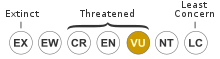
때로는 붉은 빛깔의 두리안,[5] 주황빛의 두리안, 또는 노란색의 두리안이라고 불리는 두리오 데브롤렌스는 말바과과에 속하는 나무의 한 종이다.[6][7]이탈리아의 자연주의자 오도아르도 베카리가 이름 붙인 두리안 6종 중 하나이다.[8]특정한 묘비명('강한 냄새' 또는 '솔직한 냄새')[9]은 냄새 때문이다.두리오(대부분 두드러지게 두리오 둘시스)의 대부분의 종은 강한 향을 가지고 있지만, 붉은 빛깔의 D. 다발렌즈(D. dravolens)의 종류는 은은한 향을 가지고 있다.[10][11]동남아시아가 원산지다.
D. 그라볼렌스는 식용 두리안,[12][13] 아마도 가장 인기 있는 '야생' 두리안 종으로, 지역적으로 상업적으로 판매되고 있다.[14]그러나, 그것의 착향료인 듀리오 지베티누스는 먹는 전형적인 종이며 전세계적으로 판매량을 지배하고 있다.[citation needed]
이름
이 종은 D지베티누스에 속하기 때문에 '붉은 살'(D164)과 '붉은 새우'(D175)로 알려진 말레이시아의 인기 있는 두리안 복제와 혼동해서는 안 된다.[15]
그러나 D. 데브롤렌즈에는 'DQ2 nyekak (DK8)'[15]라는 등록된 품종이 있다.과일의 색깔은 오렌지색, 붉은 색, 노란 색 등 다른 품종을 나타낸다.이 품종들은 다른 종일 수도 있지만, 현재 공감대가 형성되지 않고 있다.[10][14]노란 빛깔의 종류를 두리안 심포라 부르기도 한다.[10][6][5]
학명 Durio dravolens에서 묘비란 '강력한 냄새'[16][9][10]를 의미하지만, 미국 국립연구위원회가 발간한 책에서는 '악취 없는 냄새'[11][11]라고 표현하기도 했다.
말레이어로 이 과일은 두리안 부롱, 두리안 부룽[5], 두리안 림바("정글 두리안"),[13] 두리안 쿠닝[5][17][10]("노란 두리안"),[4] 두리안 메라("빨간 두리안"),[5][14][10][12] 두리안 오탁 우당갈라[17][10]("크레이피쉬 브레인 두리안")라고 불린다.[6]이반에서는 두리안 이수다.[6]비다유어는 그것을 두리안 유모트라고 부른다.[6]켄야족과 다야족 중에서 두리안 앙강("경적새 두리안"),[13] 두리안 아잔족, 페상족,[13] 타벨라족 또는 타벨라족,[13] 타벨라족, 타벨라족, 타벨라족, 타벨라족, 타벨라족,[10][5] 타벨라족, 타벨라족, 타벨라족, 타벨라족,[13][10][6] 타벨라족, 타벨라족, 타벨라족, 타벨라족,수마트라에서는 바탁이 그것을 티남벨라라고 부른다.[13][10][6]카로에서는 메란이라고 불린다.[18]In Thailand, it is referred to as thurian rak kha (Thai: ทุเรียนรากขา) or thurian khua tit (ทุเรียนขั้วติด; sources differ on which name refers to this species, with the other being attributed to D. kutejensis).[19][20]아체 타미앙 리젠시에서는 두리안 바투("스톤 두리안")라고 할 수 있고, 수마트라에서는 다른 곳에서는 두리안 아잔으로 알려져 있다.[13][10]다른 지역 이름으로는 두리안 달릿[14][10][21](Durio oxleyanus[22]) 알라우, 두진, 두리안 알라우, 두리안 다운 둥고, 두리안 후탄[10]("숲 두리안"), 두리안 피펫, 라이벵강, 메랑 쿠니트, 파상, 통카이 등이 있다.[6]
D. 다발렌스와 D. 지베티누스의 천연 잡종을 두리안 시웅공 또는 두리안 술루크라고 한다.[5][6][10]그것은 인기 있는 D. 지베티누스의 식감과 맛과 D. 데브솔렌스의 탄 카라멜 오버톤을 가지고 있다.[6][5]
1889년 오도아르도 베카리가 처음 묘사한 후 1924년 네덜란드의 식물학자 라이니에 코넬리스 바크히젠 반 덴 브링크는 그것을 D. 코니쿠스의 동의어로 줄였다.영국의 식물학자 존 와이어트 스미스는 1953년 D. 둘시스하에서 모든 것을 결합했다.인도네시아의 식물학자 안드레 요셉 기욤 앙리 코스터만스와 베르띠 소엥 레크소디하르조는 1958년 D. 묘비를 다시 자신의 종으로 분리했다.[23]
분배
야생[6][13][5][12] D. 무덤은 말레이시아 반도(요호르, 케다, 켈란탄, 말라카, 페낭, 페락, 셀랑고르, 테렝가누),[6][13][5][12] 보르네오,[13][12][5][6] 수마트라, 팔라완,[5] 태국 남부에서 자란다.[24]브루나이,[5] 사라왁, 사바,[6] 오스트레일리아 북부 영토에서 재배된다.[12]브루나이에서는 그 인기가 D. 지베티누스를 능가하는데,[17] 이 나라에서는 재배되지 않는다.[25]
그것은 가끔 열대지방 밖에서 자란다.플로리다에서는 비록 천에 싸여 있지만 0℃(32℃)[26]에서 이틀 연속 생존하는 것으로 나타났다.
설명

D. 묘목(D. davolens)은 D. dulcis와 많은 특징을 공유하는 큰 나무다.[2]그것은 높이가 최대 50m(160ft)까지 자라는 상부 캐노피에 서식한다.[6][13]트렁크는 지름이 85–100 cm(33–39 in)이고 높이가 약 25m(82ft)가 될 때까지 가지를 가질 수 없다.[6]그 트렁크는 매끈하거나 날렵하고, 회색/마우브는 가파른 버팀목 뿌리를 가진 루디한 갈색으로 될 것이다.[6]버팀목은 3m(9.8ft)에 도달하고 1.5m(4ft 11in)까지 확장된다.[13]

길쭉한 잎은 꽃잎이 없는 길이가 10–26cm(3.9–10.2인치)이고 너비는 4–10cm(1.6–3.9인치)이다.[2][6]그것들은 양쪽 끝이 완벽하게 둥글고, 단단하며, 약간 각질(느낌이나 질감에서 모체처럼)이 있다.[6][2]위로는 광택이 있고(매끈매끈하고 털이 없다) 바삭바삭하고 [6]거의 버니코스(바니싱)[2]하다.그 아래 잎은 구리갈색과 레피도테(비늘)로,[6] 지름이 최대 2mm(0.079인치)에 이르는 큰 비늘로 적어도 건조할 때는 별로 눈에 띄지 않는다.[2]잎 비늘은 펠트레이트(방패 모양), 치리방사선(날개)이며, 3~5부분으로 깊게 사랑받는다.[2]비늘 외에도, 긴 가닥의 스텔라이트 털과 다양한 크기의 다른 삼색 털들이 부드러운 토멘토스(퍼지) 표면을 형성한다.[2]잎사귀의 아랫부분이 매우 두드러져 윗부분이 주름을 이루고 있다.[2]잎사귀는 명료하다.[6]잎은 한 면당 10-12개의 측면 정맥(몇몇 개의 작은 정맥이 혼합되어 있음)을 가지고 있는데, 위로는 작고 표면적이며 더 뚜렷하지만, 여전히 거의 보이지 않는다.[2]페티오는 매우 크고, 길이가 15–18 mm(0.59–0.71인치)이며, 중간부터 깃털이 난다.[2]
꽃은 짧은 자낭과 가는 칼릭스에 가지에서[2][27] 자란다.[6]그 밑부분은 3-5개의 콘네이트 로브가 있는 주머니 같다.[6][27]그것은 길이가 25-35 밀리미터(0.98–1.38인치)인 흰색 [27]주걱 모양의 꽃잎을 가지고 있다.[6]내부에는 길이의 절반도 안 되는 기간 동안 융합된 [6]5개의 별개의 스타미닌과 스탬펜이 있다.[27]앤터는 네다섯 개의 긴 꽃가루로 이루어진 작은 군집을 가지고 있는데, 이 군집은 세로 슬릿으로 열린다.[27]난소는 난형에서 글로부스(거대한 구면)까지이며, 노란색 카피테이트(핀헤드처럼 생긴 모양) 오명을 가지고 있으며, 약 48mm(1.9인치)의 흰색에서 녹색으로 된 스타일을[6] 가지고 있다.[28]꽃가루는 실레이트(상대적으로 부드러움), 스피로이드(spheroidal), 지름 54μm(0.0021in)이다.[28]꽃가루 표면에는 3개의 큰 구멍들이 있는데, 이것은 그 구멍들이 결합한 콜푸스와 모공을 가지고 있다는 것을 의미한다.[28]꽃가루 알갱이는 모나드여서 군집하지 않는다.[28]
과일은 직경이 10-15cm(3.9~5.9인치)까지이며,[2][6][12][29][27] 무게는 약 757.5g(26.72온스)이다.[30]초록색에서 주황색까지의 바깥쪽은 길고(1cm(0.39인치)가 촘촘히 덮여 있으며, 직선이거나 약간 구부러져 있고, 따끔거리면서도[2][6][12] 약간 부드럽다.[27]과일은 5-6밀리미터(0.20–0.24인치) 두께의 벽이 있는 5개의 섬유질-각질 밸브(섹션)[6][12][29]로 쉽게 부서진다.[2]전형적으로 열매가 나무에서 열리지만,[6][12] 어떤 품종은 땅에 떨어지거나 수확될 때까지 열 수 없다.한 구역당 2개의 구근이나 밤 모양의 씨앗이 있으며, 각각은 살찐 아릴에 완전히 싸여 있다.[2][12][27]이 광택이 나는 갈색 씨앗은 2cm × 4cm (0.79 in × 1.57 in.[6][12][29]자극적인 아릴은 음식으로 소비되는 부분이지만,[2] 일부 공급원은 냄새가 때때로 매우 온화하다고 지적한다.[12][27][13]연한[2] 노랑색에서 주황색, 립스틱 적색까지 다양하다.[6][5][12][27]
분류학
D. 데브롤렌스는 두리오속(Durio속)의 핵심 쇄골인 팔라타두리오에 있다.[27]듀리오 쿠테옌시스와 가장 밀접한 관련이 있다.[27]
| 팔라타두리오 |
| ||||||||||||||||||||||||||||||||||||||||||
생태학

D. 데스볼렌스는 높은 열과 습도가 필요한 열대 식물 종이다.[6]전형적으로, 그것은 강둑과 늪을 따라 종종 습기가 많은 저지대 딥테로카프 숲의 진흙이 풍부한 토양에서 발견된다.[6]습식 서식지에 대한 내성 때문에 오미케테 피토페토라 팔미보라에 의한 감염에 내성이 있을 가능성이 있다.[13][12][17]그것은 또한 1,000m(3,300ft) 높이까지의 산허리와 셰일 능선에서 발견될 수 있다.[6]
그것은 박쥐에 의해 수분된다.[28]자연적으로 D. 지베티누스와 교배하는 유일한 종 중 하나이기 때문에,[5][6][31] 그들은 아마도 동굴 과즙 박쥐(Eonycteris spelaea)일 가능성이 있는 꽃가루 매개체를 공유하는 것으로 생각된다.[32][23]이 두리안 종의 꽃가루는 동굴 과즙 박쥐 배설물에서, 그리고 아마도 긴 언어를 사용하는 과일 박쥐 배설물에서 발견되었다.[33]
수확 후, 열매는 라시오디플로디아 테오브로마, 글로멜라 신굴라타, 지오트리쿰 칸디다움, 칼로네테리아 쿄텐시스, 그리고 때때로 그리오세팔로트리히움 구불구불과 같은 곰팡이에 의해 설정될 수 있다.[17]2차 또는 기회주의적인 곰팡이 감염은 아스페르길루스 니제르 및 기타 아스페르길루스 spp, 칸디다 spp, 지브렐라 복잡성, 페니실륨 spp와 같은 종에서 발생할 수 있다.[17]
열매는 보르네안 오랑우탄(퐁고 피그마우스)이 먹고,[18]프레보스트의 다람쥐(Callosciurus prevostii), 게를 먹는 마카크(Macacaca passicularis), 검은 뿔풍뎅이(Anthracoceros malayanus), 아마도 바이버라이드와[29] 태양곰(Helarctos malayanus)일 것이다.[34]검은 뿔풍뎅이는 또한 나무의 효과적인 종자 분산제로서,[29] 이것은 나무의 몇몇 지역 이름에 언급되어 있다.
생화학
과일의 지방산은 포화도가 30%, 불포화도가 70%이다.[4]포화지방은 미리스틱산(14.49%), 아라키드산(7.08%), 펜타데카노산(3.61%), 헵타데카노산(2.2%), 데카노산(1.62%), 라우르산(1.31%)[4] 등이다.불포화지방은 올레산(22.18%), 팔미톨레산(13.55%), 리놀레산(12.39%), 리놀레산(12.39%), 리놀레산(12.23%), 리놀레산(4.95%), 엘라이드산(2.50%), 미리스톨레산(1.89%)[4] 등이다.
사용하다
과일의 과육은 일반적으로 날것으로 먹으며 구운 아몬드나[6][5][17] 탄 카라멜 향이 난다.[6][5]그 맛은 달콤하고 느끼하거나[17] 아보카도나 피멘토 치즈를 먹는 것과 비슷하다고 묘사된다.[10]때때로, 그것은 조미료 튀김으로 발효된다.[14]홍채는 민물고기(인도네시아 전통 채소찌개)의 일종으로 민물고기와 함께 사용한다.[6]
이 씨앗들은 또한 밀가루로 갈아서, 예를 들어, 물고기 크래커를 만드는 데 사용될 수 있다.[21]
이 나무는 사라왁에서도 목재를 위해 수확된다.[6]그곳의 이반 사람들도 피부를 튼튼하게 해준다고 믿기 때문에 하루살이 유아(특히 임신 전)를 성숙한 나무껍질의 티산느로 목욕시킨다.[6]
참고 항목
참조
- ^ "Durio graveolens". IUCN Red List. 6 February 2020. Retrieved 25 February 2022.
- ^ a b c d e f g h i j k l m n o p q r Beccari, Odoardo (1889). Malesia: raccolta di osservazioni botaniche intorno alle piante dell'arcipelago Indo-Malese e Papuano pubblicata da Odoardo Beccari, destinata principalmente a descrivere ed illustrare le piante da esso raccolte in quelle regioni durante i viaggi eseguiti dall'anno 1865 all'anno 1878 [Malaysia: collection of botanical observations about the plants of the Indo-Malay and Papuan archipelago published by Odoardo Beccari, mainly intended to describe and illustrate the plants he collected in those regions during travels carried out from the years 1865 to 1878] (PDF) (in Italian). Vol. 3. Florence & Rome, Italy: Tipografia del R. Instituto sordo-muti. pp. 242–3. ASIN B000MTM2A0. OCLC 880509632. Retrieved 29 October 2017.
- ^ Hoe, Voon Boon; Siong, Kueh Hong (March 1999). "The nutritional value of indigenous fruits and vegetables in Sarawak" (PDF). Asia Pacific Journal of Clinical Nutrition. 8 (1): 24–31. doi:10.1046/j.1440-6047.1999.00046.x. ISSN 1440-6047. OCLC 5534067161. PMID 24393732. Archived (PDF) from the original on 15 August 2017. Retrieved 3 November 2017.
- ^ a b c d e Nasaruddin, Mohd hanif; Noor, Noor Qhairul Izzreen Mohd; Mamat, Hasmadi (2013). "Komposisi Proksimat dan Komponen Asid Lemak Durian Kuning (Durio graveolens) Sabah" [Proximate and Fatty Acid Composition of Sabah Yellow Durian (Durio graveolens)] (PDF). Sains Malaysiana (in Malay). 42 (9): 1283–1288. ISSN 0126-6039. OCLC 857479186. Archived (PDF) from the original on 1 December 2017. Retrieved 28 November 2017.
- ^ a b c d e f g h i j k l m n o p q O'Gara, E.; Guest, D. I.; Hassan, N. M. (2004). "Occurrence, Distribution and Utilisation of Durian Germplasm" (PDF). In Drenth, A.; Guest, D. I. (eds.). Diversity and Management of Phytophthora in Southeast Asia ACIAR Monograph No. 114. Australian Centre for International Agricultural Research (ACIAR). pp. 187–193. ISBN 978-1-86320-405-7.
- ^ a b c d e f g h i j k l m n o p q r s t u v w x y z aa ab ac ad ae af ag ah ai aj ak al am an ao ap Lim, Tong Kwee (29 September 2011). "Durio graveolens". Edible Medicinal and Non-Medicinal Plants. Dordrecht: Springer. pp. 552–555. doi:10.1007/978-90-481-8661-7_74. ISBN 978-90-481-8661-7. OCLC 988813302.
- ^ "Durio graveolens". NCBI taxonomy. Bethesda, MD: National Center for Biotechnology Information. Archived from the original on 14 May 2018. Retrieved 26 October 2017.
Lineage( full ) cellular organisms; Eukaryota; Viridiplantae; Streptophyta; Streptophytina; Embryophyta; Tracheophyta; Euphyllophyta; Spermatophyta; Magnoliophyta; Mesangiospermae; eudicotyledons; Gunneridae; Pentapetalae; rosids; malvids; Malvales; Malvaceae; Helicteroideae; Durio
- ^ "Durio". The Plant List. 1.1. England: The Plant List. 23 March 2012. Archived from the original on 5 September 2017. Retrieved 9 November 2017.
- ^ a b Griffith, Chuck (2005). "Dictionary of Botanical Epithets". Dictionary of Botanical Epithets. Archived from the original on 19 September 2017. Retrieved 27 October 2017.
graveolens graveolens graveolens strong smelling graveolens graveolent adj strong smelling; rank Ruta graveolens L.
- ^ a b c d e f g h i j k l m n o Gasik, Lindsay (May 2013). "Durio graveolens". Year of the Durian. yearofthedurian.com. Archived from the original on 14 October 2017. Retrieved 4 November 2017.
- ^ a b c National Research Council (1975). Underexploited Tropical Plants with Promising Economic Value (2002 ed.). New York; Hong Kong: The Minerva Group. p. 65. ISBN 9780894991868. Retrieved 10 October 2019.
- ^ a b c d e f g h i j k l m n o Lim, Tong Kwee; Luders, L. (July 1997). Boosting Durian Productivity (PDF). Research Report, Chicken Meat & Egg Programs. Vol. RIRDC Project DNT - 13A. Barton, ACT: Rural Industries Research Development Corporation (RIRDC). ISBN 9780724530151. ISSN 1440-6845. OCLC 38412745. Archived (PDF) from the original on 19 April 2018. Retrieved 10 November 2017.
- ^ a b c d e f g h i j k l m n o Kostermans, André Joseph Guillaume Henri (December 1958). Dilmy, A.; Van Steens, C. G. G. J. (eds.). "The Genus Durio Adans. (Bombac.)" (PDF). Reinwardtia. 4 (3): 91–95. doi:10.14203/reinwardtia.v4i3.1008 (inactive 28 February 2022). ISSN 2337-8824. OCLC 4142407. Archived from the original on 2 December 2017. Retrieved 10 November 2017.
{{cite journal}}: CS1 maint : 2022년 2월 현재 DOI 비활성화(링크) - ^ a b c d e "Wild durians of Borneo". Daily Express. Kota Kinabalu, Malaysia: Sabah Publishing House Sdn. Bhd. 5 February 2012. Archived from the original on 1 December 2017. Retrieved 5 November 2017.
- ^ a b "Varieties Registered For National Crop List". Plant Variety Protection Malaysia. Kuala Lumpur, Malaysia: Department of Agriculture, Malaysia. pp. 15–6, 52. Archived from the original on 1 December 2017. Retrieved 2 November 2017.
D164 Durian Durio zibethinus Linn. D175 Durian Durio zibethinus Linn. DQ2 Durian Sarawak Durio graveolens Becc Nyekak (DK8)
- ^ Lewis, Charlton T.; Short, Charles (1879). A Latin Dictionary. Oxford: Clarendon Press. Archived from the original on 10 October 2019. Retrieved 10 October 2019.
- ^ a b c d e f g h Sivapalan, A.; Metussin, Rosidah; Harndan, Fuziah; Zain, Rokiah Mohd (December 1998). "Fungi associated with postharvest fruit rots of Durio graveolens and D. kutejensis in Brunei Darussalam". Australasian Plant Pathology. 27 (4): 274–277. doi:10.1071/AP98033. ISSN 1448-6032. OCLC 204773204. S2CID 37024997.
- ^ a b Mackinnon, John (February 1974). "The behaviour and ecology of wild orang-utans (Pongo pygmaeus)". Animal Behaviour. 22 (1): 3–74. doi:10.1016/S0003-3472(74)80054-0. ISSN 0003-3472.
- ^ "ชื่อพรรณไม้ เต็ม สมิตินันทน์". Forest Herbarium (in Thai). Department of National Parks, Wildlife and Plant Conservation. Retrieved 14 May 2020.
- ^ Songpol Somsri (1999). "Interspecific Hybridization of Durian". Thai Agricultural Research Journal (in Thai). 17 (3): 294–302.
- ^ a b Yong, Yen Cze (2015). Aplikasi Tepung Biji Durian Dalit (Durio graveolens) Dalam Keropok Ikan [Application of Durian Dalit (Durio graveolens) Seed Flour in Fish Crackers] (in Malay). Kota Kinabalu: Universiti Malaysia Sabah. OCLC 973237888.
- ^ Ng, Murphy (19 December 2012). "Red and Orange Durians of Sabah". MySabah.com. Sabah, Malaysia. Archived from the original on 7 February 2018. Retrieved 29 November 2017.
Durian Dalit (Orange-flesh Durian), Species: Durio oxleyanus The husk of Durian Dalit is green color, with long and thick thorns outside. Durian Sukang (Red-flesh Durian), Species: Durio graveolens When ripe, the husk of Durian Sukang turns yellow, with short and sharp spines.
- ^ a b Brown, Michael J. (1997). Arora, R.K.; Ramanatha Rao, V.; Rao, A.N. (eds.). Durio, a Bibliographic Review. New Delhi, India: International Plant Genetic Resource Institute. p. 13. ISBN 9789290433187. OCLC 38754437. Retrieved 11 November 2017.
- ^ "Durio graveolens Beccari, 1889". Species 2000 & ITIS Catalogue of Life. Species 2000: Naturalis, Leiden, the Netherlands. Retrieved 29 September 2017.
- ^ Osman, M. B.; Mohamed, Z. A.; Idris, S.; Aman, R. (1995). Tropical fruit production and genetic resources in Southeast Asia: Identifying the priority fruit species (PDF). International Plant Genetic Resources Institute (IPGRI). ISBN 978-92-9043-249-4. OCLC 723476105. Archived from the original on 2008-09-30. Retrieved 10 November 2017.
In Brunei Darussalam, D. zibethinus does not occur locally. The people in Brunei prefer the other species, such as D. graveolens, D. kutejensis and D. oxyleyanus. These species are quite commonly distributed in the country and together with other species like D. testudinarium and D. dulcis, represent rich genetic diversity.
- ^ Whitman, William F. (November 1990). Cockshutt, Nicholas (ed.). "Ultra Tropicals vs. Freezing Point". Tropical Fruit World. 1 (5): 147–148. ISSN 1053-850X. OCLC 22610361.
- ^ a b c d e f g h i j k l Nyffeler, Reto; Baum, David A. (2001). "Systematics and character evolution in Durio s. lat. (Malvaceae/Helicteroideae/Durioneae or Bombacaceae-Durioneae)". Organisms Diversity & Evolution. 1 (3): 165–178. doi:10.1078/1439-6092-00015. ISSN 1439-6092. OCLC 199110722.
- ^ a b c d e Stroo, A (March 2000). "Pollen morphological evolution in bat pollinated plants". Plant Systematics and Evolution. 222 (1–4): 225–242. doi:10.1007/BF00984104. ISSN 1615-6110. OCLC 197044000. S2CID 42391364.
- ^ a b c d e Nakashima, Yoshihiro; Lagan, Peter; Kitayama, Kanehiro (March 2008). "A Study of Fruit–Frugivore Interactions in Two Species of Durian (Durio, Bombacaceae) in Sabah, Malaysia". Biotropica. 40 (2): 255–258. doi:10.1111/j.1744-7429.2007.00335.x. ISSN 1744-7429. OCLC 5155811169. S2CID 82212472.
- ^ Yumoto, Takakazu (August 2000). "Bird-Pollination of Three Durio Species (Bombacaceae) in a Tropical Rainforest in Sarawak, Malaysia" (PDF). American Journal of Botany. 87 (8): 1185. doi:10.2307/2656655. ISSN 1537-2197. JSTOR 2656655. PMID 10948003. Retrieved 14 November 2017.
Wet masses of fruits recorded in Lambir Hills National Park were as follows: D. graveolens, 757. 5 g;... (T. Yumoto, unpublished data)
- ^ Hambali, GG; Yatazawa, M; Sunarto, AT (1989). Siemonsma, J.S.; Wulijarni-Soetjipto, N. (eds.). Wild Durio Germplasm for improving fruit quality and performance of Durio zibethinus (PDF). Plant Resources of South-East Asia Proceedings of the First PROSEA International Symposium May 22–25, 1989, Jakarta, Indonesia. p. 261. ISBN 978-90-220-0999-4. OCLC 956468165. Retrieved 12 November 2017.
Four hybrid seedlings were obtained in the crosses between D. zibethinus and D. graveolens, whereas no fruit set was observed in the crosses between D. zibethinus and D. oxleyanus, and between D. oxleyanus and D. graveolens.
- ^ Soepadmo, Engkik; Eow, BK (31 August 1977). Mabberley, DJ; Lan, Chang Kiaw (eds.). "The Reproductive Biology of Durio zibethinus Murr" (pdf). The Gardens' Bulletin, Singapore. 29: 25–33. ISSN 2382-5812. OCLC 918436212. Archived from the original on 31 December 2018. Retrieved 12 November 2017.
- ^ Start, A.N.; Marshall, A.G. (1976). "Nectarivorous Bats as Pollinators of Trees in West Malaysia". In Burley, J.; Styles, B.T. (eds.). Tropical Trees: Variation, Breeding and Conservation. Linnean Society Symposium Series. Vol. 2. London, UK: Academic Press. pp. 141–159. ISBN 978-0121451509. OCLC 476102040.
- ^ Fredriksson, Gabriella M.; Wich, Serge A.; Trisno (1 November 2006). "Frugivory in sun bears (Helarctos malayanus) is linked to El Niño-related fluctuations in fruiting phenology, East Kalimantan, Indonesia" (PDF). Biological Journal of the Linnean Society. 89 (3): 489–508. doi:10.1111/j.1095-8312.2006.00688.x. ISSN 1095-8312. Archived (PDF) from the original on 19 February 2019. Retrieved 14 December 2018.
Durio graveolens Bombacaceae S fr Tree
외부 링크
 위키미디어 커먼스의 두리오 데브롤렌즈 관련 매체
 Wikispeece의 Durio dravolens 관련 데이터
- 두리안의 해에 무덤을 파는 두리오
- 두리오가 닥터에게 무덤을 판다.듀크의 식물화학 및 윤리학 데이터베이스


