
구형파 변환
Spherical wave transformation구형파 변환은 모든 관성 프레임에서 광학 및 전기역학 법칙뿐만 아니라 구형파의 형태를 남긴다. 그들은 1908년에서 1909년 사이에 해리 베이트만과 에베네저 커닝햄에 의해 정의되었고, 베이트만은 그 변형에게 그 이름을 지어주었다.[M 1] 그것들은 19세기에 이미 알려진 리구 기하학의 틀과 관련하여 "상호 반지름에 의한 변환"의 일치 그룹에 해당한다. 시간은 민코프스키 공간처럼 4차원으로 사용되기 때문에 구면파 변환은 특수상대성이론의 로렌츠 변환과 연결되며, 스팩타임의 정합성 그룹에는 로렌츠 그룹과 푸앵카레 그룹이 하위그룹으로 포함되는 것으로 밝혀졌다. 그러나 로렌츠/푸앵카레 그룹만이 역학을 포함한 모든 자연 법칙의 대칭을 나타내는 반면, 등정 그룹은 전기 역학과 같은 특정 영역과 관련된다.[1][2][3] 또한, 평면의 정합성 그룹(확장된 복합면의 뫼비우스 그룹에 대응)이 로렌츠 그룹에 이형성이 있음을 보여줄 수 있다.[4]
리구 기하학의 특별한 경우는 상호 방향이나 라구에르 역방향에 의한 변환으로 라구에르 그룹의 생성자가 된다. 구를 구로 뿐만 아니라 평면도 평면으로 변형시킨다.[5][6][7] 시간을 네 번째 차원으로 사용한다면 로렌츠 그룹에 대한 이형성뿐만 아니라 로렌츠 변혁과 밀접한 유사성이 베이트만, 카르탄, 푸앵카레 등 여러 저자에 의해 지적되었다.[M 2][8][M 3][9][10][11][12][13]
상호 반지름에 의한 변환
19세기의 발전
원 사이의 각도를 보존하는 역전은 듀란드(1820)에 의해 처음 논의되었는데, 퀘틀레(1827)와 플뤼커(1828)는 해당 변환 공식을 적었고, 은 반전 반경이 된다.[14]

- .
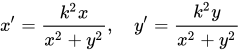
이러한 반전은 후에 "상호반 반지름에 의한 변환"이라고 불렸으며, 톰슨(1845, 1847)이 전기 공학에서 반전 방법을 개발하는 과정에서 좌표 , y, 를 가진 구에 적용하면서 더 잘 알려지게 되었다.[15] 조셉 리우빌(1847)은 다음과 같은 이차적 형태를 생성하는 순응적 변환에 속함을 보여줌으로써 수학적 의미를 입증했다.[M 4]

- .

리우빌 자신[M 5] 그리고 보다 광범위하게 소푸스 리(1871)[M 6]는 관련 순응 집단을 구별할 수 있다는 것을 보여주었다(리우빌의 정리). 예를 들어 = 에는 유클리드 일반 동작 그룹이 포함되며, 1 1 스케일 또는 이전 변환의 좌표에 과=4 / (가 곱되는 유사성 변환이 있다. + ) 우측 호혜적 반지름에 의한 톰슨의 변혁:[M 5]



- .

이후 Liouville의 정리는 Lie(1871년)[M 6]와 Darboux(1878년)와 같은 다른 것에 n 차원으로 확장되었다.[M 7]

- .

역수 반지름에 의한 이 정합체 변환 그룹은 각도를 보존하고 구를 구 또는 초자체로 변환한다(Möbius 변환, 정합체 대칭, 특수 정합체 변환 참조). 연장된 복합 평면의 뫼비우스 그룹에 해당하는2 평면 R의 6-모수 그룹3, 공간 R의 10-모수 그룹,[16][4] R의4 15-모수 그룹이다. R에서는2 리우빌의 정리에 따라, R에서는2+n 모든 순응적 변환의 작은 부분집합만을 나타내는 반면, R에서는 모든 순응적 변환의 그룹(높은 차원의 뫼비우스 변환에 대응)과 동일하다.[16] R의3 등각 변환은 흔히 다부스(1873)가 다섯 개의 구를 바탕으로 한 균일한 좌표와 점을 연관시켜 "용구형 좌표"라고 부르는 것에 적용되었다.[17][18]
지향성구
그러한 구면 문제를 해결하는 또 다른 방법은 구면 반경과 함께 좌표를 적는 것이었다.[19] 이것은 (접촉 변환의 특별한 경우로서) 구면 변환의 일반적인 틀을 나타내는 리구 기하학의 맥락에서 리(1871)가 곡면선을 보존하고 구면으로의 구를 변환하는 것을 채용했다.[M 8] 앞서 언급한 5구형 좌표와 관련된 R의3 10변수 집단은 반경과 관련된 6번째 균일한 좌표를 추가하여 "헥사구형 좌표"(1893년 클라인이 이름)와 관련된 리구형 변환의 15변수 집단으로 확장된다.[M 9][17][20] 구의 반지름은 양 또는 음의 기호를 가질 수 있기 때문에, 하나의 구는 항상 두 개의 변형된 구에 대응한다. 확실한 기호를 반지름에 귀속시켜 이러한 모호성을 제거하는 것이 유리하며, 결과적으로 하나의 지향적인 구가 하나의 변형된 지향적인 구에 대응하도록 구들 역시 확실한 방향을 부여한다.[21] 이 방법은 때때로 그리고 암묵적으로 리 (1871)[M 6] 자신이 고용했고 (1880) 라구에르 (1880)가 명시적으로 도입했다.[M 10] 또한 Darboux(1887)는 역수 반지름에 의한 변환을 다른 하나의 반지름을 알면 구의 반지름 r을 결정할 수 있는 형태로 가져왔다.[M 11]
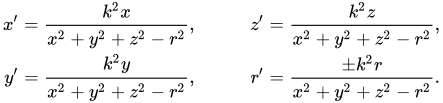
좌표를 반지름과 함께 사용하는 것은 흔히 클라인(1893)에 의해 "최소 투영"이라는 수법으로 연결되었는데,[M 12] 이후 블래쉬케(1926)가 지향적인 원과 구와의 관계를 강조하여 "이소트로피 투영"이라고 불렀다.[22] 예를 들어 직교 좌표로, 원), R2에서 y, 반경{\displaystyle x,y}r{r\displaystyle}R3의 지점에 좌표와 같이 해당합니다, y, z{\displaystyle x,y,z}. 이 메서드는 위쪽은 원 기하학( 하지만 방향의 개념을 사용하지 않고)에서 얼마간 수 있고 더 진행되 differen 알려져 있었다.tIated이 추가적인 좌표 또는 실질적인 상상의 처리가 되는 것 같습니다에:z)나는{\displaystyle z=ir}샬:프랑스의 수학자.(1852년), 뫼비우스(1857년), 케일리(1867년), 그리고 다르부(1872년)에 의해 사용되었다이었고 넌 결코 모르네, 따라.[M13]zr{\displaystyle z=r}Cousinery(1826년), Druckenmüller(1842년), 그리고 피들러(1882년), 따라서 그 latt의"cyclography"에서 사용되었다.er method는 "사이클러 투영"이라고도 불렸다. 요약은 E. 뮐러(1910)를 참조한다.[23] 이 방법은 다부스(1872년),[M 15][M 6] 리(1871년), 클라인(1893년)에 의해 구에도[M 14] 적용되었다.[M 12] r 과 x x을 3차원 공간 R에3 있는 두 구의 중심 좌표와 반경이 되게 하라. 구들이 같은 방향으로 서로 닿으면 그 방정식이 주어진다.
 x
x
- - ) +( - ) +( - ) -( - r ) = (r

설정 = 이 좌표는 4차원 공간 R4:[M 15][M 12]

- - ) +( - ) +( - z ) +( - - t ) 2= 2}+(z-z2}+(

일반적으로, Lie(1871)는 Rn(상호 반지름에 의한 움직임, 유사성 및 변환의 조합)의 등정점 변환이 R에서n-1 접촉 변환인 구체 변환과 일치한다는 것을 보여주었다.[M 16][24] 클라인(1893)은 육각형 좌표에 최소 투영을 사용함으로써3 R의 15-모수 리 구체 변환은 단순히 R의4 15-모수 일치점 변환의 투영일 뿐, R의4 포인트는 R의5 구 점의 입체 투영으로 볼 수 있다고 지적했다.[M 9][25]
전기역학과의 관계
해리 베이트먼과 에베네저 커닝햄(1909)[M 1]은 전자기 방정식이 로렌츠 불변성일 뿐만 아니라 규모와 순응 불변성이라는 것을 보여주었다.[26] 그것들은 관계를 생성하는 R에서4 15-모수 일치 변환 그룹 G 상호 반지름에 의한 변환)에 따라 불변한다.

- ,

여기서 = i 은(는) 시간 구성 요소로 을(를) 포함하고 c c}은는) 빛의 속도로 포함한다. 또한 Bateman(1909)은 R에서3 이전에 언급된 Lie 구체 변환과 동등하다는 것을 알아챘다. 이 변환에 사용된 r 은 c 과 수축하거나 확장되는 구형 파형의 반지름 c로 해석될 수 있기 때문에 이를 "구형 파형"이라고 불렀다 변형".[M 17] 그는 다음과 같이 썼다.[M 18]


 . 또한 Bateman(1909)은 R에서3 이전에 언급된 Lie 구체 변환과 동등하다는 것을 알아챘다. 이 변환에 사용된
 수축하거나 확장되는 구형 파형의 반지름
 의 4 {\ S_의 한 점을 S {3}}의 구면파로 표현하면 G 15 {\ 그룹의 변환 그룹이 되어 구형파를 구면파로 변환한다 이 변혁의 그룹은 S에 의해 논의되었다. 거짓말; 구면파에 둘러싸인 표면의 곡률선을 해당 구면파에 둘러싸인 표면의 곡률 선으로 변환하는 변환 그룹이다.


에 따라 다음과 같이 하위 그룹으로 구분할 수 있다.[27]

(a) = 은 구를 구로 변환할 뿐만 아니라 평면으로 변환하는 매핑에 해당한다. 이것들은 라구에르 그룹을 형성하는 라구에르 변환/역전이라고 불리며, 물리학에서는 6-모수 로렌츠 그룹이나 10-모수 푸앵카레 그룹을 형성하는 로렌츠 변환에 해당한다.[28]
(b)λ ≠ 1{\displaystyle \lambda \neq 1}은 로렌츠 변환의 시공간 변수의 예를 들어 일정한 요소λ{\lambda\displaystyle}.[29]에 따라, l=λ{\displaystyle l={\sqrt{\lambda}}}, 다음 transformatio 사용된다에 의해 곱셈에 의해 규모나 유사성 변환을 나타냅니다.ngi1905년 푸앵카레(Poincaré)에 의해 벤([M 19]Ven
- .

그러나 상대성 원리(로렌츠 그룹)에서 요구하는 대로 자연 법칙의 대칭인 집단을l = l1}만이 생성하는 반면, 척도 변환 집단은 광학 및 전기역학의 대칭에 불과하다는 것이 푸앵카레와 아인슈타인에 의해 밝혀졌다.
 생성하는 반면, 척도 변환 집단은 광학 및 전기역학의 대칭에 불과하다는 것이 푸앵카레와
 (c) 설정 = r /( x + 2+ 2+ 2) 2}+z^{^{2}+u2}+2}+u^{} 특히 역수 반지름에 의한 변환의 광범위한 일치 그룹과 관련이 있다. 그것은 4차원 하이퍼바이저로 일반화된 뒤집기를 나타내는 기본적인 변환으로 구성된다.[30]

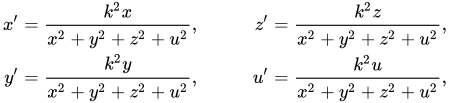
실제 을를[M 1] 사용하여 + + z - x2}-^{22}}{2}}}}}}{2}}}}:{22}}}}}}}}}}}}}}}}}}}}}}}}}}}}}}}}

펠릭스 클라인(1921년)은 1871년 리와 자신의 연구와 이러한 관계의 유사성을 지적하면서, 전자는 전기역학에 적용되는 반면 후자는 역학을 포함한 자연 법칙의 대칭이기 때문에 등정 집단은 로렌츠 그룹과 같은 의미를 갖지 않는다고 덧붙였다.[M 20] 순응적 변환이 균일하게 가속된 프레임으로의 변환을 허용하는지 여부에 대해 한동안 가능성이 논의되었다.[31] 후에, 등정 불변성은 등정장 이론과 같은 특정 영역에서 다시 중요해졌다.[32]
로렌츠 그룹과 뫼비우스 그룹 간 이형성
또한 R의3 6-모수 일치 집단(즉, 리만 구의 자동화로 구성된 뫼비우스 집단)[4]이 R의 6-모수 쌍곡선 운동 그룹(즉, 쌍곡선 공간의 등축성)과 이형성인 R의2 6-모수 일치 집단([33]즉, 쌍곡선 공간의 등축성)도 물리적으로 해석할 수 있는 것으로 나타났다. 로렌츠 그룹과는 이형이다.
예를 들어, Fricke와 Klein (1897)은[34] 2도의 한 부분 곡선 표면의 관점에서 "절대적인" Cayley 메트릭을 정의함으로써 시작되었는데, 이 지표는 내부가 방정식과 함께 쌍곡선 공간을 나타내는 구체로 나타낼 수 있다.
- ,

여기서 ,z ,z ,z 는 균일한 좌표다. 그들은 쌍곡선 공간이 그 자체로 움직이는 것 또한 이 구역을 그 자체로 변화시킨다고 지적했다. 그들은 구의[35] 복잡한 매개 변수 }을(를) 정의하여 그에 상응하는 변환을 개발했다.


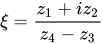
대체에 의해 다른 매개 변수 에 연결됨


여기서 , , , {\ ,\gamma 은 복합 계수다. 또한 : 2: z : 3: z = :Y: 1 위의 관계는 R3:[36]의 단위 영역 관점에서 형태를 가정한다.



1884년 클라인이 이미 제공한 구형 표면에 평면의 입체 투영과 동일하다.[M 21] Since the substitutions are Möbius transformations (German: Kreisverwandtschaften) in the -plane or upon the -sphere, they concluded that by carrying out an arbitrary motion of hyperbolic space in itself, the -sphe뫼비우스 변환을 다시 겪는다. 즉, 쌍곡선 움직임의 전체 그룹이 모든 직접적인 뫼비우스 변환을 제공하며, 마지막으로 어떤 직접적인 뫼비우스 변환도 쌍곡선 공간의 동작에 해당한다는 것이다.[37]

프릭케 & 클라인의 작업에 근거해, 로렌츠 그룹에 대한 그 쌍곡 운동 그룹(그리고 결과적으로 뫼비우스 그룹의)의 이소모르프(Isomorphism)는 구스타프 헤르글로츠(1909)에 의해 증명되었다.[M 22] 즉, Minkowski 메트릭은 위의 Cayley 메트릭(실제 원뿔 단면 기준)에 해당하며, 만약 스페이스타임 좌표가 위의 동종 좌표로 식별된다면
- = = 3= z z = t }=y

와 같은 가 되는 것은 것이 되는 것이다.
- again connected by the substitution .

헤르글로츠는 그러한 대체는 로렌츠 변환에 해당하며, R에서3 쌍곡선 운동에 대한 일대일 대응관계를 확립한다고 결론지었다. 쌍곡선 공간에서 로렌츠 그룹과 케이리 메트릭스의 관계도 클라인(1910)[M 23]은 물론 파울리(1921년)도 지적했다.[38] 로저 펜로즈에 의해 로렌츠 그룹에 뫼비우스 집단의 상응하는 이소모르페르시즘이 채용되었다.
상호방향에 의한 변환
19세기의 발전
위에서는, 리 구 기하학 내의 구의 반지름을 포함한 좌표와의 정합성 변환의 연결성이 언급되었다. 특수한 경우 = 1 은 에드먼드 라구에르(1880-1885)가 준 구체 변환에 해당한다. 그는 이것을 "상호적 방향에 의한 변환"이라고 불렀고 지향적인 구와 평면의 기하학의 기초를 놓았다.[M 10][5][6] 다르부스와[M 24] 바테만 등에 따르면,[M 2] 이전에도 알버트 리바쿠르(1870년)[M 25]와 리 자신(1871년)이 비슷한 관계를 논의했다고 한다.[M 6] 스테파노스(1881)는 라구에르(Laguerre)의 기하학이 정말로 리의 구체 기하학의 특수한 경우라고 지적했다.[M 26] 그는 또한 콰테르니온 (1883년)에 의해 라구에르(Laguerre)가 지향하는 구체들을 표현하였다.[M 27]
특정 방향의 반지름을 가진 선, 원, 평면 또는 구를 라구어르 반선, 반원(사이클), 반평면, 반경간 등으로 부른다. 접선은 양쪽 방향이 같은 지점에서 주기를 자르는 반선을 말한다. 상호방향에 의한 변환은 지향적인 구를 지향적인 구와 지향적인 면으로 변환하여 두 사이클의 "접선 거리(각 공통 접선 지점 사이의 거리)를 불변하게 하고 곡률의 선도 보존한다.[39] 라구에르(1882)는 다음과 같은 조건에서 변환을 두 사이클로 적용했다. 그들의 급진적인 축은 변혁의 축이며, 공통적인 접선은 스스로 변형되는 반선의 두 가지 고정된 방향과 평행하다(Laguere는 이 구체적인 방법을 "상호적인 반선에 의한 변환"이라고 불렀고, 후에 "Laguere 역행"[40][41]이라고 불렀다. 및 을(를) 주기의 반경으로 설정하고 및 ′을(를) 축에 대한 중심 거리로 설정하여 다음을 얻었다.[M 28]


 (를) 축에 대한 중심 거리로 설정하여

변환 시:[M 29]

Darboux(1887)는 다음과 x {\ y {\ y} 좌표도 포함했지만, "상호방향에 의한 변환"에 대한 처리에서 다른 표기법(= {\z = {\ y으로 동일한 공식을 얻었다.[M 30]


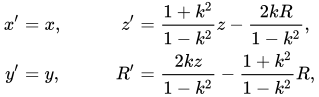
와 함께

결과적으로 그는 그 관계를 얻었다.
- ′ + 2+ - = + y 2+ - R premium 2}=2}+y2}-

위에서 언급했듯이 R에서3 지향하는 구들은 최소(이소트로피) 투영을 사용하여 4차원 공간 R의4 점으로 표현될 수 있는데, 이는 라구에르 기하학에서 특히 중요해졌다.[5] 예를 들어, E. 뮐러(1898)는 4차원의 평면 다지관(Fiedler의 1882년부터의 "사이클로그래피"에 비유한 것)의 지점에 그것들이 지도화될 수 있다는 사실에 근거하여 그의 지향적인 구체에 대한 논의를 근거로 삼았다. 그는 역수 반지름에 의한 변환("구면에서의 반전"이라고 부름)과 역수 방향에 의한 변환("면 구면 복합에서의 반전"이라고 부름)[M 31]을 체계적으로 비교했다. 뮐러의 논문에 이어 스미스(1900년)는 라구에르(Laguerre)의 변혁과 관련되는 "상호적 방향의 기하학적 그룹"에 대해 논의했다. 그는 클라인의 최소 투영 처리(1893)를 언급하면서 "4차원의 공간에서의 모든 변위와 대칭 변환의 그룹과 단순히 이형화"라고 지적했다.[M 32] 스미스는 다른 표기법으로 라구에르, 다르부스와 같은 변형을 얻어, 이것을 "구형 콤플렉스로의 반전"[M 33]이라고 불렀다.

관계와 함께

라그레 반전 및 로렌츠 변환
1905년 푸앵카레와 아인슈타인 모두 특수상대성이성의 로렌츠 변환( c= 1 을 지적했다.


관계 + y + - 개의 불변성을 남긴다.[2] 아인슈타인은 이러한 변형에 의해 한 프레임의 구면 광파가 다른 프레임의 구면 광파로 변형된다는 점을 강조했다.[42] 푸앵카레 교수는 로렌츠 변환은 시간을 네 번째 좌표로 하여 4차원 공간에서 회전하는 것으로 볼 수 있다는 것을 보여주었고, 밍코프스키가 이러한 통찰력을 훨씬 더 심화시켰다(특수 상대성의 역사 참조).

위에 나타낸 것과 같이, Darboux (1887)가 제공한 형태로 상호 방향이나 반선(나중에 Laguerre 반전이라고[40][41] 불림)에 의한 Laguerre의 변환은 x + + 2- R 2}}: 불변형식을 그 후, 로렌츠 변환과의 관계는 여러 저자에 의해 주목되었다. 예를 들어, 베이트만(1910년)은 (리바쿠르의 탓으로 돌린) 이러한 변혁이 로렌츠 변혁의 "동일적"이라고 주장했다.[M 2] 특히 그는 (1912년) = R = R 용어가 속도에 의해 대체되는 경우, Darboux (1887)가 제공한 이 z{\ z방향의 로렌츠 변환에 해당한다고 주장했다.[M 34] 베이트먼(1910)은 또한 그러한 구형 시스템을 사용하여 상대론적 광구의 기하학적 표현을 스케치했다.[M 35][43] 그러나 쿠보타(1925년)는 바테만에게 로렌츠 변환은 아닌 반면, 라게르 역전은 비자발적인 것이라고 주장함으로써 대응했다. 그는 이들을 동등하게 만들기 위해서는 라구에르 역전이 사이클의 방향 역전과 결합되어야 한다고 결론지었다.[M 36]



The specific relation between the Lorentz transformation and the Laguerre inversion can also be demonstrated as follows (see H.R. Müller (1948)[M 37] for analogous formulas in different notation). Laguerre's inversion formulas from 1882 (equivalent to those of Darboux in 1887) read:
by setting

it follows

finally by setting the Laguerre inversion becomes very similar to the Lorentz transformation except that the expression is reversed into :



- .

According to Müller, the Lorentz transformation can be seen as the product of an even number of such Laguerre inversions that change the sign. First an inversion is conducted into plane which is inclined with respect to plane under a certain angle, followed by another inversion back to .[M 37] See section #Laguerre group isomorphic to Lorentz group for more details of the connection between the Laguerre inversion to other variants of Laguerre transformations.


Lorentz transformation within Laguerre geometry
Timerding (1911)[M 38] used Laguerre's concept of oriented spheres in order to represent and derive the Lorentz transformation. Given a sphere of radius , with as the distance between its center and the central plane, he obtained the relations to a corresponding sphere

resulting in the transformation

By setting and , it becomes the Lorentz transformation.


Following Timerding and Bateman, Ogura (1913) analyzed a Laguerre transformation of the form[M 39]
- ,

which become the Lorentz transformation with
- .


He stated that "the Laguerre transformation in sphere manifoldness is equivalent to the Lorentz transformation in spacetime manifoldness".
Laguerre group isomorphic to Lorentz group
As shown above, the group of conformal point transformations in Rn (composed of motions, similarities, and inversions) can be related by minimal projection to the group of contact transformations in Rn-1 transforming circles or spheres into other circles or spheres. In addition, Lie (1871, 1896) pointed out that in R3 there is a 7-parameter subgroup of point transformations composed of motions and similarities, which by using minimal projection corresponds to a 7-parameter subgroup of contact transformations in R2 transforming circles into circles.[M 40] These relations were further studied by Smith (1900),[M 32] Blaschke (1910),[M 41] Coolidge (1916)[44] and others, who pointed out the connection to Laguerre's geometry of reciprocal directions related to oriented lines, circles, planes and spheres. Therefore, Smith (1900) called it the "group of the geometry of reciprocal directions",[M 32] and Blaschke (1910) used the expression "Laguerre group".[M 41] The "extended Laguerre group" consists of motions and similarities, having 7 parameters in R2 transforming oriented lines and circles, or 11 parameters in R3 transforming oriented planes and spheres. If similarities are excluded, it becomes the "restricted Laguerre group" having 6 parameters in R2 and 10 parameters in R3, consisting of orientation-preserving or orientation-reversing motions, and preserving the tangential distance between oriented circles or spheres.[M 42][45] Subsequently, it became common that the term Laguerre group only refers to the restricted Laguerre group.[45][46] It was also noted that the Laguerre group is part of a wider group conserving tangential distances, called the "equilong group" by Scheffers (1905).[M 43][47]
In R2 the Laguerre group leaves invariant the relation , which can be extended to arbitrary Rn as well.[48] For instance, in R3 it leaves invariant the relation .[49] This is equivalent to relation in R4 by using minimal (isotropy) projection with imaginary radius coordinate, or cyclographic projection (in descriptive geometry) with real radius coordinate.[9] The transformations forming the Laguerre group can be further differentiated into "direct Laguerre transformations" which are related to motions preserving both the tangential distance as well as the sign; or "indirect Laguerre transformations" which are related to orientation-reversing motions, preserving the tangential distance with the sign reversed.[M 43][50] The Laguerre inversion first given by Laguerre in 1882 is involutory, thus it belongs to the indirect Laguerre transformations. Laguerre himself did not discuss the group related to his inversion, but it turned out that every Laguerre transformation can be generated by at most four Laguerre inversions and every direct Laguerre transformation is the product of two involutory transformations, thus Laguerre inversions are of special importance because they are generating operators of the entire Laguerre group.[M 44][51]



It was noted that the Laguerre group is indeed isomorphic to the Lorentz group (or the Poincaré group if translations are included), as both groups leave invariant the form . After the first comparison of the Lorentz transformation and the Laguerre inversion by Bateman (1910) as mentioned above, the equivalence of both groups was pointed out by Cartan in 1912[M 45] and 1914,[M 46] and he expanded upon it in 1915 (published 1955) in the French version of Klein's encyclopedia.[8] Also Poincaré (1912, published 1921) wrote:[M 3][52]

Mr. Cartan has recently given a curious example. We know the importance in mathematical physics of what has been called the Lorentz group; it is this group upon which our new ideas on the principle of relativity and the dynamics of the electron are based. On the other hand, Laguerre once introduced into geometry a group of transformations that change the spheres into spheres. These two groups are isomorphic, so that mathematically these two theories, one physical, the other one geometric, show no essential difference.[M 47]
— Henri Poincaré, 1912
Others who noticed this connection include Coolidge (1916),[9] Klein & Blaschke (1926),[10] Blaschke (1929),[11] H.R. Müller,[M 48] Kunle & Fladt (1970),[12] Benz (1992).[13] It was recently pointed out:
A Laguerre transformation (L-transform) is a mapping which is bijective on the sets of oriented planes and oriented spheres, respectively, and preserves tangency between plane and sphere. L-transforms are more easily understood if we use the so-called cyclographic model of Laguerre geometry. There, an oriented sphere is represented as point . An oriented plane in may be interpreted as the set of all oriented spheres which are tangent to . Mapping via this set of spheres into , one finds a hyperplane in which is parallel to a tangent hyperplane of the cone . In the cyclographic model, an L-transform is seen as a special affine map (Lorentz transformation),...
— Pottmann, Grohs, Mitra (2009)[53]





See also
Primary sources
- Bateman, Harry (1909) [1908]. . Proceedings of the London Mathematical Society. 7: 70–89. doi:10.1112/plms/s2-7.1.70.
- Bateman, Harry (1910) [1909]. . Proceedings of the London Mathematical Society. 8: 223–264. doi:10.1112/plms/s2-8.1.223.
- Bateman, Harry (1910a). . Manchester Memoirs. 54 (14): 1–13.
- Bateman, Harry (1910b). "The Relation between Electromagnetism and Geometry". Philosophical Magazine. 20 (118): 623–628. doi:10.1080/14786441008636944.
- Bateman, Harry (1912) [1910]. "Some geometrical theorems connected with Laplace's equation and the equation of wave motion". American Journal of Mathematics. 34 (3): 325–360. doi:10.2307/2370223. JSTOR 2370223.
- Blaschke, Wilhelm (1910). "Untersuchungen über die Geometrie der Speere in der Euklidischen Geometrie". Monatshefte für Mathematik und Physik. 21 (1): 3–60. doi:10.1007/bf01693218. S2CID 120182503.
- Cartan, Élie (1912). "Sur les groupes de transformation de contact et la Cinématique nouvelle". Société de Mathématique the France - Comptes Rendus des Séances: 23.
- Cartan, Élie (1914). "La théorie des groupes". Revue du Mois: 452–457.
- Cunningham, Ebenezer (1910) [1909]. "The principle of Relativity in Electrodynamics and an Extension Thereof". Proceedings of the London Mathematical Society. 8: 77–98. doi:10.1112/plms/s2-8.1.77.
- Darboux, Gaston (1872). "Sur les relations entre les groupes de points, de cercles et de sphères". Annales Scientifiques de l'École Normale Supérieure. 1: 323–392. doi:10.24033/asens.87.
- Darboux, Gaston (1878). "Mémoire sur la théorie des coordonnées curvilignes et des systèmes orthogonaux. Troisième partie". Annales Scientifiques de l'École Normale Supérieure. 7: 275–348. doi:10.24033/asens.164.
- Darboux, Gaston (1887). Leçons sur la théorie générale des surfaces. Première partie. Paris: Gauthier-Villars.
- Herglotz, Gustav (1910) [1909], "Über den vom Standpunkt des Relativitätsprinzips aus als starr zu bezeichnenden Körper" [Wikisource translation: On bodies that are to be designated as "rigid" from the standpoint of the relativity principle], Annalen der Physik, 336 (2): 393–415, Bibcode:1910AnP...336..393H, doi:10.1002/andp.19103360208
- Felix Klein (1884), Vorlesungen über das Ikosaeder und die Auflösung der Gleichungen vom fünften Grade, Teubner, Leipzig; English translation: Lectures on the ikosahedron and the solution of equations of the fifth degree (1888)
- Klein, Felix (1910). "Über die geometrischen Grundlagen der Lorentzgruppe". . Jahresbericht der Deutschen Mathematiker-Vereinigung. 19. pp. 533–552. doi:10.1007/978-3-642-51960-4_31. ISBN 978-3-642-51898-0. Reprinted in Klein, Felix (1921). "Über die geometrischen Grundlagen der Lorentzgruppe". Gesammelte mathematische Abhandlungen. 1. pp. 533–552. doi:10.1007/978-3-642-51960-4_31. ISBN 978-3-642-51898-0. English translation by David Delphenich: On the geometric foundations of the Lorentz group
- Kubota, Tadahiko (1925). "Über die (2-2)-deutigen quadratischen Verwandtschaften V". Science Reports of the Tôhoku Imperial University. 14: 155–164..
- Laguerre, Edmond (1881). . Comptes Rendus. 92: 71–73.
- Laguerre, Edmond (1882). . Nouvelles annales de mathématiques. 1: 542–556.
- Laguerre, Edmond (1905). "Collection of papers published between 1880 and 1885". Œuvres de Laguerre, vol. 2. Paris: Gauthier-Villars. pp. 592–684.
- Lie, Sophus (1871). "Ueber diejenige Theorie eines Raumes mit beliebig vielen Dimensionen, die der Krümmungs-Theorie des gewöhnlichen Raumes entspricht". Göttinger Nachrichten: 191–209.
- Lie, Sophus (1872). "Ueber Complexe, insbesondere Linien- und Kugel-Complexe, mit Anwendung auf die Theorie partieller Differentialgleichungen". Mathematische Annalen. 5: 145–256. doi:10.1007/bf01446331. S2CID 122317672. English translation by David Delphenich: On complexes - in particular, line and sphere complexes - with applications to the theory of partial differential equations
- Lie, Sophus; Scheffers, Georg (1896). Geometrie der Berührungstransformationen. Leipzig: B.G. Teubner.
- Liouville, Joseph (1847). "Note au sujet de l'article précédent". Journal de Mathématiques Pures et Appliquées. 12: 265–290.
- Liouville, Joseph (1850a). "Théorème sur l'équation dx²+dy²+dz²=λ(dα²+dβ²+dγ²)". Journal de Mathématiques Pures et Appliquées. 15: 103.
- Liouville, Joseph (1850b). "Extension au cas des trois dimensions de la question du tracé géographique". In Gaspard Monge (ed.). Application de l'analyse à la Géométrie. Paris: Bachelier. pp. 609–616.
- Müller, Emil (1898). "Die Geometrie orientierter Kugeln nach Grassmann'schen Methoden". Monatshefte für Mathematik und Physik. 9 (1): 269–315. doi:10.1007/bf01707874. S2CID 121786469.
- Müller, Hans Robert (1948). "Zyklographische Betrachtung der Kinematik der speziellen Relativitätstheorie". Monatshefte für Mathematik und Physik. 52 (4): 337–353. doi:10.1007/bf01525338. S2CID 120150204.[permanent dead link]
- Ogura, Kinnosuke (1913). "On the Lorentz Transformation with some Geometrical Interpretations". Science Reports of the Tôhuku University. 2: 95–116.
- Poincaré, Henri (1906) [1905], [Wikisource translation: On the Dynamics of the Electron], Rendiconti del Circolo Matematico di Palermo, 21: 129–176, Bibcode:1906RCMP...21..129P, doi:10.1007/BF03013466, S2CID 120211823
- Poincaré, Henri (1921) [1912]. "Rapport sur les travaux de M. Cartan (fait à la Faculté des sciences de l'Université de Paris)". Acta Mathematica. 38 (1): 137–145. doi:10.1007/bf02392064. S2CID 122517182.. Written by Poincaré in 1912, printed in Acta Mathematica in 1914 though belatedly published in 1921.
- Ribaucour, Albert (1870). . Comptes Rendus. 70: 330–333.
- Smith, Percey F. (1900). "On a Transformation of Laguerre". Annals of Mathematics. 1 (1/4): 153–172. doi:10.2307/1967282. JSTOR 1967282.
- Stephanos, C. (1881). "Sur la géométrie des sphères". Comptes Rendus. 92: 1195–1197.
- Stephanos, C. (1883). "Sur la théorie des quaternions". Mathematische Annalen. 7 (4): 589–592. doi:10.1007/bf01443267. S2CID 179178015.
- Timerding, H. E. (1912). "Über ein einfaches geometrisches Bild der Raumzeitwelt Minkowskis". Jahresbericht der Deutschen Mathematiker-Vereinigung. 21: 274–285.
- ^ a b c Bateman (1908); Bateman (1909); Cunningham (1909)
- ^ a b c Bateman (1910b), p. 624
- ^ a b Poincaré (1912), p. 145
- ^ Liouville (1847); Liouville (1850a); Liouville (1850b)
- ^ a b Liouville (1850b)
- ^ a b c d e Lie (1871); Lie (1872)
- ^ Darboux (1872), p. 282
- ^ Lie (1872), p. 183
- ^ a b Klein (1893), p. 474
- ^ a b Laguerre (1881); Laguerre (1905), pp. 592–684 (collection or papers published between 1880 and 1885).
- ^ Darboux (1887), p. 225
- ^ a b c Klein (1893), p. 473
- ^ Darboux (1872), pp. 343-349, 369-383
- ^ Bateman (1912), pp. 328 and 336
- ^ a b Darboux (1872), p. 366
- ^ Lie (1871), p. 201ff; Lie (1872), p. 186; Lie & Scheffers (1896), pp. 433–444
- ^ Bateman (1909), p. 225, 240; (1910b), p. 623
- ^ Bateman (1912), p. 358
- ^ Poincaré (1906), p. 132.
- ^ Klein (1910/21)
- ^ Klein (1884), p. 32; (English translation: p. 34)
- ^ Herglotz (1909)
- ^ Klein (1910)
- ^ Darboux (1887), p. 259
- ^ Ribaucour (1870)
- ^ Stephanos (1881)
- ^ Stephanos (1883)
- ^ Laguerre (1882), p. 550.
- ^ Laguerre (1882), p. 551.
- ^ Darboux (1887), p. 254
- ^ E. Müller (1898), see footnote on p. 274.
- ^ a b c Smith (1900), p. 172
- ^ Smith (1900), p. 159
- ^ Bateman (1912), p. 358
- ^ Bateman (1910a), see footnote on pp. 5–7
- ^ Kubota (1925), see footnote on p. 162.
- ^ a b H.R. Müller (1948), p. 349
- ^ Timerding (1911), p. 285
- ^ Ogura (1913), p. 107
- ^ Lie (1871), p. 201ff; Lie (1872), pp. 180–186; Lie & Scheffers (1896), p. 443
- ^ a b Blaschke (1910)
- ^ Blaschke (1910), p. 11–13
- ^ a b Blaschke (1910), p. 13
- ^ Blaschke (1910), p. 15
- ^ Cartan (1912), p. 23
- ^ Cartan (1914), pp. 452–457
- ^ Poincare (1912), p. 145: M. Cartan en a donné récemment un exemple curieux. On connaît l’importance en Physique Mathématique de ce qu’on a appelé le groupe de Lorentz; c’est sur ce groupe que reposent nos idées nouvelles sur le principe de relativité et sur la Dynamique de l’Electron. D’un autre côté, Laguerre a autrefois introduit en géométrie un groupe de transformations qui changent les sphères en sphères. Ces deux groupes sont isomorphes, de sorte que mathématiquement ces deux théories, l’une physique, l’autre géométrique, ne présentent pas de différence essentielle.
- ^ H.R. Müller (1948), p. 338
Secondary sources
- Textbooks, encyclopaedic entries, historical surveys:
- Bateman, Harry (1915). The mathematical analysis of electrical and optical wave motion on the basis of Maxwell's equations. Cambridge: University Press.
- Benz, Walter (2005) [1992]. Classical Geometries in Modern Contexts: Geometry of Real Inner Product Spaces Third Edition. Springer. pp. 133–175. ISBN 978-3034804202.
- Blaschke, Wilhelm (1929). Thomsen, Gerhard (ed.). Vorlesungen über Differentialgeometrie und geometrische Grundlagen von Einsteins Relativitätstheorie Bd. 3. Berlin: Springer. doi:10.1007/978-3-642-50823-3. hdl:2027/mdp.39015017405492. ISBN 978-3-642-50513-3.
- Cartan, Élie; Fano, Gino (1915). "La théorie des groupes continus et la géométrie". Encyclopédie des Sciences Mathématiques Pures et Appliquées. 3 (1): 39–43. (Only pages 1–21 were published in 1915, the entire article including pp. 39–43 concerning the groups of Laguerre and Lorentz was posthumously published in 1955 in Cartan's collected papers, and was reprinted in the Encyclopédie in 1991.)
- Cecil, Thomas E. (2008) [1992], "Laguerre geometry", Lie sphere geometry, Springer, pp. 37–46, ISBN 978-0387746555
- Coolidge, Julian (1916). A treatise on the circle and the sphere. Oxford: Clarendon Press.
- Cunningham, Ebenezer (1914). The principle of relativity. Cambridge: University Press.
- Fano, Gino (1907). "Kontinuierliche geometrische Gruppen. Die Gruppentheorie als geometrisches Einteilungsprinzip". Encyklopädie der Mathematischen Wissenschaften mit Einschluss ihrer Anwendungen. Encyclopädie der Mathematischen Wissenschaften. 3.1.1. pp. 289–388. doi:10.1007/978-3-663-16027-4_5. ISBN 978-3-663-15456-3.
- Robert Fricke & Felix Klein (1897), Vorlesungen über die Theorie der autormorphen Functionen - Erster Band: Die gruppentheoretischen Grundlagen, Teubner, Leipzig
- Kastrup, H. A. (2008). "On the advancements of conformal transformations and their associated symmetries in geometry and theoretical physics". Annalen der Physik. 520 (9–10): 631–690. arXiv:0808.2730. Bibcode:2008AnP...520..631K. doi:10.1002/andp.200810324. S2CID 12020510.
- Klein, Felix (1893). Einleitung in die höhere Geometrie I. Göttingen: Göttingen.
- Klein, Felix; Blaschke, Wilhelm (1926). Vorlesungen über höhere Geometrie. Berlin: Springer. (Klein's lectures from 1893 updated and edited by Blaschke in 1926.)
- Kunle H.; Fladt K. (1926). "Erlangen program and higher geometry – Laguerre geometry". In Heinrich Behnke (ed.). Fundamentals of Mathematics: Geometry. MIT Press. pp. 460–516.CS1 maint: multiple names: authors list (link)
- Müller, Emil (1910). "Die verschiedenen Koordinatensysteme". Encyklopädie der Mathematischen Wissenschaften mit Einschluss ihrer Anwendungen. Encyclopädie der Mathematischen Wissenschaften. 3.1.1. pp. 596–770. doi:10.1007/978-3-663-16027-4_9. ISBN 978-3-663-15456-3.
- Pedoe, Daniel (1972). "A forgotten geometrical transformation". L'Enseignement Mathématique. 18: 255–267. doi:10.5169/seals-45376.
- Rougé, André (2008). Relativité restreinte: la contribution d'Henri Poincaré. Editions Ecole Polytechnique. ISBN 978-2730215251.
- Walter, Scott (2012). "Figures of light in the early history of relativity". To appear in Einstein Studies, D. Rowe, ed., Basel: Birkhäuser.
- Warwick, Andrew (1992). "Cambridge mathematics and Cavendish physics: Cunningham, Campbell and Einstein's relativity 1905–1911 Part I: The uses of theory". Studies in History and Philosophy of Science Part A. 23 (4): 625–656. doi:10.1016/0039-3681(92)90015-X.
- Warwick, Andrew (2003). Masters of Theory: Cambridge and the Rise of Mathematical Physics. Physics Today. 57. Chicago: University of Chicago Press. pp. 58. Bibcode:2004PhT....57i..58W. doi:10.1063/1.1809094. ISBN 978-0-226-87375-6.
- ^ Kastrup (2008)
- ^ a b Walter (2012)
- ^ Warwick (1992), (2012)
- ^ a b c Kastrup (2008), p. 22
- ^ a b c Fano (1907), p. 320
- ^ a b Müller (1910), chapter 25
- ^ Pedoe (1972)
- ^ a b Cartan (1915), pp. 39–43
- ^ a b c Coolidge (1916), p. 422, is the invariant distance between two points in R4.
- ^ a b Klein & Blaschke (1926), pp. 253-262
- ^ a b Blaschke (1929), Chapter 4
- ^ a b Kunle and Fladt (1970), p. 481
- ^ a b Benz (1992), Chapter 3.17
- ^ Kastrup (2008), section 2.2
- ^ Kastrup (2008), section 2.3
- ^ a b Fano (1907), pp. 312-315
- ^ a b E. Müller (1910), pp. 706-712
- ^ Kastrup (2008), section 2.4
- ^ E. Müller (1910), p. 706
- ^ Fano (1907), p. 316
- ^ Müller (1910), p. 717
- ^ Klein & Blaschke (1926), pp. 246-253
- ^ E. Müller (1910), pp. 706–707, see especially footnote 424.
- ^ Klein & Blaschke (1926), p. 258
- ^ Klein & Blaschke (1926), p. 253
- ^ Kastrup (2008), section 1.1
- ^ Cunningham (1914), pp. 87–89
- ^ Cunningham (1914), pp. 87–88
- ^ Cunningham (1914), p. 88
- ^ Cunningham (1914), pp. 88–89
- ^ Kastrup (2008), section 5.2
- ^ Kastrup (2008), section 6
- ^ Fricke & Klein (1897), Introduction - §§ 12, 13
- ^ Fricke & Klein (1897), p. 44
- ^ Fricke & Klein (1897), p. 46
- ^ Fricke & Klein (1897), p. 49
- ^ Fricke & Klein (1897), p. 50
- ^ Pauli (1921), p. 626
- ^ Fano (1907), pp. 318-320
- ^ a b Coolidge (1916), p. 355
- ^ a b Pedoe (1972), p. 256
- ^ Walter (2012), section 1
- ^ Walter (2012), section 4
- ^ Coolidge (1916), chapters 10 & 11
- ^ a b Coolidge (1916), p. 369 & p. 415
- ^ Cecil (1992)
- ^ Coolidge (1916), pp. 370-372
- ^ Cartan (1915), p. 40
- ^ Cartan (1915), p. 42, is the power of the invariant tangential distance between two oriented spheres.
- ^ Coolidge (1916), p. 372
- ^ Coolidge (1916), p. 378, p. 382
- ^ Rougé (2008), pp. 127–128
- ^ Pottmann, Grohs, Mitra (2009)




