PCK2
PCK2| PCK2 | |||||||||||||||||||||||||
|---|---|---|---|---|---|---|---|---|---|---|---|---|---|---|---|---|---|---|---|---|---|---|---|---|---|
| 식별자 | |||||||||||||||||||||||||
| 에일리어스 | PCK2, PEPCK, PEPCK-M, PEPCK-M, PEphosphoenolpyroubsan 카르복시키나아제2, 미토콘드리아 | ||||||||||||||||||||||||
| 외부 ID | OMIM : 614095 MGI : 1860456 HomoloGene : 3356 GenCard : PCK2 | ||||||||||||||||||||||||
| |||||||||||||||||||||||||
| |||||||||||||||||||||||||
| |||||||||||||||||||||||||
| |||||||||||||||||||||||||
| 맞춤법 | |||||||||||||||||||||||||
| 종. | 인간 | 마우스 | |||||||||||||||||||||||
| 엔트레즈 | |||||||||||||||||||||||||
| 앙상블 | |||||||||||||||||||||||||
| 유니프로트 | |||||||||||||||||||||||||
| RefSeq(mRNA) | |||||||||||||||||||||||||
| RefSeq(단백질) | |||||||||||||||||||||||||
| 장소(UCSC) | Chr 14: 24.09 ~24.11 Mb | Chr 14: 55.78 ~55.79 Mb | |||||||||||||||||||||||
| PubMed 검색 | [3] | [4] | |||||||||||||||||||||||
| 위키데이터 | |||||||||||||||||||||||||
| |||||||||||||||||||||||||


포스포에놀피루브산카르복시키나아제2, 미토콘드리아(PCK2, PEPCK-M)는 인간에서 14번 염색체의 PCK2 유전자에 의해 코드되는 포스포에놀피루브산카르복시키나아제(PCK, PEPCK)의 동질효소이다.이 유전자는 구아노신 삼인산(GTP)의 존재 하에서 옥살아세트산(OAA)의 포스포에놀피루브산(PEP)으로의 전환을 촉매하는 미토콘드리아 효소를 암호화한다.이 단백질의 세포성 형태는 다른 유전자에 의해 코드되며 간에서 포도당생성의 핵심 효소이다.대체적으로 스플라이스된 트랜스크립트 변형에 대해 설명했습니다.[RefSeq 제공,[5] 2014년 4월]
구조.
PCK2 유전자는 PCK의 미토콘드리아 형태를 암호화하고, DNA 배열에서 PCK1과 68% 호몰로지를 공유하고, 아미노산 배열에서 70% 호몰로지를 암호화된 세포질 형태인 PCK1과 [6][7]공유한다.또 PCK2는 PCK1과 구조 호몰로지를 공유해 공통 조상 [6]유전자에서 유래했음을 알 수 있다.그럼에도 불구하고, 두 유전자는 10개의 엑손과 9개의 인트론을 가지고 있지만, 그들의 인트론의 크기는 2.5kb에 이르는 PCK2에서 가장 큰 인트론을 포함하여 2kb까지 차이가 날 수 있다.PCK2 유전자의 총 길이는 최대 10kb이다.또 다른 차이점은 PCK1에 [6]존재하지 않는 Alu 시퀀스가 인트론 내에 존재한다는 것입니다.PCK2는 또한 N [7]말단에 18-잔류 미토콘드리아 표적배열을 포함한다.5개의 GC 박스와 3개의 CCAAT 박스를 포함한 잠재적인 규제 요소는 문자 변환 시작 [8]사이트의 업스트림 1819 bp에 있습니다.또한 PCK2의 근위 프로모터 영역은 ATF4와 [9]결합하는 2개의 추정 ATF/CRE 배열을 포함한다.
기능.
PCK로서 PCK2는 글루코네제네시스에서의 속도제한 단계로서 OAA의 GTP 구동 PEP로의 변환을 촉매한다.이 전환 단계는 미토콘드리아에서 [6][9]해당과정과 TCA 회로 중간체 사이의 가교 역할을 한다.췌장β세포에서 PCK2는 숙시닐-CoA 합성효소 반응에서 생성된 GTP를 재활용함으로써 포도당 자극 인슐린 분비를 조절한다.이것은 구연산합성효소 [9]반응을 위해 PEP를 피루브산으로 아세틸-CoA로 변환하면서 TCA 회로를 구동한다.PEP의 상류 및 포도당 6-인산(G6P)의 하류에서 거의 모든 해당과정 반응이 가역적이기 때문에 PCK2 매개 PEP 합성은 세린 합성, 글리세롤 합성 및 뉴클레오티드 [10]합성과 같은 여러 생합성 과정을 촉진할 수 있다.특히 PCK2는 젖산유래 OAA를 우선적으로 변환하므로 저포도 조건에서도 [6][9][10]생합성을 촉진할 수 있다.그 결과 PCK2 활성은 스트레스 [9]동안 세포 성장과 생존에 기여합니다.
PCK1은 주로 간 및 신장에서 발현되는 반면 PCK2는 백혈구 및 뉴런을 포함한 다양한 세포 유형뿐만 아니라 췌장, 뇌, 심장을 포함한 비글루콘 생성 조직에서도 널리 발현된다.또한 PCK1 발현이 당원생성에 관여하는 호르몬 또는 영양소에 의해 조절되는 반면 PCK2는 구성적으로 발현된다.이러한 차이는 PCK2가 비글루코네제닉 [6][9]기능을 수행할 수도 있음을 나타냅니다.
임상적 의의
PCK2는 폐암을 포함한 여러 암과 관련되어 있으며, 글루코네제닉 [9][10]기능을 통해 종양 발생을 촉진합니다.저포도당 설정에서는 내소체 망막 응력이 ATF4를 상향 조정하고, 그 후 PCK2를 [9]상향 조정한다.PCK2는 세포가 TCA 순환 중간체를 해당과정의 중간체로 변환하는 대체 대격변 경로를 이용할 수 있도록 하기 때문에 PCK2 활성은 감소된 포도당 [9][10]수준에 직면한 생존 종양 세포를 향상시킬 수 있다.
PCK2의 당원성 기능 때문에 PCK2 결핍은 포도당 항상성을 교란시켜 저혈당을 일으킬 것으로 예상된다.그러나 두 가지 사례가 기록되었지만, 후속 연구는 PCK2 결핍이 주요 [7][11]원인이 아닐 수 있음을 시사했다.
인터랙티브 패스 맵
아래의 유전자, 단백질 및 대사물을 클릭하여 각각의 기사와 연결하세요.[§ 1]
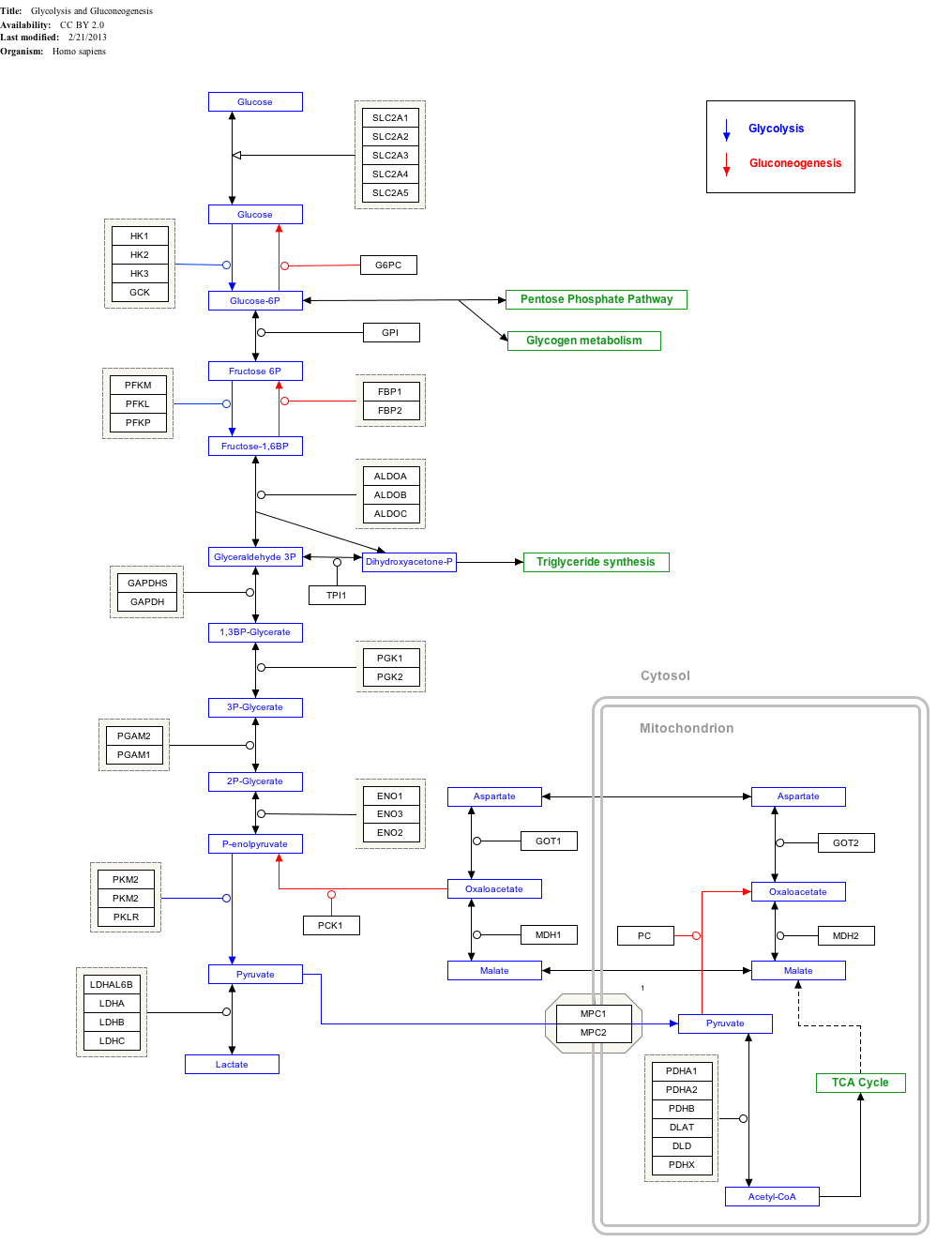
- ^ 대화형 경로 맵은 WikiPathways에서 편집할 수 있습니다."GlycolysisGluconeogenesis_WP534".
「 」를 참조해 주세요.
레퍼런스
- ^ a b c ENSG00000285241 GRCh38: 앙상블 릴리즈 89: ENSG00000100889, ENSG00000285241 - Ensembl, 2017년 5월
- ^ a b c GRCm38: 앙상블 릴리즈 89: ENSMUSG000040618 - 앙상블, 2017년 5월
- ^ "Human PubMed Reference:". National Center for Biotechnology Information, U.S. National Library of Medicine.
- ^ "Mouse PubMed Reference:". National Center for Biotechnology Information, U.S. National Library of Medicine.
- ^ "PCK2 phosphoenolpyruvate carboxykinase 2 (mitochondrial)". NCBI Entrez Gene database.
- ^ a b c d e f Modaressi S, Brechtel K, Christ B, Jungermann K (July 1998). "Human mitochondrial phosphoenolpyruvate carboxykinase 2 gene. Structure, chromosomal localization and tissue-specific expression". The Biochemical Journal. 333 ( Pt 2) (2): 359–66. doi:10.1042/bj3330359. PMC 1219593. PMID 9657976.
- ^ a b c Modaressi S, Christ B, Bratke J, Zahn S, Heise T, Jungermann K (May 1996). "Molecular cloning, sequencing and expression of the cDNA of the mitochondrial form of phosphoenolpyruvate carboxykinase from human liver". The Biochemical Journal. 315 ( Pt 3) (3): 807–14. doi:10.1042/bj3150807. PMC 1217278. PMID 8645161.
- ^ Suzuki M, Yamasaki T, Shinohata R, Hata M, Nakajima H, Kono N (September 2004). "Cloning and reporter analysis of human mitochondrial phosphoenolpyruvate carboxykinase gene promoter". Gene. 338 (2): 157–62. doi:10.1016/j.gene.2004.06.005. PMID 15315819.
- ^ a b c d e f g h i Méndez-Lucas A, Hyroššová P, Novellasdemunt L, Viñals F, Perales JC (August 2014). "Mitochondrial phosphoenolpyruvate carboxykinase (PEPCK-M) is a pro-survival, endoplasmic reticulum (ER) stress response gene involved in tumor cell adaptation to nutrient availability". The Journal of Biological Chemistry. 289 (32): 22090–102. doi:10.1074/jbc.M114.566927. PMC 4139223. PMID 24973213.
- ^ a b c d Leithner K, Hrzenjak A, Trötzmüller M, Moustafa T, Köfeler HC, Wohlkoenig C, Stacher E, Lindenmann J, Harris AL, Olschewski A, Olschewski H (February 2015). "PCK2 activation mediates an adaptive response to glucose depletion in lung cancer". Oncogene. 34 (8): 1044–50. doi:10.1038/onc.2014.47. PMID 24632615.
- ^ Samuel VT, Beddow SA, Iwasaki T, Zhang XM, Chu X, Still CD, Gerhard GS, Shulman GI (July 2009). "Fasting hyperglycemia is not associated with increased expression of PEPCK or G6Pc in patients with Type 2 Diabetes". Proceedings of the National Academy of Sciences of the United States of America. 106 (29): 12121–6. doi:10.1073/pnas.0812547106. PMC 2707270. PMID 19587243.