
PCK1
PCK1| PCK1 | |||||||||||||||||||||||||
|---|---|---|---|---|---|---|---|---|---|---|---|---|---|---|---|---|---|---|---|---|---|---|---|---|---|
 | |||||||||||||||||||||||||
| 식별자 | |||||||||||||||||||||||||
| 에일리어스 | PCK1, PEPCK-C, PEPEPCKC, 포스포에놀피루브산카르복시키나아제1, PCKDC | ||||||||||||||||||||||||
| 외부 ID | OMIM: 614168 MGI: 97501 HomoloGene: 1944 GeneCard: PCK1 | ||||||||||||||||||||||||
| |||||||||||||||||||||||||
| |||||||||||||||||||||||||
| |||||||||||||||||||||||||
| 맞춤법 | |||||||||||||||||||||||||
| 종. | 인간 | 마우스 | |||||||||||||||||||||||
| 엔트레즈 | |||||||||||||||||||||||||
| 앙상블 | |||||||||||||||||||||||||
| 유니프로트 | |||||||||||||||||||||||||
| RefSeq(mRNA) | |||||||||||||||||||||||||
| RefSeq(단백질) | |||||||||||||||||||||||||
| 장소(UCSC) | Chr 20: 57.56 ~57.57 Mb | Chr 2: 172.99 ~173 Mb | |||||||||||||||||||||||
| PubMed 검색 | [3] | [4] | |||||||||||||||||||||||
| 위키데이터 | |||||||||||||||||||||||||
| |||||||||||||||||||||||||


PCK1로도 알려진 포스포에놀피루브산카르복시키나아제 1(용해성)은 인간에서 PCK1 [5][6]유전자에 의해 암호화되는 효소이다.
기능.
이 효소는 글루코네제네시스 조절의 주요 조절 지점이다.이 유전자에 의해 코드된 세포질 효소는 GTP와 함께 이산화탄소와 GDP의 방출과 함께 옥살아세트산으로부터 포스포에놀피루브산의 형성을 촉매한다.이 유전자의 발현은 인슐린, 글루코콜티코이드, 글루카곤, cAMP, 그리고 식이요법에 의해 조절될 수 있다.코드화된 단백질의 미토콘드리아 동질효소도 [5]특징지어졌다.
인터랙티브 패스 맵
아래의 유전자, 단백질 및 대사물을 클릭하여 각각의 기사와 연결하세요.[§ 1]
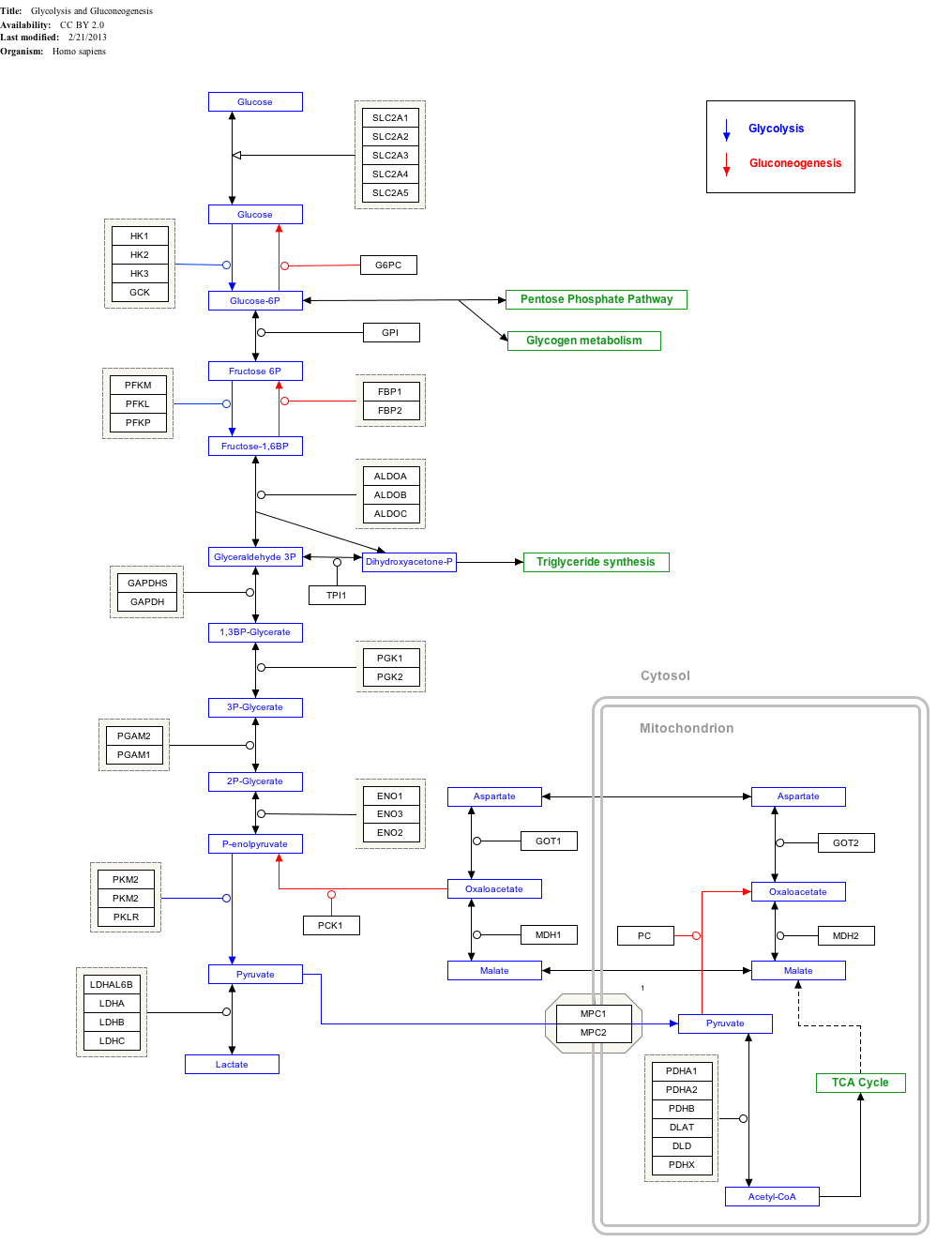
당분해 및 글루코네제네시스 편집
- ^ 대화형 경로 맵은 WikiPathways에서 편집할 수 있습니다."GlycolysisGluconeogenesis_WP534".
「 」를 참조해 주세요.
레퍼런스
- ^ a b c GRCh38: 앙상블 릴리즈 89: ENSG00000124253 - 앙상블, 2017년 5월
- ^ a b c GRCm38: 앙상블 릴리즈 89: ENSMUSG000027513 - 앙상블, 2017년 5월
- ^ "Human PubMed Reference:". National Center for Biotechnology Information, U.S. National Library of Medicine.
- ^ "Mouse PubMed Reference:". National Center for Biotechnology Information, U.S. National Library of Medicine.
- ^ a b "Entrez Gene: PCK1 phosphoenolpyruvate carboxykinase 1 (soluble)".
- ^ Pilz AJ, Willer E, Povey S, Abbott CM (October 1992). "The genes coding for phosphoenolpyruvate carboxykinase-1 (PCK1) and neuronal nicotinic acetylcholine receptor alpha 4 subunit (CHRNA4) map to human chromosome 20, extending the known region of homology with mouse chromosome 2". Ann. Hum. Genet. 56 (Pt 4): 289–93. doi:10.1111/j.1469-1809.1992.tb01155.x. PMID 1492743. S2CID 23586336.
추가 정보
- Beale EG, Hammer RE, Antoine B, Forest C (2004). "Disregulated glyceroneogenesis: PCK1 as a candidate diabetes and obesity gene". Trends Endocrinol. Metab. 15 (3): 129–35. doi:10.1016/j.tem.2004.02.006. PMID 15046742. S2CID 9194909.
- Pilz AJ, Willer E, Povey S, Abbott CM (1993). "The genes coding for phosphoenolpyruvate carboxykinase-1 (PCK1) and neuronal nicotinic acetylcholine receptor alpha 4 subunit (CHRNA4) map to human chromosome 20, extending the known region of homology with mouse chromosome 2". Ann. Hum. Genet. 56 (Pt 4): 289–93. doi:10.1111/j.1469-1809.1992.tb01155.x. PMID 1492743. S2CID 23586336.
- Giralt M, Park EA, Gurney AL, et al. (1991). "Identification of a thyroid hormone response element in the phosphoenolpyruvate carboxykinase (GTP) gene. Evidence for synergistic interaction between thyroid hormone and cAMP cis-regulatory elements". J. Biol. Chem. 266 (32): 21991–6. doi:10.1016/S0021-9258(18)54735-9. PMID 1657985.
- Beale EG, Chrapkiewicz NB, Scoble HA, et al. (1985). "Rat hepatic cytosolic phosphoenolpyruvate carboxykinase (GTP). Structures of the protein, messenger RNA, and gene". J. Biol. Chem. 260 (19): 10748–60. doi:10.1016/S0021-9258(19)85145-1. PMID 2993287.
- Ting CN, Burgess DL, Chamberlain JS, et al. (1993). "Phosphoenolpyruvate carboxykinase (GTP): characterization of the human PCK1 gene and localization distal to MODY on chromosome 20" (PDF). Genomics. 16 (3): 698–706. doi:10.1006/geno.1993.1250. hdl:2027.42/30779. PMID 8325643.
- Yu H, Thun R, Chandrasekharappa S, et al. (1993). "Human PCK1 encoding phosphoenolpyruvate carboxykinase is located on chromosome 20q13.2" (PDF). Genomics. 15 (1): 219–21. doi:10.1006/geno.1993.1040. hdl:2027.42/31063. PMID 8432541.
- Stoffel M, Xiang KS, Espinosa R, et al. (1993). "cDNA sequence and localization of polymorphic human cytosolic phosphoenolpyruvate carboxykinase gene (PCK1) to chromosome 20, band q13.31: PCK1 is not tightly linked to maturity-onset diabetes of the young". Hum. Mol. Genet. 2 (1): 1–4. doi:10.1093/hmg/2.1.1. PMID 8490617.
- O'Brien RM, Printz RL, Halmi N, et al. (1996). "Structural and functional analysis of the human phosphoenolpyruvate carboxykinase gene promoter". Biochim. Biophys. Acta. 1264 (3): 284–8. doi:10.1016/0167-4781(95)00194-8. PMID 8547315.
- Parissi V, Calmels C, De Soultrait VR, et al. (2001). "Functional interactions of human immunodeficiency virus type 1 integrase with human and yeast HSP60". J. Virol. 75 (23): 11344–53. doi:10.1128/JVI.75.23.11344-11353.2001. PMC 114720. PMID 11689615.
- Deloukas P, Matthews LH, Ashurst J, et al. (2002). "The DNA sequence and comparative analysis of human chromosome 20". Nature. 414 (6866): 865–71. doi:10.1038/414865a. PMID 11780052.
- Dunten P, Belunis C, Crowther R, et al. (2002). "Crystal structure of human cytosolic phosphoenolpyruvate carboxykinase reveals a new GTP-binding site". J. Mol. Biol. 316 (2): 257–64. doi:10.1006/jmbi.2001.5364. PMID 11851336.
- Jurado LA, Song S, Roesler WJ, Park EA (2002). "Conserved amino acids within CCAAT enhancer-binding proteins (C/EBP(alpha) and beta) regulate phosphoenolpyruvate carboxykinase (PEPCK) gene expression". J. Biol. Chem. 277 (31): 27606–12. doi:10.1074/jbc.M201429200. PMID 11997389.
- Wilson HL, McFie PJ, Roesler WJ (2003). "Different transcription factor binding arrays modulate the cAMP responsivity of the phosphoenolpyruvate carboxykinase gene promoter". J. Biol. Chem. 277 (46): 43895–902. doi:10.1074/jbc.M203169200. PMID 12237288.
- Borgius LJ, Steffensen KR, Gustafsson JA, Treuter E (2003). "Glucocorticoid signaling is perturbed by the atypical orphan receptor and corepressor SHP". J. Biol. Chem. 277 (51): 49761–6. doi:10.1074/jbc.M205641200. PMID 12324453.
- Strausberg RL, Feingold EA, Grouse LH, et al. (2003). "Generation and initial analysis of more than 15,000 full-length human and mouse cDNA sequences". Proc. Natl. Acad. Sci. U.S.A. 99 (26): 16899–903. doi:10.1073/pnas.242603899. PMC 139241. PMID 12477932.
- Chakravarty K, Wu SY, Chiang CM, et al. (2004). "SREBP-1c and Sp1 interact to regulate transcription of the gene for phosphoenolpyruvate carboxykinase (GTP) in the liver". J. Biol. Chem. 279 (15): 15385–95. doi:10.1074/jbc.M309905200. PMID 14744869.
- Cao H, van der Veer E, Ban MR, et al. (2004). "Promoter polymorphism in PCK1 (phosphoenolpyruvate carboxykinase gene) associated with type 2 diabetes mellitus". J. Clin. Endocrinol. Metab. 89 (2): 898–903. doi:10.1210/jc.2003-031361. PMID 14764811.
- Gerhard DS, Wagner L, Feingold EA, et al. (2004). "The status, quality, and expansion of the NIH full-length cDNA project: the Mammalian Gene Collection (MGC)". Genome Res. 14 (10B): 2121–7. doi:10.1101/gr.2596504. PMC 528928. PMID 15489334.
- Hajarnis S, Schroeder JM, Curthoys NP (2005). "3'-Untranslated region of phosphoenolpyruvate carboxykinase mRNA contains multiple instability elements that bind AUF1". J. Biol. Chem. 280 (31): 28272–80. doi:10.1074/jbc.M501204200. PMID 15951444.
PDB 갤러리 | |
|---|---|
|


