
적핵
Red nucleus| 적핵 | |
|---|---|
 | |
| 세부 사항 | |
| 의 일부 | 중간뇌 |
| 식별자 | |
| 라틴어 | 핵 루버 |
| 메슈 | D012012 |
| NeuroNames | 505 |
| NeuroEx ID | 버넥스_1478 |
| TA98 | A14.1.06.323 |
| TA2 | 5898 |
| FMA | 62407 |
| 신경조영술의 해부학적 용어 | |
적핵 또는 핵 루버는 운동 조정에 관여하는 회전 중뇌의 구조물이다.[1] 붉은 핵은 옅은 분홍색인데, 이는 헤모글로빈과 페리틴의 적어도 두 가지 다른 형태의 철분이 존재하기 때문인 것으로 생각된다.[2][3] 구조는 실체형 니그라 옆에 있는 중뇌의 티그넘에 위치하며, 후두막세포와 로스트랄 파보세포 구성요소로 구성된다.[1] 적핵과 실체니아 니그라는 외사성 운동계의 부역학적 중심이다.
함수
유의미한 피질경이 없는 척추동물에서 걸음걸이는 주로 적핵에 의해 조절된다.[4] 그러나 피질공간관이 지배적인 영장류에서 루브로스피질관은 운동기능에서 잔재물로 간주될 수 있다. 그러므로, 붉은 핵은 영장류에서 다른 많은 포유동물들보다 덜 중요하다.[1][5] 그럼에도 불구하고, 아기들의 기어가는 것은 전형적인 걸음걸이에서 팔을 휘두르는 것과 마찬가지로 적핵에 의해 조절된다.[6] 적핵은 자기세포 부분의 투영을 통해 어깨와 상팔의 근육을 조절하는 추가적인 역할을 할 수 있다.[7][8] 인간에게 있어서 붉은 핵은 또한 손의 통제가 제한되는데, 이는 루브로 척추관이 팔의 그것과 같은 큰 근육 이동에 더 많이 관여하기 때문이다(그러나 척수의 상부 흉부 부위에서 종지부를 찍기 때문에 다리의 경우는 그렇지 않다). 손가락의 미세한 조절은 적핵의 기능에 의해 변형되는 것이 아니라 피질공장에 의존한다.[9] 대다수의 적핵 차축은 척수에 투영되지 않고 파보세포 부분을 통해 운동 피질에서 소뇌로 정보를 전달하는데, 이는 중수체의 중요한 계전기 중심이다.[1]
입출력
적핵은 반대편의 소뇌(간격핵과 측간소뇌핵)로부터 많은 입력을 받고, 같은 쪽의 운동피질로부터 입력을 받는다.[10]
적핵에는 두 세트의 용출수가 있다.[10]
- 인간에게 있어서 대부분의 산출물은 같은 쪽의 열등 올리브 쪽을 향해 내분장을 통해 계속되어 궁극적으로 소뇌에 영향을 미치는 경로의 일부를 형성한다.
- 다른 출력물(루브로스피날 투영법)은 횡방향 코르티실린 트랙으로 복측으로 이어지는 루브로스피날 트랙을 구성하며, 반대편의 롬브지팔 망막 형성 및 척수로 간다. 앞에서 말한 바와 같이, 루브로스피널은 비원산종에서 더 중요하다: 영장류에서는 대뇌피질이 잘 발달되어 있기 때문에, 코르티코스피탈이 루브로스피널의 역할을 대신하게 되었다.
참고 항목
추가 이미지

주요 갱년기 범주(I ~ V)의 도식적 표현.
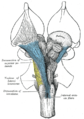
뇌조직의 심층 절개. 복측도.

대뇌를 통한 횡단면.
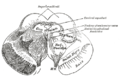
상급 콜리쿨리 수준에서의 중뇌 횡단면.

뇌 관상동맥이 바로 앞쪽이야

인간 뇌전면(코론) 섹션

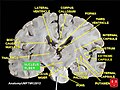
적핵

뇌척수, 시신경, 뇌수관. 열등감. 깊은 해부.

대뇌 열등감.깊은 해부.


참조
- ^ a b c d Cacciola, Alberto; Milardi, Demetrio; Basile, Gianpaolo Antonio; Bertino, Salvatore; Calamuneri, Alessandro; Chillemi, Gaetana; Paladina, Giuseppe; Impellizzeri, Federica; Trimarchi, Fabio; Anastasi, Giuseppe; Bramanti, Alessia; Rizzo, Giuseppina (2019-08-20). "The cortico-rubral and cerebello-rubral pathways are topographically organized within the human red nucleus". Scientific Reports. 9 (1): 12117. Bibcode:2019NatSR...912117C. doi:10.1038/s41598-019-48164-7. ISSN 2045-2322. PMC 6702172. PMID 31431648.
- ^ 위키백과 적핵 개정 https://sites.google.com/site/childrenoftheamphioxus/table-of-contents/wikipedia-red-nucleus-revision
- ^ Drayer, B.; Burger, P.; Darwin, R.; Riederer, S.; Herfkens, R.; Johnson, G. A. (July 1986). "MRI of brain iron". AJR. American Journal of Roentgenology. 147 (1): 103–110. doi:10.2214/ajr.147.1.103. ISSN 0361-803X. PMID 3487201.
- ^ ten Donkelaar, H. J. (1988-04-01). "Evolution of the red nucleus and rubrospinal tract". Behavioural Brain Research. 28 (1): 9–20. doi:10.1016/0166-4328(88)90072-1. ISSN 0166-4328. PMID 3289562. S2CID 54367413.
- ^ Onodera, Satoru; Hicks, T. Philip (2009-08-13). "A Comparative Neuroanatomical Study of the Red Nucleus of the Cat, Macaque and Human". PLOS ONE. 4 (8): –6623. Bibcode:2009PLoSO...4.6623O. doi:10.1371/journal.pone.0006623. ISSN 1932-6203. PMC 2722087. PMID 19675676. S2CID 18760268.
- ^ Being and Perceiving. Manupod Press. 2011. p. 49. ISBN 978-0-9569621-0-2.
- ^ Gibson, A. R.; Houk, J. C.; Kohlerman, N. J. (1985). "Magnocellular red nucleus activity during different types of limb movement in the macaque monkey". The Journal of Physiology. 358 (1): 527–549. doi:10.1113/jphysiol.1985.sp015565. ISSN 1469-7793. PMC 1193356. PMID 3981472.
- ^ van Kan, Peter L.; McCurdy, Martha L. (2002-01-01). "Discharge of primate magnocellular red nucleus neurons during reaching to grasp in different spatial locations". Experimental Brain Research. 142 (1): 151–157. doi:10.1007/s00221-001-0924-5. ISSN 1432-1106. PMID 11797092. S2CID 42113292.
- ^ Bunday, Karen L.; Tazoe, Toshiki; Rothwell, John C.; Perez, Monica A. (2014-05-21). "Subcortical Control of Precision Grip after Human Spinal Cord Injury". Journal of Neuroscience. 34 (21): 7341–7350. doi:10.1523/JNEUROSCI.0390-14.2014. ISSN 1529-2401. PMC 4028504. PMID 24849366.
- ^ a b Milardi, Demetrio; Cacciola, Alberto; Cutroneo, Giuseppina; Marino, Silvia; Irrera, Mariangela; Cacciola, Giorgio; Santoro, Giuseppe; Ciolli, Pietro; Anastasi, Giuseppe; Calabrò, Rocco Salvatore; Quartarone, Angelo (2016-07-28). "Red nucleus connectivity as revealed by constrained spherical deconvolution tractography". Neuroscience Letters. 626: 68–73. doi:10.1016/j.neulet.2016.05.009. ISSN 0304-3940. PMID 27181514. S2CID 46756208. Retrieved 2020-08-30.
외부 링크
 | 위키미디어 커먼즈에는 적핵과 관련된 미디어가 있다. |


