에스트린(복합)
Estrin (compound) | |
| 이름 | |
|---|---|
| 우선 IUPAC 이름 (3aS,3bS,9bS,11aS)-11a-메틸-2,3,3a,4,5,9b,10,11a-데카히드로-1H-시클로펜타[a]페난트렌 | |
| 기타 이름 에스트라-1, 3, 5(10)-트리엔; 에스트라트리엔 | |
| 식별자 | |
3D 모델(JSmol) | |
| 첸블 | |
| 켐스파이더 | |
PubChem CID | |
CompTox 대시보드 (EPA ) | |
| |
| |
| 특성. | |
| C18H24 | |
| 몰 질량 | 240.39 g/g |
달리 명시되지 않은 한 표준 상태(25°C[77°F], 100kPa)의 재료에 대한 데이터가 제공됩니다. | |

에스트라-1,3,5(10)-트리엔이라고도 알려진 에스트린(미국 영어) 또는 에스트린은 에스트란 스테로이드이다.C1, C3, C5(10) 위치에 특이적으로 이중 결합을 가진 탈수소 에스트란이다.에스트린은 [1][2]디히드록시에스트린, 케토히드록시에스트린, 트리히드록시에스트린으로도 알려진 에스트로겐 스테로이드 호르몬 에스트라디올, 에스트리오르의 모구조이다.
에스트로겐 유도체와는 달리 에스트린은 최소한의 에스트로겐 활성을 가지고 있으며, 이는 C3 및 C17 위치의 수산기 및/또는 케토 치환이 에스트로겐 [3][4]수용체에 대한 높은 결합 친화성에 매우 중요하기 때문이다.에스트린은 [5][6][3]에스트라디올보다 체외 에스트로겐 반응을 유도하는 효과가 1000배 정도 낮은 것으로 밝혀졌다.에스트린 외에 에스트라디올의 3-히드록실기가 결여된 에스트라트리엔-17β-ol 및 에스트라디올의 17β-히드록실기가 결여된 3-히드록시에스트라트리엔은 에스트로겐 수용체에 대해 측정 가능한 친화력을 가지며 수용체를 활성화하여 프로게스테론 수용체 [6][7][3]발현을 유도할 수 있다.
에스트린이라는 용어는 [8]에스트로겐의 동의어이기도 하다.그것은 Alan S. Parkes 경과 C에 의해 만들어졌다.1926년 벨러비는 동물의 발정을 유발하는 난소에서 분비되는 호르몬(에스트로겐)[8]을 기술했다.
주요 내인성 에스트로겐 구조  |
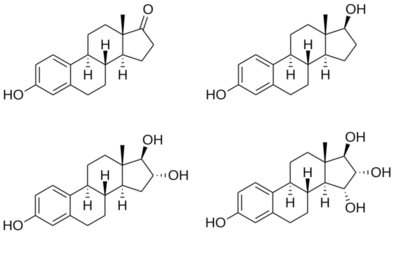
「 」를 참조해 주세요.
레퍼런스
- ^ Biskind, Morton S. (1935). "Commercial glandular products". Journal of the American Medical Association. 105 (9): 667. doi:10.1001/jama.1935.92760350007009a. ISSN 0002-9955.
- ^ Fluhmann CF (1938). "Estrogenic Hormones: Their Clinical Usage". Cal West Med. 49 (5): 362–6. PMC 1659459. PMID 18744783.
- ^ a b c Anstead GM, Carlson KE, Katzenellenbogen JA (1997). "The estradiol pharmacophore: ligand structure-estrogen receptor binding affinity relationships and a model for the receptor binding site". Steroids. 62 (3): 268–303. doi:10.1016/s0039-128x(96)00242-5. PMID 9071738.
- ^ Thomas L. Lemke; David A. Williams (24 January 2012). Foye's Principles of Medicinal Chemistry. Lippincott Williams & Wilkins. pp. 1395–. ISBN 978-1-60913-345-0.
- ^ Jordan VC, Koch R (April 1989). "Regulation of prolactin synthesis in vitro by estrogenic and antiestrogenic derivatives of estradiol and estrone". Endocrinology. 124 (4): 1717–26. doi:10.1210/endo-124-4-1717. PMID 2924721.
- ^ a b Brooks SC, Wappler NL, Corombos JD, Doherty LM, Horwitz JP (1987). "Estrogen structure-receptor function relationships". In Moudgil VK (ed.). Recent Advances in Steroid Hormone Action. Walter de Gruyter. pp. 443–466.
- ^ Schwartz JA, Skafar DF (September 1993). "Ligand-mediated modulation of estrogen receptor conformation by estradiol analogs". Biochemistry. 32 (38): 10109–15. doi:10.1021/bi00089a029. PMID 8399136.
- ^ a b Marc A. Fritz; Leon Speroff (28 March 2012). Clinical Gynecologic Endocrinology and Infertility. Lippincott Williams & Wilkins. pp. 750–. ISBN 978-1-4511-4847-3.