TPI1
TPI1| TPI1 | |||||||||||||||||||||||||
|---|---|---|---|---|---|---|---|---|---|---|---|---|---|---|---|---|---|---|---|---|---|---|---|---|---|
 | |||||||||||||||||||||||||
| 식별자 | |||||||||||||||||||||||||
| 에일리어스 | TPI1, HEL-S-49, TIM, TPI, TPID, 삼인산 이성질화효소 1 | ||||||||||||||||||||||||
| 외부 ID | OMIM: 190450 MGI: 98797 HomoloGene: 128432 GeneCard: TPI1 | ||||||||||||||||||||||||
| |||||||||||||||||||||||||
| |||||||||||||||||||||||||
| |||||||||||||||||||||||||
| |||||||||||||||||||||||||
| 맞춤법 | |||||||||||||||||||||||||
| 종. | 인간 | 마우스 | |||||||||||||||||||||||
| 엔트레즈 | |||||||||||||||||||||||||
| 앙상블 | |||||||||||||||||||||||||
| 유니프로트 | |||||||||||||||||||||||||
| RefSeq(mRNA) | |||||||||||||||||||||||||
| RefSeq(단백질) | |||||||||||||||||||||||||
| 장소(UCSC) | Chr 12: 6.87 ~6.87 Mb | Chr 6: 124.79 ~124.79 Mb | |||||||||||||||||||||||
| PubMed 검색 | [3] | [4] | |||||||||||||||||||||||
| 위키데이터 | |||||||||||||||||||||||||
| |||||||||||||||||||||||||


트리오스인산 이성질화효소는 사람에게서 TPI1 유전자에 의해 코드되는 효소이다.
이 유전자는 글리세린알데히드 3-인산(G3P)과 디히드록시아세톤 인산(DHAP)의 이성화를 촉매하는 두 개의 동일한 단백질로 구성된 효소를 암호화한다.이 유전자의 돌연변이는 삼인산 이성질화효소 결핍과 관련이 있다.유사유전자는 1, 4, 6, 7번 염색체에서 확인되었다.대체 스플라이싱으로 인해 여러 개의 트랜스크립트 [5]변형이 발생합니다.
구조.
트리오스인산 이성질화효소는 단백질의 알파 및 베타(α/β) 등급의 구성원이다. 호모디머이며 각 서브유닛은 247개의 아미노산을 포함한다.각 TPI1 단량체는 전체 촉매 잔류물을 포함하지만 효소는 올리고머 [6]형태에서만 활성입니다.따라서 효소의 완전한 기능을 얻기 위해서는 두 활성 부위가 서로 [7]협력하는 것으로 여겨지지 않더라도 효소는 이합체 내에 있어야 한다.각 서브유닛은 8개의 내부 베타 가닥을 둘러싼 8개의 외부 알파 나선형(alpha helic)을 포함하며, 폐쇄 알파/베타 배럴(αβ) 또는 더 구체적으로 TIM 배럴이라고 하는 보존된 구조 도메인을 형성합니다.대부분의 TIM 배럴 도메인의 특징은 베타 가닥의 C-말단과 알파 나선의 N-말단을 연결하는 8개의 루프에 의해 생성된 하부 루프 영역에 효소의 활성 부위가 존재한다는 것이다.TIM 배럴 단백질은 또한 구조적으로 보존된 인산염 결합 모티브를 기질 또는 보조 [5]인자에서 발견되는 인산염기와 공유한다.
각 사슬에서 베타 가닥에서 안쪽으로 향하는 비극성 아미노산이 구조의 소수성 코어에 기여한다.알파 나선은 양친매성입니다. 외부(물과 접촉하는) 표면은 극성이고 내부 표면은 대부분 소수성입니다.
기능.
TPI는 수소 원자의 탄소 1에서 탄소 2로의 전달을 촉매하여 분자 내 산화 환원 반응이다.알도스로의 케토스의 이성화는 시스-에네디올(산염) 중간체를 통해 진행된다.이 이성질화는 보조인자 없이 진행되며 효소는 화학적 염기(아세테이트 [8]이온)를 포함하는 비효소 반응에 대해 10 비율의 증가를 제공합니다9.TPI는 당분해에서의 역할 외에도 글루코네제네시스, 펜토스인산분로 및 지방산 생합성을 포함한 몇 가지 추가적인 대사 생물학적 과정에도 관여한다.
임상적 의의
삼인산 이성질화효소 결핍은 적혈구 부족(빈혈), 운동 문제, 감염에 대한 감수성 증가, 호흡과 심장 기능에 영향을 줄 수 있는 근육 약화로 특징지어지는 질환이다.이 상태의 빈혈은 유아기에 시작된다.빈혈은 적혈구의 조기 붕괴(용혈)에서 비롯되기 때문에 용혈성 빈혈로 알려져 있다.체내에 산소를 운반할 적혈구의 부족은 극심한 피로감, 창백한 피부, 그리고 호흡곤란을 초래한다.적혈구가 분해될 때, 철분과 빌리루빈이라고 불리는 분자가 방출된다; 삼인산 이성질화효소 결핍증을 가진 사람들은 혈액에서 이러한 물질들이 과다하게 순환한다.혈중 빌리루빈이 과다하면 황달이 생기는데, 황달은 피부와 눈의 흰자가 노랗게 변하는 것입니다.이동 문제는 일반적으로 2세부터 삼인산 이성질화효소 결핍증 환자에서 명백해진다.운동장애는 근육의 움직임을 조절하는 뇌와 척수의 특수 신경세포인 운동신경세포의 장애에 의해 발생한다.이 장애는 근육 약화와 소모로 이어지고, 무의식적인 근육 긴장, 떨림, 그리고 약한 근육 긴장(hypotonia)을 포함한 삼인산 이성질체 결핍의 전형적인 운동 문제를 일으킨다.영향을 받은 사람들은 또한 발작을 일으킬 수 있다.심장(심근증으로 알려진 상태)과 흉강에서 복부를 분리하는 근육(격막)과 같은 다른 근육의 약화도 삼인산 이성질화효소 결핍에서 발생할 수 있습니다.횡격막의 약화는 호흡 장애를 일으킬 수 있고 궁극적으로 호흡 부전으로 이어질 수 있습니다.삼인산 이성질화효소 결핍증을 가진 사람들은 백혈구가 제대로 작동하지 않기 때문에 감염에 걸릴 위험이 높아진다.이 면역 체계 세포들은 보통 감염을 막기 위해 바이러스나 박테리아와 같은 외부 침입자들을 인식하고 공격한다.삼인산 이성질화효소 결핍증 환자에게서 가장 흔한 감염은 호흡기의 세균 감염이다.삼인산 이성질화효소 결핍증을 가진 사람들은 종종 호흡부전으로 인해 어린 시절부터 살아남지 못한다.드문 경우지만, 심각한 신경 손상이나 근육 약화 없이 영향을 받은 사람들이 성인이 [5]될 때까지 살았다.결핍은 TPI1의 돌연변이에 의해 가장 일반적으로 발생하지만, 다른 동질 형태에서의 돌연변이는 확인되었다.TPI 결핍에 대한 일반적인 지표는 적혈구 추출물에서 DHAP의 축적이 증가하는 것이다. 이는 결함 효소가 더 이상 GAP에 대한 이성화를 촉매할 수 없기 때문이다.점 돌연변이는 촉매 작용 속도에 영향을 주지 않고 오히려 효소가 호모디머로 [9][10]결합하는 데 영향을 미친다.
알츠하이머병 연구의 최근 발견은 아밀로이드 베타펩타이드 유도 니트로 산화성 손상이 인간 신경아세포에서 [11]TPI의 니트로티로화를 촉진한다는 것을 보여준다.니트로실화 TPI는 알츠하이머병 환자뿐만 아니라 인간 아밀로이드 전구 단백질을 과잉 발현하는 이중 유전자 생쥐의 뇌 슬라이드에 존재하는 것으로 밝혀졌다.구체적으로 니트로티로시네이션은 촉매 중심 부근에 있는 단백질 내의 Tyr164와 Tyr208에서 발생하며, 이 변형은 이성화 활성 감소와 관련이 있다.
인터랙티브 패스 맵
아래의 유전자, 단백질 및 대사물을 클릭하여 각각의 기사와 연결하세요.[§ 1]
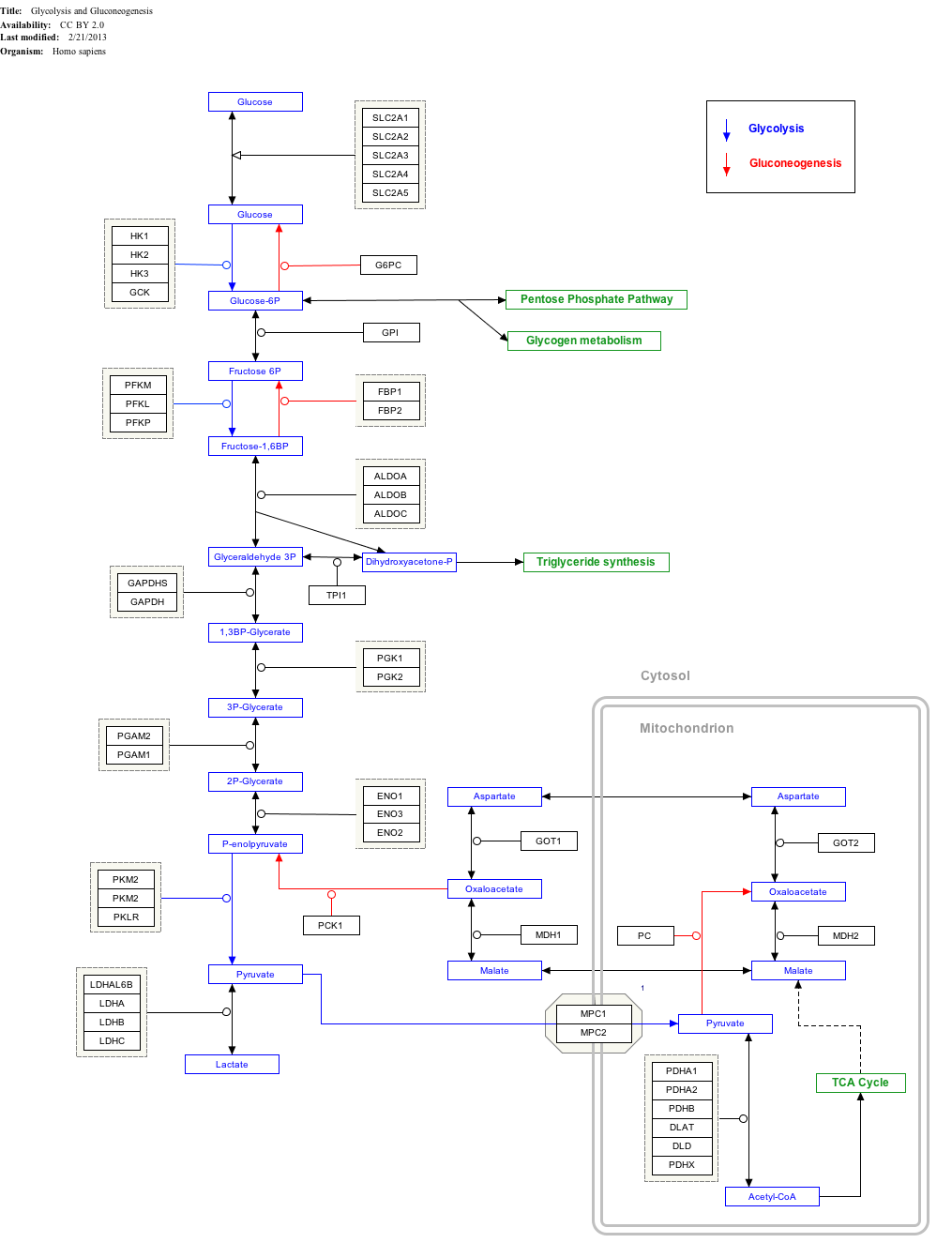
- ^ 대화형 경로 맵은 WikiPathways에서 편집할 수 있습니다."GlycolysisGluconeogenesis_WP534".
모델 유기체
| 특성. | 표현형 |
|---|---|
| 호모이지고트 생존력 | 비정상적인 |
| 열성 치사 연구 | 비정상적인 |
| 번식력 | 보통의 |
| 체중 | 보통의 |
| 불안. | 보통의 |
| 신경학적 평가 | 보통의 |
| 그립 강도 | 보통의 |
| 핫플레이트 | 보통의 |
| 이형학 | 보통의 |
| 간접 열량 측정 | 보통의 |
| 포도당 내성 시험 | 보통의 |
| 청각 뇌간 반응 | 보통의 |
| DEXA | 보통의 |
| 방사선 촬영 | 보통의 |
| 체온 | 보통의 |
| 눈의 형태학 | 보통의 |
| 임상화학 | 보통의 |
| 플라즈마 면역글로불린 | 보통의 |
| 혈액학 | 보통의 |
| 말초혈액 림프구 | 보통의 |
| 미크로뉴클러스 시험 | 보통의 |
| 심장 무게 | 보통의 |
| 피부조직병리학 | 보통의 |
| 뇌조직병리학 | 보통의 |
| 살모넬라균 감염 | 이상[12] |
| 시트로박터 감염 | 보통[13] |
| 모든 테스트 및 분석[14][15]: |
모델 유기체는 TPI1 기능의 연구에 사용되어 왔다.Tpi1이라고tm1a(EUCOMM)Wtsi[16][17] 불리는 조건부 녹아웃 마우스 라인이 International Knockout Mouse Consortium 프로그램의 일부로 생성되었습니다.이것은 질병 동물 모델을 생성하고 관심 있는 [18][19][20]과학자들에게 배포하는 높은 처리량 돌연변이 유발 프로젝트입니다.
수컷과 암컷은 표준화된 표현형 검사를 통해 [14][21]결실의 효과를 확인했습니다.돌연변이 생쥐에 대해 26개의 검사가 수행되었고 3개의 유의한 이상이 [14]관찰되었다.임신 기간 동안 동종 돌연변이 배아는 확인되지 않았고, 따라서 젖을 뺄 때까지 생존한 배아는 없었다.나머지 테스트는 헤테로 접합 돌연변이 성체 쥐를 대상으로 수행되었으며 수컷 [14]동물에서 세균 감염에 대한 감수성 증가가 관찰되었다.
「 」를 참조해 주세요.
레퍼런스
- ^ a b c GRCh38: 앙상블 릴리즈 89: ENSG00000111669 - 앙상블, 2017년 5월
- ^ a b c GRCm38: 앙상블 릴리즈 89: ENSMUSG000023456 - 앙상블, 2017년 5월
- ^ "Human PubMed Reference:". National Center for Biotechnology Information, U.S. National Library of Medicine.
- ^ "Mouse PubMed Reference:". National Center for Biotechnology Information, U.S. National Library of Medicine.
- ^ a b c "Entrez Gene: TPI1 triosephosphate isomerase 1".
- ^ Rodríguez-Almazán C, Arreola R, Rodríguez-Larrea D, Aguirre-López B, de Gómez-Puyou MT, Pérez-Montfort R, Costas M, Gómez-Puyou A, Torres-Larios A (Aug 2008). "Structural basis of human triosephosphate isomerase deficiency: mutation E104D is related to alterations of a conserved water network at the dimer interface". The Journal of Biological Chemistry. 283 (34): 23254–63. doi:10.1074/jbc.M802145200. PMID 18562316.
- ^ Schnackerz KD, Gracy RW (Jul 1991). "Probing the catalytic sites of triosephosphate isomerase by 31P-NMR with reversibly and irreversibly binding substrate analogues". European Journal of Biochemistry. 199 (1): 231–8. doi:10.1111/j.1432-1033.1991.tb16114.x. PMID 2065677.
- ^ Davenport RC, Bash PA, Seaton BA, Karplus M, Petsko GA, Ringe D (Jun 1991). "Structure of the triosephosphate isomerase-phosphoglycolohydroxamate complex: an analogue of the intermediate on the reaction pathway". Biochemistry. 30 (24): 5821–6. doi:10.1021/bi00238a002. PMID 2043623.
- ^ Ralser M, Heeren G, Breitenbach M, Lehrach H, Krobitsch S (20 December 2006). "Triose phosphate isomerase deficiency is caused by altered dimerization--not catalytic inactivity--of the mutant enzymes". PLOS ONE. 1: e30. doi:10.1371/journal.pone.0000030. PMC 1762313. PMID 17183658.
- ^ Schneider AS (Mar 2000). "Triosephosphate isomerase deficiency: historical perspectives and molecular aspects". Baillière's Best Practice & Research. Clinical Haematology. 13 (1): 119–40. doi:10.1053/beha.2000.0061. PMID 10916682.
- ^ Guix FX, Ill-Raga G, Bravo R, Nakaya T, de Fabritiis G, Coma M, Miscione GP, Villà-Freixa J, Suzuki T, Fernàndez-Busquets X, Valverde MA, de Strooper B, Muñoz FJ (May 2009). "Amyloid-dependent triosephosphate isomerase nitrotyrosination induces glycation and tau fibrillation". Brain. 132 (Pt 5): 1335–45. doi:10.1093/brain/awp023. PMID 19251756.
- ^ "Salmonella infection data for Tpi1". Wellcome Trust Sanger Institute.
- ^ "Citrobacter infection data for Tpi1". Wellcome Trust Sanger Institute.
- ^ a b c d Gerdin AK (2010). "The Sanger Mouse Genetics Programme: High throughput characterisation of knockout mice". Acta Ophthalmologica. 88: 925–7. doi:10.1111/j.1755-3768.2010.4142.x. S2CID 85911512.
- ^ Wellcome Trust Sanger Institute의 마우스 리소스 포털.
- ^ "International Knockout Mouse Consortium".
- ^ "Mouse Genome Informatics".
- ^ Skarnes WC, Rosen B, West AP, Koutsourakis M, Bushell W, Iyer V, Mujica AO, Thomas M, Harrow J, Cox T, Jackson D, Severin J, Biggs P, Fu J, Nefedov M, de Jong PJ, Stewart AF, Bradley A (Jun 2011). "A conditional knockout resource for the genome-wide study of mouse gene function". Nature. 474 (7351): 337–42. doi:10.1038/nature10163. PMC 3572410. PMID 21677750.
- ^ Dolgin E (Jun 2011). "Mouse library set to be knockout". Nature. 474 (7351): 262–3. doi:10.1038/474262a. PMID 21677718.
- ^ Collins FS, Rossant J, Wurst W (Jan 2007). "A mouse for all reasons". Cell. 128 (1): 9–13. doi:10.1016/j.cell.2006.12.018. PMID 17218247. S2CID 18872015.
- ^ van der Weyden L, White JK, Adams DJ, Logan DW (2011). "The mouse genetics toolkit: revealing function and mechanism". Genome Biology. 12 (6): 224. doi:10.1186/gb-2011-12-6-224. PMC 3218837. PMID 21722353.
추가 정보
- Ationu A, Humphries A (Dec 1998). "The feasibility of replacement therapy for inherited disorder of glycolysis: triosephosphate isomerase deficiency (review)". International Journal of Molecular Medicine. 2 (6): 701–4. doi:10.3892/ijmm.2.6.701. PMID 9850739.
- Oláh J, Orosz F, Keserü GM, Kovári Z, Kovács J, Hollán S, Ovádi J (Apr 2002). "Triosephosphate isomerase deficiency: a neurodegenerative misfolding disease". Biochemical Society Transactions. 30 (2): 30–8. doi:10.1042/BST0300030. PMID 12023819.
- Rethoré MO, Kaplan JC, Junien C, Lejeune J (Apr 1977). "12pter to 12p12.2: possible assignment of human triose phosphate isomerase". Human Genetics. 36 (2): 235–7. doi:10.1007/BF00273263. PMID 858628. S2CID 25241150.
- Perry BA, Mohrenweiser HW (Mar 1992). "Human triosephosphate isomerase: substitution of Arg for Gly at position 122 in a thermolabile electromorph variant, TPI-Manchester". Human Genetics. 88 (6): 634–8. doi:10.1007/BF02265287. PMID 1339398. S2CID 35721080.
- Dawson SJ, White LA (May 1992). "Treatment of Haemophilus aphrophilus endocarditis with ciprofloxacin". The Journal of Infection. 24 (3): 317–20. doi:10.1016/S0163-4453(05)80037-4. PMID 1602151.
- Boyer TG, Maquat LE (Nov 1990). "Minimal sequence and factor requirements for the initiation of transcription from an atypical, TATATAA box-containing housekeeping promoter". The Journal of Biological Chemistry. 265 (33): 20524–32. doi:10.1016/S0021-9258(17)30534-3. PMID 2243103.
- Maquat LE, Chilcote R, Ryan PM (Mar 1985). "Human triosephosphate isomerase cDNA and protein structure. Studies of triosephosphate isomerase deficiency in man". The Journal of Biological Chemistry. 260 (6): 3748–53. doi:10.1016/S0021-9258(19)83687-6. PMID 2579079.
- Daar IO, Artymiuk PJ, Phillips DC, Maquat LE (Oct 1986). "Human triose-phosphate isomerase deficiency: a single amino acid substitution results in a thermolabile enzyme". Proceedings of the National Academy of Sciences of the United States of America. 83 (20): 7903–7. doi:10.1073/pnas.83.20.7903. PMC 386831. PMID 2876430.
- Boyer TG, Krug JR, Maquat LE (Mar 1989). "Transcriptional regulatory sequences of the housekeeping gene for human triosephosphate isomerase". The Journal of Biological Chemistry. 264 (9): 5177–87. doi:10.1016/S0021-9258(18)83716-4. PMID 2925688.
- Brown JR, Daar IO, Krug JR, Maquat LE (Jul 1985). "Characterization of the functional gene and several processed pseudogenes in the human triosephosphate isomerase gene family". Molecular and Cellular Biology. 5 (7): 1694–706. doi:10.1128/mcb.5.7.1694. PMC 367288. PMID 4022011.
- Lu HS, Yuan PM, Gracy RW (Oct 1984). "Primary structure of human triosephosphate isomerase". The Journal of Biological Chemistry. 259 (19): 11958–68. doi:10.1016/S0021-9258(20)71304-9. PMID 6434534.
- Mande SC, Mainfroid V, Kalk KH, Goraj K, Martial JA, Hol WG (May 1994). "Crystal structure of recombinant human triosephosphate isomerase at 2.8 A resolution. Triosephosphate isomerase-related human genetic disorders and comparison with the trypanosomal enzyme". Protein Science. 3 (5): 810–21. doi:10.1002/pro.5560030510. PMC 2142725. PMID 8061610.
- Maruyama K, Sugano S (Jan 1994). "Oligo-capping: a simple method to replace the cap structure of eukaryotic mRNAs with oligoribonucleotides". Gene. 138 (1–2): 171–4. doi:10.1016/0378-1119(94)90802-8. PMID 8125298.
- Chang ML, Artymiuk PJ, Wu X, Hollán S, Lammi A, Maquat LE (Jun 1993). "Human triosephosphate isomerase deficiency resulting from mutation of Phe-240". American Journal of Human Genetics. 52 (6): 1260–9. PMC 1682273. PMID 8503454.
- Watanabe M, Zingg BC, Mohrenweiser HW (Feb 1996). "Molecular analysis of a series of alleles in humans with reduced activity at the triosephosphate isomerase locus". American Journal of Human Genetics. 58 (2): 308–16. PMC 1914533. PMID 8571957.
- Mainfroid V, Terpstra P, Beauregard M, Frère JM, Mande SC, Hol WG, Martial JA, Goraj K (Mar 1996). "Three hTIM mutants that provide new insights on why TIM is a dimer". Journal of Molecular Biology. 257 (2): 441–56. doi:10.1006/jmbi.1996.0174. PMID 8609635.
- Ansari-Lari MA, Muzny DM, Lu J, Lu F, Lilley CE, Spanos S, Malley T, Gibbs RA (Apr 1996). "A gene-rich cluster between the CD4 and triosephosphate isomerase genes at human chromosome 12p13". Genome Research. 6 (4): 314–26. doi:10.1101/gr.6.4.314. PMID 8723724.
- Ansari-Lari MA, Shen Y, Muzny DM, Lee W, Gibbs RA (Mar 1997). "Large-scale sequencing in human chromosome 12p13: experimental and computational gene structure determination". Genome Research. 7 (3): 268–80. doi:10.1101/gr.7.3.268. PMID 9074930.
- Rasmussen RK, Ji H, Eddes JS, Moritz RL, Reid GE, Simpson RJ, Dorow DS (1997). "Two-dimensional electrophoretic analysis of human breast carcinoma proteins: mapping of proteins that bind to the SH3 domain of mixed lineage kinase MLK2". Electrophoresis. 18 (3–4): 588–98. doi:10.1002/elps.1150180342. PMID 9150946. S2CID 37336552.
- Ji H, Reid GE, Moritz RL, Eddes JS, Burgess AW, Simpson RJ (1997). "A two-dimensional gel database of human colon carcinoma proteins". Electrophoresis. 18 (3–4): 605–13. doi:10.1002/elps.1150180344. PMID 9150948. S2CID 25454450.
외부 링크
PDB 갤러리 | |
|---|---|
|