레이저에 의한 파괴 분광법
Laser-induced breakdown spectroscopy |

LIBS(Laser-Indivated Breakdown Spectroscopy)는 원자 방출 분광법의 일종으로,[1][2] 들뜸원으로서 고에너지 레이저 펄스를 사용한다.레이저가 초점을 맞추어 플라즈마를 형성하고, 플라즈마는 샘플을 분무하고 들뜨게 합니다.플라즈마 형성은 집속 레이저가 광학 파괴의 특정 임계값을 달성했을 때에만 시작됩니다.이것은 일반적으로 환경과 대상 [3]물질에 따라 달라집니다.
2000년대의 발전
2000년부터 2010년까지 미국 육군연구연구소(ARL)는 LIBS 기술의 잠재적 확장을 연구했으며, 이는 위험 물질 [4][5]탐지에 초점을 맞췄다.ARL에서 조사된 응용 분야에는 폭발물 잔류물 및 기타 유해물질의 교착상태 검출, 플라스틱 지뢰 식별, 다양한 금속 합금과 폴리머의 재료 특성화가 포함됩니다.ARL에 의해 제시된 결과에 따르면 LIBS는 에너지 [6]물질과 비에너지 물질을 구별할 수 있습니다.
조사.
2000년에 광대역 고해상도 분광계가 개발되어 2003년에 상용화 되었다.재료 분석을 위해 설계된 이 분광계를 통해 LIBS 시스템은 [7]저농도의 화학 원소에 민감하게 반응할 수 있었습니다.
2000년부터 2010년까지 조사된 ARL LIBS 어플리케이션은 다음과 같습니다.[5]
- Halon 대체제 검출 테스트 완료
- 필드 포터블 LIBS 시스템을 테스트하여 흙과 페인트의 납 검출
- 다양한 욕조 가스 중 벌크 알루미늄에서 발생하는 알루미늄 및 산화 알루미늄의 스펙트럼 방출에 관한 연구
- LIBS 플룸의 동적 모델링 수행
- 지질물질, 플라스틱 지뢰, 폭발물, 화학·생물전 대리물질 검출 및 식별 시연
이 기간 동안 연구한 ARL LIBS 프로토타입은 다음과 같습니다.[5]
- 실험실 LIBS 설정
- 상용 LIBS 시스템
- 휴대용 LIBS 장치
- 100m 이상의 폭발물 잔류물을 감지하고 식별하기 위해 개발된 스탠드오프 LIBS 시스템.
2010년대 개발
LIBS는 순수 실험실 기법(예: 스파크 OES)과 달리 현장에서 전개할 수 있는 여러 분석 기법 중 하나이다.2015년 현재[update] LIBS에 대한 최근 연구는 소형 및 (남자) 휴대용 시스템에 초점을 맞추고 있습니다.LIBS의 일부 산업적 응용 분야에는 재료 [8]혼입 검출, 철강 내 배합물 분석, 2차 야금 [9]슬래그 분석, 연소 [10]과정 분석 및 재료 고유의 재활용 작업을 위한 스크랩 조각의 고속 식별이 포함됩니다.데이터 분석 기술로 무장한 이 기술은 의약품 [11][12]샘플로 확장되고 있습니다.
짧은 레이저 펄스를 사용한 LIBS
다광자 또는 터널 이온화에 이어 전자는 역브렘스스트룽에 의해 가속되고 있으며 인근 분자와 충돌하여 충돌을 통해 새로운 전자를 생성할 수 있습니다.펄스 지속시간이 길면 새로 이온화된 전자가 가속되어 최종적으로 눈사태 또는 캐스케이드 이온화가 뒤따른다.전자의 밀도가 임계치에 이르면 파괴가 일어나 레이저 펄스의 메모리가 없는 고밀도 플라즈마가 생성된다.따라서 고밀도 미디어에서의 펄스 쇼트 기준은 다음과 같습니다.상호작용 중에 눈사태 이온화의 역치에 도달하지 않으면 밀도가 높은 물질과 상호작용하는 펄스는 짧은 것으로 간주된다.언뜻 보면 이 정의는 너무 제한적으로 보일 수 있습니다.다행히 고밀도 미디어에서는 펄스의 동작이 섬세하게 균형화되어 있기 때문에 임계값에 [citation needed]쉽게 도달할 수 없습니다.밸런스의 원인이 되는 현상은 고밀도 미디어에서 강한 레이저 펄스가 전파되는 동안 필라멘테이션 프로세스의 시작을 통한 강도[13] 클램핑입니다.
LIBS에 대한 잠재적으로 중요한 개발은 분광 [14]소스로서 짧은 레이저 펄스를 사용하는 것이다.이 방법에서는 기체 중 초고속 레이저 펄스를 집속시킨 결과 플라즈마 컬럼을 생성한다.자기발광 플라즈마는 낮은 연속체 수준과 더 작은 라인 확대에 있어 월등히 우수합니다.이는 상호작용 영역의 펄스 강도를 제한하여 [15][16]가스의 멀티호톤/터널 이온화를 방지하는 디포커스 효과로 인해 짧은 레이저 펄스의 경우 혈장 밀도가 낮기 때문으로 풀이된다.
라인 명암
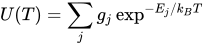
국소 열평형(LTE)에 있는 단일 중성 원자종으로 구성된 광학적으로 얇은 플라즈마의 경우, 레벨 i에서 레벨 j로의[17] 이행에 의해 방출되는 광자의 밀도는 다음과 같다.

여기서:
- i { 는 광자의 방출 속도 밀도(단위−1: m−1 sr−3 s)입니다).
- 0은 플라즈마 내의 중성 원자의 수(단위−3: m)입니다.
- j는 레벨 i와 레벨 j(s−1) 사이의 전이 확률입니다.
- 는 상위 레벨 i(2J+1)의 퇴화입니다.
- { U는 파티션 함수입니다(단위는−1 s).
- })는 상위 레벨 i(eV 단위)의 에너지 수준입니다.
- B는 볼츠만 상수(eV/K 단위)입니다.
- T는 온도(K)입니다.
- I는I displaystyle \ _}^{\}I}가 되는 라인 프로파일입니다.
- \displayda는 파장(nm)입니다.
 광자의 방출 속도 밀도(단위−1: m−1 sr−3 s)입니다).
 플라즈마 내의 중성 원자의 수(단위−3: m)입니다.
 레벨 i와 레벨 j(s−1) 사이의 전이 확률입니다.
 상위 레벨 i(2J+1)의 퇴화입니다.
 파티션 함수입니다(단위는−1 s).
 상위 레벨 i(eV 단위)의 에너지 수준입니다.
 온도(K)입니다.
 파장(nm)입니다.
U { U는 원자종의 모든 k(\ k의 통계 점유율이다.
 통계 점유율이다.
식품 분석용 LIBS
최근 LIBS는 빠르고 미세 파괴적인 식품 분석 도구로 조사되었다.질적, 정량적 화학 분석을 위한 잠재적 분석 도구로서 PAT(Process Analysis Technology) 또는 휴대용 도구로서 적합하다.우유, 베이커리 제품, 차, 식물성 기름, 물, 시리얼, 밀가루, 감자, 팜 대추 그리고 다양한 종류의 고기를 LIBS를 [18]사용하여 분석했습니다.특정 [19][20]식품에 대한 불순물 탐지 도구로서의 가능성을 보여준 연구는 거의 없다.LIBS는 또한 [21]육류에서 유망한 요소 이미징 기술로 평가되어 왔다.
2019년 요크 대학과 리버풀 존 무어스 대학 연구진은 코너스 섬(아일랜드 공화국)의 후기 중석기 조개껍데기에서 나온 12개의 유럽 굴(Ostrea edulis, Linnaeus, 1758)을 연구하기 위해 LIBS를 채용했다.결과는 LIBS가 생물학적 나이와 성장뿐만 아니라 선사시대 계절적 관행을 결정하기 위한 적용 가능성을 이전에 달성 [22]가능했던 것보다 개선된 속도와 비용 절감으로 부각시켰다.
「 」를 참조해 주세요.
레퍼런스
- ^ Radziemski, Leon J.; Cremers, David A. (2006). Handbook of laser-induced breakdown spectroscopy. New York: John Wiley. ISBN 0-470-09299-8.
- ^ Schechter, Israel; Miziolek, Andrzej W.; Vincenzo Palleschi (2006). Laser-induced breakdown spectroscopy (LIBS): fundamentals and applications. Cambridge, UK: Cambridge University Press. ISBN 0-521-85274-9.
- ^ J. P. Singh와 S. N. Thakur, 레이저 유도 분해 분광학, 제1판..(Elsevier, 2007).
- ^ Munson, Jennifer L. Gottfried Frank C. De Lucia Jr. Andrzej W. Miziolek Chase A. "Current Status of Standoff LIBS Security Applications at the United States Army Research Laboratory". www.spectroscopyonline.com. Retrieved 2018-08-27.
- ^ a b c Gottfried, Jennifer L.; De Lucia, Frank C., Jr. (2010). "Laser-Induced Breakdown Spectroscopy: Capabilities and Applications". doi:10.21236/ada528756.
{{cite journal}}:Cite 저널 요구 사항journal=(도움말) - ^ "Detection of Energetic Materials and Explosive Residues With Laser-Induced Breakdown Spectroscopy: I. Laboratory Measurements" (PDF). Archived (PDF) from the original on May 10, 2020.
- ^ "U.S. Army Researchers Explore Laser Detection Techniques Quality Digest". www.qualitydigest.com. Retrieved 2018-08-27.
- ^ Noll, Reinhard; Bette, Holger; Brysch, Adriane; Kraushaar, Marc; Mönch, Ingo; Peter, Laszlo; Sturm, Volker (2001). "Laser-induced breakdown spectrometry — applications for production control and quality assurance in the steel industry". Spectrochimica Acta Part B: Atomic Spectroscopy. 56 (6): 637–649. Bibcode:2001AcSpe..56..637N. doi:10.1016/s0584-8547(01)00214-2.
- ^ Sanghapi, Hervé K.; Ayyalasomayajula, Krishna K.; Yueh, Fang Y.; Singh, Jagdish P.; McIntyre, Dustin L.; Jain, Jinesh C.; Nakano, Jinichiro (2016). "Analysis of slags using laser-induced breakdown spectroscopy". Spectrochimica Acta Part B: Atomic Spectroscopy. 115: 40–45. Bibcode:2016AcSpe.115...40S. doi:10.1016/j.sab.2015.10.009.
- ^ Hsu, Paul S.; Gragston, Mark; Wu, Yue; Zhang, Zhili; Patnaik, Anil K.; Kiefer, Johannes; Roy, Sukesh; Gord, James R. (2016). "Sensitivity, stability, and precision of quantitative Ns-LIBS-based fuel-air-ratio measurements for methane-air flames at 1–11 bar". Applied Optics. 55 (28): 8042–8048. Bibcode:2016ApOpt..55.8042H. doi:10.1364/ao.55.008042. PMID 27828047.
- ^ St-Onge, L.; Kwong, E.; Sabsabi, M.; Vadas, E.B (2002). "Quantitative analysis of pharmaceutical products by laser-induced breakdown spectroscopy". Spectrochimica Acta Part B: Atomic Spectroscopy. 57 (7): 1131–1140. Bibcode:2002AcSpe..57.1131S. doi:10.1016/s0584-8547(02)00062-9.
- ^ Myakalwar, Ashwin Kumar; Sreedhar, S.; Barman, Ishan; Dingari, Narahara Chari; Venugopal Rao, S.; Prem Kiran, P.; Tewari, Surya P.; Manoj Kumar, G. (2011). "Laser-induced breakdown spectroscopy-based investigation and classification of pharmaceutical tablets using multivariate chemometric analysis". Talanta. 87: 53–59. doi:10.1016/j.talanta.2011.09.040. PMC 3418677. PMID 22099648.
- ^ Xu, Shengqi; Sun, Xiaodong; Zeng, Bin; Chu, Wei; Zhao, Jiayu; Liu, Weiwei; Cheng, Ya; Xu, Zhizhan; Chin, See Leang (2012). "Simple method of measuring laser peak intensity inside femtosecond laser filament in air". Optics Express. 20 (1): 299–307. Bibcode:2012OExpr..20..299X. doi:10.1364/oe.20.000299. PMID 22274353.
- ^ A. Talebpour 등, 강렬한 펨토초 레이저 펄스와 상호작용하는 가스의 분광학, 2001, 레이저 물리학, 11:68-76
- ^ Talebpour, A.; Abdel-Fattah, M.; Chin, S.L (2000). "Focusing limits of intense ultrafast laser pulses in a high pressure gas: Road to new spectroscopic source". Optics Communications. 183 (5–6): 479–484. Bibcode:2000OptCo.183..479T. doi:10.1016/s0030-4018(00)00903-2.
- ^ Geints, Yu. E.; Zemlyanov, A. A. (2009). "On the focusing limit of high-power femtosecond laser pulse propagation in air". The European Physical Journal D. 55 (3): 745–754. Bibcode:2009EPJD...55..745G. doi:10.1140/epjd/e2009-00260-0. S2CID 121616255.
- ^ Reinhard., Noll (2012). Laser-induced breakdown spectroscopy : fundamentals and applications. Springer-Verlag Berlin Heidelberg. ISBN 9783642206672. OCLC 773812336.
- ^ Markiewicz-Keszycka, Maria; et al. (2017). "Laser-induced breakdown spectroscopy (LIBS) for food analysis: A review". Trends in Food Science & Technology. 65: 80–93. doi:10.1016/j.tifs.2017.05.005.
- ^ Sezer, Banu; et al. (2018). "Identification of milk fraud using laser-induced breakdown spectroscopy (LIBS)". International Dairy Journal. 81: 1–7. doi:10.1016/j.idairyj.2017.12.005.
- ^ Dixit, Yash; et al. (2017). "Laser induced breakdown spectroscopy for quantification of sodium and potassium in minced beef: a potential technique for detecting beef kidney adulteration". Analytical Methods. 9 (22): 3314–3322. doi:10.1039/C7AY00757D.
- ^ Dixit, Yash; et al. (2018). "Introduction to laser induced breakdown spectroscopy imaging in food: Salt diffusion in meat". Journal of Food Engineering. 216: 120–124. doi:10.1016/j.jfoodeng.2017.08.010.
- ^ Hausmann, Niklas; Robson, Harry K.; Hunt, Chris (2019-09-30). "Annual Growth Patterns and Interspecimen Variability in Mg/Ca Records of Archaeological Ostrea edulis (European Oyster) from the Late Mesolithic Site of Conors Island". Open Quaternary. 5 (1): 9. doi:10.5334/oq.59. ISSN 2055-298X.
- Lee, Won-Bae; Wu, Jianyong; Lee, Yong-Ill; Sneddon, Joseph (2004). "Recent Applications of Laser-Induced Breakdown Spectrometry: A Review of Material Approaches". Applied Spectroscopy Reviews. 39 (1): 27–97. Bibcode:2004ApSRv..39...27L. doi:10.1081/ASR-120028868. ISSN 0570-4928. S2CID 98545359.
- Noll, Reinhard; Bette, Holger; Brysch, Adriane; Kraushaar, Marc; Mönch, Ingo; Peter, Laszlo; Sturm, Volker (2001). "Laser-induced breakdown spectrometry — applications for production control and quality assurance in the steel industry". Spectrochimica Acta Part B: Atomic Spectroscopy. 56 (6): 637–649. Bibcode:2001AcSpe..56..637N. doi:10.1016/S0584-8547(01)00214-2. ISSN 0584-8547.
추가 정보
- Andrzej W. Miziolek; Vincenzo Palleschi; Israel Schechter (2006). Laser Induced Breakdown Spectroscopy. New York: Cambridge University Press. ISBN 0-521-85274-9.
- Gornushkin, I.B.; Amponsah-Manager, K.; Smith, B.W.; Omenetto, N.; Winefordner, J.D. (2004). "Microchip Laser Induced Breakdown Spectroscopy: Preliminary Feasibility Investigation". Applied Spectroscopy. 58 (7): 762–769. Bibcode:2004ApSpe..58..762G. doi:10.1366/0003702041389427. PMID 15282039. S2CID 41416641. Archived from the original on 2013-04-15.
- Amponsah-Manager, K.; Omenetto, N.; Smith, B. W.; Gornushkin, I. B.; Winefordner, J. D. (2005). "Microchip laser ablation of metals: Investigation of the ablation process in view of its application to laser-induced breakdown spectroscopy". Journal of Analytical Atomic Spectrometry. 20 (6): 544. doi:10.1039/B419109A.
- Lopez-Moreno, C.; Amponsah-Manager, K.; Smith, B. W.; Gornushkin, I. B.; Omenetto, N.; Palanco, S.; Laserna, J. J.; Winefordner, J. D. (2005). "Quantitative analysis of low-alloy steel by microchip laser induced breakdown spectroscopy". Journal of Analytical Atomic Spectrometry. 20 (6): 552. doi:10.1039/B419173K. S2CID 39938942.
- Bette, H; Noll, R (2004). "High speed laser-induced breakdown spectrometry for scanning microanalysis". Journal of Physics D: Applied Physics. 37 (8): 1281. Bibcode:2004JPhD...37.1281B. doi:10.1088/0022-3727/37/8/018.
- Balzer, Herbert; Hoehne, Manuela; Noll, Reinhard; Sturm, Volker (2006). "New approach to online monitoring of the Al depth profile of the hot-dip galvanised sheet steel using LIBS". Analytical and Bioanalytical Chemistry. 385 (2): 225–33. doi:10.1007/s00216-006-0347-z. PMID 16570144. S2CID 42607960.
- Sturm, V.; Peter, L.; Noll, R. (2000). "Steel analysis with laser-induced breakdown spectrometry in the vacuum ultraviolet". Applied Spectroscopy. 54 (9): 1275–1278. Bibcode:2000ApSpe..54.1275S. doi:10.1366/0003702001951183. S2CID 32765892.
- Vadillo, José M.; Laserna, J.Javier (2004). "Laser-induced plasma spectrometry: Truly a surface analytical tool". Spectrochimica Acta Part B: Atomic Spectroscopy. 59 (2): 147. Bibcode:2004AcSpe..59..147V. doi:10.1016/j.sab.2003.11.006.
- Doucet, François R.; Faustino, Patrick J.; Sabsabi, Mohamad; Lyon, Robbe C. (2008). "Quantitative molecular analysis with molecular bands emission using laser-induced breakdown spectroscopy and chemometrics". Journal of Analytical Atomic Spectrometry. 23 (5): 694. doi:10.1039/b714219f. S2CID 97020157.
- В.Копачевский, В.Шпектор, Д.Клемято, В.Бойков, М.Кривошеева, Л.Боброва. (2008). "Количественный анализ состава тарных стекол анализатором LEA S500". Фотоника (in Russian) (1): 38–40.
{{cite journal}}: CS1 maint: 여러 이름: 작성자 목록(링크) - Noll, Reinhard (2012). Laser-Induced Breakdown Spectroscopy: Fundamentals and Applications. Berlin: Springer. ISBN 978-3-642-20667-2.
외부 링크


| 레이저의 종류 | |
|---|---|
| 레이저 물리학 | |
| 레이저 광학 | |