에리다니 오메가
Omega Eridani| 관측 데이터 Epoch J2000.0 이쿼녹스 J2000.0(ICRS) | |
|---|---|
| 별자리 | 에리다누스 |
| 우측 상승 | 04h 52m 53.66995s[1] |
| 탈위임 | −05° 27′ 09.6972″[1] |
| 겉보기 크기 (V) | 4.37[2] |
| 특성. | |
| 스펙트럼형 | A9 IVn[3] |
| U-B색지수 | +0.12[2] |
| B-V색지수 | +0.26[2] |
| 아스트로메트리 | |
| 방사 속도 (Rv) | -8.3km[4]/s |
| 고유 운동 (μ) | RA: −17.86[1]mas/yr Dec.: +25.57[1]mas/yr |
| 시차 (π) | 13.88 ± 0.24[1] 마스 |
| 거리 | 235 ± 4 리 (72 ± 1 pc) |
| 절대치수 (MV) | 0.10[5] |
| 궤도[6] | |
| 기간 (P) | 3,057 d |
| 편심성 (e) | 0.46 |
| 페리아스트론 신기원을 이루다 (T) | 2419973.0 JD |
| 페리아스트론의 인수 (ω) (2차) | 227° |
| 반암도 (K1) (iii) | 18.1km/s |
| 세부 사항 | |
| 반지름 | 6.7[7] R☉ |
| 루미도 | 69[8] L☉ |
| 표면 중력 (log g) | 3.4[5] cgs |
| 온도 | 6,878[8] K |
| 금속성 [Fe/H] | 0.18[5] 덱스 |
| 회전 속도 (v sin i) | 시속 186km[9] |
| 기타 지정 | |
| 데이터베이스 참조 | |
| 심바드 | 자료 |
오메가 에리다니(Ω 에리)는 에리다누스자리에 있는 이항성계다[9].육안으로 볼 수 있으며, 겉으로 보이는 시각적 크기는 4.37이다.[2]시차법에 의해 결정되는 이 별까지의 거리는 약 235광년이다.
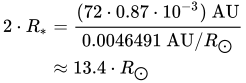
이것은 궤도 주기가 3,057일(8.4년)이고 이심률이 0.46인 단일선 분광형 2진법이다[11].1차 성분은 A9 IVn의 항성분류를 가진 A형 아항성으로,[3] 여기서 'n' 접미사는 회전으로 인한 넓은("위험한") 흡수를 나타낸다.예상 회전 속도는 186[9] km/s이다.[9]이것은 이 별에게 극 반지름보다 13% 넓은 적도를 가진 지운 모양을 주고 있다.오메가 에리다니의 각도 크기는 0.87 mas이다.[12]항성의 추정 거리에서, 이것은 태양의 반경의 약 6.7배의 물리적 크기를 산출한다.[7]
참조
- ^ a b c d e van Leeuwen, F. (2007), "Validation of the new Hipparcos reduction", Astronomy and Astrophysics, 474 (2): 653–664, arXiv:0708.1752, Bibcode:2007A&A...474..653V, doi:10.1051/0004-6361:20078357, S2CID 18759600.
- ^ a b c d Mermilliod, J.-C. (1986), "Compilation of Eggen's UBV data, transformed to UBV (unpublished)", Catalogue of Eggen's UBV Data, SIMBAD, Bibcode:1986EgUBV........0M.
- ^ a b Abt, Helmut A.; Morrell, Nidia I. (July 1995), "The Relation between Rotational Velocities and Spectral Peculiarities among A-Type Stars", Astrophysical Journal Supplement, 99: 135, Bibcode:1995ApJS...99..135A, doi:10.1086/192182.
- ^ De Bruijne, J. H. J.; Eilers, A.-C. (2012), "Radial velocities for the HIPPARCOS-Gaia Hundred-Thousand-Proper-Motion project", Astronomy & Astrophysics, 546: A61, arXiv:1208.3048, Bibcode:2012A&A...546A..61D, doi:10.1051/0004-6361/201219219, S2CID 59451347.
- ^ a b c Giridhar, S.; et al. (August 2013), "Identification of metal-poor stars using the artificial neural network", Astronomy & Astrophysics, 556: 11, arXiv:1307.6308, Bibcode:2013A&A...556A.121G, doi:10.1051/0004-6361/201219918, S2CID 118316149, A121.
- ^ Pourbaix, D.; et al. (2004), "SB9: The ninth catalogue of spectroscopic binary orbits", Astronomy and Astrophysics, 424 (2): 727–732, arXiv:astro-ph/0406573, Bibcode:2004A&A...424..727P, doi:10.1051/0004-6361:20041213, S2CID 119387088.
- ^ a b Lang, Kenneth R. (2006), Astrophysical formulae, Astronomy and astrophysics library, vol. 1 (3rd ed.), Birkhäuser, ISBN 3-540-29692-1. 반지름(R*)은 다음을 통해 제공된다.
- ^ a b McDonald, I.; et al. (2012), "Fundamental Parameters and Infrared Excesses of Hipparcos Stars", Monthly Notices of the Royal Astronomical Society, 427 (1): 343–57, arXiv:1208.2037, Bibcode:2012MNRAS.427..343M, doi:10.1111/j.1365-2966.2012.21873.x, S2CID 118665352.
- ^ a b c d Royer, F.; et al. (February 2007), "Rotational velocities of A-type stars. III. Velocity distributions", Astronomy and Astrophysics, 463 (2): 671–682, arXiv:astro-ph/0610785, Bibcode:2007A&A...463..671R, doi:10.1051/0004-6361:20065224, S2CID 18475298.
- ^ "* ome Eri -- Spectroscopic binary". SIMBAD. Centre de données astronomiques de Strasbourg. Retrieved 2016-11-03.
{{cite web}}: CS1 maint : 포스트스크립트(링크) - ^ Abt, Helmut A.; Boonyarak, Chayan (November 2004), "Tidal Effects in Binaries of Various Periods", The Astrophysical Journal, 616 (1): 562–566, Bibcode:2004ApJ...616..562A, doi:10.1086/423795.
- ^ van Belle, Gerard T., Gerard T. (March 2012), "Interferometric observations of rapidly rotating stars", The Astronomy and Astrophysics Review, 20 (1): 51, arXiv:1204.2572, Bibcode:2012A&ARv..20...51V, doi:10.1007/s00159-012-0051-2, S2CID 119273474.