
디티올레인
Dithiolane
| |||
| |||
| 이름 | |||
|---|---|---|---|
| IUPAC 이름 디티올레인 | |||
| 기타 이름 1,2-디티올레인, 1,3-디티올레인 | |||
| 식별자 | |||
| |||
3D 모델(JSmol) | |||
| 체비 |
| ||
| 켐스파이더 |
| ||
펍켐 CID | |||
| 유니 | |||
| |||
| |||
| 특성. | |||
| C3H6S2 | |||
| 어금질량 | 106.20 g.20−1 g.20 | ||
| 관련 화합물 | |||
관련 화합물 | 에탄-1,2-디티올 | ||
달리 명시된 경우를 제외하고, 표준 상태(25°C [77°F], 100 kPa)의 재료에 대한 데이터가 제공된다. | |||
 이버라이시 이버라이시  (?) (?) | |||
| Infobox 참조 자료 | |||


디티올레인은 두 개의 메틸렌 다리(-CH-단위
2)를 티오에더 그룹으로 대체하여 사이클로펜탄에서 파생된 황 헤테로사이클론이다. 모화합물은 1,2-디티올레인과 1,3-디티올레인이다.
1,2-디티올레인은 순환 이황화물이다. 일부 디티올레인은 아스파라거스의 아스파라거스산과 같은 음식에서 발견될 수 있는 천연 제품이다[1].[2] 4-디메틸아미노 파생 네레이스톡신은 니코틴닉 아세틸콜린 수용체를 차단해 작용하는 살충제의 영감이었다.[3] 리포산은 포유류에서 유산소대사에 필수적이며 금, 몰리브덴, 텅스텐 등 많은 금속과 친화력이 강하다.[4] 다른 1,2-디티올레인은 금 나노입자나 TMD(MoS2, WS2)와 같은 나노물질에 관련성이 있다.[5][6][7]

아스파라거스산
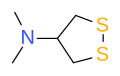
네레이스톡신(Nereistoxin), 여기서 카르탑과 벤술탑을 포함한 살충제가 파생되었다.

리포산


1,3-디티올레인은 광범위한 조건에 불활성화되기 때문에 카보닐 화합물의 그룹을 보호하는 데 중요하다. 카보닐 그룹을 1,2-에탄네디톨로 반응시키면 아래와 같이 1,3-디티올란으로 변환된다.

참조
- ^ Teuber, Lene (1990). "Naturally Occurring 1,2-Dithiolanes and 1,2,3-Trithianes. Chemical and Biological Properties". Sulfur Reports. 9 (4): 257–333. doi:10.1080/01961779008048732.
- ^ Pelchat, M. L.; Bykowski, C.; Duke, F. F.; Reed, D. R. (2011). "Excretion and perception of a characteristic odor in urine after asparagus ingestion: A psychophysical and genetic study". Chemical Senses. 36 (1): 9–17. doi:10.1093/chemse/bjq081. PMC 3002398. PMID 20876394.
- ^ Casida, John E.; Durkin, Kathleen A. (2013). "Neuroactive Insecticides: Targets, Selectivity, Resistance, and Secondary Effects". Annual Review of Entomology. 58: 99–117. doi:10.1146/annurev-ento-120811-153645. PMID 23317040.
- ^ "Lipoic acid". Micronutrient Information Center, Linus Pauling Institute, Oregon State University, Corvallis. 1 January 2019. Retrieved 27 August 2020.
- ^ Bilewicz, Renata; Więckowska, Agnieszka; Kruszewski, Marcin; Stępkowski, Tomasz; Męczynska-Wielgosz, Sylwia; Cichowicz, Grzegorz; Piątek, Piotr; Załubiniak, Dominika; Dzwonek, Maciej (2018-04-18). "Towards potent but less toxic nanopharmaceuticals – lipoic acid bioconjugates of ultrasmall gold nanoparticles with an anticancer drug and addressing unit". RSC Advances. 8 (27): 14947–14957. doi:10.1039/C8RA01107A. ISSN 2046-2069.
- ^ Vallan, Lorenzo; Canton-Vitoria, Ruben; Gobeze, Habtom B.; Jang, Youngwoo; Arenal, Raul; Benito, Ana M.; Maser, Wolfgang K.; D’Souza, Francis; Tagmatarchis, Nikos (2018-10-17). "Interfacing Transition Metal Dichalcogenides with Carbon Nanodots for Managing Photoinduced Energy and Charge-Transfer Processes". Journal of the American Chemical Society. 140 (41): 13488–13496. doi:10.1021/jacs.8b09204. hdl:10442/16257. ISSN 0002-7863. PMID 30222336.
- ^ Tagmatarchis, Nikos; Ewels, Christopher P.; Bittencourt, Carla; Arenal, Raul; Pelaez-Fernandez, Mario; Sayed-Ahmad-Baraza, Yuman; Canton-Vitoria, Ruben (2017-06-05). "Functionalization of MoS 2 with 1,2-dithiolanes: toward donor-acceptor nanohybrids for energy conversion". NPJ 2D Materials and Applications. 1 (1): 13. doi:10.1038/s41699-017-0012-8. ISSN 2397-7132.
외부 링크
 위키미디어 커먼스의 디티올라네스 관련 매체
- 1,3-디티올레인 반응


