
매혹
Fasciation

파찰(fasciation, 라틴어의 "띠" 또는 "줄"을 의미하는 뿌리에서 /ˌfæʃiˈn/로 발음됨)은 혈관 식물에서 비교적 드문 비정상적인 성장 상태로, 보통 한 점 주위에 집중되어 있고 대략 원통형의 조직을 생성하는 심낭 메리스템(성장하는 끝)이 대신 길어집니다.성장 방향에 수직으로, 따라서 평평하고 리본 모양이며, 볏(또는 "중간") 또는 정교하게 변형된 [1]조직을 생성합니다.어떤 경우에는 [2]식물 부품의 무게와 부피가 증가할 수도 있습니다.이 현상은 줄기, 뿌리, 열매 또는 꽃의 머리 부분에서 발생할 수 있습니다.
어떤 식물들은 [3]매혹의 발달 때문에 미적으로 자라고 소중하게 여겨집니다.매혹의 발생에는 호르몬, 유전적, 박테리아, 곰팡이, 바이러스 및 환경적 원인을 포함한 여러 가지 가능한 원인이 있습니다.
원인
식물의 기질세포에서 호르몬 불균형이 생겨나는데, 이것은 성장이 [4][5]일어날 수 있는 세포입니다.매혹은 무작위 유전자 돌연변이에 [6]의해서도 발생할 수 있습니다.세균과 바이러스 감염도 신경을 [4]건드릴 수 있습니다.단완두콩([7]Lathyrus odoratus) 식물에서와 같이 세균성 식물성 식물성 로도코커스 페시안(Rhodococcus fascians)이 박력의 한 원인으로 입증되었지만, 많은 박력 있는 식물들이 [8][better source needed]연구에서 박테리아에 음성 반응을 보였으므로, 박테리아 감염이 유일한 원인은 아닙니다.
매료를 유발할 수 있는 추가적인 환경적 요인으로는 곰팡이, 진드기 또는 곤충의 공격, [8]화학물질에 대한 노출 등이 있습니다.식물의 자라나는[8] 끝 부분에 전반적인 손상을 입히고 추위와 서리에 노출되는 것 또한 [4][6]매혹을 일으킬 수 있습니다.완두콩과 수탉과 같은 몇몇 식물들은 셀로시아의 [8]특성을 물려받을지도 모릅니다.
유전적인 흥분은 전염성이 없지만, 감염된 식물에 상처가 닿거나 박테리아를 다른 식물로 옮기는 물에 의해 감염된 식물에서 [9]다른 식물로 전염될 수 있습니다.
발생
전체적으로 매혹은 드물지만, Acer, Aloe, Acanthosicyos, Cannabis, Celosia, Cycas, Delphinium, Digitalis, Echinacea, Euphorbia, Forsythia, Glycine max (특히 콩 식물),[11] Primula, Iochroma, Prunus, Salix 및 선인장과의 많은 속을 포함한 100개 이상의 혈관 식물 [10][better source needed]과에서 관찰되었습니다., 선인장과[citation needed]크레스팅은 성숙한 사가로 [12]선인장에서 볼 수 있는 전형적인 "팔" 대신 기복이 있는 주름으로 이어집니다.
셀로시아의 일부 품종들은 특히 믿을 수 있을 정도로 매혹된 꽃 머리 때문에 길러지는데, 이 때문에 그것들은 "꼬끄콤"[4]이라고 불립니다.일본판타일 버드나무(Salix sachalinensis 'Sekka')도 [4][8]매력으로 평가받는 식물입니다.
예방
박테리아에 의해 발생하는 매혹은 매혹된 식물을 사용하지 않고 매혹된 [9]물질을 처리함으로써 조절될 수 있습니다.식물 염기의 손상을 피하고 건조하게 유지하면 세균의 [9]확산을 줄일 수 있습니다.식물을 접목하는 것을 피하고, 박하된 물질을 가지치는 것 또한 [9]박테리아의 확산을 줄일 수 있습니다.
예
- 매혹
-
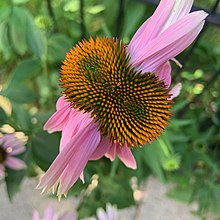
원뿔꽃(Echinacea)에 대한 매혹, 즉 "크레스팅"의 예입니다.
-

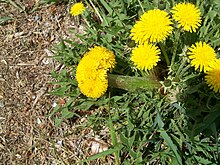
민들레 위에 두 개의 꽃머리가 완전히 형성되는 매혹.
-
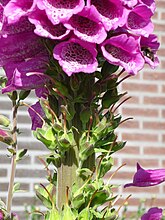
디지탈리스의 매력.왼쪽에 있는 정상 크기의 꽃봉오리에 비해 굵어진 줄기가 더 크다는 것을 주목하십시오.
-
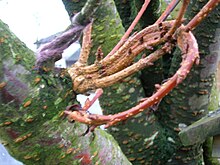
꽃벚나무에 매료됨 (Prunus)
-

아스파라거스 (Asparagus officialis) 매혹.스템의 평평한 상태를 기록합니다.이미지 출판 1893.
-
-
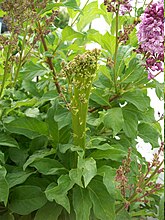
라일락 관목의 매혹.
-

파셀리아 캄파눌라리아 또는 캘리포니아 블루벨 야생화에 매료됨.
-

매혹적인 현란한 데이지 (에리거론 스페시오수스).
-

매혹된 크룩넥 스쿼시
-
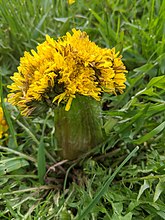
민들레에서 볼 수 있는 매혹
-
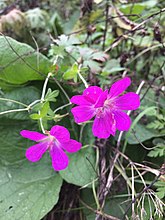
보통(왼쪽)과 매혹된(오른쪽) 제라늄 꽃
-

재배된 Odontonema tubae forme 식물의 꽃차례에 대한 매혹
-

Sedum sexangulare에 나타난 매혹.


.jpg)


참고 항목
참고문헌
- ^ White, Orland E. (1948). "Fasciation". The Botanical Review. 14 (6): 319–358. doi:10.1007/BF02861723.
- ^ Albertsen, Marc C.; Curry, Therese M.; Palmer, Reid G.; Lamotte, Clifford E. (1983). "Genetics and Comparative Growth Morphology of Fasciation in Soybeans (Glycine max [L.] Merr.)". Botanical Gazette. 144 (2): 263–275. doi:10.1086/337372. JSTOR 2474652. S2CID 84260097.
- ^ Morris, Scott. "Fasciation in Flowers – What You Need To Know". Gardentoolbox. Archived from the original on 10 January 2014. Retrieved 10 January 2014.
- ^ a b c d e Lerner, B. Rosie (September 2007). "Fascinating Fasciation". Purdue University Extension. Archived from the original on December 15, 2012. Retrieved July 3, 2012.
- ^ 갈룬, 에스라 (2007)식물 패턴화: 구조적 및 분자적 유전적 측면.세계과학출판사 페이지 333ISBN 9789812704085
- ^ a b "Fasciation in Vegetables and Fruits". University of Delaware Cooperative Extension. May 27, 2011. Archived from the original on February 7, 2015. Retrieved July 6, 2012.
- ^ Tilford, P.E. (1936). "Fasciation of Sweet Peas caused by Phytomonas fascians n.sp". Journal of Agricultural Research. 53 (5): 383–394. Retrieved July 7, 2012.
- ^ a b c d e Swift, Curtis E. (April 12, 1999). "Fasciation: Fascinating distortions of the plant world". Colorado State University Extension. Archived from the original on June 30, 2012. Retrieved July 3, 2012.
- ^ a b c d "Managing Pests in Gardens: Floriculture: Diseases: Fasciation". Statewide Integrated Pest Management Program, Agriculture and Natural Resources, University of California. October 13, 2008. Archived from the original on September 15, 2022.
- ^ Tang, Yuhong; Knap, Halina T. (1998). "Fasciation Mutation Enhances Meristematic Activity and Alters Pattern Formation in Soybean". International Journal of Plant Sciences. 159 (2): 249–260. doi:10.1086/297546. ISSN 1058-5893. JSTOR 2475089. S2CID 83559228.
- ^ Yamamoto, Etsuo; et al. (April 25, 2000). "Molecular characterization of two soybean homologs of Arabidopsis thaliana CLAVATA1 from the wild type and fasciation mutant". Biochimica et Biophysica Acta (BBA) - Gene Structure and Expression. 1491 (1–3): 333–340. doi:10.1016/S0167-4781(00)00061-0. PMID 10760600.
- ^ "Campus Arboretum". University of Arizona. 2008-08-20. Archived from the original on 2010-01-06. Retrieved 2010-01-14.
추가열람
- White, Orland E. (1945). "The Biology of Fasciation". Journal of Heredity. 36: 11–22. doi:10.1093/oxfordjournals.jhered.a105409.
- Crespi, M.; Messens, E.; Caplan, A.B.; Van Montagu, M.; Desomer, J. (1992). "Fasciation induction by the phytopathogen Rhodococcus fascians depends upon a linear plasmid encoding a cytokinin synthase gene". The EMBO Journal. 11 (3): 795–804. doi:10.1002/j.1460-2075.1992.tb05116.x. PMC 556518. PMID 1547783.
- Nilsson, O.; Moritz, T.; Sundberg, B.; Sandberg, G.; Olsson, O. (1996). "Expression of the Agrobacterium rhizogenes rolC Gene in a Deciduous Forest Tree Alters Growth and Development and Leads to Stem Fasciation". Plant Physiology. 112 (2): 493–502. doi:10.1104/pp.112.2.493. PMC 157972. PMID 12226405.
- Crespi, M.; Vereecke, D.; Temmerman, W.; Van Montagu, M.; Desomer, J. (1994). "The fas operon of Rhodococcus fascians encodes new genes required for efficient fasciation of host plants". Journal of Bacteriology. 176 (9): 2492–2501. doi:10.1128/jb.176.9.2492-2501.1994. hdl:1854/LU-322183. PMC 205384. PMID 8169198.
외부 링크


- "Definition of "Fasciation"". Merriam-Webster Dictionary. Retrieved July 6, 2012.


