
일반화 클리포드 대수
Generalized Clifford algebra수학에서 일반화 클리포드 대수학(GCA)은 클리포드 대수학을 일반화하는 연상 대수학으로, J. J. 실베스터(1882년)[2]가 도입하고 카르탄(1898년)[3]과 슈윙거가 조직한 이러한 시계와 교대 연산자를 활용, 공식화한 헤르만 바일의 작품으로 거슬러 올라간다.[1][4]
시계와 시프트 매트릭스는 유한 차원 벡터 공간에서 양자 역학의 초석을 제공하면서 수학 물리학의 수많은 영역에서 일상적인 응용을 찾는다.[5][6][7]스피너라는 개념은 이러한 알헤브라와 더욱 연결될 수 있다.[6]
일반화 클리포드 알헤브라스라는 용어는 또한 2차적 형태가 아닌 더 높은 수준의 형태를 사용하여 만들어진 연관성 있는 알헤브라를 지칭할 수 있다.[8][9][10][11]
정의 및 속성
추상적 정의
n차원 일반화된 클리포드 대수학(Clifford 대수학)은 f분야에 걸친 연관 대수학으로서 정의되며[12], f분야에 의해 생성된다.
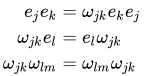
그리고

∀ j,k,l,m = 1,...,n
더욱이 물리적인 용도와 관련된 모든 되돌릴 수 없는 매트릭스 표현에서는 다음과 같은 것이 요구된다.

∀ j,k = 1,...,n 및 N = gcd ) 필드 F는 일반적으로 복합 숫자 C로 간주된다.


보다 구체적인 정의
좀 더 일반적인 GCA의 경우,[6] 순서 p의 n차원 일반화된 클리포드 대수학에서는 모든 j,k에 Ωkj = Ω, N = {\ =1 {\kj}의 속성이 있다 그 뒤를 따른다.


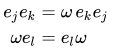
그리고

모든 j,k,l = 1,...,n 및

1의 p번째 뿌리다.
문헌에는 일반화된 클리포드 대수학의 몇 가지 정의가 있다.[13]
- 클리포드 대수
(직교) 클리포드 대수학에서 원소들은 Ω = -1, p = 2로 반공계 규칙을 따른다.
행렬 표현
시계와 시프트 행렬은 슈윙거의 표준 표기법에서 n×n 행렬로 나타낼[14] 수 있다.
- V&, ={\begin{pmatrix}0&, 1&, 0&, \cdots &, 0\\0&, 0&, 1&, \cdots &, 0\\0&, 0&, \ddots &, 1&, 0\\\vdots, \vdots &, \vdots &, \ddots &, \vdots \\1& &, 0&, 0&, \cdots &, 0\end{pmatrix}},&을 말한다.U&, ={\begin{pmatrix}1&, 0&, 0&, \cdots &, 0\\0&,\omega&0&, \cdots &, 0\\0&, 0&,\omega ^{2}&, \cdots, 0\\\vdots &, \vdots &, \vdots &, \ddots &, \vdots \\0& &, 0&, 0&, \cdots &, \omega ^{(n-1)}\end{pmatrix}},&을 말한다.W&, ={\begin{pmatrix}1&, 1&, 1&, \cdots &, 1\\ .

특히 Vn = 1, VU = ΩUV(웨이일 브레이딩 관계), WVW−1 = U(이산 푸리에 변환) 등이 대표적이다.e1 = V , e = VU2, e3 = U를 사용하는 경우, Ω과 함께 일반화 클리포드 대수학(GCA)의 위의 조건을 충족하는 3가지 기본 원소를 갖는다.
일반적으로"시프트 및 클럭 매트릭스"라고 불리는 이러한 매트릭스 V와 U는 J.J. Sylvester에 의해 1880년대에 도입되었다.매트릭스 V는 순환 이동을 수행하는 주기적 순열 매트릭스라는 점에 유의한다.매트릭스들은 각각의 대각선 위 또는 아래에 매트릭스만 있는 상한 및 하한 변속 매트릭스와 혼동해서는 안 된다.라이다
구체적인 예
사례 n = p = 2
이 경우 Ω = -1이 있고,

이리하여
- E1컵(0110), e2)(0− 110), e3)(100− 1){\displaystyle{\begin{정렬}e_{1}&, ={\begin{pmatrix}0&, 1\\1&, 0\end{pmatrix}},&, e_{2}&, ={\begin{pmatrix}0&, -1\\1&, 0\end{pmatrix}},&, e_{3}&, ={\begin{pmatrix}1&, 0\\0&, -1\e.nd{pmatrix}}\end{정렬}}},
Pauli 매트릭스를 구성한다.
사례 n = p = 4
이 경우 Ω = i, 그리고

그리고 e1, e2, e는3 그에 따라 결정될 수 있다.
참고 항목
참조
- ^ Weyl, H. (1927). "Quantenmechanik und Gruppentheorie". Zeitschrift für Physik. 46 (1–2): 1–46. Bibcode:1927ZPhy...46....1W. doi:10.1007/BF02055756. S2CID 121036548.
— (1950) [1931]. The Theory of Groups and Quantum Mechanics. Dover. ISBN 9780486602691. - ^ Sylvester, J. J. (1882), A word on Nonions, Johns Hopkins University Circulars, vol. I, pp. 241–2, hdl:1774.2/32845; ibid II (1883) 46; ibid III (1884) 7–9.온라인과 더 나아가 제임스 조셉 실베스터(Cambridge University Press, 1909년) v III의 수학 논문집에 요약되어 있다.
- ^ Cartan, E. (1898). "Les groupes bilinéaires et les systèmes de nombres complexes" (PDF). Annales de la Faculté des Sciences de Toulouse. 12 (1): B65–B99.
- ^ Schwinger, J. (April 1960). "Unitary operator bases". Proc Natl Acad Sci U S A. 46 (4): 570–9. Bibcode:1960PNAS...46..570S. doi:10.1073/pnas.46.4.570. PMC 222876. PMID 16590645.
— (1960). "Unitary transformations and the action principle". Proc Natl Acad Sci U S A. 46 (6): 883–897. Bibcode:1960PNAS...46..883S. doi:10.1073/pnas.46.6.883. PMC 222951. PMID 16590686. - ^ Santhanam, T. S.; Tekumalla, A. R. (1976). "Quantum mechanics in finite dimensions". Foundations of Physics. 6 (5): 583. Bibcode:1976FoPh....6..583S. doi:10.1007/BF00715110. S2CID 119936801.
- ^ a b c 예를 참조하십시오.
- ^ Kwaśniewski, A.K. (1999). "On generalized Clifford algebraC(n)4 and GLq(2;C) quantum group". Advances in Applied Clifford Algebras. 9 (2): 249–260. arXiv:math/0403061. doi:10.1007/BF03042380. S2CID 117093671.
- ^ Tesser, Steven Barry (2011). "Generalized Clifford algebras and their representations". In Micali, A.; Boudet, R.; Helmstetter, J. (eds.). Clifford algebras and their applications in mathematical physics. Springer. pp. 133–141. ISBN 978-90-481-4130-2.
- ^ Childs, Lindsay N. (30 May 2007). "Linearizing of n-ic forms and generalized Clifford algebras". Linear and Multilinear Algebra. 5 (4): 267–278. doi:10.1080/03081087808817206.
- ^ Pappacena, Christopher J. (July 2000). "Matrix pencils and a generalized Clifford algebra". Linear Algebra and Its Applications. 313 (1–3): 1–20. doi:10.1016/S0024-3795(00)00025-2.
- ^ Chapman, Adam; Kuo, Jung-Miao (April 2015). "On the generalized Clifford algebra of a monic polynomial". Linear Algebra and Its Applications. 471: 184–202. arXiv:1406.1981. doi:10.1016/j.laa.2014.12.030. S2CID 119280952.
- ^ 서비스 가능한 검토는 다음을 참조하십시오.
- ^ 다음에서 제공하는 리뷰를 참조하십시오.
- ^ Ramakrishnan, Alladi (1971). "Generalized Clifford Algebra and its applications – A new approach to internal quantum numbers". Proceedings of the Conference on Clifford algebra, its Generalization and Applications, January 30–February 1, 1971 (PDF). Madras: Matscience. pp. 87–96.
추가 읽기
- Fairlie, D. B.; Fletcher, P.; Zachos, C. K. (1990). "Infinite-dimensional algebras and a trigonometric basis for the classical Lie algebras". Journal of Mathematical Physics. 31 (5): 1088. Bibcode:1990JMP....31.1088F. doi:10.1063/1.528788.
- Jagannathan, R. (2010). "On generalized Clifford algebras and their physical applications". arXiv:1005.4300 [math-ph]. (Aladi Ramakrishnan의 수학적 과학 (pp. 465–489)에서)뉴욕주 스프링거)
- Morinaga, K.; Nono, T. (1952). "On the linearization of a form of higher degree and its representation". J. Sci. Hiroshima Univ. Ser. A. 16: 13–41. doi:10.32917/hmj/1557367250.
- Morris, A.O. (1967). "On a Generalized Clifford Algebra". Quart. J. Math (Oxford. 18 (1): 7–12. Bibcode:1967QJMat..18....7M. doi:10.1093/qmath/18.1.7.
- Morris, A.O. (1968). "On a Generalized Clifford Algebra II". Quart. J. Math (Oxford. 19 (1): 289–299. Bibcode:1968QJMat..19..289M. doi:10.1093/qmath/19.1.289.


