오리온자리 로
Rho Orionis  | |
| 관측 데이터 신기루 J2000.0 이쿼녹스 J2000.0 | |
|---|---|
| 별자리 | 오리온 |
| 우측 상승 | 05h 13m 17.48015s[1] |
| 탈위임 | +02° 51′ 40.5479″[1] |
| 겉보기 크기 (V) | +4.44[2] |
| 특성. | |
| 스펙트럼형 | K0 III[3] |
| U-B색지수 | +1.13[2] |
| B-V색지수 | +1.19[2] |
| 아스트로메트리 | |
| 방사 속도 (Rv) | +40.5km[4]/s |
| 고유 운동 (μ) | RA: +0.83[1]mas/yr Dec.: +3.91[1]mas/yr |
| 시차 (π) | 9.32 ± 0.94[1] 마스 |
| 거리 | 약 350리 (약 110pc) |
| 절대치수 (MV) | −0.65[5] |
| 세부사항[6] | |
| 미사 | 2.67 M☉ |
| 반지름 | 25[7] R☉ |
| 루미도 | 251 L☉ |
| 표면 중력 (log g) | 2.4[8] cgs |
| 온도 | 4,533 K |
| 금속성 [Fe/H] | 0.06[8] 덱스 |
| 나이 | 650 Merr |
| 궤도[9] | |
| 기간 (P) | 1031.4일 |
| 반주축 (a) | 6.9 마스[note 1] |
| 편심성 (e) | 0.1 |
| 기울기 (i) | 122.8° |
| 노드의 경도 (Ω) | 242.6° |
| 페리아스트론 신기원을 이루다 (T) | 2426182.46 |
| 페리아스트론의 인수 (ω) (2차) | 17.9° |
| 반암도 (K1) (iii) | 8.70km/s |
| 기타 지정 | |
| 데이터베이스 참조 | |
| 심바드 | 자료 |
오리온자리 로(Rho Orionis)는 오리온자리 적도 별자리에 있는 주황색 후두의 이항성계 바이엘의 이름이다.육안으로 볼 수 있는 시각적 크기는 +4.44이다.[2]이 별은 지구의 궤도 운동으로 인해 연간 시차 이동 9.32마스를 나타내며, 태양으로부터 약 350광년의 거리를 추정할 수 있다.그것은 방사상 속도 +40.5 km/s로 태양으로부터 멀어지고 있다.[4]약 260만년 전에, Ro Orionis는 약 10광년(3.1파섹)의 거리에서 그것의 근막 통로를 만들었다.[10]
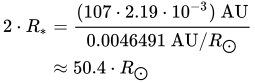
이것은 궤도 주기가 2.8년이고 편심률이 0.1인 단일선 분광형 2진법이다.[9]가시성 성분은 K0 III의 별 분류를 가진 K형식의 진화된 거대 항성이다.[3]측정된 각 직경은 2.19±0.02 mas이며,[11] 추정 거리에서 태양 반지름의 약 25배의 물리적 크기를 산출한다.[7]태양 질량의 2.67배, 약 6억5000만년 전이다.이 별은 4,533K의 유효 온도에서 확대된 광구에서 태양 광도의 251배를 방출하고 있다.[6]
메모들
- ^ 이것은 멀리 있는 물체에 대해 관찰된 "별"이 보여주는 움직임으로부터, 그리고 실제로 2중주 축에 상대적인 복사체 반주축이다.이것은 항상 궤도 반주축보다 작으며, 1차 항성이 2차 항성보다 훨씬 더 거대하거나 그다지 밝지 않을 때 극적으로 작다.
참조
- ^ a b c d e van Leeuwen, F. (2007), "Validation of the new Hipparcos reduction", Astronomy and Astrophysics, 474 (2): 653–664, arXiv:0708.1752, Bibcode:2007A&A...474..653V, doi:10.1051/0004-6361:20078357, S2CID 18759600.
- ^ a b c d Ducati, J. R. (2002). "VizieR Online Data Catalog: Catalogue of Stellar Photometry in Johnson's 11-color system". CDS/ADC Collection of Electronic Catalogues. 2237. Bibcode:2002yCat.2237....0D.
- ^ a b Houk, N.; Swift, C. (1999). "Michigan catalogue of two-dimensional spectral types for the HD Stars, Vol. 5". Michigan Spectral Survey. 05: 0. Bibcode:1999MSS...C05....0H.
- ^ a b Famaey, B.; Jorissen, A.; Luri, X.; Mayor, M.; Udry, S.; Dejonghe, H.; Turon, C. (2005). "Local kinematics of K and M giants from CORAVEL/Hipparcos/Tycho-2 data. Revisiting the concept of superclusters". Astronomy and Astrophysics. 430: 165. arXiv:astro-ph/0409579. Bibcode:2005A&A...430..165F. doi:10.1051/0004-6361:20041272. S2CID 17804304.
- ^ Smith, Graeme H.; Shetrone, Matthew D. (2000). "CaII K Emission-Line Asymmetry among Red Giants Detected by the ROSAT Satellite". The Publications of the Astronomical Society of the Pacific. 112 (776): 1320. Bibcode:2000PASP..112.1320S. doi:10.1086/316634.
- ^ a b Luck, R. Earle (2015). "Abundances in the Local Region. I. G and K Giants". The Astronomical Journal. 150 (3): 88. arXiv:1507.01466. Bibcode:2015AJ....150...88L. doi:10.1088/0004-6256/150/3/88. S2CID 118505114.
- ^ a b Lang, Kenneth R. (2006), Astrophysical formulae, Astronomy and astrophysics library, vol. 1 (3rd ed.), Birkhäuser, ISBN 3-540-29692-1. 반지름(R*)은 다음을 통해 제공된다.
- ^ a b Soubiran, C.; Le Campion, J.-F.; Cayrel de Strobel, G.; Caillo, A. (June 2010), "The PASTEL catalogue of stellar parameters", Astronomy and Astrophysics, 515: A111, arXiv:1004.1069, Bibcode:2010A&A...515A.111S, doi:10.1051/0004-6361/201014247, S2CID 118362423.
- ^ a b Ren, S. (2013), "Hipparcos Photocentric Orbits of 72 Single-lined Spectroscopic Binaries", The Astronomical Journal, 145 (3): 81, Bibcode:2013AJ....145...81R, doi:10.1088/0004-6256/145/3/81
- ^ Bailer-Jones, C. A. L. (March 2015), "Close encounters of the stellar kind", Astronomy & Astrophysics, 575: 13, arXiv:1412.3648, Bibcode:2015A&A...575A..35B, doi:10.1051/0004-6361/201425221, S2CID 59039482, A35.
- ^ Richichi, A.; Percheron, I.; Khristoforova, M. (February 2005), "CHARM2: An updated Catalog of High Angular Resolution Measurements", Astronomy and Astrophysics, 431 (2): 773–777, Bibcode:2005A&A...431..773R, doi:10.1051/0004-6361:20042039