지시정보
Directed information | 이 기사는 주제에 익숙하지 않은 사람들에게 충분한 맥락을 제공합니다.(2016년 9월 (이메시지를 및 ) |
지시 정보는 임의 n = ( {\ X}=( Yn={2},\,X_{displaystyle Y^{n}=(Y_1}}.지시 정보라는 용어는 James Massey에 의해 만들어졌고 다음과 같이 정의됩니다[1].

서 I( - {\I (는 조건부 상호 I {\ I ...,


지시 정보는 [1][2][3][4]피드백이 있는 채널의 용량, 이산 메모리리스 [5]네트워크의 용량, 인-블록 [6]메모리가 있는 네트워크의 용량, 인과적 측면 [7]정보가 있는 도박, 인과적 측면 [8]정보가 있는 압축, 실시간 제어 통신 [9][10]설정 등 인과성이 중요한 역할을 하는 문제에 적용됩니다.그리고 통계 물리학.[11]
인과조건
지시 정보의 본질은 인과적 조건입니다. n x에서 인과적으로 조건화된 n {\ y의 확률은 다음과 같이 정의됩니다[5].

 인과적으로 조건화된
 - ( y ) n ( x - 1 ){\ P y P{n} ^{i=
이는 모든 y y가 아닌 "과거" 및 "현재" y{\ y}}에 대한 한 조건을 제외하고는 기존 P ( y )= n ( y= \ y에 대한 체인 규칙과 유사합니다. "과거" 기호만 포함하려면상수 기호를 붙여 지연을 도입할 수 있습니다.
- ( n ( n - ( x - i -1 ) {\ (^{n-1^{P(x_{i} xi-1},
형식적으로는 모든 문자열에 동일한 수의 기호가 있어야 하지만 이 식에 대해 P y - ){\ P y를(를) 써 표기법을 남용하는 것이 일반적입니다.
 (를) 써 표기법을 남용하는 것이 일반적입니다.
여러 문자열에 조건을 붙일 수도 있습니다. ( n ) ∏ = ( - 1 , {\ P y=x_{ xi-1},},i
인과조건부 엔트로피
인과 조건화 엔트로피는 [2]다음과 같이 정의됩니다.
![{\displaystyle H(X^{n}||Y^{n})=\mathbf {E} \left[-\log {P(X^{n}||Y^{n})}\right]=\sum _{i=1}^{n}H(X_{i}|X^{i-1},Y^{i})}](https://wikimedia.org/api/rest_v1/media/math/render/svg/5338ceae2ff53da6523795b88e396e72bff0e74e)
마찬가지로 여러 문자열에 인과적으로 조건을 지정하고 H( n ) =[ - ( Y ,n )] {\ },^{n=\left Z}\right를 쓸 수 있습니다.
특성.
인과[1] 조건화를 위한 분해 규칙은
- x

이 규칙은 P n - 1), n n ){\ P y P x의 모든 곱이 공동 P n n{\ P를 제공함을 보여줍니다.
 모든 곱이 공동
캐주얼 P ( n n )= ∏ = ( - 1i ) {\ P x^{n})=\=는 확률 벡터, 즉,
- ( y x ) 이고 ∑ n ( ) 에 1 입니다 {\ P x 0}\{andtext \} P x})= }(
지시 정보는 인과 조건의 [2]관점에서 작성될 수 있습니다.
- X
![{\displaystyle I(X^{N}\rightarrow Y^{N})=\mathbf {E} \left[\log {\frac {P(Y^{N}||X^{N})}{P(Y^{N})}}\right]=H(Y^{n})-H(Y^{n}||X^{n})}](https://wikimedia.org/api/rest_v1/media/math/render/svg/6e4fca6bd07be5c8ce3169e0839219604d93598e)
관계는 세 개의 문자열로 일반화됩니다. {\ X에서 Z에 으로된 Yn {\displaystyle Y로 흐르는 지시 정보는


- Z X

정보의 보존법칙
James Massey와 그의 [12]아들 Peter Massey에 의해 만들어진 이 법은 지시된 정보와 상호 정보를 연관시킴으로써 직관을 줍니다.법칙에 따르면 의, {\}, 다음 등식이 성립합니다.




서I ( n ↔ ) = ∑ = I ( - 1 ){\I( Y})=\ _=

추정 및 최적화
n개의 n개의 항이 n개의{\displaystyle n이(가) 크기 때문에 지시된 정보를 추정하고 최적화하는 것이 어렵습니다.많은 경우, 제한 평균, 즉의 {\ n}이(가 무한대로 성장할 를 다중 문자 표현식이라고 하는 최적화에 관심이 있습니다.

견적
방향 정보 식을 표본에 하지 않고 합동 분포 {P( - 1 ) = n \{},= 알 수 없는 샘플로부터 방향 정보를 추정하는 것은 어려운 문제입니다.상황 트리[14] 가중치 및 경험적 모수 분포를[15] 기반으로 하고 장기 단기 [16]메모리를 사용하는 여러 알고리즘이 있습니다.
최적화
지시 정보를 극대화하는 것은 정보 이론의 근본적인 문제입니다.예를 들어 채널분포 {( i - = n ){\\{=인 경우 채널 입력분포 { i - - = ) I Y {\} x=i}^{{i→1})

Blahut-Arimoto,[17] Markov 의사결정 프로세스,[18][19][20][21] Recurrent neural [16]network, Reinforcement learning.[22] 및 Graphical method(Q-graphs)[23][24]를 기반으로 지시 정보를 최적화하는 알고리즘이 있습니다.Blahut-Arimoto [17]알고리즘의 주요 아이디어는 지시 정보 표현의 마지막 상호 정보에서 시작하여 뒤로 가는 것입니다.마코프 결정 과정의 경우,[18][19][20][21] 주요 아이디어는 최적화를 무한 수평 평균 보상 마코프 결정 과정으로 변환하는 것입니다.순환 신경망의 [16]경우, 주요 아이디어는 순환 신경망을 사용하여 입력 분포를 모델링하고 그래디언트 강하를 사용하여 파라미터를 최적화하는 것입니다.강화 [22]학습의 주요 아이디어는 강화 학습 도구를 사용하여 용량의 마르코프 결정 프로세스 공식을 해결하는 것으로, 이를 통해 큰 알파벳이나 연속적인 알파벳을 다룰 수 있습니다.
마르코의 쌍방향 커뮤니케이션 이론
Massey의 지시 정보는 Marko의 초기 양방향 의사소통 [25][26]이론 개발(1966)에 의해 동기 부여되었습니다.Marko의 방향 전환 정보에 대한 정의는 {\ n에서 - 1 {\ Y^{에 대한 조건을 하나씩만 적용하고 한계를 갖는다는 점에서 Massey의 정의와 약간 다릅니다.

![{\displaystyle T_{12}=\lim _{n\to \infty }\mathbf {E} \left[-\log {\frac {P(X_{n}|X^{n-1})}{P(X_{n}|X^{n-1},Y^{n-1})}}\right]\quad {\text{and}}\quad T_{21}=\lim _{n\to \infty }\mathbf {E} \left[-\log {\frac {P(Y_{n}|Y^{n-1})}{P(Y_{n}|Y^{n-1},X^{n-1})}}\right].}](https://wikimedia.org/api/rest_v1/media/math/render/svg/1441353ad8c885688aae94d34eaaa76c8a6914c9)
마르코는 다음과 같은 몇 가지 다른 양을 정의했습니다.
- 총 정보: 1 n → [ - ( n -) ]{\ _ \ \P( X n → [ - ( - ) ]{\ _ _ \P( Y
- 무료 정보: 1 n → [ - ( X -, n -) ] _ \ \left[ -\P(}, Y^{ n → [ -log ( Y - -) ]{\ _ _ \P(
- 일치: = n → ∞[ - ( X - ) ( n- ) ( n , -)] K=\ _ \{\ X Y
총 정보는 보통 엔트로피 속도라고 불립니다.Marko는 그가 관심을 가지고 있는 문제에 대해 다음과 같은 관계를 보여주었습니다.
- 1 12+ {\} = + 2 = 2{\} = +

또한 그는 잔류 엔트로피라고 부르는 양을 다음과 같이 정의했습니다.


그리고 1 + 2 = + + = 1 + - K{\ F_ + } = + + K = 및 여러 경계가 있습니다.

전이 엔트로피와의 관계
지시 정보는 Marko의 지시 전달 {\ T_의 절단된 버전인 전달 엔트로피와 관련이 있습니다.

i 에서 메모리가 {\ d인 전송 엔트로피는
 메모리가 {\
 전송 엔트로피는
현재 {\ X_ 또는 과거 - - - - {\ X 를 포함하지 않는 경우 i- {\ i-d

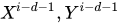 포함하지 않는 경우 i
전송 엔트로피는 일반적으로 정지성을 가정합니다. , → 는 i i 시간에 의존하지 .
참고문헌
- ^ a b c Massey, James (1990). "Causality, Feedback And Directed Information". Proceedings 1990 International Symposium on Information Theory and its Applications, Waikiki, Hawaii, Nov. 27-30, 1990.
- ^ a b c d Kramer, Gerhard (1998). Directed information for channels with feedback (Doctoral). ETH Zurich. doi:10.3929/ethz-a-001988524. hdl:20.500.11850/143796.
- ^ Tatikonda, Sekhar Chandra (2000). Control under communication constraints (Doctoral). Massachusetts Institute of Technology. hdl:1721.1/16755.
- ^ Permuter, Haim Henry; Weissman, Tsachy; Goldsmith, Andrea J. (February 2009). "Finite State Channels With Time-Invariant Deterministic Feedback". IEEE Transactions on Information Theory. 55 (2): 644–662. arXiv:cs/0608070. doi:10.1109/TIT.2008.2009849. S2CID 13178.
- ^ a b Kramer, G. (January 2003). "Capacity results for the discrete memoryless network". IEEE Transactions on Information Theory. 49 (1): 4–21. doi:10.1109/TIT.2002.806135.
- ^ Kramer, Gerhard (April 2014). "Information Networks With In-Block Memory". IEEE Transactions on Information Theory. 60 (4): 2105–2120. arXiv:1206.5389. doi:10.1109/TIT.2014.2303120. S2CID 16382644.
- ^ Permuter, Haim H.; Kim, Young-Han; Weissman, Tsachy (June 2011). "Interpretations of Directed Information in Portfolio Theory, Data Compression, and Hypothesis Testing". IEEE Transactions on Information Theory. 57 (6): 3248–3259. arXiv:0912.4872. doi:10.1109/TIT.2011.2136270. S2CID 11722596.
- ^ Simeone, Osvaldo; Permuter, Haim Henri (June 2013). "Source Coding When the Side Information May Be Delayed". IEEE Transactions on Information Theory. 59 (6): 3607–3618. arXiv:1109.1293. doi:10.1109/TIT.2013.2248192. S2CID 3211485.
- ^ Charalambous, Charalambos D.; Stavrou, Photios A. (August 2016). "Directed Information on Abstract Spaces: Properties and Variational Equalities". IEEE Transactions on Information Theory. 62 (11): 6019–6052. arXiv:1302.3971. doi:10.1109/TIT.2016.2604846. S2CID 8107565.
- ^ Tanaka, Takashi; Esfahani, Peyman Mohajerin; Mitter, Sanjoy K. (January 2018). "LQG Control With Minimum Directed Information: Semidefinite Programming Approach". IEEE Transactions on Automatic Control. 63 (1): 37–52. arXiv:1510.04214. doi:10.1109/TAC.2017.2709618. S2CID 1401958.
- ^ Vinkler, Dror A; Permuter, Haim H; Merhav, Neri (20 April 2016). "Analogy between gambling and measurement-based work extraction". Journal of Statistical Mechanics: Theory and Experiment. 2016 (4): 043403. arXiv:1404.6788. Bibcode:2016JSMTE..04.3403V. doi:10.1088/1742-5468/2016/04/043403. S2CID 124719237.
- ^ Massey, J.L.; Massey, P.C. (September 2005). "Conservation of mutual and directed information". Proceedings. International Symposium on Information Theory, 2005. ISIT 2005. pp. 157–158. doi:10.1109/ISIT.2005.1523313. ISBN 0-7803-9151-9. S2CID 38053218.
- ^ Amblard, Pierre-Olivier; Michel, Olivier (28 December 2012). "The Relation between Granger Causality and Directed Information Theory: A Review". Entropy. 15 (1): 113–143. arXiv:1211.3169. Bibcode:2012Entrp..15..113A. doi:10.3390/e15010113.
- ^ Jiao, Jiantao; Permuter, Haim H.; Zhao, Lei; Kim, Young-Han; Weissman, Tsachy (October 2013). "Universal Estimation of Directed Information". IEEE Trans. Inf. Theory. 59 (10): 6220–6242. arXiv:1201.2334. doi:10.1109/TIT.2013.2267934. S2CID 10855063.
- ^ Quinn, Christopher J.; Kiyavash, Negar; Coleman, Todd P. (December 2015). "Directed Information Graphs". IEEE Trans. Inf. Theory. 61 (12): 6887–6909. arXiv:1204.2003. doi:10.1109/TIT.2015.2478440. S2CID 3121664.
- ^ a b c Aharoni, Ziv; Tsur, Dor; Goldfeld, Ziv; Permuter, Haim Henry (June 2020). "Capacity of Continuous Channels with Memory via Directed Information Neural Estimator". 2020 IEEE International Symposium on Information Theory (ISIT). pp. 2014–2019. arXiv:2003.04179. doi:10.1109/ISIT44484.2020.9174109. ISBN 978-1-7281-6432-8. S2CID 212634151.
{{cite book}}:journal=무시됨(도움말) - ^ a b Naiss, Iddo; Permuter, Haim H. (January 2013). "Extension of the Blahut–Arimoto Algorithm for Maximizing Directed Information". IEEE Trans. Inf. Theory. 59 (1): 204–222. arXiv:1012.5071. doi:10.1109/TIT.2012.2214202. S2CID 3115749.
- ^ a b Permuter, Haim; Cuff, Paul; Van Roy, Benjamin; Weissman, Tsachy (July 2008). "Capacity of the Trapdoor Channel With Feedback". IEEE Trans. Inf. Theory. 54 (7): 3150–3165. arXiv:cs/0610047. doi:10.1109/TIT.2008.924681. S2CID 1265.
- ^ a b Elishco, Ohad; Permuter, Haim (September 2014). "Capacity and Coding for the Ising Channel With Feedback". IEEE Trans. Inf. Theory. 60 (9): 5138–5149. arXiv:1205.4674. doi:10.1109/TIT.2014.2331951. S2CID 9761759.
- ^ a b Sabag, Oron; Permuter, Haim H.; Kashyap, Navin (January 2016). "The Feedback Capacity of the Binary Erasure Channel With a No-Consecutive-Ones Input Constraint". IEEE Trans. Inf. Theory. 62 (1): 8–22. doi:10.1109/TIT.2015.2495239. S2CID 476381.
- ^ a b Peled, Ori; Sabag, Oron; Permuter, Haim H. (July 2019). "Feedback Capacity and Coding for the $(0,k)$ -RLL Input-Constrained BEC". IEEE Trans. Inf. Theory. 65 (7): 4097–4114. arXiv:1712.02690. doi:10.1109/TIT.2019.2903252. S2CID 86582654.
- ^ a b Aharoni, Ziv; Sabag, Oron; Permuter, Haim Henri (18 August 2020). "Reinforcement Learning Evaluation and Solution for the Feedback Capacity of the Ising Channel with Large Alphabet". arXiv:2008.07983 [cs.IT].
- ^ Sabag, Oron; Permuter, Haim Henry; Pfister, Henry (March 2017). "A Single-Letter Upper Bound on the Feedback Capacity of Unifilar Finite-State Channels". IEEE Trans. Inf. Theory. 63 (3): 1392–1409. arXiv:1604.01878. doi:10.1109/TIT.2016.2636851. S2CID 3259603.
- ^ Sabag, Oron; Huleihel, Bashar; Permuter, Haim Henry (2020). "Graph-Based Encoders and their Performance for Finite-State Channels with Feedback". IEEE Trans. Commun. 68 (4): 2106–2117. arXiv:1907.08063. doi:10.1109/TCOMM.2020.2965454. S2CID 197544824.
- ^ Marko, Hans (1 September 1966). "Die Theorie der bidirektionalen Kommunikation und ihre Anwendung auf die Nachrichtenübermittlung zwischen Menschen (Subjektive Information)". Kybernetik (in German). 3 (3): 128–136. doi:10.1007/BF00288922. ISSN 1432-0770. PMID 5920460. S2CID 33275199.
- ^ Marko, H. (December 1973). "The Bidirectional Communication Theory--A Generalization of Information Theory". IEEE Transactions on Communications. 21 (12): 1345–1351. doi:10.1109/TCOM.1973.1091610. S2CID 51664185.