시그스펙
SigSpec
SigSpec(SIGnificance SPECtrum의 어크로니마)은 측정된 (소음이고 반드시 동일하지 않은) 시계열에서 주기성의 신뢰성을 제공하기 위한 통계 기법이다.[1]이산 푸리에 변환(DFT)이 획득한 진폭 스펙트럼에 의존하며 스펙트럼 유의성(주로 "sig"로 약칭)이라는 양을 각 진폭에 할당한다.이 양은 주어진 진폭 수준이 1종 오류라는 의미에서 백색 노이즈로 나타날 확률을 로그 측정값으로 나타낸 것이다."분석된 시계열이 랜덤이라면 측정된 시계열과 같은 진폭을 얻을 기회가 얼마나 될까?"라는 질문에 대한 답을 나타낸다.
SigSpec은 Lomb-Scargle 주기그램에 대한 공식적인 확장으로 간주될 수 있으며,[2][3] 많은 실제 적용에서 수행되는 DFT를 적용하기 전에 평균이 0으로 되도록 시계열을 적절히 통합할 수 있다.0평균 보정 데이터 집합을 랜덤 표본과 통계적으로 비교해야 하는 경우, 모집단 평균이 아닌 표본 평균은 0이어야 한다.
푸리에 공간 내 백색 노이즈의 확률밀도함수(pdf)
K 쌍 k, x 으로 나타낼 시계열을 고려할 때 주파수 및 위상 각도에 따라 푸리에 공간 내 백색 노이즈의 진폭 pdfdf는 { 0의 세 가지 파라미터로 설명할 수 있다. {0 {\0}}에 따라 "profile을 정의함



![{\displaystyle \alpha _{0}={\sqrt {{\frac {2}{K^{2}}}\left(K\sum _{k=0}^{K-1}\cos ^{2}\left(\omega t_{k}-\theta _{0}\right)-\left[\sum _{l=0}^{K-1}\cos \left(\omega t_{k}-\theta _{0}\right)\right]^{2}\right)}},}](https://wikimedia.org/api/rest_v1/media/math/render/svg/135c6c873a89540d3fa6131a218c21f070493820)
![{\displaystyle \beta _{0}={\sqrt {{\frac {2}{K^{2}}}\left(K\sum _{k=0}^{K-1}\sin ^{2}\left(\omega t_{k}-\theta _{0}\right)-\left[\sum _{l=0}^{K-1}\sin \left(\omega t_{k}-\theta _{0}\right)\right]^{2}\right)}}.}](https://wikimedia.org/api/rest_v1/media/math/render/svg/e48dae93812fe2e8fea9a7a02b8d50b714389a12)
푸리에 공간에서의 위상 각도로 볼 때, 와 함께.

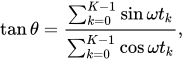
진폭의 확률 밀도는 다음과 같다.

양말 함수가 정의된 위치:
![{\displaystyle \operatorname {sock} (\omega ,\theta )=\left[{\frac {\cos ^{2}\left(\theta -\theta _{0}\right)}{\alpha _{0}^{2}}}+{\frac {\sin ^{2}\left(\theta -\theta _{0}\right)}{\beta _{0}^{2}}}\right]}](https://wikimedia.org/api/rest_v1/media/math/render/svg/fb81d0d8b512119f1694a883cc6c8d674d5774e9)


거짓 경보 확률 및 스펙트럼 유의성
pdf를 통합하면 시간 영역의 백색 노이즈가 최소 의 진폭을 생성할 수 있는 거짓 경보 확률이 산출된다


SIG는 거짓 경보 확률의 음수 로그로 정의되며
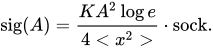
주어진 주파수 및 위상에서 을(를) 초과하는 진폭을 얻기 위해 검사해야 하는 랜덤 시계열 수를 반환한다.
적용들
SigSpec은 주로 항성을 식별하고 항성 맥동을 분류하기 위해 별자리론에 사용된다(아래 참조 참조).이 방법은 시간 영역 샘플링의 특성을 적절히 통합한다는 사실은 데이터 간격을 포함하는 전형적인 천문학적 측정에 귀중한 도구가 된다.
참고 항목
참조
- ^ P. Reegen (2007). "SigSpec - I. Frequency- and phase-resolved significance in Fourier space". Astronomy and Astrophysics. 467: 1353–1371. arXiv:physics/0703160. Bibcode:2007A&A...467.1353R. doi:10.1051/0004-6361:20066597.
- ^ N. R. Lomb (1976). "Least-squares frequency analysis of unequally spaced data". Astrophysics and Space Science. 39: 447–462. Bibcode:1976Ap&SS..39..447L. doi:10.1007/BF00648343.
- ^ J. D. Scargle (1982). "Studies in astronomical time series analysis. II. Statistical aspects of spectral analysis of unevenly spaced data". The Astrophysical Journal. 263: 835–853. Bibcode:1982ApJ...263..835S. doi:10.1086/160554.
- M. Breger; S. M. Rucinski; P. Reegen (2007). "The Pulsation of EE Camelopardalis". The Astronomical Journal. 134: 1994–1998. arXiv:0709.3393. Bibcode:2007AJ....134.1994B. doi:10.1086/522795.
- M. Gruberbauer; K. Kolenberg; J. F. Rowe; D. Huber; J. M. Matthews; P. Reegen; R. Kuschnig; C. Cameron; T. Kallinger; W. W. Weiss; D. B. Guenther; A. F. J. Moffat; S. M. Rucinski; D. Sasselov; G. A. H. Walker (2007). "MOST photometry of the RRdLyrae variable AQLeo: two radial modes, 32 combination frequencies and beyond". Monthly Notices of the Royal Astronomical Society. 379: 1498–1506. arXiv:0705.4603. Bibcode:2007MNRAS.379.1498G. doi:10.1111/j.1365-2966.2007.12042.x.
- M. Gruberbauer; H. Saio; D. Huber; T. Kallinger; W. W. Weiss; D. B. Guenther; R. Kuschnig; J. M. Matthews; A. F. J. Moffat; S. M. Rucinski; D. Sasselov; G. A. H. Walker (2008). "MOST photometry and modeling of the rapidly oscillating (roAp) star γ Equulei". Astronomy and Astrophysics. 480: 223–232. arXiv:0801.0863. Bibcode:2008A&A...480..223G. doi:10.1051/0004-6361:20078830.
- D. B. Guenther; T. Kallinger; P. Reegen; W. W. Weiss; J. M. Matthews; R. Kuschnig; A. F. J. Moffat; S. M. Rucinski; D. Sasselov; G. A. H. Walker (2007). "Searching for p-modes in η Bootis & Procyon using MOST satellite data". Communications in Asteroseismology. 151: 5–25. Bibcode:2007CoAst.151....5G. doi:10.1553/cia151s5.
- D. B. Guenther; T. Kallinger; K. Zwintz; W. W. Weiss; J. Tanner (2007). "Seismology of Pre-Main-Sequence Stars in NGC 6530" (PDF). The Astrophysical Journal. 671: 581–591. Bibcode:2007ApJ...671..581G. doi:10.1086/522880.
- D. Huber; H. Saio; M. Gruberbauer; W. W. Weiss; J. F. Rowe; M. Hareter; T. Kallinger; P. Reegen; J. M. Matthews; R. Kuschnig; D. B. Guenther; A. F. J. Moffat; S. M. Rucinski; D. Sasselov; G. A. H. Walker (2008). "MOST photometry of the roAp star 10 Aquilae". Astronomy and Astrophysics. 483: 239–248. arXiv:0803.1721. Bibcode:2008A&A...483..239H. doi:10.1051/0004-6361:20079220.
- T. Kallinger; D. B. Guenther; J. M. Matthews; W. W. Weiss; D. Huber; R. Kuschnig; A. F. J. Moffat; S. M. Rucinski; D. Sasselov (2008). "Nonradial p-modes in the G9.5 giant ε Ophiuchi? Pulsation model fits to MOST photometry". Astronomy and Astrophysics. 478: 497–505. arXiv:0711.0837. Bibcode:2008A&A...478..497K. doi:10.1051/0004-6361:20078171.
- T. Kallinger; P. Reegen; W. W. Weiss (2008). "A heuristic derivation of the uncertainty for frequency determination in time series data". Astronomy and Astrophysics. 481: 571–574. arXiv:0801.0683. Bibcode:2008A&A...481..571K. doi:10.1051/0004-6361:20077559.
- P. Reegen (2005). "SigSpec - reliable computation of significance in Fourier space", in The A-Star Puzzle, Proceedings IAU Symp. 224, eds. J. Zverko, J. Ziznovsky, S.J. Adelman, W.W. Weiss. The A-Star Puzzle, Proceedings of IAU Symposium 224. Cambridge, UK: Cambridge University Press. pp. 791–798. ISBN 0-521-85018-5.
- P. Reegen; M. Gruberbauer; L. Schneider; W. W. Weiss (2008). "Cinderella - Comparison of INDEpendent RELative Least-squares Amplitudes". Astronomy and Astrophysics. 484: 601–608. arXiv:0710.2963. Bibcode:2008A&A...484..601R. doi:10.1051/0004-6361:20078855.
- C. Schoenaers; A. E. Lynas-Gray (2007). "A new slowly pulsating subdwarf-B star: HD 4539". Communications in Asteroseismology. 151: 67–76. Bibcode:2007CoAst.151...67S. doi:10.1553/cia151s67.
- M. Zechmeister; M. Kuerster (2009). "The gemeralised Lomb-Scargle periodogram. A new formalism for the floating-mean and Keplerian periodograms". Astronomy and Astrophysics. 496: 577–584. arXiv:0901.2573. Bibcode:2009A&A...496..577Z. doi:10.1051/0004-6361:200811296.
- K. Zwintz; T. Kallinger; D. B. Guenther; M. Gruberbauer; D. Huber; J. Rowe; R. Kuschnig; W. W. Weiss; J. M. Matthews; A. F. J. Moffat; S. M. Rucinski; D. Sasselov; G. A. H. Walker; M. P. Casey (2009). "MOST photometry of the enigmatic PMS pulsator HD 142666". Astronomy and Astrophysics. 494: 1031–1040. arXiv:0812.1960. Bibcode:2009A&A...494.1031Z. doi:10.1051/0004-6361:200811116.
- K. Zwintz; M. Hareter; R. Kuschnig; P. J. Amado; N. Nesvacil; E. Rodriguez; D. Diaz-Fraile; W. W. Weiss; T. Pribulla; D. B. Guenther; J. M. Matthews; A. F. J. Moffat; S. M. Rucinski; D. Sasselov; G. A. H. Walker (2009). "MOST observations of the young open cluster NGC 2264". Astronomy and Astrophysics. 502: 1239–252. doi:10.1051/0004-6361:200911863.