스티브
STEVE
.jpg)
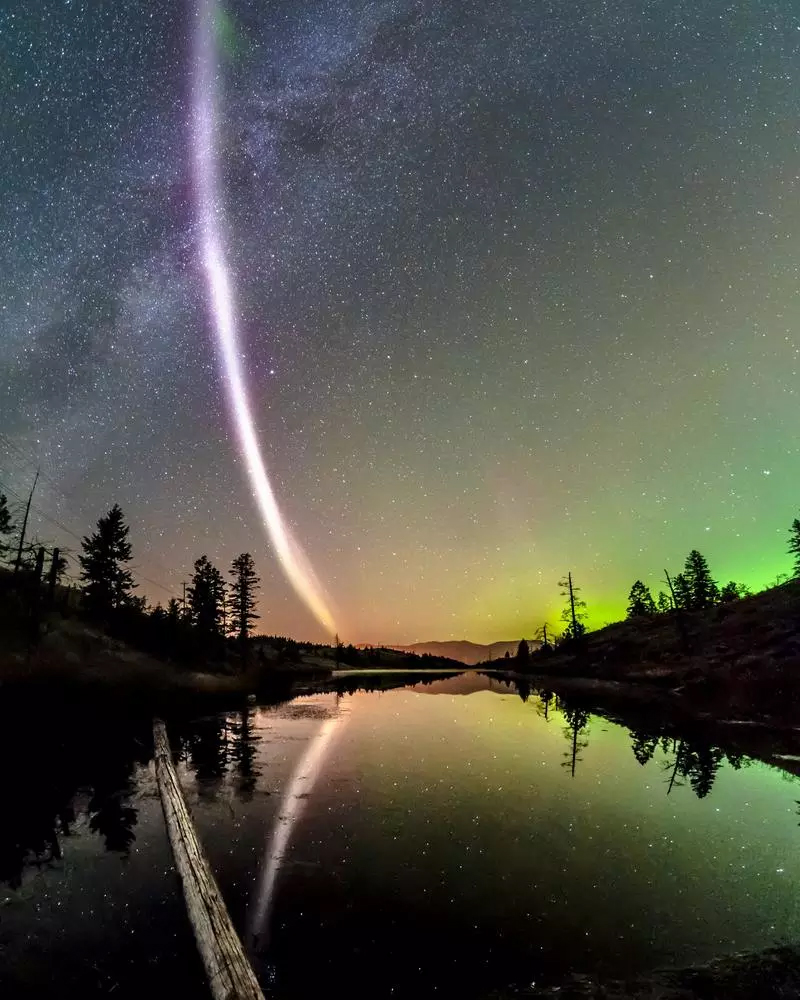
스티브(STEVE)는 2016년 말 캐나다 앨버타의 오로라 관측자들에 의해 명명된, 하늘에 보라색과 녹색 빛 리본으로 나타나는 대기 광학 현상입니다.유럽우주국(European Space Agency)의 스웜(Swarm) 임무의 위성 데이터 분석에 따르면, 이 현상은 450km(280mi) 고도에서 25km(16mi) 폭의 뜨거운 플라즈마 리본이 3,000°C(3,270K; 5,430°F)의 온도와 6km/s(3.7mi/s)(리본 바깥의 10m/s)의 속도로 흐르기 때문에 발생합니다.이 현상은 드물지는 않지만, 그 이전에는 과학적으로 조사되고 기술되지 않았습니다.[1][2][3]
검색 및 이름 지정
스티브 현상은 오로라 사진작가들에 의해 수십 년간 관찰되어 왔습니다.[3]어떤 증거들은 스티브의 관찰이 이르면 1705년에 기록되었을지도 모른다는 것을 암시합니다.[4]1911년부터 1950년대까지 칼 슈퇴르머가 관측한 일부 자료에는 이 현상과 유사한 표기가 있습니다.[5][6]
그러나 이 현상의 본질에 대한 최초의 정확한 결정은 페이스북 그룹의 멤버들이 이 현상의 이름을 짓고, 양성자 오로라의 탓으로 돌리고, "양성자 호"라고 부르기 시작할 때까지 내려지지 않았습니다.[7]캘거리 대학의 물리학 교수 에릭 도노반이 그들의 사진들을 보고 양성자 오로라가 보이지 않기 때문에 그들의 결정이 틀렸다고 의심했을 때,[8] 그는 스웜 위성 데이터와 알버타 오로라 추적자 사진작가 중 한 명인 송 데스핀스와 그 현상의 시간과 위치를 연관시켰습니다.그녀는 도노반이 그 현상을 식별하기 위해 데이터를 연결하는 것을 도와준 앨버타주 비미의 GPS 좌표를 제공했습니다.[1]
오로라 관찰자 중 한 명인 사진작가 크리스 라츨라프(Chris Ratzlaff)[9][10]는 2006년 애니메이션 코미디 영화 "오버 더 헤지(Over the Hedge)"에서 발생한 상황에서 비롯된 현상에 "스티브"라는 이름을 사용할 것을 제안했습니다.영화 속 등장인물들은 하룻밤 사이에 나타나는 울타리에 그 이름을 붙여 더 친절하게 보이게 합니다.[11]지금까지 설명되지 않은 특이한 "오로라"에 대한 보고는 오로라사우루스에 대한 시민 과학의 한 예로 입소문이 났습니다.[12][13]
2016년 12월 미국 지구물리학 연합 가을 회의에서 로버트 리삭은 "강력한 열 방출 속도 향상"을 나타내는 현상에 대해 "스티브"라는 백로닉을 사용할 것을 제안했습니다.[14]그 두문자 "STEVE"는 그 현상을 연구하고 있는 NASA Goddard 우주 비행 센터의 팀에 의해 채택되었습니다.[15]
| 외부매체 | |
|---|---|
| 이미지들 | |
 현상 사진 현상 사진 | |
| 갤러리 | |
| 비디오 | |
 유튜브 타임랩스 현상 유튜브 타임랩스 현상 |
발생원인
위치 및 시기
극지방에서 오로라보다 더 멀리 스티브 현상이 관측될 수 있으며,[16] 2018년 3월 현재 영국, 캐나다, 알래스카, 미국 북부 주, 호주, 뉴질랜드에서 관측되고 있습니다.[17]이 현상은 동서로 정렬된 수백 또는 수천 마일에 걸쳐 매우 좁은 원호로 나타납니다.그것은 보통 20분에서 1시간 동안 지속됩니다.2018년 3월 현재, 스티브 현상은 오로라가 있는 곳에서만 발견되었습니다.2016년 10월부터 2017년 2월까지, 또는 2017년 10월부터 2018년 2월까지 관찰되지 않았으며, 이로 인해 NASA는 특정 계절에만 스티브 현상이 나타날 수 있다고 믿게 되었습니다.[18]
원인조사
엘리자베스 A가 2018년 3월 발표한 연구. 동료 평가 저널인 Science Advances에서 맥도날드와 공동저자들은 스티브 현상이 극도로 뜨거운 입자의 빠르게 움직이는 흐름인 [19]아오로라 이온 드리프트(SAID)를 동반한다고 제안했습니다.스티브는 SAID에 수반되는 최초의 관찰된 시각적 효과를 표시합니다.[18]
2018년 8월, 연구원들은 이 현상의 천광이 입자 침전(전자 또는 이온)과 관련이 없으며 결과적으로 전리층에서 생성될 수 있다고 결정했습니다.[20]
빛을 내기 위한 한 가지 제안된 메커니즘은 들뜬 질소가 분해되고 산소와 상호작용하여 빛나는 산화 질소를 형성한다는 것입니다.[21]
피켓 울타리 오로라와의 연관성
지구물리학 연구 편지에 실린 한 연구에 따르면, 항상은 아니지만, 종종 스티브 현상이 녹색의 "피켓 울타리" 오로라 위에서 관찰됩니다.[22]
[23] 피켓 울타리 오로라는 전자의 침전을 통해 생성되지만, 오로라 타원형 외부에 나타나기 때문에 기존의 오로라와는 그 형성이 다릅니다.[24]이 연구는 또한 이러한 현상들이 두 반구에서 동시에 나타난다는 것을 보여주었습니다.피켓 울타리 오로라의 목격은 스티브의 관찰 없이 이루어졌습니다.[25]
피켓 울타리 오로라의 녹색 방출은 주변의 물보다 더 느리게 움직이는 강에서 보이는 에디와 유사하게 하전 입자의 초음속 흐름에서의 에디와 관련이 있는 것으로 보입니다.따라서, 피켓 울타리 안의 녹색 막대들은 자주색 방출의 구조물들보다 더 느리게 움직이고 있고, 일부 과학자들은 그것들이 우주로부터 하전된 입자들의 난류에 의한 것일 수 있다고 추측해왔습니다.[26]
조사.
2017
- "내가 스티브를 만난 방법" - 에릭 도노반의 2017 ESA 지구 탐험가 미션 과학 회의 발표, 2017년 3월 20일 (1:08:30 - 1:26:00)
- "스티브의 위치에서, 신비로운 아우로랄의 특징"
2018
- "대기권 상층부 광학구조 발견 시민과학자 주도"
- "스티브의 기원에 관하여: 입자 침전 또는 이온권 하늘빛?"
- "STEVE의 역사적 관찰"
- "시민 과학과 '아마추어' 관찰이 스티브에 대해 또 무엇을 밝힐 수 있을까요?"
- "불꽃에서 불까지, 오로라 연구 5년 국민참여 반성"
- "STEVE의 형성 기원과 지자기 조건에 관하여"
- "STEVE의 통계적 분석"
2019
- "우리가 어떻게 이걸 놓쳤을까요?스티브라는 이름의 대기 상층부 발견"
- "TREx 분광기에서 처음 관측한 내용:스티브의 광 스펙트럼과 피켓 펜스 현상"
- "Subauroral (STEVE) 아크의 색 비율"
- "여러 태양 주기에 걸친 스티브 현상 관련 관측의 새로운 데이터 세트"
- "초록색 STEVE 아크: 저에너지 흥분에 대한 증거"
- "스티브의 자기권 서명: 자기권 에너지원과 반구간 접합에 대한 시사점"
- "시민과학자들에 의해 보고된 스티브 사건 동안의 에너지와 운동량 침착을 특징으로 하는 고위도 전리층 전기역학"
- "스티브: 강렬한 아오로라 이온 드리프트의 광학적 특징"
- "이중층 스티브의 광스펙트럼과 방출고도: 사례연구"
- "스티브와 피켓 펜스 이벤트의 광 방출 수직 분포"
- "자기권과 지상에서의 복합 관측을 이용한 스티브의 자기권 드라이버 식별"
- "STEVE와 피켓 울타리: 피드백-불안정 자기권-전리권 상호작용의 증거"
- "Dynamics Explorer-2 데이터에서 스티브의 증거 가능성"
2020
- 오로라 개척자 칼 슈퇴르머(Carl Størmer)의 고고도 분리 아오로라 아크에 대한 초기 지상 기반 연구(현재 "STEVE"로 알려져 있음) 초기 지상 기반 연구
- "오로라 개척자 칼 슈퇴르머(Carl Størmer)가 아오로라 위도 100km 지역에서 관측한 고립된 오로라 구조의 초기 증거"
- 오로라 개척자 칼 슈퇴르머(Carl Størmer)의 고고도 분리 아오로라 아크에 대한 초기 지상 기반 연구(현재 "STEVE"로 알려져 있음) 초기 지상 기반 연구
- "스티브와 SAID의 자기권 조건: 입자 주입, 서브스톰 서지 및 현장 정렬 전류"
- "STEVE 발생 이전의 중성풍동역학과 이들의 가능한 사전조건화 역할"
- "STEVE 연속체 방출 메커니즘"
- "STEVE 사건 중 고위도 전리층 전기역학"
- "STEVE와 SAID와 연관된 오로라 강수 경계의 역학"
- "STEVE의 겉보기 움직임과 피켓 펜스 현상"
- "스발바르에서 관측된 조각난 오로라 유사 방출(FAE)의 특성"
- "새로운 유형의 오로라 현상으로 파편화된 오로라 유사 방출(FAEs)"
2021
- "캐나다 아타바스카에서 스티브의 다파장 영상 관측"
- "2017년 3월 1일 서브스톰 중 동기 지자기 맥동 및 양성자 오로라 등록"
- "시민과학자 데이터와 630.0nm 전하늘 영상, 위성을 결합한 STEVE와 SAR 아크 최초 동시 관측"
- 아오로라 지역의 양성자 오로라와 광학적 방출
- "STEVE의 동시대 시민과학 관측의 고품질 삼각측량 개선을 위한 강력한 기술"
- "2017년 3월 1일 마이마가 아우라럴 스테이션에 등록된 SAR 아크, STEVE와 피켓 펜스 역학 비교"
- "STEVE 사진 분석 개선"
2022
- "밤의 무지개:SAR 아크가 스티브로 진화하는 것을 최초로 직접 관찰"
- "오랄 구조물:메조 스케일 M-I 커플링의 중요성을 밝힘"
참고 항목
참고문헌
- ^ a b McRae, Mike (24 April 2017). "Introducing Steve - a Newly Discovered Astronomical Phenomenon". ScienceAlert.
- ^ "When Swarm Met Steve". ESA. 21 April 2017.
- ^ a b American Geophysical Union (20 August 2018). "New kind of aurora is not an aurora at all". Physorg.com. Retrieved 2018-08-21.
- ^ Finnegan, James; Asher, David; Nezic, Rok; Byrne, Conor; Bailey, Mark (23 July 2018). "Historical observations of STEVE". The Observatory. 138: 227–245. arXiv:1808.01872. Bibcode:2018Obs...138..227B.
- ^ Hunnekuhl M, MacDonald E (12 February 2020). "Early Ground-Based Work by Auroral Pioneer Carl Størmer on the High-Altitude Detached Subauroral Arcs Now Known as "STEVE"". Space Weather. 18 (3). Bibcode:2020SpWea..1802384H. doi:10.1029/2019SW002384.
- ^ "When Størmer Met STEVE". Aurorasaurus. 3 March 2020.
- ^ "Meet Steve". European Space Agency. Retrieved 2017-04-24.
- ^ "Aurora photographers find new night sky lights and call them Steve". BBC News. 23 April 2017.
- ^ ""I propose we call it Steve until then" - Alberta Aurora Chasers". Facebook. February 10, 2016.
- ^ "Amateur Sky-Watchers Discover Celestial Phenomenon, Name It 'Steve'". 24 April 2017.
- ^ "New atmospheric phenomenon named STEVE discovered by aurora watchers". ABC News. 24 April 2017.
- ^ Rozell, Ned (2015-04-02). "Citizen science meets the aurora". University of Alaska Fairbanks Geophysical Institute.
- ^ "7 Things to Know About "STEVE"". Aurorasaurus. 2017-03-14.
- ^ Moravec, Jeff. "Meet Steve, a sky phenomenon coming into its own". StarTribune. MediaCompany. Retrieved 9 May 2019.
- ^ "Meet 'Steve,' a Totally New Kind of Aurora". 2018-03-14. Retrieved 2018-03-22.
- ^ Saner, Emine (2018-03-19). "'Steve': the mystery purple aurora that rivals the northern lights". the Guardian. Retrieved 2018-03-22.
- ^ Skywatching, Samantha Mathewson 2018-03-15T22:47:11Z (15 March 2018). "Help NASA Study 'Steve,' a Newfound Aurora Type". Space.com. Retrieved 2019-05-13.
- ^ a b Garner, Rob (2018-03-14). "NASA Needs Your Help to Find Steve and Here's How". NASA. Retrieved 2018-03-22.
- ^ a b MacDonald, Elizabeth A.; Donovan, Eric; Nishimura, Yukitoshi; Case, Nathan A.; Gillies, D. Megan; Gallardo-Lacourt, Bea; Archer, William E.; Spanswick, Emma L.; Bourassa, Notanee; Connors, Martin; Heavner, Matthew; Jackel, Brian; Kosar, Burcu; Knudsen, David J.; Ratzlaff, Chris; Schofield, Ian (2018-03-01). "New science in plain sight: Citizen scientists lead to the discovery of optical structure in the upper atmosphere". Science Advances. 4 (3): eaaq0030. Bibcode:2018SciA....4...30M. doi:10.1126/sciadv.aaq0030. ISSN 2375-2548. PMC 5851661. PMID 29546244.
- ^ Gallardo-Lacourt, B.; Liang, J.; Nishimura, Y.; Donovan, E. (20 August 2018). "On the Origin of STEVE: Particle Precipitation or Ionospheric Skyglow?". Geophysical Research Letters. 45 (16): 7968. Bibcode:2018GeoRL..45.7968G. doi:10.1029/2018GL078509.
- ^ Kasha Patel (April 1, 2023). "How to find STEVE, the purple streak that looks like an aurora but isn't".
- ^ Andrews, Robin George (3 May 2019). "Steve the odd 'aurora' revealed to be two sky shows in one". National Geographic. Retrieved 4 May 2019.
- ^ Nishimura, Y.; Gallardo‐Lacourt, B.; Zou, Y.; Mishin, E.; Knudsen, D.J.; Donovan, E.F.; Angelopoulos, V.; Raybell, R. (16 April 2019). "Magnetospheric signatures of STEVE: Implication for the magnetospheric energy source and inter‐hemispheric conjugacy". Geophysical Research Letters. 46 (11): 5637–5644. Bibcode:2019GeoRL..46.5637N. doi:10.1029/2019GL082460.
- ^ Lipuma, Lauren. "Scientists discover what powers celestial phenomenon STEVE". AGU News. American Geophysical Union. Retrieved 4 May 2019.
- ^ Dunlevie, James (2018-11-06). "Aurora Australis with bonus 'picket fence' wows southern lights chasers in Tasmania". ABC News. Australian Broadcasting Corporation. Retrieved 4 May 2019.
- ^ "Aurora-chasing citizen scientists help discover a new feature of STEVE". phys.org. Retrieved 2020-11-14.
- ^ "How I met Steve". Vimeo/European Space Agency. 20 March 2017.
- ^ Gallardo-Lacourt, B.; Nishimura, Y.; Donovan, E.; Gillies, D.M.; Spanswick, E.; Archer, W.E.; MacDonald, E.; Knudsen, D.J. (December 2017). "On the location of Steve, the mysterious subauroral feature". AGU Fall Meeting Abstracts. 2017. Bibcode:2017AGUFMSA51B2387G.
- ^ Gallardo-Lacourt, B.; Liang, J.; Nishimura, Y.; Donovan, E. (February 20, 2018). "On the Origin of STEVE: Particle Precipitation or Ionospheric Skyglow?". Geophysical Research Letters. 45 (16): 7968–7973. Bibcode:2018GeoRL..45.7968G. doi:10.1029/2018GL078509. S2CID 134540082.
- ^ Bailey, M.; Byrne, C.; Nezic, R.; Asher, D.; Finnegan, J. (July 23, 2018). "Historical observations of STEVE". The Observatory. 138: 227–245. arXiv:1808.01872. Bibcode:2018Obs...138..227B.
- ^ MacDonald, E.; Conde, J.M.; Kosar, B.; Lynch, K.A.; Semeter, J.L.; Zeller, N. (December 1, 2018). "What else can citizen science and 'amateur' observations reveal about STEVE?". American Geophysical Union, Fall Meeting 2018. 2018. Bibcode:2018AGUFMSM43A..09M.
- ^ MacDonald, E.; Ratzlaff, C. (December 1, 2018). "From the spark to the fire, reflections on five years of public participation in aurora research". American Geophysical Union, Fall Meeting 2018. 2018. Bibcode:2018AGUFM.U51A..04M.
- ^ Gallardo-Lacourt, B.; Liang, J.; Nishimura, Y.; Donovan, E.; Gillies, D.M.; Perry, G.W.; Archer, W.E.; Nava, O.; Spanswick, E.L. (December 1, 2018). "On the origin and geomagnetic conditions of STEVE's formation". American Geophysical Union, Fall Meeting 2018. 2018. Bibcode:2018AGUFMSM51E2787G.
- ^ Gallardo-Lacourt, B.; Nishimura, e.; Donovan, E.; Gillies, D.M.; Perry, G.W.; Archer, W.E.; Nava, O.; Spanswick, E.L. (November 8, 2018). "A Statistical Analysis of STEVE". Journal of Geophysical Research: Space Physics. 123 (11): 9893–9905. Bibcode:2018JGRA..123.9893G. doi:10.1029/2018JA025368. S2CID 134931832.
- ^ Gallardo-Lacourt, B.; Perry, G. W.; Archer, W. E.; Donovan, E. (March 2019). "How Did We Miss This? An Upper Atmospheric Discovery Named STEVE". Eos Science News by AGU.
- ^ Gillies, D.M.; Donovan, E.; Hampton, D.; Liang, J.; Connors, M.; Nishimura, Y.; Gallardo-Lacourt, B.; Spanswick, E.L. (July 3, 2019). "First Observations From the TREx Spectrograph: The Optical Spectrum of STEVE and the Picket Fence Phenomena". Geophysical Research Letters. 46 (13): 7207–7213. Bibcode:2019GeoRL..46.7207G. doi:10.1029/2019GL083272. S2CID 198413976.
- ^ Mende, S.B.; Turner, C. (June 24, 2019). "Color Ratios of Subauroral (STEVE) Arcs". Journal of Geophysical Research: Space Physics. 124 (7): 5945–5955. Bibcode:2019JGRA..124.5945M. doi:10.1029/2019JA026851. S2CID 197560558.
- ^ MacDonald, E.; Hunnekuhl, M. (December 2019). "A new dataset of STEVE phenomenon related observations spanning multiple solar cycles". American Geophysical Union, Fall Meeting 2019. 2019. Bibcode:2019AGUFMSM11C3299M.
- ^ Mende, S.B.; Harding, B.J.; Turner, C. (December 18, 2019). "Subauroral Green STEVE Arcs: Evidence for Low-Energy Excitation". Geophysical Research Letters. 46 (24): 14256–14262. Bibcode:2019GeoRL..4614256M. doi:10.1029/2019GL086145. S2CID 214009144.
- ^ Nishimura, Y.; Gallardo-Lacourt, B.; Zou, Y.; Mishin, E.; Knudsen, D.J.; Donovan, E.; Angelopoulos, V.; Raybell, R. (April 16, 2019). "Magnetospheric Signatures of STEVE: Implications for the Magnetospheric Energy Source and Interhemispheric Conjugacy". Geophysical Research Letters. 46 (11): 5637–5644. Bibcode:2019GeoRL..46.5637N. doi:10.1029/2019GL082460. S2CID 146182527.
- ^ Svaldi, V.C.; Matsuo, T.; Kilcommons, L.M.; MacDonald, E.; Gallardo-Lacourt, B. (December 1, 2019). "High-Latitude Ionospheric Electrodynamics Characterizing Energy and Momentum Deposition during STEVE Events Reported by Citizen Scientists". American Geophysical Union, Fall Meeting 2019. 2019. Bibcode:2019AGUFMSM11B3283S.
- ^ Archer, W.E.; Gallardo-Lacourt, B.; Perry, G.W.; St.-Maurice, J.P.; Buchert, S.C.; Donovan, E. (June 4, 2019). "Steve: The Optical Signature of Intense Subauroral Ion Drifts". Geophysical Research Letters. 46 (12): 6279–6286. Bibcode:2019GeoRL..46.6279A. doi:10.1029/2019GL082687. S2CID 195545155.
- ^ Liang, J.; Donovan, E.; Connors, M.; Gillies, D.; St-Maurice, J.P.; Jackel, B.; Gallardo-Lacourt, B.; Spanswick, E.; Chu, X. (December 3, 2019). "Optical Spectra and Emission Altitudes of Double-Layer STEVE: A Case Study". Geophysical Research Letters. 46 (23): 13630–13639. Bibcode:2019GeoRL..4613630L. doi:10.1029/2019GL085639. S2CID 212794445.
- ^ Archer, W.E.; St.-Maurice, J.P.; Gallardo-Lacourt, B.; Perry, G.W.; Cully, C.M.; Donovan, E.; Gillies, G.M.; Downie, R.; Smith, J.; Eurich, D. (September 3, 2019). "The Vertical Distribution of the Optical Emissions of a Steve and Picket Fence Event". Geophysical Research Letters. 46 (19): 10719–10725. Bibcode:2019GeoRL..4610719A. doi:10.1029/2019GL084473. S2CID 202900390.
- ^ Chu, X.; Malaspina, D.; Gallardo-Lacourt, B.; Liang, J.; Andersson, L.; Ma, Q.; Artemyev, A.; Liu, J.; Ergun, R.E.; Thaller, S.; Akbari, H.; Akbari, H.; Larsen, B.; Reeves, R.; Wygant, J.; Breneman, A.; Tian, S.; Connors, M.; Donovan, E.; Archer, W.; MacDonald, E. (November 11, 2019). "Identifying STEVE's Magnetospheric Driver Using Conjugate Observations in the Magnetosphere and on the Ground". Geophysical Research Letters. 46 (22): 12665–12674. Bibcode:2019GeoRL..4612665C. doi:10.1029/2019GL082789. S2CID 210258255.
- ^ Mishin, E.; Streltsov, A. (December 10, 2019). "STEVE and the Picket Fence: Evidence of Feedback-Unstable Magnetosphere-Ionosphere Interaction". EPJ Web of Conferences. 46 (24): 14247–14255. Bibcode:2019GeoRL..4614247M. doi:10.1029/2019GL085446. S2CID 213702359.
- ^ Erlandson, R.E. (December 1, 2019). "Possible Evidence of STEVE in Dynamics Explorer-2 Data". American Geophysical Union, Fall Meeting 2019. 2019. Bibcode:2019AGUFMSM22A..01E.
- ^ Hunnekulh, M.; MacDonald, E. (February 12, 2020). "Early Ground-Based Work by Auroral Pioneer Carl Størmer on the High-Altitude Detached Subauroral Arcs Now Known as "STEVE"". Space Weather. 18 (3). Bibcode:2020SpWea..1802384H. doi:10.1029/2019SW002384. S2CID 213841874.
- ^ Hunnekuhl, M.; MacDonald, E. (December 1, 2020). "Early Evidence of Isolated Auroral Structures in the 100 km Height Regime Observed at Subauroral Latitudes by the Aurora Pioneer Carl Størmer". American Geophysical Union, Fall Meeting 2020. 2020. Bibcode:2020AGUFMSM044..07H.
- ^ Hunnekuhl, M.; MacDonald, E. (February 12, 2020). "Early Ground-Based Work by Auroral Pioneer Carl Størmer on the High-Altitude Detached Subauroral Arcs Now Known as "STEVE"". Space Weather. 18 (3). Bibcode:2020SpWea..1802384H. doi:10.1029/2019SW002384. S2CID 213841874.
- ^ Nishimura, Y.; Yang, J.; Weygand, M.; Wang, W.; Kosar, B.; Donovan, E.; Angelopoulos, V.; Paxton, L.J.; Nishitani, N. (July 13, 2020). "Magnetospheric Conditions for STEVE and SAID: Particle Injection, Substorm Surge, and Field-Aligned Currents". Journal of Geophysical Research: Space Physics. 125 (8). Bibcode:2020JGRA..12527782N. doi:10.1029/2020JA027782. S2CID 225441915.
- ^ Liang, J.; Zou, Y.; Nishimura, Y.; Donovan, E. (2021). "Neutral Wind Dynamics Preceding the STEVE Occurrence and Their Possible Preconditioning Role in STEVE Formation". Journal of Geophysical Research: Space Physics. 126 (3). Bibcode:2021JGRA..12628505L. doi:10.1029/2020JA028505. S2CID 233894542.
- ^ Harding, B.J.; Mende, S.B.; Triplett, C.; Wu, Y-J.J. (March 18, 2020). "A Mechanism for the STEVE Continuum Emission". Geophysical Research Letters. 47 (7). Bibcode:2020GeoRL..4787102H. doi:10.1029/2020GL087102. S2CID 216435319.
- ^ Svaldi, V.C.; Matsuo, T.; Kilcommons, L.M.; Gallardo-Lacourt, B.; McDonald, E. (December 1, 2020). "High-latitude Ionospheric Electrodynamics during STEVE Events". American Geophysical Union, Fall Meeting 2020. 2020. Bibcode:2020AGUFMSA0210010S.
- ^ Nishimura, Y.; Donovan, E.; Angelopoulos, V.; Nishitani, N. (June 18, 2020). "Dynamics of Auroral Precipitation Boundaries Associated With STEVE and SAID". Journal of Geophysical Research: Space Physics. 125 (8). Bibcode:2020JGRA..12528067N. doi:10.1029/2020JA028067. S2CID 225490404.
- ^ Gillies, D.M.; Liang, J.; Donovan, E.; Spanswick, E. (October 16, 2020). "The Apparent Motion of STEVE and the Picket Fence Phenomena". Geophysical Research Letters. 47 (20). Bibcode:2020GeoRL..4788980G. doi:10.1029/2020GL088980. S2CID 225138775.
- ^ Dreyer, J.; Partamies, N.; Whiter, D.; Ellingsen, P.G.; Baddeley, L.; Buchert, S.C. (2021). "Characteristics of fragmented aurora-like emissions (FAEs) observed on Svalbard". Annales Geophysicae. 39 (2): 277–288. Bibcode:2021AnGeo..39..277D. doi:10.5194/angeo-39-277-2021. hdl:10037/21576. S2CID 233808838.
- ^ Dreyer, J.; Partamies, N.; Whiter, D.; Ellingsen, P.G.; Baddeley, L.; Buchert, S.C. (June 30, 2020). "Fragmented Aurora-like Emissions (FAEs) as a new type of aurora-like phenomenon" (PDF). Annales Geophysicae. Archived from the original (PDF) on 11 August 2020. Retrieved 27 May 2022.
- ^ Yadav, S.; Shiokawa, K.; Otsuka, Y.; Connors, M.; St Maurice, J.-P. (February 2, 2021). "Multi-Wavelength Imaging Observations of STEVE at Athabasca, Canada". Journal of Geophysical Research: Space Physics. 126 (2). Bibcode:2021JGRA..126.8622Y. doi:10.1029/2020JA028622. S2CID 234036468.
- ^ Varlamov, I.; Parnikov, S.; Ievenko, I.; Baishev, D.; Shiokawa, K. (November 8, 2021). "Registration of synchronous geomagnetic pulsations and proton aurora during the substorm on March 1, 2017". EPJ Web of Conferences. 254: 02012. Bibcode:2021EPJWC.25402012V. doi:10.1051/epjconf/202125402012. S2CID 243901884.
- ^ Martinis, C.; Nishimura, Y.; Wroten, J.; Bhatt, A.; Dyer, A.; Gallardo-Lacourt, B. (April 6, 2021). "First Simultaneous Observation of STEVE and SAR Arc Combining Data From Citizen Scientists, 630.0 nm All-Sky Images, and Satellites". Geophysical Research Letters. 48 (8). Bibcode:2021GeoRL..4892169M. doi:10.1029/2020GL092169. S2CID 233528380.
- ^ Gallardo-Lacourt, B.; Frey, H.U.; Martinis, C. (January 6, 2021). "Proton Aurora and Optical Emissions in the Subauroral Region". Space Science Reviews. 217 (1): 10. Bibcode:2021SSRv..217...10G. doi:10.1007/s11214-020-00776-6. S2CID 230796229.
- ^ Hunnekuhl, M.; MacDonald, E.; Swanson, B.; Voss, S.; Maynard, T.; Chernenkoff, A.; Stone, J.; Standring, W.; Stott, D.; Atkins, R.; Monk, N.; Ward, S. (December 30, 2022). "Robust techniques to improve high quality triangulations of contemporaneous citizen science observations of STEVE". AGU Poster Sessions. 2021. Bibcode:2021AGUFMSA35F1957H.
- ^ Parnikov, S.G.; Ievenko, I.B.; Koltovskoy, I.I. (December 15, 2021). "Comparison of the SAR arc, STEVE and Picket fence dynamics registered at the Maimaga subauroral station on March 1, 2017". In Romanovskii, Oleg A; Matvienko, Gennadii G (eds.). 27th International Symposium on Atmospheric and Ocean Optics, Atmospheric Physics. Vol. 11916. pp. 1615–1619. Bibcode:2021SPIE11916E..7LP. doi:10.1117/12.2603112. ISBN 9781510646971. S2CID 245270235 – via SPIE Digital Library.
- ^ Bennett, C.L.; Bourassa, N. (March 18, 2021). "Improved Analysis of STEVE Photographs". Journal of Geophysical Research: Space Physics. 126 (4). Bibcode:2021JGRA..12627843B. doi:10.1029/2020JA027843. S2CID 233738641.
- ^ Martinis, C.; Gallardo-Lacourt, B.; Wroten, J.; Nishimura, Y.; Baumgardner, J.; Knudsen, D.J. (May 2, 2022). "Rainbow of the Night: First Direct Observation of a SAR arc evolving into STEVE". Geophysical Research Letters. 49 (11). Bibcode:2022GeoRL..4998511M. doi:10.1029/2022GL098511. S2CID 248703659.
- ^ Lyons, L.R.; Gallardo-Lacourt, B.; Nishimura, Y. (January 1, 2022). "Auroral structures: Revealing the importance of meso-scale M-I coupling". Cross-Scale Coupling and Energy Transfer in the Magnetosphere-Ionosphere-Thermosphere System. pp. 65–101. doi:10.1016/B978-0-12-821366-7.00004-4. ISBN 9780128213667. S2CID 245030339.
외부 링크


- Eric Donovan의 2017 ESA Earth Explorer 미션 과학 회의 발표 (1:08:30 - 1:26:00)
- 앨버타 오로라 체이서스
- NASA Goddard with Liz MacDonald (14 March 2018). "The Aurora Named Steve". YouTube.
- 2021년 5월 5일 동항을 둘러싼 스티브