젠센-샤논의 차이
Jensen–Shannon divergence확률 이론과 통계에서 젠슨-샤논 분비는 두 확률 분포 사이의 유사성을 측정하는 방법이다.평균에 대한 정보 반지름(IRAD)[1] 또는 총 차이라고도 한다.[2]그것은 Kullback-Leibler 분리에 기초하며, 대칭적이고 항상 유한한 가치를 가지고 있다는 것을 포함하여 몇 가지 주목할 만한 (그리고 유용한) 차이점을 가지고 있다.옌센-샨논 분리의 제곱근은 종종 옌센-샨논 거리라고 불리는 지표다.[3][4][5]
정의
A는 측정 가능한 하위 집합의 일부 σ-알지브라와 함께 제공된 집합인 확률 분포의 + ( )을(를) 고려하십시오.특히 우리는 모든 하위 집합을 측정할 수 있는 유한 또는 계수 가능한 집합으로 A를 취할 수 있다.

The Jensen–Shannon divergence (JSD) is a symmetrized and smoothed version of the Kullback–Leibler divergence . It is defined by



여기서 = ( + )
기하학적 옌센-샨논 발산(또는 G-젠센-샨논 발산)은 기하학적 평균을 취함으로써 두 가우스 분포 사이의 분산을 위한 폐쇄형 공식을 산출한다.
세 개 이상의 확률 분포를 비교할 수 있는 보다 일반적인 정의는 다음과 같다.
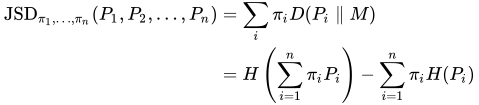
어디에
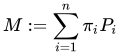
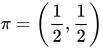
and are weights that are selected for the probability distributions , and is the Shannon entropy for distribution . For the two-dist위에서 설명한 늑골 케이스,





따라서 이러한 의 P ,Q

경계
Jensen-Shannon 차이점은 두 가지 확률 분포에 대해 1로 제한되며, 한 분포는 기준 2 로그 값을 사용한다.[6]

이 정규화에서는 P와 Q 사이의 총 변동 거리에 대한 하한이 된다.

통계 열역학에서 일반적으로 사용되는 base-e 로그의 경우 상한은 ( 2 ) \ln(2이며으로 base b의 바운드는 ( ) :



좀 더 일반적인 경계인 젠슨-샨논 분비는 두 개 이상의 확률 분포에 대해 ) 에 의해 제한된다.[6]


상호 정보와의 관계
젠슨-샤논 분비는 과 사이의 혼합물 분포와 관련된 랜덤 X 과( 과(와) 사이의 상호 정보다.혼합물을 생성하기 위한 Q 을(를) 이벤트 간에 잘 구별되는 기본 이벤트 집합에서 추상적인 기능이 되도록 하고, = Z이면 P = 1 이면 Q 에 따라 을 선택하십시오 을(를) 장착할 수 있다.즉, 확률 측정치 M=(+ )/ 에 따라 를 선택하고 있으며 그 분포는 혼합물 분포다.우리는 계산한다.

 (
(



![{\begin{aligned}I(X;Z)&=H(X)-H(X|Z)\\&=-\sum M\log M+{\frac {1}{2}}\left[\sum P\log P+\sum Q\log Q\right]\\&=-\sum {\frac {P}{2}}\log M-\sum {\frac {Q}{2}}\log M+{\frac {1}{2}}\left[\sum P\log P+\sum Q\log Q\right]\\&={\frac {1}{2}}\sum P\left(\log P-\log M\right)+{\frac {1}{2}}\sum Q\left(\log Q-\log M\right)\\&={{\rm {JSD}}}(P\parallel Q)\end{aligned}}](https://wikimedia.org/api/rest_v1/media/math/render/svg/6c04d41629d525136eee01540bdfe87b899cd108)
상호 정보가 음이 아니고 베이스 2 로그에서 )= 1 에 의해 경계되기 때문에 위의 결과에서 젠슨-샨논 분차가 0과 1로 경계된다.

동일한 원칙을 공동 분포와 그 두 한계 분포의 곱에 적용할 수 있으며(Kullback-Leibler 차이 및 상호 정보와 유사함), 주어진 반응이 공동 분포 또는 제품 분포에서 오는 경우 얼마나 신뢰성 있게 결정할 수 있는지를 측정할 수 있다(이것들이 유일한 tw라는 가정에 따라).o [7]가능성
퀀텀 옌센-샨논의 차이
밀도 행렬에 대한 확률 분포의 일반화를 통해 양자 젠슨-샤논 발산(QJSD)을 정의할 수 있다.[8][9]밀도 행렬 set1,… ,) n}) 및 확률 = ( … , n) 1},\에 대해 정의된다.



여기서 ( ) 은 의 폰 노이만 엔트로피 이 양은 양자 정보 이론에서 소개되었는데, 여기서 홀보 정보라고 한다 양자 상태에 의해 인코딩된 고전적 정보의 양에 대한 상한( , …, 을 준다 이전 분포 에 따라 (홀보의 정리 참조).[10]= , 2)에 대한 Quantum Jensen-Shannon 분기점 이며, 두 밀도 행렬은 정의되고 경계되며 두 밀도 행렬이 동일한 경우에만 0과 동일한 대칭 함수다.이것은 순수한 상태의 측정 기준의 제곱이며,[11] 최근에 이 측정 기준 속성이 혼합 상태의 측정 기준도 가지고 있는 것으로 나타났다.[12][13]Bures 메트릭은 양자 JS 차이와 밀접하게 관련되어 있다; 그것은 피셔 정보 메트릭의 양자 아날로그다.


 , 두 밀도 행렬은 정의되고 경계되며 두
 적용들
젠슨-샤논의 차이는 생물정보학 및 게놈 비교,[14][15] 단백질 표면 비교,[16] 사회과학,[17] 역사,[18] 화재 실험[19], 기계학습에 적용되었다.[20]
메모들
- ^ Hinrich Schütze; Christopher D. Manning (1999). Foundations of Statistical Natural Language Processing. Cambridge, Mass: MIT Press. p. 304. ISBN 978-0-262-13360-9.
- ^ Dagan, Ido; Lillian Lee; Fernando Pereira (1997). "Similarity-Based Methods For Word Sense Disambiguation". Proceedings of the Thirty-Fifth Annual Meeting of the Association for Computational Linguistics and Eighth Conference of the European Chapter of the Association for Computational Linguistics: 56–63. arXiv:cmp-lg/9708010. Bibcode:1997cmp.lg....8010D. doi:10.3115/979617.979625. Retrieved 2008-03-09.
- ^ Endres, D. M.; J. E. Schindelin (2003). "A new metric for probability distributions" (PDF). IEEE Trans. Inf. Theory. 49 (7): 1858–1860. doi:10.1109/TIT.2003.813506. hdl:10023/1591. S2CID 14437777.
- ^ Ôsterreicher, F.; I. Vajda (2003). "A new class of metric divergences on probability spaces and its statistical applications". Ann. Inst. Statist. Math. 55 (3): 639–653. doi:10.1007/BF02517812. S2CID 13085920.
- ^ Fuglede, B.; Topsoe, F. (2004). "Jensen-Shannon divergence and Hilbert space embedding" (PDF). Proceedings of the International Symposium on Information Theory, 2004. IEEE. p. 30. doi:10.1109/ISIT.2004.1365067. ISBN 978-0-7803-8280-0. S2CID 7891037.
- ^ a b Lin, J. (1991). "Divergence measures based on the shannon entropy" (PDF). IEEE Transactions on Information Theory. 37 (1): 145–151. CiteSeerX 10.1.1.127.9167. doi:10.1109/18.61115.
- ^ Schneidman, Elad; Bialek, W; Berry, M.J. 2nd (2003). "Synergy, Redundancy, and Independence in Population Codes". Journal of Neuroscience. 23 (37): 11539–11553. doi:10.1523/JNEUROSCI.23-37-11539.2003. PMC 6740962. PMID 14684857.
- ^ Majtey, A.; Lamberti, P.; Prato, D. (2005). "Jensen-Shannon divergence as a measure of distinguishability between mixed quantum states". Physical Review A. 72 (5): 052310. arXiv:quant-ph/0508138. Bibcode:2005PhRvA..72e2310M. doi:10.1103/PhysRevA.72.052310. S2CID 32062112.
- ^ Briët, Jop; Harremoës, Peter (2009). "Properties of classical and quantum Jensen-Shannon divergence". Physical Review A. 79 (5): 052311. arXiv:0806.4472. Bibcode:2009PhRvA..79e2311B. doi:10.1103/PhysRevA.79.052311.
- ^ Holevo, A. S. (1973), "Bounds for the quantity of information transmitted by a quantum communication channel", Problemy Peredachi Informatsii (in Russian), 9: 3–11. 영어 번역: 프로블. Inf. Transform, 9: 177–183 (1975) MR456936
- ^ Braunstein, Samuel; Caves, Carlton (1994). "Statistical distance and the geometry of quantum states". Physical Review Letters. 72 (22): 3439–3443. Bibcode:1994PhRvL..72.3439B. doi:10.1103/PhysRevLett.72.3439. PMID 10056200.
- ^ Virosztek, Dániel (2021). "The metric property of the quantum Jensen-Shannon divergence". Advances in Mathematics. 380: 107595. arXiv:1910.10447. doi:10.1016/j.aim.2021.107595. S2CID 204837864.
- ^ Sra, Suvrit (2019). "Metrics Induced by Quantum Jensen-Shannon-Renyí and Related Divergences". arXiv:1911.02643 [cs.IT].
- ^ Sims, GE; Jun, SR; Wu, GA; Kim, SH (2009). "Alignment-free genome comparison with feature frequency profiles (FFP) and optimal resolutions". Proceedings of the National Academy of Sciences of the United States of America. 106 (8): 2677–82. Bibcode:2009PNAS..106.2677S. doi:10.1073/pnas.0813249106. PMC 2634796. PMID 19188606.
- ^ Itzkovitz, S; Hodis, E; Segal, E (2010). "Overlapping codes within protein-coding sequences". Genome Research. 20 (11): 1582–9. doi:10.1101/gr.105072.110. PMC 2963821. PMID 20841429.
- ^ Ofran, Y; Rost, B (2003). "Analysing six types of protein-protein interfaces". Journal of Molecular Biology. 325 (2): 377–87. CiteSeerX 10.1.1.6.9207. doi:10.1016/s0022-2836(02)01223-8. PMID 12488102.
- ^ DeDeo, Simon; Hawkins, Robert X. D.; Klingenstein, Sara; Hitchcock, Tim (2013). "Bootstrap Methods for the Empirical Study of Decision-Making and Information Flows in Social Systems". Entropy. 15 (6): 2246–2276. arXiv:1302.0907. Bibcode:2013Entrp..15.2246D. doi:10.3390/e15062246.
- ^ Klingenstein, Sara; Hitchcock, Tim; DeDeo, Simon (2014). "The civilizing process in London's Old Bailey". Proceedings of the National Academy of Sciences of the United States of America. 111 (26): 9419–9424. Bibcode:2014PNAS..111.9419K. doi:10.1073/pnas.1405984111. PMC 4084475. PMID 24979792.
- ^ Flavia-Corina Mitroi-Symeonidis; Ion Anghel; Nicuşor Minculete (2020). "Parametric Jensen-Shannon statistical complexity and its applications on full-scale compartment fire data". Symmetry. 12 (1): 22. doi:10.3390/sym12010022.
- ^ Goodfellow, Ian J.; Pouget-Abadie, Jean; Mirza, Mehdi; Xu, Bing; Warde-Farley, David; Ozair, Sherjil; Courville, Aaron; Bengio, Yoshua (2014). Generative Adversarial Networks. NIPS. arXiv:1406.2661. Bibcode:2014arXiv1406.2661G.