하이퍼그래프 제거 보조정리
Hypergraph removal lemma그래프 이론에서 하이퍼그래프 제거 보조정리에서는 하이퍼그래프가 주어진 서브하이퍼그래프의 복사본을 거의 포함하지 않을 때, 적은 수의 증류제를 제거하면 모든 복사본이 제거될 수 있다고 기술하고 있다.그래프 제거 보조정리 일반화다.그래프가 사면체인 특별한 경우를 사면체 제거 보조정리라고 한다.그것은 고워스에[1] 의해 처음 증명되었고 독립적으로 나글, 뢰들, 샤흐트, 스코칸에 의해 증명되었다.[2]
하이퍼그래프 제거 보조마사는 스제메레디의 정리[2], 다차원 스제메레디 정리 등의 결과를 입증하는 데 사용할 수 있다.[2]
성명서
그 하이퍼 그래프 제거 부명제에서는 어떤 ε, r, m>0{\displaystyle \varepsilon ,r,m>0}에는 δ)δ(ε, r, m)을이 존재한다;0{\displaystyle\delta =\delta(\varepsilon ,r,m)>0}가에 대한 r{r\displaystyle}-uniform 하이퍼 그래프 H{H\displaystyle}과 m{m\displaystyle}vertices.그 following is true: if is any -vertex -uniform hypergraph with at most subgraphs isomorphic to , then it is possible to eliminate all copies of from r {\displaystyle 을(를) G {\에서 제거하여


An equivalent formulation is that, for any graph with copies of , we can eliminate all copies of from by removing hyperedges.


하이퍼그래프 제거 보조정리 증명 아이디어
증거에 대한 높은 수준의 아이디어는 그래프 제거 보조정리 아이디어와 유사하다.우리는 Szemerédi의 규칙성 보조정리(Partition Hypergraphs to philosiveorandom blocks)와 계산 보조정리(적절한 의사표시의 하이퍼그래프 수를 추정)의 하이퍼그래프 버전을 증명한다.그 증거의 핵심 난이도는 하이퍼그래프 규칙성의 올바른 개념을 정의하는 것이다.하이퍼그래프에서 '파티션'과 '의사(정규) 블록'을 정의하려는 시도가[3][4][5][6][7][8][9][10][11][12] 여러 차례 있었지만, 어느 것도 강력한 셈 보조마크를 줄 수 없는 것은 아니다.일반 하이퍼그래프에 대한 스제메레디의 규칙성 보조정리법의 첫 번째 정확한 정의는 뢰들 외 연구진이 제시한다.[2]
스제메레디의 규칙성 보조정리에서는 정점(1-형성)에 칸막이를 수행하여 에지(2-형성)를 조절한다.그러나 > 의 경우, 단순히 만을 사용하여 -hydges의 모든 j 의 정보를 잃어버리고 보조자를 찾지 못하게 된다.[13] 버전은 k -hydoges를 조절하기 위해 - ) -hydoges를 분할해야 한다.- ) -hydges를 더 많이 제어하려면 한 단계 더 깊이 들어가 (- )-hydges를 분할하여 규제하는 등의 작업을 할 수 있다.결국, 우리는 혼합물을 규제하는 복잡한 구조에 도달할 것이다.


 정보를 잃어버리고

3-유니폼 하이퍼그래프에 대한 증명 아이디어
예를 들어, 우리는 프랑클과 뢰들가 처음으로 제공한 스제메르디의 규칙성 보조정리 버전을 비공식적으로 3-하이퍼그래프 버전으로 시연한다.[14]에지 = 1( ) ( ) 의 파티션을 고려하십시오. such that for most triples there are a lot of triangles on top of We say that is "pseudorandom" in the sense that for all subgraphs with not too few triangles on top of ( ), ( 2), k}^{(이(가) 있다.


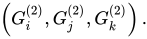
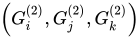

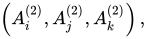 (가) 있다.
- 여기서 ( , Y, ) 은는)에있는 삼각형 중 ( 3) 에 있는 {\ 3 - Uniform Hyunderge의 비율을 나타낸다



이후 정규 파티션을 정규 파티션이 아닌 부품의 3배가 파티션의 모든 3배 중 최대 부분을 구성하는 파티션으로 정의한다.

이 외에도 정점 세트의 칸막이를 통해 ( 2) , , ( ) 을 더 정규화할 필요가 있다.그 결과 다음과 같은 하이퍼그래프 정규성의 총 데이터를 확보하게 되었다.
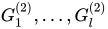
- () 를 그래프로 분할하여 G ( 3 ){\G^{(가 유사하게 위에 위치하도록 한다.
- (1)의 그래프가 극히 유사하게(Szemerédi의 정규성 보조기법과 유사한 으로) V( V(G)}의 분할.
 그래프로 분할하여 G ( 3 ){\
 ) V
) V하이퍼그래프 규칙성 보조정리 증명 후에, 우리는 보조정리 수를 세는 하이퍼그래프를 증명할 수 있다.나머지 증거는 Graph 제거 보조정리 보조정리처럼 진행된다.
스제메레디의 정리 증명
( ) 을(를) 길이 ,의 산술 추이를 포함하지 않는 큰 부분 집합의 크기가 되도록 한다.Szemerédi의 정리에는 모든 k{\}에 r () = () 라고 명시되어 있다증거의 높은 수준의 아이디어는 길이 의 산술적 연속이 없는 부분집합에서 하이퍼그래프를 구성한 다음 그래프 제거 보조마사를 사용하여 이 그래프가 너무 많은 혼합물을 가질 수 없다는 것을 보여주며, 이는 다시 원래의 부분집합이 너무 클 수 없다는 것을 보여준다.


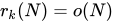
, A \{1,N을(를) 길이 k {\ 산술 추이를 포함하지 않는 하위 집합으로 두십시오Let = 2 + }은는) 충분히 큰 정수여야 한다.We can think of as a subset of . Clearly, if doesn't have length arithmetic progression in , it also doesn't have length arithmetic p/

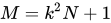


We will construct a -partite -uniform hypergraph from with parts , all of which are element vertex sets indexed by . For each , we add a hyperedge among vertices if and only if H을(를) 한 k k} -partite(- ) {\-uniform hypergraph가 되게 한다.If contains an isomorphic copy of with vertices , then for any . However, note that is a length arithmetic progression with common difference . Since has no length arithmetic progression =α= k = k {\}=\cdots 따라서 = {\ \



![{\displaystyle (v_{j}\in V_{j})_{j\in [k]\setminus \{i\}}}](https://wikimedia.org/api/rest_v1/media/math/render/svg/eacb074a48d9d658f5356f6e76be321bdc0a3ae6)
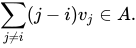

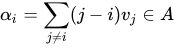


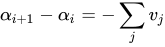


Thus, for each hyperedge , we can find a unique copy of that this edge lies in by finding .The number of copies of in equals . Therefore, by the hypergraph removal lemma, we can remove edges to eliminate all copies of in . Since every hyperedge of is in a unique copy of , to eliminate all copies of in , we need to remove at least edges.따라서 ( )= ( N - ) .
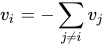




의 축약 개수는 k - A = (- 1) })이며 는 A= ( N ) A 라고 결론짓는다


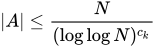
하이퍼그래프 제거 보조정리기의 숨겨진 상수는 역 아커만 함수를 포함하기 때문에 이 방법은 일반적으로 좋은 정량적 경계를 제공하지 않는다.For a better quantitive bound, Gowers proved that for some constant depending on .[15] It is the best bound for so far.


적용들
- 하이퍼그래프 제거 보조정리(hypergraph remema)는 J. Solymosi에 의한 다차원 Szemerédi 정리를 증명하는 데 사용된다.[16]그 성명 Zr의 어떤 유한 부분 집합 S{S\displaystyle}(^{r}}을 위해 어떤 δ>0{\displaystyle \delta>0}과 n{n\displaystyle}에 충분한,[n]r{\displaystyle[n]^{r}의 어떤 부분 집합}크기의 최소한δ nr{\displaystyle\delta n^{r}}이다.contains a subset of the form , that is, a dilated and translated copy of . Corners theorem is a special case when .
- 다항식 스제메레디 정리, 유한장 스제메레디 정리, 유한 아벨 그룹 스제메레디 정리 등을 증명하는 데도 사용된다.[17][18]



참고 항목
참조
- ^ Gowers, William (2007-11-01). "Hypergraph regularity and the multidimensional Szemerédi theorem". Annals of Mathematics. 166 (3): 897–946. arXiv:0710.3032. Bibcode:2007arXiv0710.3032G. doi:10.4007/annals.2007.166.897. ISSN 0003-486X.
- ^ a b c d Rodl, V.; Nagle, B.; Skokan, J.; Schacht, M.; Kohayakawa, Y. (2005-05-26). "From The Cover: The hypergraph regularity method and its applications". Proceedings of the National Academy of Sciences. 102 (23): 8109–8113. Bibcode:2005PNAS..102.8109R. doi:10.1073/pnas.0502771102. ISSN 0027-8424. PMC 1149431. PMID 15919821.
- ^ Haviland, Julie; Thomason, Andrew (May 1989). "Pseudo-random hypergraphs". Discrete Mathematics. 75 (1–3): 255–278. doi:10.1016/0012-365x(89)90093-9. ISSN 0012-365X.
- ^ Chung, F. R. K.; Graham, R. L. (1989-11-01). "Quasi-random hypergraphs". Proceedings of the National Academy of Sciences. 86 (21): 8175–8177. Bibcode:1989PNAS...86.8175C. doi:10.1073/pnas.86.21.8175. ISSN 0027-8424. PMC 298241. PMID 16594074.
- ^ Chung, Fan R. K. (1990). "Quasi-random classes of hypergraphs". Random Structures and Algorithms. 1 (4): 363–382. doi:10.1002/rsa.3240010401. ISSN 1042-9832.
- ^ Chung, F. R. K.; Graham, R. L. (1990). "Quasi-random hypergraphs". Random Structures and Algorithms. 1 (1): 105–124. doi:10.1002/rsa.3240010108. ISSN 1042-9832. PMC 298241. PMID 16594074.
- ^ Chung, F. R. K.; Graham, R. L. (January 1991). "Quasi-Random Set Systems". Journal of the American Mathematical Society. 4 (1): 151. doi:10.2307/2939258. ISSN 0894-0347. JSTOR 2939258.
- ^ Kohayakawa, Yoshiharu; Rödl, Vojtěch; Skokan, Jozef (February 2002). "Hypergraphs, Quasi-randomness, and Conditions for Regularity". Journal of Combinatorial Theory, Series A. 97 (2): 307–352. doi:10.1006/jcta.2001.3217. ISSN 0097-3165.
- ^ Frieze, Alan; Kannan, Ravi (1999-02-01). "Quick Approximation to Matrices and Applications". Combinatorica. 19 (2): 175–220. doi:10.1007/s004930050052. ISSN 0209-9683.
- ^ Czygrinow, Andrzej; Rödl, Vojtech (January 2000). "An Algorithmic Regularity Lemma for Hypergraphs". SIAM Journal on Computing. 30 (4): 1041–1066. doi:10.1137/s0097539799351729. ISSN 0097-5397.
- ^ Chung, Fan R.K. (2007-07-05). "Regularity lemmas for hypergraphs and quasi-randomness". Random Structures & Algorithms. 2 (2): 241–252. doi:10.1002/rsa.3240020208. ISSN 1042-9832.
- ^ Frankl, P.; Rödl, V. (December 1992). "The Uniformity Lemma for hypergraphs". Graphs and Combinatorics. 8 (4): 309–312. doi:10.1007/bf02351586. ISSN 0911-0119.
- ^ Nagle, Brendan; Rödl, Vojtěch (2003-07-17). "Regularity properties for triple systems". Random Structures & Algorithms. 23 (3): 264–332. doi:10.1002/rsa.10094. ISSN 1042-9832.
- ^ Frankl, Peter; Rödl, Vojtěch (2002-02-07). "Extremal problems on set systems". Random Structures & Algorithms. 20 (2): 131–164. doi:10.1002/rsa.10017. ISSN 1042-9832.
- ^ Gowers, W. T. (1998-07-01). "A New Proof of Szemerédi's Theorem for Arithmetic Progressions of Length Four". Geometric and Functional Analysis. 8 (3): 529–551. doi:10.1007/s000390050065. ISSN 1016-443X.
- ^ SOLYMOSI, J. (March 2004). "A Note on a Question of Erdős and Graham". Combinatorics, Probability and Computing. 13 (2): 263–267. doi:10.1017/s0963548303005959. ISSN 0963-5483.
- ^ Bergelson, Vitaly; Leibman, Alexander; Ziegler, Tamar (February 2011). "The shifted primes and the multidimensional Szemerédi and polynomial Van der Waerden theorems". Comptes Rendus Mathématique. 349 (3–4): 123–125. arXiv:1007.1839. doi:10.1016/j.crma.2010.11.028. ISSN 1631-073X.
- ^ Furstenberg, H.; Katznelson, Y. (December 1991). "A density version of the Hales-Jewett theorem". Journal d'Analyse Mathématique. 57 (1): 64–119. doi:10.1007/bf03041066. ISSN 0021-7670.