탄산염 경질
Carbonate hardgrounds
탄산염 하드그라운드는 해저에 노출된 합성 시멘트 탄산염 층의 표면이다(Wilson and Palmer, 1992).하드그라운드는 본질적으로 석화된 해저입니다.고대 경질들은 석회암 배열에서 발견되며 일반적인 바닷물에 노출되었다는 증거로 후석화된 퇴적물과 구별된다.이러한 증거는 생물 파괴, 초기 해양 석회석 시멘트 또는 철산화물이나 칼슘 인산염에 의해 광물화된 광범위한 표면(특히 브리오조안, 굴, 따나클, 코뉴리티드, 헤데렐로이드, 마이크로콘치드 및 크리노이드), 생물 파괴를 통해 생성된 유기체의 붕소로 구성될 수 있다(Palmer, 1982; Bodenbender et al, 1989;).Vinn과 Wilson, 2010년, Vinn과 Toom, 2015년).현대의 하드그라운드는 보통 얕은 물에서 소리를 내거나 사이드 스캔 레이더와 같은 원격 감지 기술을 통해 감지됩니다.

탄산염 하드그라운드는 종종 단단한 표면에 적응된 독특한 동식물을 가지고 있다.유기체는 보통 기질에 접착되어 세실 필터 공급자로 살아간다(Brett and Liddell, 1982).일부는 시멘트로 된 탄산염에 구멍을 뚫어 필터 공급용 보호 주소(보링)를 만듭니다.때때로 경질 지반이 그 아래의 부드러운 침전물을 제거하는 해류에 의해 약해져, 지하 동물군을 수용하는 얕은 공동과 동굴을 만든다(Palmer and Fürsich, 1974).딱딱한 동물군의 진화는 캄브리아기부터 오늘날까지 판네로생대를 통해 추적할 수 있다(테일러와 윌슨, 2003).


탄산염 경질 지면은 지구 역사상 저마그네슘 석회암이 빠르게 강수되고 골격 아라고나이트가 용해된 시기인 석회석 해수 간격 동안 가장 흔하게 형성되었다(Palmer and Wilson, 2004).오르도비스기-실루리아계와 쥐라기-크레타기계가 가장 단단하고(때로는 한 구역에서 수백 개), 페름기-트라이아스기계가 가장 적다(보통 없음).이러한 경질지반 형성의 순환은 경질지반 거주 공동체의 진화에 반영된다.고생대와 중생대 하드그라운드 군락 사이에는 뚜렷한 차이가 있다. 전자는 두꺼운 석회암 브리오조아 및 극피층에 의해 지배되고 후자는 굴과 깊은 이매패류(가스트로캐놀라이트)와 스폰지(엔토비아) 보링(테일러와 윌슨, 2003)에 의해 지배된다.
성층 분석가와 퇴적학자는 종종 지표 지평선 및 퇴적 히아토스와 홍수 사건의 지표로 경질 지평을 사용한다(Fürsich et al., 1981, 1992; Pope and Read, 1997).경지와 그 사우나는 조수 수로(Wilson et al., 2005)와 얕은 해양 탄산 경사로(Palmer and Palmer, 1977; Malpas et al., 2004)와 같은 매우 특정한 퇴적 환경을 나타낼 수도 있다.

오하이오 남부의 리버티 포메이션(상부 오르도비스식)에 있는 하드그라운드.
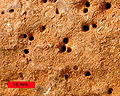
켄터키 북부에서 온 어퍼 오르도비스식 경질지대에서 트라이패니트 볼링을 하고 있습니다.

탄산염 경화물;오라층, 백악기 상부(터키), 이스라엘 남부.


레퍼런스
- Bodenbender, B.E.; Wilson, M.A.; Palmer, T.J. (1989). "Paleoecology of Sphenothallus on an Upper Ordovician hardground". Lethaia. 22 (2): 217–225. doi:10.1111/j.1502-3931.1989.tb01685.x.
- Brett, C.E.; Liddell, W.D. (1981). "Preservation and paleoecology of a Middle Ordovician hardground community". Paleobiology. 4 (3): 329–348. doi:10.1017/s0094837300006035.
- Fürsich F.T., Kennedy, W.J., Palmer, T.J. (1981). "Trace fossils at a regional discontinuity surface: the Austin/Taylor (Upper Cretaceous) contact in central Texas". Journal of Paleontology. 55: 537–551.
{{cite journal}}: CS1 maint: 여러 이름: 작성자 목록(링크) - Fürsich, F.T.; Oschmann, W.; Singh, B.; Jaitly, A.K. (1992). "Hardgrounds, reworked concretion levels and condensed horizons in the Jurassic of western India: their significance for basin analysis". Journal of the Geological Society of London. 149 (3): 313–331. Bibcode:1992JGSoc.149..313F. doi:10.1144/gsjgs.149.3.0313. S2CID 130374753.
- Malpas, J.A.; Gawthorpe, R. L.; Pollard, J.E.; Sharp, I.R. (2004). "Ichnofabric analysis of the shallow marine Nukhul Formation (Miocene), Suez Rift, Egypt: implications for depositional processes and sequence stratigraphic evolution". Palaeogeography, Palaeoclimatology, Palaeoecology. 215 (3–4): 239–264. doi:10.1016/j.palaeo.2004.09.007.
- Palmer, T.J. Fürsich, F.T. (1974). "The ecology of a Middle Jurassic hardground and crevice fauna". Palaeontology. 17: 507–524.
{{cite journal}}: CS1 maint: 여러 이름: 작성자 목록(링크) - Palmer, T.J.; Palmer, C.D. (1977). "Faunal distribution and colonization strategy in a Middle Ordovician hardground community". Lethaia. 10 (3): 179–199. doi:10.1111/j.1502-3931.1977.tb00608.x.
- Palmer, T.J.; Wilson, M.A. (2004). "Calcite precipitation and dissolution of biogenic aragonite in shallow Ordovician calcite seas". Lethaia. 37 (4): 417–427 [1]. doi:10.1080/00241160410002135.
- Palmer, T.J. (1978). "Burrows at certain omission surfaces in the Middle Ordovician of the Upper Mississippi Valley". Journal of Paleontology. 52: 109–117.
- Palmer, T.J. (1982). "Cambrian to Cretaceous changes in hardground communities". Lethaia. 15 (4): 309–323. doi:10.1111/j.1502-3931.1982.tb01696.x.
- Pope, M.C.; Read, J.F. (1997). "High-resolution surface and subsurface sequence stratigraphy of the Middle to Late Ordovician (late Mohawkian-Cincinnatian) foreland basin rocks, Kentucky and Virginia". AAPG Bulletin. 81: 1866–1893. doi:10.1306/3b05c654-172a-11d7-8645000102c1865d.
- Taylor, P.D.; Wilson, M.A. (2003). "Palaeoecology and evolution of marine hard substrate communities". Earth-Science Reviews. 62 (1–2): 1–103 [2]. Bibcode:2003ESRv...62....1T. doi:10.1016/S0012-8252(02)00131-9.
- Vinn, O.; Wilson, M.A. (2010). "Microconchid-dominated hardground association from the late Pridoli (Silurian) of Saaremaa, Estonia". Palaeontologia Electronica. 2010 (2): 13.2.9A. Retrieved 2012-09-16.
- Vinn, O.; Toom, U. (2015). "Some encrusted hardgrounds from the Ordovician of Estonia (Baltica)". Carnets de Géologie. 15 (7): 63–70. doi:10.4267/2042/56744. Retrieved 2015-06-18.
- Wilson, M.A.; Palmer, T.J. (1992). "Hardgrounds and hardground faunas". University of Wales, Aberystwyth, Institute of Earth Studies Publications. 9: 1–131.
- Wilson, M.A.; Wolfe, K.R.; Avni, Y. (2005). "Development of a Jurassic rocky shore complex (Zohar Formation, Makhtesh Qatan, southern Israel)". Israel Journal of Earth Sciences. 54 (3): 171–178 [3]. doi:10.1560/71EQ-CNDF-K3MQ-XYTA.
추가 정보
- Vinn, O. (2015). "Sparsely encrusted hardground in the Darriwilian calcareous sandstone of Cape Pakri, NW Estonia (Baltica)" (PDF). Estonian Journal of Earth Sciences. 64: 249–253. doi:10.3176/earth.2015.31. Retrieved 2015-09-23.
- Vinn, O.; Wilson, M.A. (2010). "Early large borings from a hardground of Floian-Dapingian age (Early and Middle Ordovician) in northeastern Estonia (Baltica)". Carnets de Géologie. 2010: CG2010_L04. doi:10.4267/2042/35594.
- Vinn, O.; Wilson, M.A.; Toom, U. (2015). "Bioerosion of Inorganic Hard Substrates in the Ordovician of Estonia (Baltica)". PLOS ONE. 10 (7): e0134279. Bibcode:2015PLoSO..1034279V. doi:10.1371/journal.pone.0134279. PMC 4517899. PMID 26218582.
- Vinn, O.; Toom, U. (2016). "A sparsely encrusted hardground with abundant Trypanites borings from the Llandovery of the Velise River, western Estonia (Baltica)" (PDF). Estonian Journal of Earth Sciences. 65: 19–26. doi:10.3176/earth.2016.01. Retrieved 2016-03-05.