
p-adic 감마 함수
p-adic gamma function수학에서 p-adic 감마함수 Ⅱ는p 감마함수와 유사한 p-adic 변수의 함수다.보야르스키(1980)는 드워크(1964)가 암묵적으로 같은 기능을 사용했다고 지적했지만, 처음에는 모리타(1975)가 명시적으로 정의했다.다이아몬드(1977)는 로그 Ⅱ의 p-adic 아날로그 G를p 정의했다.Overholtzer(1952)는 이전에 감마함수의 다른 p-adic 아날로그에 대한 정의를 내렸으나, 그의 기능은 만족스러운 성질을 가지지 못하고 많이 사용되지 않는다.
정의.
p-adic 감마함수는 다음과 같은 p-adic 정수 x( 의 고유한 연속함수다.

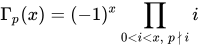
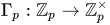
제품이 정수로 제한되는 경우 p로 분할되지 않는다.As the positive integers are dense with respect to the p-adic topology in , can be extended uniquely to the whole of . Here is the ring of p-adic 정수 ( Z) 의 값이 p \{에서 변환불가능하다는 정의에 따른 것이다 이는 이러한 값이 p로 분할할 수 없는 정수의 산물이며, 이 속성은 p {style로 계속 확장된 후에 유지되기 때문이다.Thus . Here is the set of invertible p-adic integers.



p-adic 감마 함수의 기본 특성
고전적 감마함수는 xequation x { {에 대해서도 함수 방정식 을 한다.Morita 감마 함수와 관련된 아날로그:



오일러의 반사식 () ( 1- )= ( ) }{\ x은 p-adic 케이스에 다음과 같은 간단한 상호를 가지고 있다.
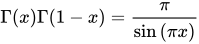

여기서 은(는) x _이(가) 0이 아닌 = 이(가)가 아닌 경우 x의 p-adic 확장에서 첫 번째 숫자다.


특수값


그리고, 대체적으로
![{\displaystyle \Gamma _{p}(n+1)={\frac {(-1)^{n+1}n!}{[n/p]!p^{[n/p]}}}\quad (n\geq 2).}](https://wikimedia.org/api/rest_v1/media/math/render/svg/8ad37519263a5eb7551eb97d983da03d4df9bfa4)
= x Morita 감마 함수는 다음과 같은 범례 기호) {와 관련이 있다


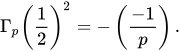
It can also be seen, that hence as .[1]: 369



다른 흥미로운 특별한 가치는 공동의 도구들에 의해 처음 증명된 Gross-Koblitz 공식에서 나왔고, 후에 더 많은 기본적인 방법들을 사용하여 증명되었다.[2]예를 들면
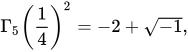
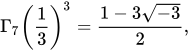
where denotes the square root with first digit 3, and denotes the square root with first digit 2. (Such specifications must always be done if we talk about roots.)


또 다른 예는 다음과 같다.

여기서- 은(는) 3 의- 의 제곱근이다.[3]
 (는)
(는) 

p-adic Raabe 공식
고전 감마 함수의 Raabe-formula는 다음과 같이 말한다.

Morita 감마 함수의 이와사와 로그에 대한 아날로그가 있다.[4]

p-adic 한계 → { { {\{\frac }}}\ 이렇게 → → x → x


말러 팽창
말러 팽창은 고전 분석에서 테일러 팽창과 마찬가지로 p-adic 함수에 중요하다.p-adic 감마 함수의 말러 팽창은 다음과 같다.[1]: 374
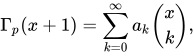
서 k 시퀀스는 다음 ID로 정의된다.


참고 항목
참조
- Boyarsky, Maurizio (1980), "p-adic gamma functions and Dwork cohomology", Transactions of the American Mathematical Society, 257 (2): 359–369, doi:10.2307/1998301, ISSN 0002-9947, JSTOR 1998301, MR 0552263
- Diamond, Jack (1977), "The p-adic log gamma function and p-adic Euler constants", Transactions of the American Mathematical Society, 233: 321–337, doi:10.2307/1997840, ISSN 0002-9947, JSTOR 1997840, MR 0498503
- Diamond, Jack (1984), "p-adic gamma functions and their applications", in Chudnovsky, David V.; Chudnovsky, Gregory V.; Cohn, Henry; et al. (eds.), Number theory (New York, 1982), Lecture Notes in Math., vol. 1052, Berlin, New York: Springer-Verlag, pp. 168–175, doi:10.1007/BFb0071542, ISBN 978-3-540-12909-7, MR 0750664
- Dwork, Bernard (1964), "On the zeta function of a hypersurface. II", Annals of Mathematics, Second Series, 80 (2): 227–299, doi:10.2307/1970392, ISSN 0003-486X, JSTOR 1970392, MR 0188215
- Morita, Yasuo (1975), "A p-adic analogue of the Γ-function", Journal of the Faculty of Science. University of Tokyo. Section IA. Mathematics, 22 (2): 255–266, hdl:2261/6494, ISSN 0040-8980, MR 0424762
- Overholtzer, Gordon (1952), "Sum functions in elementary p-adic analysis", American Journal of Mathematics, 74 (2): 332–346, doi:10.2307/2371998, ISSN 0002-9327, JSTOR 2371998, MR 0048493
- ^ a b Robert, Alain M. (2000). A course in p-adic analysis. New York: Springer-Verlag.
- ^ Robert, Alain M. (2001). "The Gross-Koblitz formula revisited". Rendiconti del Seminario Matematico della Università di Padova. The Mathematical Journal of the University of Padova. 105: 157–170. doi:10.1016/j.jnt.2009.08.005. hdl:2437/90539. ISSN 0041-8994. MR 1834987.
- ^ Cohen, H. (2007). Number Theory. Vol. 2. New York: Springer Science+Business Media. p. 406.
- ^ Cohen, Henri; Eduardo, Friedman (2008). "Raabe's formula for p-adic gamma and zeta functions". Annales de l'Institut Fourier. 88 (1): 363–376. doi:10.5802/aif.2353. hdl:10533/139530. MR 2401225.


