
아브라모프의 알고리즘
Abramov's algorithm수학에서, 특히 컴퓨터 대수에서, 아브라모프의 알고리즘은 다항식 계수를 가진 선형 재발 방정식의 모든 이성적인 해결책을 계산한다.이 알고리즘은 세르게이 A에 의해 출판되었다.1989년 [1][2]아브라모프
범용분모
아브라모프 알고리즘의 주요 개념은 보편적 분모다. 를) 특성 0의 필드가 되도록 한다.분산 ,) 의 두 다항식 q [ 으)로 정의된다.

 두 다항식
두 다항식 ![{\textstyle p,q\in \mathbb {K} [n]}](https://wikimedia.org/api/rest_v1/media/math/render/svg/36bcc87d3123b013a99b2fa730743a44a6a60db8)
여기서 은는) 음이 아닌 정수 집합을 의미한다.따라서 분산은 과(와) -time shifted {\q}이(가) 공통 인자를 가질 수 있는 최대 N k이다.이러한 이(가) 없는 경우- -1이다.그 분산 이로 인한 재산 n(p(n)의 가장 큰 음이 아닌 정수 뿌리,q(n+k))로 ∈ K[k]{\textstyle \operatorname{물}_ᆷ(p(n),q(n+k))\in\mathbb{K}[k]}.[3][4]자∑ k=0rpkm그리고 4.9초 만(n)((n+k))f({\textstyle \sum_{k=0}(n)\,y(n+k)=f(n)}가 되recurre 계산할 수 있다.encequation of order with polynomial coefficients , polynomial right-hand side and rational sequence solution . It is possible to write for two relatively prime polynomials . Let and


 (와)
(와) 


![{\displaystyle p_{k}\in \mathbb {K} [n]}](https://wikimedia.org/api/rest_v1/media/math/render/svg/99a01d50ae357ea8203df5b2f6cc55dc93819501)
![{\textstyle f\in \mathbb {K} [n]}](https://wikimedia.org/api/rest_v1/media/math/render/svg/1630da272da3f2909cddd06710cb3f885ef1cd25)



여기서[ ( ) =( - ) p( n - 1 ) ( -k + 1) p (n - + )\n-k는 함수의 하강 요인(하)을 나타낸다.그러면 () 이(가) n {\u(을([5]를) 나눈다 따라서 u {\ 은 모든 합리적인 y ) y에 대한 분모로 사용할 수 있으며, 따라서 보편분모라고 불린다.
![{\displaystyle u(n)=\gcd([p_{0}(n+D)]^{\underline {D+1}},[p_{r}(n-r)]^{\underline {D+1}})}](https://wikimedia.org/api/rest_v1/media/math/render/svg/23b6a2e862fdeab2c12ec82af1bb0e9f9f7d68de)
![{\textstyle [p(n)]^{\underline {k}}=p(n)p(n-1)\cdots p(n-k+1)}](https://wikimedia.org/api/rest_v1/media/math/render/svg/6aa8c3540431b8056a7e751814de7c71a0054bc2)
 (
(

알고리즘.
다시 = 0 k() y (+ k= ) 은 다항계수를 갖는 재발 방정식이 되고 () )는 범용분모가 된다.After substituting for an unknown polynomial and setting the recurrence equation is equivalent to


![{\textstyle z(n)\in \mathbb {K} [n]}](https://wikimedia.org/api/rest_v1/media/math/render/svg/212c7e9ae4dc08d65c2e1bb22e1c0b2b4f5c2168)

+ ) 이(가) 취소함에 따라 이는 다항식 계수를 갖는 선형적 재발 방정식으로, 알 수 없는 다항식 ){\n에 대해 해결할 수 있다. 다항식 솔루션을 찾는 알고리즘이 있다. z( ) 에 대한 솔루션을 다시 사용하여 합리적인 솔루션 ( n)= z( )/ ( y을(를) 계산할 수 있다

 (가) 취소함에 따라 이는 다항식 계수를 갖는 선형적 재발 방정식으로, 알 수 없는 다항식
algorithm rational_solutions is input: Linear recurrence equation . output:해결 방법이 있을 일반적인합리적 y {\ y 그렇지 않을 경우 거짓. Solve 일반 다항식 z이가) 있는 경우 일반 다항식 = /{\을(가) 반환하거나, 잘못된 종료인 경우 반환
![{\textstyle \sum _{k=0}^{r}p_{k}(n)\,y(n+k)=f(n),p_{k},f\in \mathbb {K} [n],p_{0},p_{r}\neq 0}](https://wikimedia.org/api/rest_v1/media/math/render/svg/ed5b97019db025f15ab508dd0c09ec3610b17383)


![{\textstyle u(n)=\gcd([p_{0}(n+D)]^{\underline {D+1}},[p_{r}(n-r)]^{\underline {D+1}})}](https://wikimedia.org/api/rest_v1/media/math/render/svg/fabd1ca425f9e06bb5e3c10a1a03a1baa6c72fda)

예
순서 의 균일한 반복 방정식
이상에는 합리적인 해결책이 있다.산포를 고려하여 계산할 수 있다.


이는 다음과 같은 보편 분모를 산출한다.

그리고
![{\displaystyle u(n)=\gcd([p_{0}(n+1)]^{\underline {2}},[p_{r}(n-1)]^{\underline {2}})=(n-1)n}](https://wikimedia.org/api/rest_v1/media/math/render/svg/a788d308c3a83d2d6916118a30edf810258ea45f)
원래 반복 방정식에 을(를) 곱하고 = /를 대체하면 과 같다


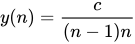
이 방정식에는 임의 c Q{\에 대한 z) = {\ 이 있다= z/ 를 사용하는 일반적인 합리적 솔루션은 다음과 같다.

 대한
대한 
임의 .
참조
- ^ Abramov, Sergei A. (1989). "Rational solutions of linear differential and difference equations with polynomial coefficients". USSR Computational Mathematics and Mathematical Physics. 29 (6): 7–12. doi:10.1016/s0041-5553(89)80002-3. ISSN 0041-5553.
- ^ a b Abramov, Sergei A. (1995). "Rational solutions of linear difference and q-difference equations with polynomial coefficients". Proceedings of the 1995 international symposium on Symbolic and algebraic computation - ISSAC '95. ISSAC '95 Proceedings of the 1995 International Symposium on Symbolic and Algebraic Computation. pp. 285–289. doi:10.1145/220346.220383. ISBN 978-0897916998. S2CID 15424889.
- ^ Man, Yiu-Kwong; Wright, Francis J. (1994). Fast polynomial dispersion computation and its application to indefinite summation. ISSAC '94 Proceedings of the International Symposium on Symbolic and Algebraic Computation. pp. 175–180. doi:10.1145/190347.190413. ISBN 978-0897916387. S2CID 2192728.
- ^ Gerhard, Jürgen (2005). Modular Algorithms in Symbolic Summation and Symbolic Integration. Lecture Notes in Computer Science. Vol. 3218. doi:10.1007/b104035. ISBN 978-3-540-24061-7. ISSN 0302-9743.
- ^ Chen, William Y. C.; Paule, Peter; Saad, Husam L. (2007). "Converging to Gosper's Algorithm". arXiv:0711.3386 [math.CA].
 위키도타 위키프로젝트 수학 위키도타 위키프로젝트 수학 |


