Wheatstone system
The Wheatstone system was an automated telegraph system that replaced a human operator with machines capable of sending and recording Morse code at a consistent fast rate.[1] The system included a perforator, which prepared punched paper tape called a Wheatstone slip, a transmitter that read the tape and converted the symbols into dots and dashes encoded as mark and space electric currents on the telegraph line, and a receiver at the other end of the telegraph line that printed the Morse symbols.[2] The system was invented by Charles Wheatstone.[2] Enhancements could be made so that it was a duplex system, able to send and receive on the same line simultaneously.

| ⠂ | inter-letter space |
|---|---|
| ⠒ | inter-word space |
| ⠇ | dot |
| ⠳ | dash |
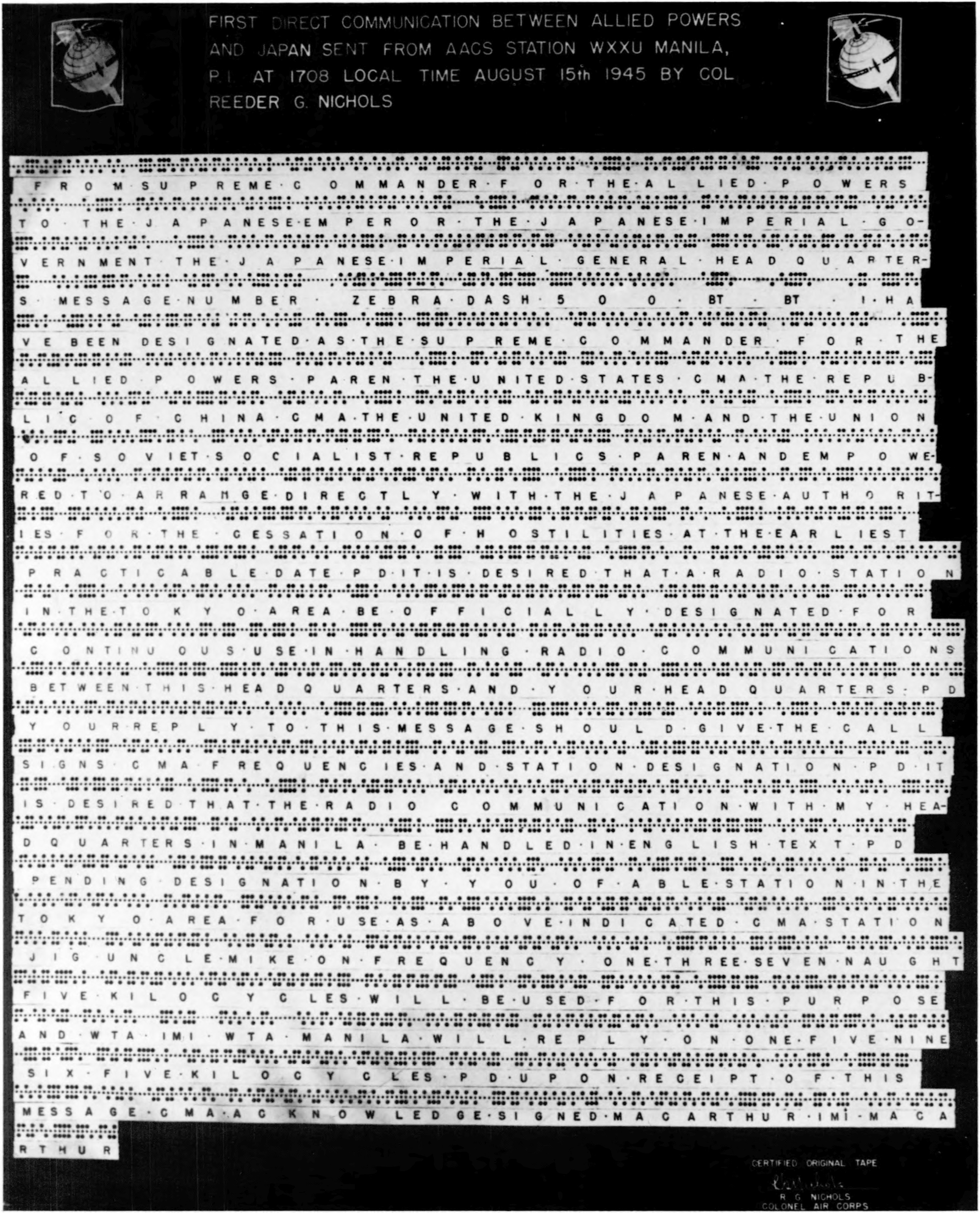
The Wheatstone slip was a paper tape that contained holes in a pattern to control the mark and space signals on the telegraph line. The paper tape was from 0.46 to 0.48 inches in width, (but the standard width is from 0.472 to 0.475 inches) and a standard thickness of 0.004 to 0.0045 inches.[3] Olive oil coating lubricated the punch process.[4] There were three rows of holes. The middle row forms a rack so that a star wheel can move the paper forward. Every used position on the tape has a middle hole punched. The top hole indicates when to turn on the mark signal on the line, and the bottom hole says to turn off the mark signal. Each vertical column represents a time interval in the Morse code, including the spacing between the holes. The holes are spaced 0.1 inches apart. A column of three holes turns on the mark at the beginning of the interval, and turns it off at the end making a dot. If there is a top hole without a bottom, and then the next column has a bottom without a top hole, mark is on for three intervals, and a dash is represented. If there is only a centre hole, then nothing changes, and this would normally be used to put in space between letters and words.[2]

The Wheatstone perforator was a development of Alexander Bain's 1848 manually operated hole punch machine for his "fast telegraph".[5] It produced Wheatstone slips using three buttons (or keys) labelled "A", "A1" and "A2". "A" punched the pattern for dot, "A1" punched the pattern for space, and "A2" punched the dash pattern in two columns. The keys were so difficult to press that fist-held rubber-tipped mallets were used to depress them and operate the punches. Using this, invalid combinations of holes could not be produced. The blank paper tape was fed in from the right over a roller and came out the left side. It was oriented in a vertical plane.[2] The paper punches were labelled with numbers: 1 for the top hole of the dot, 2 for the sprocket hole for dot, and 3 for the bottom hole for dot. When a dash was punched, extra hole punches to the right punched a centre hole with number 4 and a bottom hole with number 5.[2] The perforator was introduced in 1867.[6] It enabled transmission speeds on a telegraph line to increase to 70 words per minute.[6] The very first message ever punched onto a tape was "SOS EIOS".[7] The manual perforator was subsequently replaced by keyboard perforators like the Gell keyboard perforator or Kleinschmidt keyboard perforator.
Each of the keys had a spring to restore its position after pressing. Each key moved a corresponding lever underneath the instrument. The other end of the levers protruded up into the back of the mechanism. Each punch rod also had a spring to put it back in place after punching a hole. For space and dot keying (A or A1) the star wheel was only allowed to turn one position by a pawl, and the paper tape only moved forward one position. However, when key A2 was hit, the corresponding lever B2 raised a bar (h) which allowed another lever attached to the pawl to move further back when the star wheel rotated, and the wheel could turn two positions, for a dash. The distance the paper tape moved for each position was determined by how far lever k moved, and its range of movement had to be set by adjusting screws i and t. A flat spring g stored energy from the punch to move the paper. The force of the spring was determined by adjusting screws n and n'. A guide roller (r) with a groove was pressed by an adjustable spring to press the pawl against the star wheel. The star wheel was on a frame with a piece sticking out the left hand side as a lever. When the operator wanted to insert paper tape, this lever was pulled, and the star wheel retracted from the paper.[3]

휘트스톤 송신기는 종이 테이프(휘트스톤 슬립)를 읽고 도트 패턴을 전신선상의 마크와 스페이스 기호로 변환했다. 그것은 테이프의 구멍을 샘플링하기 위해 두 개의 막대기가 번갈아 올라가면서 작동했다. 우선 상단 구멍을 탐사했고, 로드가 통과할 수 있다면 표시 신호를 라인에 연결하는 복합 레버를 움직였다. 구멍도 없이 레버는 흔들리지 않고 있었다. 다음으로 상단 구멍 막대가 떨어졌고 하단 구멍 막대가 테이프에 하단 구멍이 있는지 확인했다. 있다면 복합 레버를 다시 움직여 선상의 우주 신호를 연결했다. 구멍이 없다면 컴파운드 레버는 그대로 내버려두었다. 여분의 스위치는 송신기를 우회시켜 Morse 키를 대신 사용할 수 있도록 했다.[8]
휘트스톤 수신기는 전신선의 신호를 종이 줄에 잉크무늬로 변환했다. 전신에 전기적으로 연결된 전자석이 인킹 휠을 움직여 종이를 눌렀다. 시계 장치가 종이 테이프를 전진시키고, 잉크 바퀴와 잉크 공급 바퀴를 돌렸다. 종이 전진 속도는 분당 7~60피트 사이에서 조절할 수 있었다. 시계 장치의 전원은 세 가지 원천을 가지고 있었다: 그것은 코일 스프링, 중량 또는 전기 모터일 수 있다. 종이 스풀은 판독기 아래 서랍에 보관해 사람이 지쳤을 때 빠르게 바꿀 수 있도록 했다. 잉크 공급 바퀴가 잉크통으로 변했다. 그 기계는 레버를 사용하여 시동되고 정지되었다. 전기적 특성에서 전자석은 각각 100옴의 저항을 가진 두 개의 권선을 가지고 있었다. 이것들은 병렬 또는 직렬로 연결되어 50 또는 200Ω 저항을 달성할 수 있으며, 전신에 더 잘 맞도록 할 수 있다. 그 밖에 마커와 공급 휠 청소, 전기자 코일 간격 조정, 표시 또는 간격 바이어스 방지, 소리 나는 혀와 접촉점 청소 등이 필요할 수 있었다. [9]
휘트스톤 전보는 모스 부호가 인쇄된 종이 테이프 조각들로 구성되었고, 양식에 붙여졌다. 그 전보는 나중에 수신자에게 마지막으로 제시할 수 있는 메시지를 만들기 위해 다시 입력될 것이다.[4]
알파벳, 숫자 및 기호
A ⠇⠳⠂ B ⠳⠇⠇⠇⠂ C ⠳⠇⠳⠇⠂ D ⠳⠇⠇⠂ E ⠇⠂ F ⠇⠇⠳⠇⠂ G ⠳⠳⠇⠂ H ⠇⠇⠇⠇⠂ I ⠇⠇⠂ J ⠇⠳⠳⠳⠂ K ⠳⠇⠳⠂ L ⠇⠳⠇⠇⠂ M ⠳⠳⠂ N ⠳⠇⠂ O ⠳⠳⠳⠂ P ⠇⠳⠳⠇⠂ Q ⠳⠳⠇⠳⠂ R ⠇⠳⠇⠂ S ⠇⠇⠇⠂ T ⠳⠂ U ⠇⠇⠳⠂ V ⠇⠇⠇⠳⠂ W ⠇⠳⠳⠂ X ⠳⠇⠇⠳⠂ Y ⠳⠇⠳⠳⠂ Z ⠳⠳⠇⠇⠂
1 ⠇⠳⠳⠳⠳⠂ 2 ⠇⠇⠳⠳⠳⠂ 3 ⠇⠇⠇⠳⠳⠂ 4 ⠇⠇⠇⠇⠳⠂ 5 ⠇⠇⠇⠇⠇⠂ 6 ⠳⠇⠇⠇⠇⠂ 7 ⠳⠳⠇⠇⠇⠂ 8 ⠳⠳⠳⠇⠇⠂ 9 ⠳⠳⠳⠳⠇⠂ 0 ⠳⠳⠳⠳⠳⠂ \ ⠇⠳⠇⠇⠳⠂ / ⠳⠇⠇⠳⠇⠂ ? ⠇⠇⠳⠳⠇⠇⠂ = ⠳⠇⠇⠇⠳⠂ [10][11]
참조
- ^ The British Quarterly Review. 59. 1874. p. 243.
- ^ a b c d e Engineer-in-Chief's Office (November 1934). Wheatstone System Morse Keyboard Perforators (PDF). Technical Pamphlets for Workmen. pp. 3–5. Retrieved 26 March 2018.
- ^ a b McNicol, Donald (1913). American Telegraph Practice. New York: McGraw Hill Book Company. pp. 402–406.
- ^ a b McMullen, Ron (2016). "Machine Telegraphy Systems Used in Australia" (PDF). pp. 1–3. Retrieved 26 March 2018.
- ^ Roberts, Steven. "3. Cooke and Wheatstone". Distant Writing: A History of the Telegraph Companies in Britain between 1838 and 1868.
- ^ a b Adler, Michael H. (1973). The Writing Machine. Rowman & Littlefield Publishers, Incorporated. p. 224. ISBN 9780874715668.
- ^ Hallas, Sam; Hobbs, Allan G. (2014). "Short History of Telegraphy - Part 2". www.samhallas.co.uk.
- ^ Engineer-in-Chief's Office (November 1934). Wheatstone System Morse Keyboard Perforators (PDF). Technical Pamphlets for Workmen. pp. 5–8. Retrieved 26 March 2018.
- ^ Engineer-in-Chief's Office (November 1934). Wheatstone System Morse Keyboard Perforators (PDF). Technical Pamphlets for Workmen. pp. 8–10. Retrieved 26 March 2018.
- ^ "Wheatstone tape message with translation - Japanese surrender". Navy Automated Morse Code(CW) 장비 사용
- ^ "Teletype bulletin 1025" (PDF). Navy Automated Morse Code(CW) 장비 사용