
세티 모형
Sethi model세티 모델은 수레쉬 P에 의해 개발되었다. 세티(Sethi)는 광고에 대응하여 매출이 시간이 지남에 따라 어떻게 진화하는지에 대해 설명하고 있다.[1][2]모델은 미분양 부분에 긍정적으로 작용하는 광고에 대한 대응, 시장의 판매 부분에 부정적으로 작용하는 경쟁적 요인에 의한 망각 또는 가능성으로 인한 손실, 어느 쪽으로든 갈 수 있는 무작위 효과 등 세 가지 효과에 따라 매출 변동률이 좌우된다고 가정한다.
수레쉬 세티는 1983년에 자신의 논문 "동적 광고 모델의 결정론적이고 확률론적 최적화"를 발표했다.[1]세티 모델은 Vidale-Wolfe 광고 모델의 확률적 확장일 뿐만 아니라 수정이다.[3]모델과 그 경쟁력과 다중 에셀론 채널 확장은 문헌에서[4] 광범위하게 사용되어 왔다.[5][6][7][8][9][10][11][12][13][14][15][16][17][18][19][20][21][22][23][24][25][26][27][28]게다가, 이러한 확장들 중 일부는 경험적으로 시험되었다.[6][7][10][13]
모델
Sethi 광고 모델 또는 단순하게 Sethi 모델은 다음과 같은 확률적 미분 방정식의 형태로 판매 광고 역동성을 제공한다.
- .

위치:
- 는 t 의 시장 점유율이다.
- 는 t{\의 광고 비율이다.
- 은(는) 광고 효과의 계수임
- 은(는) 붕괴 상수임
- ( t) 는 확산 계수임
- 은 Wiener 공정(표준 브라운 운동)이며 d z t 은 White noise로 알려져 있다.


 (는) 광고 효과의 계수임
 (는) 붕괴 상수임
 확산 계수임
 Wiener 공정(
 White
White 설명
매출 변동률은 세 가지 효과에 따라 달라진다: 을 통해 시장의 미분양 부분에 긍정적으로 작용하는 광고에 대한 반응 을통해 시장의 판매 부분에 부정적으로 작용하는 경쟁적 요인에 의한 손실 또는 가능한 가능성, 그리고 무작위 효과 usin.g 어느 쪽으로든 갈 수 있는 확산 또는 백색 소음 용어.
- 계수 은 광고 혁신 효과의 계수다.
- 계수 은(는) 붕괴 상수다.
- 제곱근이라는 용어는 적어도 낮은 판매 수준에서는 소위 입소문 효과를 가져온다.[1][5]
- 확산 용어 t) z }}}}{t는 랜덤 효과를 가져온다.

최적의 광고 문제의 예
초기 시장 점유율 과 함께 위의 Sethi 모델에 따라 다음과 같은 목표 기능을 고려하십시오

![V(x) = \max_{U_t \geq 0} \;E\left[ \int_0^\infty e^{-\rho t}(\pi X_t-U_t^2)\,dt\right],](https://wikimedia.org/api/rest_v1/media/math/render/svg/4a5cde4b39c44c02bd5ac74c311b7b5501ff7ed2)
여기서 은 총 시장에 해당하는 매출 수익을 나타내며, 즉, = > 은 할인율을 나타낸다.


 할인율을 나타낸다.
 문제의 값 함수는V ( x ) {\ V로 알려져 있으며, 다음과 같이[2] 표시된다

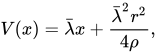
어디에
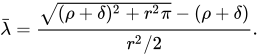

어디에
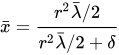
그리고
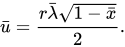
Sethi 모델의 확장
- 경쟁력 모델:나시 차등 게임[5][8][9][10][11][13][14][18][19][20][21][22][23][26][27][28]
- 멀티 에셀론 모델[4]
- Sethi 모델 및 확장의[6][7][10][13] 경험적 시험
- 공동 광고:Stackelberg 차등 게임
- 세티 내구재 모델[17][18][20][24][26]
참고 항목
참조
- ^ a b c Sethi, S. P. (1983). "Deterministic and Stochastic Optimization of a Dynamic Advertising Model". Optimal Control Applications and Methods. 4 (2): 179–184. doi:10.1002/oca.4660040207. S2CID 123673289.
- ^ a b c S.P. (2021년) 세티.최적제어이론: 경영과학과 경제학에의 적용.제4판.스프링거 354-356쪽ISBN 978-319-319-98236-6, 978-3-319-98237-3. http://doi.org/10.1007/978-3-319-98237-3
- ^ Vidale, M. L.; Wolfe, H. B. (1957). "An Operations-Research Study of Sales Response to Advertising". Operations Research. 5 (3): 370–381. doi:10.1287/opre.5.3.370.
- ^ a b c Kennedy, Adrian Patrick; Sethi, Suresh P.; Siu, Chi Chung; Yam, Sheung Chi Phillip (2021-07-26). "Cooperative Advertising in a Dynamic Three‐Echelon Supply Chain". Production and Operations Management. 30 (11): 3881–3905. doi:10.1111/poms.13487. ISSN 1059-1478.
- ^ a b c Sorger, G. (1989). "Competitive Dynamic Advertising: A Modification of the Case Game". Journal of Economic Dynamics and Control. 13 (1): 55–80. doi:10.1016/0165-1889(89)90011-0.
- ^ a b c Chintagunta, P. K.; Vilcassim, N. J. (1992). "An Empirical Investigation of Advertising Strategies in a Dynamic Duopoly". Management Science. 38 (9): 1230–1244. doi:10.1287/mnsc.38.9.1230.
- ^ a b c Chintagunta, P. K.; Jain, D. C. (1995). "Empirical Analysis of a Dynamic Duopoly Model of Competition". Journal of Economics & Management Strategy. 4 (1): 109–131. doi:10.1111/j.1430-9134.1995.00109.x.
- ^ a b Prasad, A.; Sethi, S. P. (2004). "Competitive Advertising under Uncertainty: Stochastic Differential Game Approach". Journal of Optimization Theory and Applications. 123 (1): 163–185. doi:10.1023/B:JOTA.0000043996.62867.20. S2CID 121005830.
- ^ a b Bass, F. M.; Krishamoorthy, A.; Prasad, A.; Sethi, S. P. (2005). "Generic and Brand Advertising Strategies in a Dynamic Duopoly". Marketing Science. 24 (4): 556–568. doi:10.1287/mksc.1050.0119. S2CID 17054876.
- ^ a b c d Naik, P. A.; Prasad, A.; Sethi, S. P. (2008). "Building Brand Awareness in Dynamic Oligopoly Markets". Management Science. 54 (1): 129–138. CiteSeerX 10.1.1.510.731. doi:10.1287/mnsc.1070.0755. S2CID 18908145.
- ^ a b Erickson, G. M. (2009). "An Oligopoly Model of Dynamic Advertising Competition". European Journal of Operational Research. 197: 374–388. doi:10.1016/j.ejor.2008.06.023.
- ^ Prasad, A.; Sethi, S. P. (2009). "Integrated Marketing Communications in Markets with Uncertainty and Competition". Automatica. 45 (3): 601–610. doi:10.1016/j.automatica.2008.09.018.
- ^ a b c d Erickson, G. M. (2009). "Advertising Competition in a Dynamic Oligopoly with Multiple Brands". Operations Research. 57 (5): 1106–1113. doi:10.1287/opre.1080.0663.
- ^ a b Rong, Zhang; Qingzhong, Ren (May 2013). "Equivalence between Sethi advertising model and a scalar LQ differential game". 2013 25th Chinese Control and Decision Conference (CCDC). pp. 1244–1247. doi:10.1109/ccdc.2013.6561115. ISBN 978-1-4673-5534-6. S2CID 26614539.
- ^ a b He, X.; Prasad, A.; Sethi, S.P. (2009). "Cooperative Advertising and Pricing in a Stochastic Supply Chain: Feedback Stackelberg Strategies". Production and Operations Management. 18 (1): 78–94. doi:10.1111/j.1937-5956.2009.01006.x. SSRN 1069063.
- ^ a b He, X.; Prasad, A.; Sethi, S.P.; Gutierrez, G. (2007). "A Survey of Stackelberg Differential Game Models in Supply and Marketing Channels". Journal of Systems Science and Systems Engineering. 16 (4): 385–413. doi:10.1007/s11518-007-5058-2. S2CID 11443159. SSRN 1069162.
- ^ a b Sethi, S.P.; Prasad, A.; He, X. (2008). "Optimal Advertising and Pricing in a New-Product Adoption Model". Journal of Optimization Theory and Applications. 139 (2): 351–360. doi:10.1007/s10957-008-9472-5. S2CID 16181059.
- ^ a b c 크리슈나무르티, A, 프라사드, A, 세티, S.P. (2009)내구성이 좋은 듀오폴리로 최적의 가격 책정 및 광고.European Journal of Operational Research.
- ^ a b c Bensoussan, A., Chen, S., Chutani, A., Sethi, S.P., Siu, C.C., and Yam, S.C.P., "Feedback Stackelberg-Nash Equilibria in Mixed Leadership Games with an Application to Cooperative Advertising," SIAM Journal on Control and Optimization, 2019, 57(5), 3413-3444.SSRN 3493916.
- ^ a b c d Chutani A. and Sethi, S.P., "A Feedback Stackelberg Game of Cooperative Advertising in a Durable Goods Oligopoly," Dynamic Games in Economics, 13, J.L. Haunschmied, V. Veliov, and S. Wrzaczek (Eds.), Springer-Verlag Berlin Heidelberg, 2014, 89-114.
- ^ a b 추타니, A.와 S.P. 세티, 「동적 소매 시장의 과점에서의 협력 광고」, 동적 게임과 어플리케이션, 2(4), 2012, 347-375.
- ^ a b 프라사드(Prasad) A, 세티(S.P), 나이크(Naik) P, 오토마(Automatica) 48, 2012, 2882-2887.
- ^ a b c 그, X, 크리슈나무로시, A, 프라사드, A, 세티, S.P., 43(1), 2012, 73-105. SSRN 1521239.
- ^ a b A.와 S.P.의 추타니, S.P., 「동적 내구재 공급망에서의 최적의 광고 및 가격 책정」, 154(2), 2012, 615-643.SSRN 1898309.
- ^ a b 그, X, 크리슈나무로시, A, 프라사드, A, 세티, S.P., "소매 경쟁과 협동 광고", OR Letters, 39, 2011, 11-16.SSRN 1609854.
- ^ a b c 크리슈나무르티, A, 프라사드, A, Sethi, S.P., "내구성 좋은 듀오폴리에서의 최적의 가격 책정 및 광고", 유럽 저널 오브 오퍼레이션 연구, 200(2), 2010, 486-497. SSRN 1114989.
- ^ a b 프라사드(Prasad) A, 세티(S.P), 나이크(Nai) P, "광고 과점 모델의 최적 통제", 2009년 6월 3~5일 제13회 IFAC 제조 정보 통제 문제 심포지엄(INCOM '09)의 진행.SSRN 1376394.
- ^ a b 베이스, F.M, 크리슈나무르티, A., 프라사드, A., S.P., 「유한 지평선 기업을 위한 시장 확장과 광고 경쟁」, 1(1), 2005년 2월, 1-19 SSRN 1088489.


