
2차 잔류성 문제
Quadratic residuosity problem계산 번호 이론의 2차 잔류도 문제(QRP[1])는 가 과(와 {\인지 아닌지를 결정하는 것이다이(가) 2차 잔류물 로 N 인지 여부를 결정하는 것이다.여기서 = }}2}}: 알려지지 않은 두 프리타임 는 분명히 2차 비-resides가 아닌 숫자 중 하나이다(아래 참조).
 (와
(와


이 문제는 1801년 가우스가 디스퀴즈 산수대에서 처음 설명한 것이다.이 문제는 계산적으로 어렵다고 여겨진다.몇 가지 암호화 방법은 경도에 의존한다(§ Applications 참조).
2차 잔류성 문제에 대한 효율적인 알고리즘은 알려지지 않은 인자화의 N 이(가) 2, 3회 곱인지 결정하는 것과 같은 다른 숫자의 이론적 문제에 대한 효율적인 알고리즘을 즉시 암시한다.[2]
정밀한 제형
정수 및 을(를) 고려할 때 과 같은 b b}이(가) 있는 경우{\a}은 2차 잔류물 로 T{\이라고 한다.


- ( )

그렇지 않으면 우리는 그것이 2차적 비재앙이라고 말한다.= 이(가) prime일 때는 다음과 같은 범례 기호를 사용하는 것이 관례다.
 (가) prime일 때는 다음과 같은
This is a multiplicative character which means for exactly of the values , and it is for the remaining.


유클리드 알고리즘과 유사한 방식으로 2차 상호주의 법칙을 사용하여 계산하기 쉽다. 레전드르 기호를 참조하십시오.
이제 주어진 = 2 p 1 }p_{2}}: 서로 다른 알 수 없는 prime.된{\a}은(는) 2차 잔류물 로 만약 이(가) 잔류물 모듈로 p 및 }}인 경우에만 된다
Since we don't know or , we cannot compute and . However, it is easy to compute their product.이것을 자코비 기호로 알려져 있다.


이것은 또한 자코비 기호에 대한 이차적 상호주의 법칙을 사용하여 효율적으로 계산될 수 있다.
() 이가) 2차적 잔류물 로 N{\ N인지 여부를 모든 경우에 알려줄 수는 없다!더 정확히 말하면 ()=- 1 1}이가) 같으면, 은 2차비 residue modulo이며 이 경우 는 이 을 끝낸다But if then it is either the case that is a quadratic residue modulo both and , or a quadratic non-residue modulo both and 는 단지()= 1 1}을를) 아는 것과 이러한 경우를 구별할 수 없다


이는 2차 잔류물 문제의 정확한 형성으로 이어진다.
문제:Given integers and , where and are unknown, different primes, and where , determine whether 은(는) 2차 잔류물 로 N 또는 not이다.
잔류물 분포
If is drawn uniformly at random from integers such that , is more often a quadratic residue or a quadratic non-residue modulo ?

As mentioned earlier, for exactly half of the choices of , then , and for the rest we have . By extension, this also holds for half the choices of . Similarly for . From basic algebra, it follows that this partitions }:{1 및( 의 에 따라 크기가 같은 4부분으로 구분.





The allowed in the quadratic residue problem given as above constitute exactly those two parts corresponding to the cases and )=- 1 )=- 따라서 한 a의 절반은 잔류물이고 나머지는 아니다
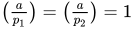

적용들
2차 잔류성 문제의 난치성은 블럼 블럼 슈브 가성수 생성기의 보안성에 대한 기초가 된다.공개키인 골드워서-미칼리 암호체계도 산출한다.[3][4]신원 기반 콕스 계획뿐 아니라
참고 항목
참조
- ^ Kaliski, Burt (2011). "Quadratic Residuosity Problem". Encyclopedia of Cryptography and Security: 1003. doi:10.1007/978-1-4419-5906-5_429.
- ^ Adleman, L. (1980). "On Distinguishing Prime Numbers from Composite Numbers". Proceedings of the 21st IEEE Symposium on the Foundations of Computer Science (FOCS), Syracuse, N.Y. pp. 387–408. doi:10.1109/SFCS.1980.28. ISSN 0272-5428.
- ^ S. Goldwasser, S. Micali (1982). "Probabilistic encryption and how to play mental poker keeping secret all partial information". Proc. 14th Symposium on Theory of Computing: 365–377. doi:10.1145/800070.802212.
- ^ S. Goldwasser, S. Micali (1984). "Probabilistic encryption". Journal of Computer and System Sciences. 28 (2): 270–299. doi:10.1016/0022-0000(84)90070-9.


