메틸페니데이트
Methylphenidate | |
 | |
| 임상자료 | |
|---|---|
| 발음 | /ˌmɛθəlˈfɛnɪdeɪt, -ˈfiː-/ |
| 상호 | 리탈린, 콘체르타 등 |
| 기타이름 | MPH[1] |
| AHFS/Drugs.com | 모노그래프 |
| 메드라인플러스 | a682188 |
| 라이센스 데이터 | |
| 임신 카테고리 |
|
| 의존성 책임감 | 하이[2] |
| 중독 책임감 | 하이[3] |
| 의 경로 행정부. | 흡입, 정맥내, 구강, 직장, 설하, 경피[2] |
| 약품반 | 중추신경계 자극제 & 노르에피네프린-도파민 재흡수 억제제 |
| ATC코드 | |
| 법적지위 | |
| 법적지위 | |
| 약동학적 자료 | |
| 생체이용률 | 흡인: 약 70% 구강: 약 30% (범위: 11~52%) |
| 단백질결합 | 10–33% |
| 신진대사 | 간(80%)은 대부분 CES1A1 매개성입니다. |
| 제거 반감기 | 2~3시간[12] |
| 활동기간 |
|
| 배설 | 소변(90%) |
| 식별자 | |
| |
| CAS 번호 | |
| 펍켐 CID | |
| IUPAR/BPS | |
| 드럭뱅크 | |
| 켐스파이더 | |
| 유니아이 | |
| KEGG | |
| ChEBI | |
| CHEMBL | |
| CompTox 대시보드 (EPA) | |
| ECHA 인포카드 | 100.003.662 |
| 화학물질 및 물리적 데이터 | |
| 공식 | C14H19NO2 |
| 어금니 질량 | 233.311 g·mol−1 |
| 3D 모델(Jsmol) | |
| 융점 | 74°C(165°F) |
| 끓는점 | 136 °C (277 °F) [13] |
| |
| |
| (verify) | |


리탈린(/ˈ ɪ ə ɪ/ RIT- ə-린) 및 콘세르타(/k ˈ ɜː rt ə/k ən-SUR-t ə) 등의 브랜드로 판매되는 메틸페니데이트는 주의력결핍 과잉행동장애(ADHD) 및 기면증 치료에 의학적으로 사용되는 중추신경계(CNS) 자극제입니다. ADHD(예: 영국[14])의 주요 약물로, 입으로 복용하거나 피부에 바를 수 있으며, 제형에 따라 효과가 다양하며, 일반적으로 2-4시간 범위입니다.[2]
메틸페니데이트의 일반적인 부작용은 행복감, 동공 확장, 빈맥, 두근거림, 두통, 불면증, 불안, 다한증, 체중 감소, 식욕 감소, 입 마름, 메스꺼움, 복통을 포함합니다.[8] 금단 증상은 오한, 우울증, 졸림, 조난, 탈진, 두통, 짜증, 무기력, 악몽, 불안, 자살 생각, 쇠약을 포함할 수 있습니다.[2]
메틸페니데이트는 신경세포에 의한 도파민과 노르에피네프린의 재흡수를 차단함으로써 작용하는 것으로 알려져 있습니다.[15][16] 페닐아민과 피페리딘 계열의 중추신경계(CNS) 자극제입니다.
어원
메틸페니데이트(methylphenidate)라는 단어는 메틸-2-페닐-2-(피페리딘-2-일) 아세테이트(Methyl-2-phenyl-2-yl acetate)의 합성어입니다.
사용하다
메틸페니데이트는 ADHD와 기면증을 치료하는 데 가장 일반적으로 사용됩니다.[17]
주의력결핍 과잉행동장애
메틸페니데이트는 주의력결핍 과잉행동장애 치료에 사용됩니다.[18] 복용량은 다양할 수 있으며 효과적으로 적정되며 일부 지침에서는 저용량으로 초기 치료를 권장합니다.[19] 즉각 방출 메틸페니데이트는 증상을 하루 종일 제어하기 위해 더 오래 지속되는 형태와 함께 매일 사용됩니다.[20][21] 메틸페니데이트는 6세 미만의 어린이에게는 승인되지 않습니다.[22][23]
6세 이상 어린이와 청소년에서 메틸페니데이트의 단기적인 이점과 비용 효과가 잘 확립되어 있습니다.[24][25] ADHD 환자에 대한 안전성과 효과는 몇 년에 걸쳐 여러 리뷰를 통해 입증되었습니다.[26][27][28]
메틸페니데이트를 사용하는 사람들의 약 70%는 ADHD 증상의 개선을 봅니다.[29] 흥분제 약물을 사용하는 ADHD 아동은 일반적으로 또래 및 가족과 더 나은 관계를 가지며, 학교에서 더 잘 수행하고, 산만하고 충동적이지 않으며, 주의 지속 시간이 더 깁니다.[26] 치료를 받지 않는 ADHD 진단을 받은 아이들이 성인이 되면서 물질 사용 장애의 위험이 증가할 것임을 시사하는 증거가 있습니다.[30][31]
메틸페니데이트 치료로 인한 ADHD 증상 및 삶의 질의 정확한 개선 정도는 2023년[update] 3월 현재 불확실합니다.[32] 메틸페니데이트는 세계보건기구 필수 의약품 목록에 포함되지 않습니다. 왜냐하면 세계보건기구의 조사 결과 ADHD 치료에서 이득 대 위해의 증거가 불분명하기 때문입니다.[33] 2021년 체계적 검토에서는 성인을 대상으로 IR 메틸페니데이트(즉시 방출)를 사용한 명확한 증거를 찾지 못했습니다.[34]
전 세계적으로 ADHD 진단이 증가했기 때문에 메틸페니데이트가 일부 인구에게 "연구용 약물"로 잘못 사용되어 유해할 수 있습니다.[35] 이것은 다른 문제를 겪고 있을 수 있고 ADHD로 오진된 사람들에게도 적용됩니다.[35] 이 범주에 속하는 사람들은 그들의 상태를 악화시키는 약물의 부정적인 부작용을 경험할 수 있습니다.[35]
기면증
압도적인 낮의 졸음과 통제할 수 없는 수면을 특징으로 하는 만성 수면장애인 기면증은 주로 자극제로 치료됩니다. 메틸페니데이트는 각성, 경계 및 성능을 높이는 데 효과적인 것으로 간주됩니다.[36] 메틸페니데이트는 MSLT(Multiple Sleep Latency Test)와 같은 표준화된 테스트에서 불면증 측정을 향상시키지만, 건강한 사람과 비슷한 수준으로 성능이 향상되지는 않습니다.[37]
기타 의료 용도
메틸페니데이트는 양극성 장애 및 주요 우울증의 치료 저항성 사례에서 라벨 외 사용을 위해 처방될 수도 있습니다.[38] 또한 뇌졸중, 암 및 HIV 양성 환자를 포함한 여러 그룹의 우울증을 개선할 수 있습니다.[39] 우울증에 대한 메틸페니데이트의 효과를 지지하는 증거는 약합니다.[40] 여기에는 항우울제와 함께 추가적인 이점을 제공하는 것도 포함됩니다.[41] 말기 암 환자에서 메틸페니데이트는 오피오이드로 인한 불면증에 대항하고, 오피오이드의 진통 효과를 증가시키고, 우울증을 치료하고, 인지 기능을 향상시키는 데 사용될 수 있습니다.[42] 2021년 체계적 검토 및 메타 분석에 따르면 노인성 우울증에 대한 모든 연구는 메틸페니데이트 사용의 긍정적인 결과를 보고했으며 검토는 시탈로프람과 함께 단기 사용을 권장했습니다.[43] 2018년 리뷰는 인지 및 인지 수행에 대한 약간의 이점 외에도 알츠하이머병에서 볼 수 있는 무감각증 치료에 대한 사용을 뒷받침하는 저품질 증거를 발견했습니다.[44]
성능향상
메틸페니데이트는 운동경기력 향상제, 인지력 향상제, 전치증, 행복감 등의 효능을 가지고 있습니다.[45][46][47][48][49][50][51][52][53] 그러나, 메틸페니데이트가 이러한 목적으로 사용되는 방식(고용량, 대체 투여 경로, 수면 부족 중 등)은 심각한 부작용을 초래할 수 있습니다.[54][55][53] 2015년 리뷰에 따르면 암페타민과 메틸페니데이트의 치료 용량은 작업 기억력, 일시적 기억력, 억제력을 포함한 인지 능력의 약간의 향상을 가져온다고 합니다. 정상적인 건강한 성인에게서 [56][a][57][b]이러한 약물의 인지 향상 효과는 전전두엽 피질에서 도파민 수용체 D와1 아드레날린 수용체 α의2 간접적인 활성화를 통해 발생하는 것으로 알려져 있습니다.[56] 메틸페니데이트 및 기타 ADHD 자극제 또한 작업 현저성을 개선하고 각성을 증가시킵니다.[58][59] 암페타민과 메틸페니데이트와 같은 자극제는 어렵고 지루한 작업에 대한 성능을 향상시킬 수 있으며,[58][c][59][60] 일부 학생들은 공부와 시험 보조로 사용됩니다.[35][61] 학생들이 각성제를 사용하는 주된 이유는 스스로 보고한 부정 자극제 사용에 대한 연구에 따르면, 오락용 약물로 사용하는 것이 아니라 경기력 향상을 위한 사용입니다.[62]
메틸페니데이트를 치료 범위 이상으로 과도하게 투여하면 작업 기억과 인지 조절에 방해가 될 수 있습니다.[58][59] 암페타민이나 부프로피온과 마찬가지로 메틸페니데이트는 주로 중추신경계의 도파민 재흡수 억제를 통해 인간의 체력과 지구력을 향상시킵니다.[63] 많은 양을 사용할 때 인지력 향상을 잃는 것과 유사하게, 메틸페니데이트를 다량 복용하면 횡문근융해증이나 온열질환과 같은 운동 능력을 손상시키는 부작용을 유발할 수 있습니다.[11] 문헌에 따르면 인지 능력을 향상시킬 수 있다고 제시되어 있지만 ADHD 진단이 없을 때 연구 보조제로 약물을 사용하는 것이 실제로 GPA를 향상시키지는 못한다는 것이 대부분의 저자들의 의견입니다.[35] 더욱이, 이 약을 공부에 사용하는 학생들은 잠재적으로 더 깊은 근본적인 문제에 대해 자가 치료를 할 수 있다고 제안되었습니다.[35]
금기사항
메틸페니데이트는 동요, 틱, 녹내장, 심장 결함 또는 메틸페니데이트 의약품에 포함된 모든 성분에 대한 과민증이 있는 개인에게는 금기입니다.[11]
임산부는 이점이 잠재적인 위험보다 클 경우에만 약물을 사용하는 것이 좋습니다.[64] 메틸페니데이트가 태아 발달에 미치는 영향을 확정적으로 입증하기에는 인체 연구가 충분하지 않습니다.[65] 2018년, 리뷰는 쥐와 토끼에서 기형 유발성이 없었으며, "주요 인간 기형 유발원이 아니다"라고 결론 내렸습니다.[66]
역기능

메틸페니데이트와 관련된 가장 일반적인 부작용은 식욕 감퇴, 구강 건조, 불안/불안, 메스꺼움 및 불면증입니다.[68] 위장계 부작용으로는 복통, 체중 감소 등이 있을 수 있습니다. 신경계 부작용으로는 현기증(자극/무긴장), 과민성, 운동이상(틱), 안구건조증, 무기력([69]졸림/피로), 현기증 등이 있을 수 있습니다. 심장 부작용에는 두근거림, 혈압 및 심박수의 변화(일반적으로 경미함), 빈맥(급격한 심박수) 등이 포함될 수 있습니다.[70] 안과적 부작용으로는 동공 확장으로 인한 시야 흐림, 안구 건조증 등이 있을 수 있으며 복시 및 균사증에 대한 보고가 적습니다.[contradictory][71][72]
메틸페니데이트를 복용하는 ADHD 흡연자는 니코틴 의존도가 증가할 수 있으며, 메틸페니데이트를 사용하기 시작하기 전보다 더 자주 담배를 피우며 니코틴 갈망이 증가하고 하루 평균 1.3개비가 증가합니다.[73]
소아에서 장기간 치료를 받으면 키가 경미하게 감소한다는 증거가 있습니다.[74] 이것은 처음 3년 동안 연간 1센티미터(0.4인치) 이하로 추정되었으며 10년 동안 총 3센티미터(1.2인치)가 감소했습니다.[75][76]
경피 메틸페니데이트 사용 시 과민성(피부 발진, 두드러기, 발열 포함)이 보고되는 경우가 있습니다. 데이트라나 패치는 경구용 메틸페니데이트보다 피부 반응률이 훨씬 높습니다.[77]
메틸페니데이트는 정신병적인 사람들의 정신병을 악화시킬 수 있으며, 매우 드물게 새로운 정신병적 증상의 출현과 관련이 있습니다.[78] 조증이나 저조증의 잠재적인 유발로 인해 조울증이 있는 사람에게는 극도로 주의하여 사용해야 합니다.[79] 자살 생각에 대한 보고는 매우 드물지만 일부 저자는 증거가 연결고리를 뒷받침하지 않는다고 주장합니다.[74] 로고르레아는 가끔 보고되고 시각적 환각은 매우 드물게 보고됩니다.[71] 소아마비는 잠재적으로 심각할 수 있는 매우 드문 부작용입니다.[80]
2011년 미국 식품의약국(FDA)이 의뢰한 연구에 따르면 어린이, 젊은 성인, 성인의 경우 심각한 심혈관 질환(급작사, 심장마비, 뇌졸중)과 메틸페니데이트 또는 기타 ADHD 자극제의 의학적 사용 사이에 연관성이 없습니다.[81]
메틸페니데이트를 만성적으로 사용하는 동안에만 일부 부작용이 나타날 수 있으므로 부작용에 대한 지속적인 관찰이 권장됩니다.[82]
2018년 코크란 리뷰는 메틸페니데이트가 심장 문제, 정신병, 사망과 같은 심각한 부작용과 관련이 있을 수 있다는 것을 발견했습니다. 증거의 확실성은 매우 낮은 것으로 진술되었습니다.[83]
같은 검토를 통해 어린이에게 심각한 부작용과 심각하지 않은 부작용을 모두 일으킬 수 있다는 잠정적인 증거를 발견했습니다.[83][d]
과다 복용
메틸페니데이트에 대한 중등도의 급성 과다복용의 증상은 주로 중추신경계 과잉 자극에서 발생합니다; 구토, 메스꺼움, 동요, 떨림, 고환각, 근육 경련, 행복감, 혼란, 환각, 섬망, 고열, 발한, 홍조, 두통, 빈맥, 심계 항진, 심장 부정맥,[11][84] 고혈압, 근육통, 점막 건조증. 심한 과다복용은 고열량, 교감신경계 독성물질, 경련, 편집증, 고정관념(반복적인 운동장애), 횡문근융해증, 혼수, 순환붕괴 등의 증상을 수반할 수 있습니다.[11][84][85][e] 메틸페니데이트 과다복용은 적절한 관리로 거의 치명적이지 않습니다.[85] 메틸페니데이트 정제를 동맥에 주입한 후 농양 형성 및 괴사와 관련된 심각한 독성 반응이 보고되었습니다.[86]
메틸페니데이트 과다복용의 치료는 일반적으로 벤조디아제핀의 투여를 포함하며, 항정신병약제, α-아드레노수용체 작용제 및 프로포폴은 2차 치료제로 사용됩니다.[85]

중독과 의존
메틸페니데이트는 암페타민과 유사한 중독 책임과 의존 책임을 가진 흥분제입니다. 중독성 약물 중에서도 중등도의 책임감을 가지며,[87][88] 따라서 메틸페니데이트를 오락용 약물로 고용량으로 사용할 경우 중독 및 심리적 의존이 가능하고 가능성이 높습니다.[88] 의료 용량 범위 이상으로 사용될 때 자극제는 자극제 정신병의 발병과 관련이 있습니다.[89]
생체분자 메커니즘
메틸페니데이트는 뇌의 보상 시스템에서 약력학적 효과(즉, 도파민 재흡수 억제)로 인해 행복감을 유발할 가능성이 있습니다. ADHD 자극제는 치료 용량에서 보상 시스템을 충분히 활성화하지 못합니다. 결과적으로 ADHD 치료를 위해 일반적으로 처방되는 용량으로 지시된 대로 복용할 경우 메틸페니데이트 사용은 중독을 유발할 수 있는 능력이 부족합니다.[88]
상호작용
메틸페니데이트는 비타민K 항응고제, 특정 항경련제 및 일부 항우울제(삼환계 항우울제, 선택적 세로토닌 재흡수 억제제)의 대사를 억제할 수 있습니다. 병용 투여는 용량 조정이 필요할 수 있으며, 혈장 약물 농도 모니터링을 통해 도움을 받을 수 있습니다.[10] 메틸페니데이트가 항우울제 병용 투여와 함께 세로토닌 증후군을 유발한 여러 증례 보고가 있습니다.[90][91][92][93]
메틸페니데이트가 에탄올과 결합하면 코카인과 에탄올로부터 코카에틸렌이 간에서 생성되는 [94][95]것과 달리 에틸페니데이트라는 대사산물이 간 에스테르 교환 반응을 통해 생성됩니다. 에틸페니데이트의 감소된 효능과 그 소량의 형성은 그것이 치료 용량에서 그리고 심지어 과다복용의 경우에도 에틸페니데이트 농도는 무시할 수 있을 정도로 유지된다는 것을 의미합니다.[96][95]
알코올(에탄올)을 공동 섭취하면 d-methylphenidate의 혈장 수치도 최대 40%[97]까지 증가합니다.
메틸페니데이트로 인한 간 독성은 극히 드물지만 제한된 증거에 따르면 메틸페니데이트와 함께 β-아드레날린 작용제를 섭취하면 간 독성의 위험이 증가할 수 있습니다.[98]
약리학
약력학
| 신경전달물질 수송기 | 재다 (units) | dl-MPH | d-MPH | l-MPH |
|---|---|---|---|---|
| DAT | Ki(nM) | 121 | 161 | 2250 |
| IC50()nM | 20 | 23 | 1600 | |
| 그물 | Ki(nM) | 788 | 206 | >10000 |
| IC50(nM) | 51 | 39 | 980 | |
| SERT | Ki(nM) | >10000 | >10000 | >6700 |
| IC50(nM) | — | >10000 | >10000 | |
| GPCR | 재다 (units) | dl-MPH | d-MPH | l-MPH |
| 5-HT1A | Ki(nM) | 5000 | 3400 | >10000 |
| IC50()nM | 10000 | 6800 | >10000 | |
| 5-HT2B | Ki(nM) | >10000 | 4700 | >10000 |
| IC50(nM) | >10000 | 4900 | >10000 |
메틸페니데이트는 주로 노르에피네프린-도파민 재흡수 억제제(NDRI) 역할을 합니다. 벤질피페리딘과 페네틸아민 유도체로 기본 구조의 일부를 카테콜아민과 공유합니다.
메틸페니데이트는 정신자극제로 신경전달물질인 노르에피네프린과 도파민의 재흡수 억제를 통해 중추신경계의 활성을 증가시킵니다. ADHD의 모델이 시사하는 바와 같이, 그것은 뇌의 일부 신경전달물질 시스템, 특히 중피질 및 중엽 경로의 도파민 및 전전두엽 피질 및 유전자좌의 노르에피네프린과 관련된 기능 장애와 관련이 있습니다.[102] 메틸페니데이트나 암페타민과 같은 정신자극제는 이러한 시스템에서 신경전달물질의 활성을 증가시키기 때문에 ADHD 치료에 효과적일 수 있습니다. 이러한 신경전달물질의 재흡수가 중단되면 시냅스에서의 농도와 효과가 각각 증가하고 더 오래 지속됩니다. 따라서 메틸페니데이트는 노르에피네프린-도파민 재흡수 억제제라고 불립니다.[96] 노르에피네프린과 도파민의 효과를 증가시켜 메틸페니데이트는 중추신경계의 활성을 증가시키고 경계심 증가, 피로감 감소, 주의력 향상 등의 효과를 발생시킵니다.[102][103]
메틸페니데이트는 도파민(DA)과 노르에피네프린(NE)[104]의 조절 수준에서 가장 활성적입니다. 메틸페니데이트는 도파민 수송체(DAT) 및 노르에피네프린 수송체(NET)와 결합하여 차단합니다.[105] DAT 차단과 세포외 도파민 사이에는 가변성이 존재하여 메틸페니데이트가 기초 도파민 활성을 증폭시켜 기초 DA 활성이 낮은 사람에서 무반응으로 이어진다는 가설로 이어집니다.[106] 평균적으로 메틸페니데이트는 선조체와 전전두엽 피질에서 도파민과 노르에피네프린의 3-4배 증가를 유도합니다.[1] 자기공명영상(MRI) 연구에 따르면 ADHD 자극제(특히 암페타민과 메틸페니데이트)로 장기간 치료하면 ADHD 환자에게서 발견되는 뇌 구조와 기능의 이상이 감소합니다.[107][108][109][f]
암페타민과 메틸페니데이트는 주로 도파민성 약물이지만 작용 메커니즘은 다릅니다. 메틸페니데이트는 노르에피네프린-도파민 재흡수 억제제 역할을 하고, 암페타민은 도파민과 노르에피네프린의 방출제이자 재흡수 억제제 역할을 합니다. 메틸페니데이트는 신경세포 발화율을 증가시키는 [110][111][112]반면 암페타민은 발화율을 감소시키는 것으로 알려져 있기 때문에, 도파민과 노르에피네프린의 방출에서 메틸페니데이트의 작용 메커니즘은 다른 대부분의 페닐아민 유도체와 근본적으로 다릅니다. 그러나 모노아민 수송체를 통한 모노아민의 흐름을 역전시킴으로써 모노아민 방출을 야기하며, 여기에는 TAAR1 활성화 및 VMAT2 기능의 조절 등의 다양한 메커니즘이 포함됩니다.[113][114][g][115][h] 메틸페니데이트와 암페타민 간의 작용 메커니즘의 차이는 메틸페니데이트가 모노아민 수송체에 미치는 암페타민의 효과를 억제하는 것을 유발합니다.[113][better source needed]
메틸페니데이트는 도파민 수송체 및 노르에피네프린 수송체 결합 친화성을 모두 가지며, 덱스트로메틸페니데이트 거울상이성질체는 노르에피네프린 수송체에 대해 현저한 친화성을 나타내는 것을 특징으로 하는,[116] 덱스트로트로틱 및 레보로트로틱 거울상이성질체 모두 세로토닌 수송체에 대한 직접적인 결합은 관찰되지 않았지만 세로토닌 5HT1A 및 5HT 하위2B 유형에 대해 수용체 친화성을 나타냈습니다.[101] 이후 연구에서 5HT1A2B 수용체에 대한 d-threo-methylphenidate(dexmethylphenidate) 결합을 확인했지만, 5HT 수용체에 대한 유의미한 활성은 발견되지 않았습니다.[117]
메틸페니데이트가 DAT(DAT 억제제)의 침묵 길항제 역할을 한다는 주장에 반대하는 역설적인 결과가 있습니다.[118] Methylphenidate의 행복감 효과를 위해서는 DAT의 80% 점유가 필요하지만, 이 수준을 넘어 Methylphenidate의 재투여는 유사하게 강력한 행복감 효과를 생성하는 것으로 밝혀졌습니다(DAT 점유가 반복 투여로 변하지 않음에도 불구하고).[118] 이에 비해 부프로피온과 같은 다른 DAT 억제제는 이러한 효과를 나타내는 것으로 관찰되지 않았습니다.[119] 이러한 관찰은 메틸페니데이트가 더 높은 용량에서 DAT에 의한 도파민 유출 방향을 역전시킴으로써 "DAT 역작용제" 또는 "DAT의 음성 알로스테릭 수식제"로 작용할 수 있다는 가설을 촉발시켰습니다.[120]
메틸페니데이트는 파킨슨병과 필로폰 사용 장애의 신경독성 효과로부터 신경세포를 보호할 수 있습니다.[121] 신경 보호의 가설적 메커니즘은 필로폰 억제를 통한 것입니다.DAT 상호작용, 그리고 세포질 도파민의 감소를 통해 도파민 관련 활성 산소 종의 생산을 감소시킵니다.[121]
덱스트로타리 거울상이성질체는 레보로타리 거울상이성질체보다 훨씬 더 강력하며, 따라서 일부 약물은 덱스메틸페니데이트만을 포함합니다.[104] 연구된 OROS 메틸페니데이트의 최대 일일 복용량은 144 mg/day인 것으로 보입니다.[122]
약동학
입으로 섭취한 메틸페니데이트는 11-52%의 생체이용률을 가지며, 즉시 방출(즉, 리탈린)의 경우 약 2-4시간, 지속 방출(즉, 리탈린 SR)의 경우 약 3-8시간, 연장 방출(즉, 콘체르타)의 경우 약 8-12시간의 작용 기간을 갖습니다. 메틸페니데이트의 반감기는 개인에 따라 2-3시간입니다. 최고 플라즈마 시간은 약 2시간에 달성됩니다.[12] 메틸페니데이트는 혈장 단백질 결합이 10~33%로 낮고 분포 부피는 2.65L/kg입니다.[9]
덱스트로메틸페니데이트는 경구 투여 시 레보메틸페니데이트보다 훨씬 더 생체이용 가능하며, 라세믹 메틸페니데이트의 정신작용을 주로 담당합니다.[12]
즉시 방출되는 메틸페니데이트에 대한 경구 생체 이용률과 흡수 속도는 식사와 함께 투여될 때 증가합니다.[123] 관찰된 C에max 대한 고지방 식사의 효과는 일부 확장 방출 제형 간에 차이가 있는데, IR/ER 및 OROS 조합 제형은 감소된max C 수준을[124] 나타내는 반면 액체 기반 확장 방출 제형은 고지방 식사와 함께 투여되었을 때 증가된max C 수준을 나타냈습니다.[125] 그러나 2003년 연구에서는 고지방 식사 투여와 경구 메틸페니데이트의 공복 투여 사이에 차이가 없음을 보여주었습니다.[126]
메틸페니데이트는 간에서 CES1A1 효소에 의해 리탈린산으로 대사됩니다. 덱스트로메틸페니데이트는 레보메틸페니데이트보다 느린 속도로 선택적으로 대사됩니다.[127] 대사된 약물의 97%는 소변으로 배출되고, 1~3%는 대변으로 배출됩니다. 약의 1% 미만인 소량이 그대로 소변으로 배출됩니다.[9]
화학
일부 도시 전설에 의한 주장에도 불구하고, 그것은 코카인 유도체도 아니고 유사체도 아닙니다; 코카인은 SNDRI 작용을 하는 국소 마취제 및 리간드 채널 차단제인 반면, 메틸페니데이트는 노르에피네프린 수송체(NET)보다 도파민 수송체(DAT)에 대해 2-3배 선택성을 갖는 NDRI입니다. 또한 코카인은 NDRI 부위보다 세로토닌 수송체(SERTs)에 더 강력합니다.[128][129]
분자에는 두 개의 카이랄 중심이 있기 때문에 메틸페니데이트의 4가지 이성질체가 가능합니다. 한 쌍의 3o 이성질체와 한 쌍의 적혈구가 구별되며, 이로부터 주로 d-threo-methylphenidate가 약리학적으로 원하는 효과를 나타냄.[104][130] 적혈구 이성질체는 세 가지 이성질체와 공유되지 않는 특성인 프레스 또는 아민입니다. 이 약이 처음 소개되었을 때는 에리트로:쓰레오 디아스테레오머의 4:1 혼합물로 판매되었지만 나중에 세 가지 디아스테레오머만 포함하도록 재구성되었습니다. "TMP"는 어떠한 에리트로디아제 이성질체, 즉 (±)threo-methylphenidate를 포함하지 않는 threo 제품을 의미합니다. 세 가지 이성질체는 에너지적으로 선호되기 때문에 원하지 않는 적혈구 이성질체를 쉽게 에피머화할 수 있습니다. 덱스트로로테이션 메틸페니데이트만을 포함하는 약물을 d-TMP라고 부르기도 하지만, 이 이름은 거의 사용되지 않고 덱스메틸페니데이트, d-MPH 또는 d-트레오-메틸페니데이트라고 훨씬 더 일반적으로 언급됩니다. 이성질체적으로 순수한 (2R,2'R)-(+)-threo-methylphenidate hydrochloride의 합성에 대한 리뷰가 발표되었습니다.[131]


생물학적 유체에서의 검출
주요 대사산물인 메틸페니데이트 또는 리탈린산의 농도는 치료적으로 약물을 투여받는 사람들의 순응도를 모니터링하고 잠재적인 중독 환자의 진단을 확인하거나 치명적인 과다복용의 경우 법의학적 조사를 돕기 위해 혈장, 혈청 또는 전혈에서 정량화될 수 있습니다.[134]
역사
메틸페니데이트는 1944년 처음 합성돼 1955년 미국에서 의료용으로 승인됐습니다.[135][136][137] 화학자 레안드로 파니존(Leandro Panizon)이 합성하고 스위스 회사 CIBA(현재 노바티스)가 판매했습니다.[135] 그는 저혈압을 보상하기 위해 리탈린을 사용한 리타라는 별명을 가진 아내 마르가리타의 이름을 따서 약의 이름을 지었습니다.[138] 메틸페니데이트는 1954년까지 흥분제로 보고되지 않았습니다.[139][140] 이 약은 1957년 미국에서 의료용으로 소개되었습니다.[141] 원래 센테드린이라는 브랜드로 80%(±)에리트로와 20%(±)트레오의 두 종족 동료의 혼합물로 판매되었습니다.[139] 레이스메이트에 대한 후속 연구는 중심 자극제 활성이 트레오 레이스메이트와 관련이 있으며 에리트로 이성질체를 보다 활성적인 트레오 이성질체로 분리 및 상호 전환하는 데 초점을 맞추고 있음을 보여주었습니다.[139][142][143][144] 적혈구 이성질체는 제거되었고, 현재 메티페니데이트의 현대 제형은 d- 이성질체와 l- 이성질체의 50:50 혼합물에 3개 이성질체만을 포함합니다.[139]
메틸페니데이트는 바르비투레이트로 인한 혼수, 기면증 및 우울증을 완화하는 데 처음 사용되었습니다.[145] 그것은 나중에 노인들의 기억력 결핍을 치료하는 데 사용되었습니다.[146] 1960년대부터 미국 정신과 의사 찰스 브래들리(Charles Bradley[147])의 벤제드린(Benzedrine)과 같은 정신 자극 약물 사용에 대한 연구를 시작으로 당시 "부적응 아동"이라고 불리는 초기 연구를 기반으로 ADHD 아동을 치료하는 데 사용되었습니다.[148] 의료 및 정신 건강 커뮤니티에서 ADHD 진단이 더 잘 이해되고 더 일반적으로 받아들여지면서 메틸페니데이트의 생산 및 처방이 1990년대에 특히 미국에서 크게 증가했습니다.[149]
Alza Corporation은 2000년에 메틸페니데이트의 확장 출시 형태인 Concerta를 시판하기 위해 미국 FDA 승인을 받았습니다.[10][150][151]
2013년 전 세계적으로 사용된 메틸페니데이트의 복용량은 2012년 대비 66% 증가한 것으로 추정되었습니다.[152] 2021년에는 미국에서 43번째로 많이 처방된 약으로 1,500만 건 이상의 처방을 받았습니다.[153][154] 일반 의약품으로 제공됩니다.[2]
사회와 문화
이름
-
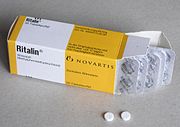 스위스 "리탈린" 브랜드 메틸페니데이트입니다.
 -
 인도의 "AddWize" 브랜드는 인스턴트 릴리스 및 확장 릴리스 제형으로, 인스턴트 릴리스 스트립의 경우 US$1.9, AddWize 확장 릴리스 스트립의 경우 US$2.9입니다.
 -
 위에서 시계방향으로: 협주곡 18mg, 메디키넷 5mg, 메틸페니닷 TAD 10mg, 리탈린 10mg, 메디키넷 XL 30mg.


메틸페니데이트는 전 세계 대부분의 국가에서 판매됩니다.[155]: 8–9 메틸페니데이트의 브랜드명은 리탈린(분자 발견자의 아내인 리타를 기리기 위해), 리라틴(Rilatine, RIT 제약회사와의 상업적 명칭 충돌을 피하기 위해 벨기에에서), 콘세르타,[10] 메디키네, Adapen, Addwize, Inspiral, Methmild, Artige, Attenta, Cognil, Konsenidat, Equasym, Foquest,[156] Methylin, Penid, Phenid, 프로히퍼, 그리고 트레이다.[155]: 8–9
사용가능양식
덱스메틸페니데이트(dexmethylphenidate)로 알려진 메틸페니데이트의 덱스트로로타리 거울상이성질체는 즉시 방출 및 확장 방출 형태 모두에서 일반 및 브랜드 이름인 Focalin 및 Attenade로 판매됩니다. 덱스메틸페니데이트가 메틸페니데이트보다 생체이용률이 더 좋고 작용 기간이 더 길다는 일부 증거가 있습니다.[157]
즉시해제
-
![Structural formula for the substance among Ritalin tablet series. (Ritalin, Ritalin LA, Ritalin SR.) The volume of distribution was 2.65±1.11 L/kg for d-methylphenidate and 1.80±0.91 L/kg for l-methylphenidate subsequent to swallow of Ritalin tablet.[8]](//upload.wikimedia.org/wikipedia/commons/3/30/Structural_formula_for_Concerta.jpg)
- 콘체르타 정제 내부의 물질에 대한 구조식. Concerta 투여 후 l-이성질체의 혈장 농도는 대략 d-이성질체의 혈장 농도의 40분의 1.[10] 성분은 Concerta의 성분과 동일하다는 점에 유의하십시오. 차이점은 개별 알약의 다른 측면에 있습니다.
![Structural formula for the substance among Ritalin tablet series. (Ritalin, Ritalin LA, Ritalin SR.) The volume of distribution was 2.65±1.11 L/kg for d-methylphenidate and 1.80±0.91 L/kg for l-methylphenidate subsequent to swallow of Ritalin tablet.[8]](/wiki/File:Structural_formula_for_Concerta.jpg)
메틸페니데이트는 원래 노바티스 브랜드 이름인 리탈린으로 즉시 출시되는 라세미 혼합 제제로 사용할 수 있었지만, 일부는 다른 브랜드 이름으로 사용할 수 있습니다. 일반 브랜드명에는 리탈리나, 릴라틴, 아워타, 메디키넷, 메타데이, 메틸린, 페니드, 트란실린, 루비펜 등이 있습니다.[citation needed]
익스텐디드 릴리즈
확장 방출 메틸페니데이트 제품은 다음과 같습니다.
| 브랜드명 | 일반명[158][159][160][161] | 지속 | 복용량 형태 |
|---|---|---|---|
| 압텐시오 XR(미국); 비펜틴(CA) | 현재 사용할 수 없음 | 12시간[162][163] | XR 캡슐의 |
| 협주곡(미국/CA/AU); 협주곡 XL (영국) | 메틸페니데이트 ER(미국/CA);[i] 메틸페니데이트 ER-C (CA)[ii] | 12시간[164] | OROS 타블렛 |
| 퀼리반트 XR (미국) | 현재 사용할 수 없음 | 12시간[164] | 오랄 정지의 |
| 데이트라나(미국) | 메틸페니데이트 필름, 확장 릴리스; 경피(미국)[iii] | 11시간[165] | 경피의 패치를 붙이다 |
| 메타데이트 CD(미국); 이카심 XL (영국) | 메틸페니데이트 ER (미국)[iv] | 8~10시간[164] | CD/XL 캡슐의 |
| QuilliChew ER (US) | 현재 사용할 수 없음 | 8시간[166] | 씹을 수 있는 타블렛 |
| 리탈린 LA(미국/AU); 메디키넷 XL (영국) | 메틸페니데이트 ER (미국)[v] | 8시간[164] | ER 캡슐의 |
| Ritalin SR (US/CA/UK); Rubifen SR (NZ) | 메타데이터 ER(미국);[vi] 메틸린 ER(미국);[vii] 메틸페니데이트 SR(미국/CA)[viii] | 5~8시간[164] | CR 타블렛 |
콘체르타 정제는 "ALZA"라는 문자로 표시되며, 밀리그램 단위의 용량 강도와 관련하여 "18", "27", "36" 또는 "54"로 표시됩니다. 용량의 약 22%는 즉시 방출되며,[167] 나머지 78%는 섭취 후 10-12시간에 걸쳐 방출되며, 처음 6-7시간 동안 초기에 증가하고 이후 방출된 약물에서 감소합니다.[168]
리탈린 LA 캡슐은 "NVR"이라는 글자로 표시됩니다. Novartis), 다음은 (mg) 투여 강도에 따라 "R20", "R30" 또는 "R40"입니다. Ritalin LA는[70] 총 투여량의 절반은 즉시 방출되고 나머지 절반은 4시간 후에 방출되는 두 가지 표준 투여량을 제공합니다. 전체적으로 각 캡슐은 약 8시간 동안 효과가 있습니다.
메타데이트 CD 캡슐에는 30%는 즉시 방출되고 나머지 70%는 고르게 지속 방출되는 두 가지 유형의 비드가 포함되어 있습니다.[169]
메디키넷 리타드/CR/성인/수정 릴리스 정제는 메틸페니데이트의 확장 릴리스 구강 캡슐 형태입니다. 복용량의 50%를 IRMP로 제공하고 나머지 50%를 3-4시간 내에 제공합니다.[170][171]
스킨패치
메틸페니데이트 스킨 패치는 미국에서 데이트라나라는 브랜드로 판매되고 있습니다. 노벤 제약에서 개발 및 시판하여 2006년 미국에서 승인을 받았습니다.[11] 메틸페니데이트 경피 시스템(methylphenidate transdermal system, MTS)이라고도 합니다. 6~17세 ADHD 아동에게 1일 1회 치료제로 승인되었습니다. 주로 구강 형태가 잘 견디지 못하거나, 순응도에 어려움이 있을 때 2차 치료제로 처방됩니다. Noven의 원래 FDA 제출에는 12시간 동안 사용해야 한다고 나와 있습니다. FDA가 제출을 거부하자 더 짧은 기간이 안전하고 효과적이라는 증거를 요구했고, 노븐은 그런 증거를 제시했고, 9시간 동안 승인을 받았습니다.[172]
경구 투여된 메틸페니데이트는 1차 통과 대사의 대상이 되며, 이를 통해 레보 이성질체가 광범위하게 대사됩니다. 이러한 1차 통과 대사를 회피함으로써, ℓ-트레오-메틸페니데이트의 상대적인 농도는 경피 투여 시 훨씬 더 높습니다(약 14-27% 대신 덱스메틸페니데이트의 50-60%).
메틸페니데이트의 39 나노그램/mL 피크 혈청 농도는 투여 후 7.5-10.5시간 사이에 발생하는 것으로 확인되었습니다.[11] 그러나 시작부터 최대 효과는 2시간이며 패치를 제거한 후 2시간까지 임상 효과가 유지됩니다. 피부 경피 패치를 염증이 있는 피부나 열에 노출된 피부에 바르면 흡수력이 증가합니다. 흡수는 도포 후 약 9시간 동안 지속됩니다(정상, 열에 노출되지 않은 피부 및 염증이 없는 피부에). 약물의 90%는 대사산물과 변하지 않는 약물로 소변으로 배출됩니다.[11]
비경구 제제
미국에서 출시되었을 때, 메틸페니데이트는 CIBA에서 의료 전문가가 사용할 수 있는 비경구 형태로 제공되었습니다. 100 mg의 메틸페니데이트 HCl과 100 mg의 락토스를 동결건조(동결건조)된 형태로 포함하는 10 mL의 다중 용량 바이알로 제공되었습니다. 또한 20 mg 메틸페니데이트 HCl을 함유한 단일 용량 앰플로도 사용할 수 있었습니다. 지침은 멸균 용매(물) 10 mL로 재구성하도록 하였습니다. 적응증은 10~20mg(MDV에서 1.0mL, 1회용 앰플 최대 1개)으로 특정 환자가 치료에 대한 내성을 분해하는 데 도움이 될 수 있는 집중적이고 말이 많은 상태를 생성했습니다. 비경구 메틸페니데이트는 실제 이점과 심령 의존성을 유발하는 것에 대한 우려로 중단되었습니다. 이것은 바르비투레이트제(Pentothal©)나 유사한 힘과 같은 정보의 흐름을 제어하는 능력을 손상시키지 않기 때문에 일반적인 의미의 진실 혈청이 아닙니다.
비용.

법적지위

국제적으로 메틸페니데이트는 향정신성 물질에 관한 협약에 따른 스케줄 II 약물입니다.[174]
합법적 | 제어 물질 | 불법 |
| 국가/지역 | 상황 | 메모들 | |
|---|---|---|---|
 호주. 호주. | "Schedule 8" 제어 물질. 이러한 약물은 조제되고 처방전 없이 소지할 경우 벌금과 징역형에 처해질 때까지 잠글 수 있는 금고에 보관해야 합니다. | [175] | |
 캐나다 캐나다 | 의약품 및 물질 관리법 별표 3은 처방전 없이 소지하는 것이 불법이며, 불법 소지 시 3년 이하의 징역 또는 (즉결) 1년 이하의 징역 또는 2천 달러 이하의 벌금에 처해질 수 있습니다. 밀매 목적의 불법 소지는 10년 이하의 징역 또는 (즉결) 18개월 이하의 징역에 처해질 수 있습니다. | [176] | |
 피지 피지 | 2004년 불법 약물 관리법에 따른 불법 약물 스케줄 1 | [177] | |
 프랑스. 프랑스. | "마약물" 일정에 따라 초기 진료 및 연간 상담 시 병원 또는 시 전문가(어린이용 소아과 의사, 정신과 의사 또는 성인용 신경과 의사)만 처방되는 등 처방 및 유통 조건이 제한됩니다.[178] | ||
 홍콩 홍콩 | 위험 약물 조례(cap. 134)의 별표 1에 따라 통제됩니다. | [179] | |
 인디아 인디아 | 메틸페니데이트는 스케줄 X 약물이며 약물 및 화장품 규칙, 1945에 의해 통제됩니다. 의사의 처방에 의해서만 조제됩니다. 법적으로 메틸페니데이트 2g은 소량, 50g은 다량 또는 상업용으로 분류됩니다. | [180][181] | |
 뉴질랜드 뉴질랜드 | 뉴질랜드에서 메틸페니데이트는 'B2급 조절 물질'입니다. 불법 소지는 징역 6개월, 유통은 징역 14년형으로 처벌됩니다. | ||
 러시아 러시아 | 목록 I은 인정된 의학적 가치 없이 향정신성 물질을 통제했습니다. 러시아 보건부의 마약 통제를 위한 상시 위원회는 메틸페니데이트 및 그 유도체를 마약, 향정신성 물질 및 그 전구체의 국가 목록에 올렸고, 정부는 2014년 10월 25일 메틸페니데이트의 사용을 금지했습니다. | [182] | |
 스웨덴 스웨덴 | 의학적 가치가 인정된 통제 물질 목록 II. 처방전 없이 소지할 경우 3년 이하의 징역에 처해질 수 있습니다. | [183] | |
 영국 영국 | 'B급' 물질을 제어했습니다. 처방전 없이 소지하는 경우에는 5년 이하의 징역 또는 무제한의 벌금 또는 둘 다를 부과하며, 메틸페니데이트를 공급하는 경우에는 14년 또는 무제한의 벌금 또는 둘 다를 부과합니다. | [184] | |
 미국 미국 | 의학적 가치는 인정받았지만 오용 가능성이 높은 물질에 사용되는 명칭으로, 부칙 Ⅱ 관리대상물질로 분류됩니다. | [185] |
논란
메틸페니데이트는 ADHD 치료에 사용되는 것과 관련하여 논란의 대상이 되어 왔습니다. ADHD 증상을 줄이기 위해 아이들에게 정신 자극 약물을 처방한 것이 주요한 비판의 대상이 되어 왔습니다.[186][need quotation to verify] 메틸페니데이트가 게이트웨이 약물로 작용한다는 주장은 여러 출처에서 신빙성이 떨어졌으며,[187] 이에 따르면 남용은 통계적으로 매우 낮고 "어린 시절의 자극적인 치료는 나중에 후속 약물 및 알코올 남용 장애의 위험을 증가시키지 않습니다."[188] ADHD 약물 치료가 담배 사용 위험 증가와 관련이 없다는 연구 결과가 나왔고, 실제로 리탈린과 같은 각성제 치료가 이 위험을 낮추는 것으로 나타났습니다.[189] 어린 시절 메틸페니데이트와 같은 자극제로 치료받은 사람들은 성인기에 물질 사용 장애가 발생할 가능성이 적었습니다.[190]
메틸페니데이트 약물 사용률이 가장 높은 나라 중에는 아이슬란드가 있는데,[191] 연구 결과에 따르면 이 약물은 약물을 주사하는 사람들 사이에서 가장 많이 사용된 물질이었습니다.[192] 이번 연구에는 약물을 주입한 108명이 참여했는데 이 중 88%는 최근 30일 이내에 메틸페니데이트를 주입했고 이 중 63%는 메틸페니데이트를 가장 선호하는 물질로 나타났습니다.
메틸페니데이트를 통한 ADHD 치료는 사전 동의, 부작용에 대한 부적절한 정보, 오진 및 학교 시스템에 의한 강압적인 약물 사용과 관련된 배임 소송을 포함한 법적 조치로 이어졌습니다.[193]
조사.
메틸페니데이트는 알츠하이머병의 무감각 치료제로 효과적일 수 있습니다.[194]
대체요법
메틸페니데이트는 필로폰에 중독되어 의존하는 사람들을 위한 대체 요법으로 몇 가지 이점을 보여주었습니다.[195] 메칠페니데이트와 암페타민은 코카인 중독 치료를 위한 화학적 대체 물질로 조사되었습니다.[196][197] 코카인, 정신자극제 중독 또는 심리적 의존성 치료에 대한 효과는 입증되지 않았습니다.[198]
각주
- ^ 정신자극제의 인지능력 향상 효과는 저용량과 관련이 있을 뿐입니다... 정신자극제의 인지능력 향상 효과는 PFC에서 카테콜아민의 우선적인 상승과 노르에피네프린 α2 및 도파민 D1 수용체의 활성화를 포함합니다. 용량에 따른 PFC 의존적 과정의 이러한 차등 조절은 노르아드레날린성 α2 대 α1 수용체의 차등 관여와 관련이 있는 것으로 보입니다.[56]
- ^ 이 메타분석의 결과는... 일반적으로 정상적인 건강한 성인에 대한 인지 강화 효과의 현실을 확인하는 동시에, 이러한 효과의 크기가 미미하다는 것을 나타냅니다.[57]
- ^ 메틸페니데이트 및 암페타민과 같은 정신 자극제의 치료적(상대적으로 낮은) 용량은 정상 피험자와 ADHD 환자 모두의 작업 기억 작업에 대한 성능을 향상시킵니다. [그것은] 현재 도파민과 노르에피네프린이 (세로토닌이 아닌) 작업 기억에 대한 자극제의 유익한 효과를 생성한다고 믿어지고 있습니다. 자극제는 남용(상대적으로 높은) 선량에서 작업 기억과 인지 조절을 방해할 수 있습니다. 자극제는 작업 기억 기능뿐만 아니라 일반적인 수준의 각성에도 작용하며 핵에 축적되면 작업의 현저성을 향상시킵니다. 따라서 자극제는 도파민과 노르에피네프린 수용체의 간접 자극을 통해 노력적이지만 지루한 작업의 성능을 향상시킵니다.[58]
- ^ "우리의 연구 결과는 메틸페니데이트가 어린이들의 심각한 부작용뿐만 아니라 많은 심각한 부작용과 관련이 있을 수 있음을 시사합니다." "치료와 관련된 부작용과 관련하여 무작위 임상시험(RCT)에 대한 우리의 체계적인 검토는 심각한 부작용의 증가가 없음을 보여주었습니다. 하지만 높은 비율의 참가자들이 심각하지 않은 부작용을 겪었습니다."[83]
- ^ 암페타민, 덱스트로암페타민, 메틸페니데이트 과다복용의 관리는 벤조디아제핀의 신중한 사용과 함께 교감신경계 증후군의 중단에 초점을 두고 크게 지원됩니다. 동요, 섬망, 운동 장애가 벤조디아제핀에 반응하지 않는 경우, 2차 치료법에는 지프라시돈이나 할로페리돌과 같은 항정신병약, 덱스메데토미딘과 같은 중심 알파-아드레날 수용체 작용제 또는 프로포폴이 포함됩니다. 하지만 적절한 관리를 받으면 사망하는 경우는 거의 없습니다.[85]
- ^ ADHD 아동은 우뇌신경절, 우뇌신경절, 우뇌신경절과 같은 기저신경절 부위가 구조적으로 영향을 받습니다. ACC와 편도체와 같은 변연계 부위의 이러한 변화와 변화는 치료받지 않은 집단에서 더 뚜렷하며 아이에서 성인까지 시간이 지남에 따라 감소하는 것으로 보입니다. 치료는 뇌 구조에 긍정적인 영향을 미치는 것 같습니다.[109]
- ^ VMAT2는 생체 아민 DA, NE, EPI, 5-HT 및 HIS 뿐만 아니라 미량 아민 TYR, PEA 및 티로나민(THYR)의 CNS 소포 수송체입니다. 시냅스로부터 DA의 AMPH 방출은 세포질로 DA를 방출하기 위한 VMAT2에서의 작용과 DAT를 통한 "역수송"을 통해 세포질로부터 DA의 공동 방출을 모두 필요로 합니다.[114]
- ^ 시냅스 소포 pH를 결정하는 데 어려움이 있음에도 불구하고 소포막을 가로지르는 양성자 구배는 그 기능에 있어서 근본적으로 중요합니다. 분리된 카테콜아민 소포가 프로토노포어에 노출되면 pH 구배가 붕괴되고 소포 내부에서 외부로 전달기가 빠르게 재분배됩니다. 암페타민 및 필로폰과 같은 유도체는 약염기성 화합물로, 비외사성 메커니즘에 의해 전달자 방출을 유도하는 것으로 알려진 유일한 종류의 약물입니다. DAT와 VMAT 모두의 기질로서 암페타민은 세포질로 흡수된 다음 소포에 격리되어 소포 pH 구배를 붕괴시키는 작용을 할 수 있습니다.[115]
참고문헌
- ^ a b Hodgkins P, Shaw M, Coghill D, Hechtman L (September 2012). "Amfetamine and methylphenidate medications for attention-deficit/hyperactivity disorder: complementary treatment options". European Child & Adolescent Psychiatry. 21 (9): 477–492. doi:10.1007/s00787-012-0286-5. PMC 3432777. PMID 22763750.
- ^ a b c d e f "Methylphenidate Hydrochloride Monograph for Professionals". Drugs.com. AHFS. Archived from the original on 19 December 2018. Retrieved 19 December 2018.
- ^ Bonewit-West K, Hunt SA, Applegate E (2012). Today's Medical Assistant: Clinical and administrative procedures. Elsevier Health Sciences. p. 571. ISBN 9781455701506. Archived from the original on 28 July 2020. Retrieved 20 August 2019.
- ^ "FDA-sourced list of all drugs with black box warnings (Use Download Full Results and View Query links.)". nctr-crs.fda.gov. FDA. Retrieved 22 October 2023.
- ^ Anvisa (31 March 2023). "RDC Nº 784 - Listas de Substâncias Entorpecentes, Psicotrópicas, Precursoras e Outras sob Controle Especial" [Collegiate Board Resolution No. 784 - Lists of Narcotic, Psychotropic, Precursor, and Other Substances under Special Control] (in Brazilian Portuguese). Diário Oficial da União (published 4 April 2023). Archived from the original on 3 August 2023. Retrieved 3 August 2023.
- ^ "Ritalin Product information". Health Canada. 25 April 2012. Archived from the original on 11 June 2022. Retrieved 11 June 2022.
- ^ "Controlled Drugs and Substances Act". Justice Laws Website. 31 March 2022. Archived from the original on 21 August 2021. Retrieved 11 June 2022.
- ^ a b c "Ritalin- methylphenidate hydrochloride tablet". DailyMed. 26 June 2021. Archived from the original on 20 March 2017. Retrieved 26 March 2022.
- ^ a b c "Ritalin LA- methylphenidate hydrochloride capsule, extended release". DailyMed. 26 June 2021. Archived from the original on 26 March 2017. Retrieved 26 March 2022.
- ^ a b c d e "Concerta- methylphenidate hydrochloride tablet, extended release". DailyMed. 1 July 2021. Archived from the original on 26 March 2017. Retrieved 26 March 2022.
- ^ a b c d e f g h "Daytrana- methylphenidate patch". DailyMed. 15 June 2021. Archived from the original on 19 March 2022. Retrieved 26 March 2022.
- ^ a b c Kimko HC, Cross JT, Abernethy DR (December 1999). "Pharmacokinetics and clinical effectiveness of methylphenidate". Clinical Pharmacokinetics. 37 (6): 457–470. doi:10.2165/00003088-199937060-00002. PMID 10628897. S2CID 397390.
- ^ a b "Methylphenidate". Pubchem. Archived from the original on 6 January 2014. Retrieved 4 September 2017.
- ^ "Attention deficit hyperactivity disorder (ADHD): Treatment". National Health Service (NHS). 24 December 2021. Retrieved 18 October 2022.
- ^ Arnsten AF, Li BM (June 2005). "Neurobiology of executive functions: catecholamine influences on prefrontal cortical functions". Biological Psychiatry. 57 (11): 1377–1384. doi:10.1016/j.biopsych.2004.08.019. PMID 15950011. S2CID 22992765.
- ^ Stahl SM (11 April 2013). Stahl's Essential Psychopharmacology: Neuroscientific basis and practical applications (4th ed.). Cambridge University Press. ISBN 978-1107686465.
- ^ "Methylphenidate". DrugBank. Archived from the original on 31 January 2019. Retrieved 30 January 2019.
- ^ Fone KC, Nutt DJ (February 2005). "Stimulants: use and abuse in the treatment of attention deficit hyperactivity disorder". Current Opinion in Pharmacology. 5 (1): 87–93. doi:10.1016/j.coph.2004.10.001. PMID 15661631.
- ^ Huss M, Duhan P, Gandhi P, Chen CW, Spannhuth C, Kumar V (2 June 2021). "Methylphenidate dose optimization for ADHD treatment: review of safety, efficacy, and clinical necessity". Neuropsychiatric Disease and Treatment. 13: 1741–1751. doi:10.2147/NDT.S130444. PMC 5505611. PMID 28740389.
- ^ Wolraich M, Brown L, Brown RT, DuPaul G, Earls M, Feldman HM, et al. (November 2011). "ADHD: clinical practice guideline for the diagnosis, evaluation, and treatment of attention-deficit / hyperactivity disorder in children and adolescents". Pediatrics. 128 (5): 1007–1022. doi:10.1542/peds.2011-2654. PMC 4500647. PMID 22003063.
{{cite journal}}: CS1 유지관리: 무시된 설정(링크) - ^ Neinstein L (2009). Handbook of Adolescent Health Care. Philadelphia, PA: Wolters Kluwer Health / Lippincott Williams & Wilkins. ISBN 978-0-7817-9020-8. OCLC 226304727.: 722
- ^ Vitiello B (October 2001). "Psychopharmacology for young children: clinical needs and research opportunities". Pediatrics. 108 (4): 983–989. doi:10.1542/peds.108.4.983. PMID 11581454. S2CID 33417584.
- ^ Hermens DF, Rowe DL, Gordon E, Williams LM (May 2006). "Integrative neuroscience approach to predict ADHD stimulant response". Expert Review of Neurotherapeutics. 6 (5): 753–763. doi:10.1586/14737175.6.5.753. PMID 16734523. S2CID 15971025.
- ^ Gilmore A, Milne R (2001). "Methylphenidate in children with hyperactivity: review and cost-utility analysis". Pharmacoepidemiology and Drug Safety. 10 (2): 85–94. doi:10.1002/pds.564. PMID 11499858. S2CID 22871134.
- ^ Mott TF, Leach L, Johnson L (August 2004). "Clinical inquiries. Is methylphenidate useful for treating adolescents with ADHD?". The Journal of Family Practice. 53 (8): 659–661. PMID 15298843. Archived from the original on 13 July 2011. Retrieved 30 April 2009.
- ^ a b Millichap JG (2010). "Chapter 3: Medications for ADHD". In Millichap JG (ed.). Attention Deficit Hyperactivity Disorder Handbook: A physician's guide to ADHD (2nd ed.). New York, NY: Springer. pp. 111–113. ISBN 9781441913968.
- ^ Huang YS, Tsai MH (July 2011). "Long-term outcomes with medications for attention-deficit hyperactivity disorder: current status of knowledge". CNS Drugs. 25 (7): 539–554. doi:10.2165/11589380-000000000-00000. PMID 21699268. S2CID 3449435.
- ^ Millichap JG (2010). "Chapter 3: Medications for ADHD". In Millichap JG (ed.). Attention Deficit Hyperactivity Disorder Handbook: A physician's guide to ADHD (2nd ed.). New York, NY: Springer. pp. 121–123. ISBN 9781441913968.
- ^ Greenhill LL, Pliszka S, Dulcan MK, Bernet W, Arnold V, Beitchman J, et al. (February 2002). "Practice parameter for the use of stimulant medications in the treatment of children, adolescents, and adults". Journal of the American Academy of Child and Adolescent Psychiatry. 41 (2 Suppl): 26S–49S. doi:10.1097/00004583-200202001-00003. PMID 11833633.
{{cite journal}}: CS1 유지관리: 무시된 설정(링크) - ^ Faraone SV, Wilens TE (2007). "Effect of stimulant medications for attention-deficit/hyperactivity disorder on later substance use and the potential for stimulant misuse, abuse, and diversion". The Journal of Clinical Psychiatry. 68 (11): 15–22. doi:10.4088/jcp.1107e28. PMID 18307377.
- ^ Wilens TE, Faraone SV, Biederman J, Gunawardene S (January 2003). "Does stimulant therapy of attention-deficit/hyperactivity disorder beget later substance abuse? A meta-analytic review of the literature". Pediatrics. 111 (1): 179–185. CiteSeerX 10.1.1.507.874. doi:10.1542/peds.111.1.179. PMID 12509574. S2CID 29956425.
- ^ Storebø OJ, Storm MR, Pereira Ribeiro J, Skoog M, Groth C, Callesen HE, et al. (27 March 2023). "Methylphenidate for children and adolescents with attention deficit hyperactivity disorder (ADHD)". The Cochrane Database of Systematic Reviews. 2023 (3) CD009885: CD009885. doi:10.1002/14651858.CD009885.pub3. PMC 10042435. PMID 36971690.
the certainty of the evidence for all outcomes is very low and therefore the true magnitude of effects remain unclear
{{cite journal}}: CS1 유지관리: 무시된 설정(링크) - ^ "eEML - Electronic Essential Medicines List". list.essentialmeds.org. Archived from the original on 26 March 2020. Retrieved 26 March 2020.
- ^ Cândido RC, Menezes de Padua CA, Golder S, Junqueira DR (January 2021). "Immediate-release methylphenidate for attention deficit hyperactivity disorder (ADHD) in adults". The Cochrane Database of Systematic Reviews. Wiley. 1 (1): CD013011. doi:10.1002/14651858.cd013011.pub2. PMC 8092481. PMID 33460048.
- ^ a b c d e f Abelman DD (October 2017). "Mitigating risks of students use of study drugs through understanding motivations for use and applying harm reduction theory: a literature review". Harm Reduction Journal. 14 (1): 68. doi:10.1186/s12954-017-0194-6. PMC 5639593. PMID 28985738.
- ^ Fry JM (February 1998). "Treatment modalities for narcolepsy". Neurology. 50 (2 Suppl 1): S43–S48. doi:10.1212/WNL.50.2_Suppl_1.S43. PMID 9484423. S2CID 36824088.
- ^ Mitler MM (December 1994). "Evaluation of treatment with stimulants in narcolepsy". Sleep. 17 (8 Suppl): S103–S106. doi:10.1093/sleep/17.suppl_8.S103. PMID 7701190.
- ^ Dell'Osso B, Dobrea C, Cremaschi L, Arici C, Altamura AC (December 2014). "Wake-promoting pharmacotherapy for psychiatric disorders". Current Psychiatry Reports. 16 (12): 524. doi:10.1007/s11920-014-0524-2. PMID 25312027. S2CID 26314915.
- ^ Leonard BE, McCartan D, White J, King DJ (April 2004). "Methylphenidate: A review of its neuropharmacological, neuropsychological, and adverse clinical effects". Human Psychopharmacology. 19 (3): 151–180. doi:10.1002/hup.579. PMID 15079851. S2CID 21173346.
- ^ Bahji A, Mesbah-Oskui L (September 2021). "Comparative efficacy and safety of stimulant-type medications for depression: A systematic review and network meta-analysis". Journal of Affective Disorders. 292: 416–423. doi:10.1016/j.jad.2021.05.119. PMID 34144366.
- ^ Pary R, Scarff JR, Jijakli A, Tobias C, Lippmann S (April 2015). "A Review of Psychostimulants for Adults With Depression". Federal Practitioner. 32 (Suppl 3): 30S–37S. PMC 6375494. PMID 30766117.
- ^ Rozans M, Dreisbach A, Lertora JJ, Kahn MJ (January 2002). "Palliative uses of methylphenidate in patients with cancer: a review". Journal of Clinical Oncology. 20 (1): 335–339. doi:10.1200/JCO.20.1.335. PMID 11773187.
- ^ Smith KR, Kahlon CH, Brown JN, Britt RB (September 2021). "Methylphenidate use in geriatric depression: A systematic review". International Journal of Geriatric Psychiatry. 36 (9): 1304–1312. doi:10.1002/gps.5536. PMID 33829530. S2CID 233184870.
- ^ Ruthirakuhan MT, Herrmann N, Abraham EH, Chan S, Lanctôt KL (May 2018). "Pharmacological interventions for apathy in Alzheimer's disease". The Cochrane Database of Systematic Reviews. 5 (6): CD012197. doi:10.1002/14651858.CD012197.pub2. PMC 6494556. PMID 29727467.
- ^ "Treatment". nhs.uk. Attention deficit hyperactivity disorder (ADHD). 1 June 2018. Retrieved 24 October 2022.
- ^ Robison LS, Ananth M, Hadjiargyrou M, Komatsu DE, Thanos PK (May 2017). "Chronic oral methylphenidate treatment reversibly increases striatal dopamine transporter and dopamine type 1 receptor binding in rats". Journal of Neural Transmission. 124 (5): 655–667. doi:10.1007/s00702-017-1680-4. PMC 5400672. PMID 28116523.
- ^ Spencer RC, Devilbiss DM, Berridge CW (June 2015). "The cognition-enhancing effects of psychostimulants involve direct action in the prefrontal cortex". Biological Psychiatry. 77 (11): 940–950. doi:10.1016/j.biopsych.2014.09.013. PMC 4377121. PMID 25499957.
- ^ Ilieva IP, Hook CJ, Farah MJ (June 2015). "Prescription Stimulants' Effects on Healthy Inhibitory Control, Working Memory, and Episodic Memory: A Meta-analysis". Journal of Cognitive Neuroscience. 27 (6): 1069–1089. doi:10.1162/jocn_a_00776. PMID 25591060. S2CID 15788121. Archived from the original on 26 May 2022. Retrieved 12 June 2022.
- ^ Busardò FP, Kyriakou C, Cipolloni L, Zaami S, Frati P (2016). "From Clinical Application to Cognitive Enhancement: The Example of Methylphenidate". Current Neuropharmacology. 14 (1): 17–27. doi:10.2174/1570159x13666150407225902. PMC 4787280. PMID 26813119.
- ^ Carlier J, Giorgetti R, Varì MR, Pirani F, Ricci G, Busardò FP (January 2019). "Use of cognitive enhancers: methylphenidate and analogs". European Review for Medical and Pharmacological Sciences. 23 (1): 3–15. doi:10.26355/eurrev_201901_16741. PMID 30657540. S2CID 58643522.
- ^ Repantis D, Bovy L, Ohla K, Kühn S, Dresler M (February 2021). "Cognitive enhancement effects of stimulants: a randomized controlled trial testing methylphenidate, modafinil, and caffeine". Psychopharmacology. 238 (2): 441–451. doi:10.1007/s00213-020-05691-w. PMC 7826302. PMID 33201262.
- ^ Montgomery KA (June 2008). "Sexual desire disorders". Psychiatry. 5 (6): 50–55. PMC 2695750. PMID 19727285.
- ^ a b Berezanskaya J, Cade W, Best TM, Paultre K, Kienstra C (January 2022). "ADHD Prescription Medications and Their Effect on Athletic Performance: A Systematic Review and Meta-analysis". Sports Medicine - Open. 8 (1): 5. doi:10.1186/s40798-021-00374-y. PMC 8755863. PMID 35022919.
- ^ Thoenes MM (1 March 2011). "Heat-related illness risk with methylphenidate use". Journal of Pediatric Health Care. 25 (2): 127–132. doi:10.1016/j.pedhc.2010.07.006. PMID 21320685.
- ^ Docherty JR, Alsufyani HA (July 2021). "Cardiovascular and temperature adverse actions of stimulants". British Journal of Pharmacology. 178 (13): 2551–2568. doi:10.1111/bph.15465. PMID 33786822. S2CID 232431910.
- ^ a b c Spencer RC, Devilbiss DM, Berridge CW (June 2015). "The cognition-enhancing effects of psychostimulants involve direct action in the prefrontal cortex". Biological Psychiatry. 77 (11): 940–950. doi:10.1016/j.biopsych.2014.09.013. PMC 4377121. PMID 25499957.
- ^ a b Ilieva IP, Hook CJ, Farah MJ (June 2015). "Prescription Stimulants' Effects on Healthy Inhibitory Control, Working Memory, and Episodic Memory: A Meta-analysis". Journal of Cognitive Neuroscience. 27 (6): 1069–1089. doi:10.1162/jocn_a_00776. PMID 25591060. S2CID 15788121. Archived from the original on 19 September 2018. Retrieved 14 November 2018.
- ^ a b c d Malenka RC, Nestler EJ, Hyman SE (2009). "Chapter 13: Higher cognitive function and behavioral control". In Sydor A, Brown RY (eds.). Molecular Neuropharmacology: A foundation for clinical neuroscience (2nd ed.). New York, NY: McGraw-Hill Medical. p. 318. ISBN 9780071481274.
- ^ a b c Wood S, Sage JR, Shuman T, Anagnostaras SG (January 2014). "Psychostimulants and cognition: a continuum of behavioral and cognitive activation". Pharmacological Reviews. 66 (1): 193–221. doi:10.1124/pr.112.007054. PMC 3880463. PMID 24344115.
- ^ Agay N, Yechiam E, Carmel Z, Levkovitz Y (July 2010). "Non-specific effects of methylphenidate (Ritalin) on cognitive ability and decision-making of ADHD and healthy adults". Psychopharmacology. 210 (4): 511–519. doi:10.1007/s00213-010-1853-4. PMID 20424828. S2CID 17083986.
- ^ Twohey M (26 March 2006). "Pills become an addictive study aid". JS Online. Archived from the original on 15 August 2007. Retrieved 2 December 2007.
- ^ Teter CJ, McCabe SE, LaGrange K, Cranford JA, Boyd CJ (October 2006). "Illicit use of specific prescription stimulants among college students: prevalence, motives, and routes of administration". Pharmacotherapy. 26 (10): 1501–1510. doi:10.1592/phco.26.10.1501. PMC 1794223. PMID 16999660.
- ^ Roelands B, de Koning J, Foster C, Hettinga F, Meeusen R (May 2013). "Neurophysiological determinants of theoretical concepts and mechanisms involved in pacing". Sports Medicine. 43 (5): 301–311. doi:10.1007/s40279-013-0030-4. PMID 23456493. S2CID 30392999.
- ^ "Methylphenidate: Use During Pregnancy and Breastfeeding". Drugs.com. Archived from the original on 2 January 2018.
- ^ Humphreys C, Garcia-Bournissen F, Ito S, Koren G (July 2007). "Exposure to attention deficit hyperactivity disorder medications during pregnancy". Canadian Family Physician. 53 (7): 1153–1155. PMC 1949295. PMID 17872810.
- ^ Ornoy A (February 2018). "Pharmacological Treatment of Attention Deficit Hyperactivity Disorder During Pregnancy and Lactation". Pharmaceutical Research. 35 (3): 46. doi:10.1007/s11095-017-2323-z. PMID 29411149. S2CID 3663423.
- ^ Nutt D, King LA, Saulsbury W, Blakemore C (March 2007). "Development of a rational scale to assess the harm of drugs of potential misuse". Lancet. 369 (9566): 1047–1053. doi:10.1016/S0140-6736(07)60464-4. PMID 17382831. S2CID 5903121.
- ^ Coghill D, Banaschewski T, Zuddas A, Pelaz A, Gagliano A, Doepfner M (September 2013). "Long-acting methylphenidate formulations in the treatment of attention-deficit/hyperactivity disorder: a systematic review of head-to-head studies". BMC Psychiatry. Springer Science and Business Media LLC. 13 (1): 237. doi:10.1186/1471-244x-13-237. PMC 3852277. PMID 24074240.
- ^ Rissardo JP, Caprara AL (2020). "Oromandibular dystonia secondary to methylphenidate: A case report and literature review". Int Arch Health Sci. 7: 108–111. doi:10.4103/iahs.iahs_71_19 (inactive 1 August 2023). Archived from the original on 15 November 2021. Retrieved 15 November 2021 – via Gale Academic OneFile.
{{cite journal}}: CS1 maint: 2023년 8월 기준 DOI 비활성화 (링크) - ^ a b "Ritalin LA (methylphenidate hydrochloride) extended-release capsules" (PDF). Novartis. Archived from the original (PDF) on 20 July 2011.
- ^ a b de Sousa A, Kalra G (January 2012). "Drug therapy of attention deficit hyperactivity disorder: current trends". Mens Sana Monographs. 10 (1): 45–69. doi:10.4103/0973-1229.87261. PMC 3353606. PMID 22654382.
- ^ Jaanus SD (1992). "Ocular side effects of selected systemic drugs". Optometry Clinics. 2 (4): 73–96. PMID 1363080.
- ^ Bron TI, Bijlenga D, Kasander MV, Spuijbroek AT, Beekman AT, Kooij JJ (June 2013). "Long-term relationship between methylphenidate and tobacco consumption and nicotine craving in adults with ADHD in a prospective cohort study". European Neuropsychopharmacology. 23 (6): 542–554. doi:10.1016/j.euroneuro.2012.06.004. PMID 22809706. S2CID 23148548.
- ^ a b Cortese S, Holtmann M, Banaschewski T, Buitelaar J, Coghill D, Danckaerts M, et al. (March 2013). "Practitioner review: current best practice in the management of adverse events during treatment with ADHD medications in children and adolescents". Journal of Child Psychology and Psychiatry, and Allied Disciplines. 54 (3): 227–246. doi:10.1111/jcpp.12036. PMID 23294014.
{{cite journal}}: CS1 유지관리: 무시된 설정(링크) - ^ Poulton A (August 2005). "Growth on stimulant medication; clarifying the confusion: a review". Archives of Disease in Childhood. 90 (8): 801–806. doi:10.1136/adc.2004.056952. PMC 1720538. PMID 16040876.
- ^ Hinshaw SP, Arnold LE (January 2015). "ADHD, Multimodal Treatment, and Longitudinal outcome: Evidence, paradox, and challenge". Wiley Interdisciplinary Reviews. Cognitive Science. 6 (1): 39–52. doi:10.1002/wcs.1324. PMC 4280855. PMID 25558298.
- ^ Findling RL, Dinh S (March 2014). "Transdermal therapy for attention-deficit hyperactivity disorder with the methylphenidate patch (MTS)". CNS Drugs. 28 (3): 217–228. doi:10.1007/s40263-014-0141-y. PMC 3933749. PMID 24532028.
- ^ Kraemer M, Uekermann J, Wiltfang J, Kis B (July 2010). "Methylphenidate-induced psychosis in adult attention-deficit/hyperactivity disorder: report of 3 new cases and review of the literature". Clinical Neuropharmacology. 33 (4): 204–206. doi:10.1097/WNF.0b013e3181e29174. PMID 20571380. S2CID 34956456.
- ^ Wingo AP, Ghaemi SN (2008). "Frequency of stimulant treatment and of stimulant-associated mania / hypomania in bipolar disorder patients". Psychopharmacology Bulletin. 41 (4): 37–47. PMID 19015628.
- ^ "Methylphenidate ADHD medications: Drug safety communication – risk of long-lasting erections". U.S. Food and Drug Administration (FDA). 17 December 2013. Archived from the original on 17 December 2013. Retrieved 17 December 2013.
- ^ "FDA drug safety communication: Safety review update of medications used to treat attention-ceficit / hyperactivity disorder (ADHD) in children and young adults". U.S. Food and Drug Administration (FDA). 20 December 2011. Archived from the original on 30 October 2013. Retrieved 4 November 2013. Cooper WO, Habel LA, Sox CM, Chan KA, Arbogast PG, Cheetham TC, et al. (November 2011). "ADHD drugs and serious cardiovascular events in children and young adults". The New England Journal of Medicine. 365 (20): 1896–1904. doi:10.1056/NEJMoa1110212. PMC 4943074. PMID 22043968.
{{cite journal}}: CS1 유지관리: 무시된 설정(링크) "FDA Drug Safety Communication: Safety Review Update of Medications used to treat Attention-Deficit/Hyperactivity Disorder (ADHD) in adults". U.S. Food and Drug Administration (FDA). 15 December 2011. Archived from the original on 30 October 2013. Retrieved 4 November 2013. Habel LA, Cooper WO, Sox CM, Chan KA, Fireman BH, Arbogast PG, et al. (December 2011). "ADHD medications and risk of serious cardiovascular events in young and middle-aged adults". JAMA. 306 (24): 2673–2683. doi:10.1001/jama.2011.1830. PMC 3350308. PMID 22161946.{{cite journal}}: CS1 유지관리: 무시된 설정(링크) - ^ Gordon N (1999). "Attention deficit hyperactivity disorder: Possible causes and treatment". International Journal of Clinical Practice. 53 (7): 524–528. doi:10.1111/j.1742-1241.1999.tb11794.x. PMID 10692738. S2CID 27462347.
- ^ a b c Storebø OJ, Pedersen N, Ramstad E, Kielsholm ML, Nielsen SS, Krogh HB, et al. (May 2018). "Methylphenidate for attention deficit hyperactivity disorder (ADHD) in children and adolescents - assessment of adverse events in non-randomised studies". The Cochrane Database of Systematic Reviews (Systematic Review). 5 (5): CD012069. doi:10.1002/14651858.CD012069.pub2. PMC 6494554. PMID 29744873.
{{cite journal}}: CS1 유지관리: 무시된 설정(링크) - ^ a b Heedes G, Ailakis J. "Methylphenidate hydrochloride (PIM 344)". INCHEM. International Programme on Chemical Safety. Archived from the original on 23 June 2015. Retrieved 23 June 2015.
- ^ a b c d Spiller HA, Hays HL, Aleguas A (July 2013). "Overdose of drugs for attention-deficit hyperactivity disorder: Clinical presentation, mechanisms of toxicity, and management". CNS Drugs. 27 (7): 531–543. doi:10.1007/s40263-013-0084-8. PMID 23757186. S2CID 40931380.
- ^ Bruggisser M, Bodmer M, Liechti ME (2011). "Severe toxicity due to injected but not oral or nasal abuse of methylphenidate tablets". Swiss Medical Weekly. 141: w13267. doi:10.4414/smw.2011.13267. PMID 21984207.
- ^ Morton WA, Stockton GG (October 2000). "Methylphenidate Abuse and Psychiatric Side Effects". Primary Care Companion to the Journal of Clinical Psychiatry. 2 (5): 159–164. doi:10.4088/PCC.v02n0502. PMC 181133. PMID 15014637.
- ^ a b c Malenka RC, Nestler EJ, Hyman SE (2009). "Chapter 15: Reinforcement and addictive disorders". In Sydor A, Brown RY (eds.). Molecular Neuropharmacology: A foundation for clinical neuroscience (2nd ed.). New York: McGraw-Hill Medical. p. 368. ISBN 9780071481274.
- ^ Auger RR, Goodman SH, Silber MH, Krahn LE, Pankratz VS, Slocumb NL (June 2005). "Risks of high-dose stimulants in the treatment of disorders of excessive somnolence: A case-control study". Sleep. 28 (6): 667–672. doi:10.1093/sleep/28.6.667. PMID 16477952.
- ^ Ishii M, Tatsuzawa Y, Yoshino A, Nomura S (April 2008). "Serotonin syndrome induced by augmentation of SSRI with methylphenidate". Psychiatry and Clinical Neurosciences. 62 (2): 246. doi:10.1111/j.1440-1819.2008.01767.x. PMID 18412855. S2CID 5659107.
- ^ Türkoğlu S (2015). "Serotonin syndrome with sertraline and methylphenidate in an adolescent". Clinical Neuropharmacology. 38 (2): 65–66. doi:10.1097/WNF.0000000000000075. PMID 25768857. S2CID 38523209.
- ^ Park YM, Jung YK (May 2010). "Manic switch and serotonin syndrome induced by augmentation of paroxetine with methylphenidate in a patient with major depression". Progress in Neuro-Psychopharmacology & Biological Psychiatry. 34 (4): 719–720. doi:10.1016/j.pnpbp.2010.03.016. PMID 20298736. S2CID 31984813.
- ^ Bodner RA, Lynch T, Lewis L, Kahn D (February 1995). "Serotonin syndrome". Neurology. 45 (2): 219–223. doi:10.1212/wnl.45.2.219. PMID 7854515. S2CID 35190429.
- ^ Patrick KS, González MA, Straughn AB, Markowitz JS (January 2005). "New methylphenidate formulations for the treatment of attention-deficit/hyperactivity disorder". Expert Opinion on Drug Delivery. 2 (1): 121–143. doi:10.1517/17425247.2.1.121. PMID 16296740. S2CID 25026467.
- ^ a b Markowitz JS, DeVane CL, Boulton DW, Nahas Z, Risch SC, Diamond F, et al. (June 2000). "Ethylphenidate formation in human subjects after the administration of a single dose of methylphenidate and ethanol". Drug Metabolism and Disposition. 28 (6): 620–624. PMID 10820132.
- ^ a b Markowitz JS, Logan BK, Diamond F, Patrick KS (August 1999). "Detection of the novel metabolite ethylphenidate after methylphenidate overdose with alcohol coingestion". Journal of Clinical Psychopharmacology. 19 (4): 362–366. doi:10.1097/00004714-199908000-00013. PMID 10440465.
- ^ Patrick KS, Straughn AB, Minhinnett RR, Yeatts SD, Herrin AE, DeVane CL, et al. (March 2007). "Influence of ethanol and gender on methylphenidate pharmacokinetics and pharmacodynamics". Clinical Pharmacology and Therapeutics. 81 (3): 346–353. doi:10.1038/sj.clpt.6100082. PMC 3188424. PMID 17339864.
{{cite journal}}: CS1 유지관리: 무시된 설정(링크) - ^ Roberts SM, DeMott RP, James RC (1997). "Adrenergic modulation of hepatotoxicity". Drug Metabolism Reviews. 29 (1–2): 329–353. doi:10.3109/03602539709037587. PMID 9187524.
- ^ Markowitz JS, Patrick KS (June 2008). "Differential pharmacokinetics and pharmacodynamics of methylphenidate enantiomers: Does chirality matter?". Journal of Clinical Psychopharmacology. 28 (3 Suppl 2): S54–S61. doi:10.1097/JCP.0b013e3181733560. PMID 18480678.
- ^ Williard RL, Middaugh LD, Zhu HJ, Patrick KS (February 2007). "Methylphenidate and its ethanol transesterification metabolite ethylphenidate: brain disposition, monoamine transporters and motor activity". Behavioural Pharmacology. 18 (1): 39–51. doi:10.1097/fbp.0b013e3280143226. PMID 17218796. S2CID 20232871.
- ^ a b Markowitz JS, DeVane CL, Pestreich LK, Patrick KS, Muniz R (December 2006). "A comprehensive in vitro screening of d-, l-, and dl-threo-methylphenidate: an exploratory study". Journal of Child and Adolescent Psychopharmacology. 16 (6): 687–698. doi:10.1089/cap.2006.16.687. PMID 17201613. S2CID 22895177.
- ^ a b Malenka RC, Nestler EJ, Hyman SE (2009). "Chapter 6: Widely projecting systems: Monoamines, acetylcholine, and orexin". In Sydor A, Brown RY (eds.). Molecular Neuropharmacology: A foundation for clinical neuroscience (2nd ed.). New York: McGraw-Hill Medical. pp. 154–157. ISBN 9780071481274.
- ^ Steele M, Weiss M, Swanson J, Wang J, Prinzo RS, Binder CE (2006). "A randomized, controlled effectiveness trial of OROS-methylphenidate compared to usual care with immediate-release methylphenidate in attention deficit-hyperactivity disorder". The Canadian Journal of Clinical Pharmacology. 13 (1): e50–e62. PMID 16456216. Archived from the original (PDF) on 15 December 2011.
- ^ a b c Heal DJ, Pierce DM (2006). "Methylphenidate and its isomers: their role in the treatment of attention-deficit hyperactivity disorder using a transdermal delivery system". CNS Drugs. 20 (9): 713–738. doi:10.2165/00023210-200620090-00002. PMID 16953648. S2CID 39535277.
- ^ Iversen L (January 2006). "Neurotransmitter transporters and their impact on the development of psychopharmacology". British Journal of Pharmacology. 147 (Suppl 1): S82–S88. doi:10.1038/sj.bjp.0706428. PMC 1760736. PMID 16402124.
- ^ Volkow ND, Fowler JS, Wang G, Ding Y, Gatley SJ (1 January 2002). "Mechanism of action of methylphenidate: insights from PET imaging studies". Journal of Attention Disorders. 6 (Suppl 1): S31–S43. doi:10.1177/070674370200601s05. PMID 12685517. S2CID 9132302.
- ^ Hart H, Radua J, Nakao T, Mataix-Cols D, Rubia K (February 2013). "Meta-analysis of functional magnetic resonance imaging studies of inhibition and attention in attention-deficit/hyperactivity disorder: exploring task-specific, stimulant medication, and age effects". JAMA Psychiatry. 70 (2): 185–198. doi:10.1001/jamapsychiatry.2013.277. PMID 23247506.
- ^ Spencer TJ, Brown A, Seidman LJ, Valera EM, Makris N, Lomedico A, et al. (September 2013). "Effect of psychostimulants on brain structure and function in ADHD: a qualitative literature review of magnetic resonance imaging-based neuroimaging studies". The Journal of Clinical Psychiatry. 74 (9): 902–917. doi:10.4088/JCP.12r08287. PMC 3801446. PMID 24107764.
{{cite journal}}: CS1 유지관리: 무시된 설정(링크) - ^ a b Frodl T, Skokauskas N (February 2012). "Meta-analysis of structural MRI studies in children and adults with attention deficit hyperactivity disorder indicates treatment effects". Acta Psychiatrica Scandinavica. 125 (2): 114–126. doi:10.1111/j.1600-0447.2011.01786.x. PMID 22118249. S2CID 25954331.
- ^ Viggiano D, Vallone D, Sadile A (2004). "Dysfunctions in dopamine systems and ADHD: evidence from animals and modeling". Neural Plasticity. 11 (1–2): 97–114. doi:10.1155/NP.2004.97. PMC 2565441. PMID 15303308.
- ^ "Focalin XR". RxList. Archived from the original on 6 August 2020. Retrieved 5 February 2020.
- ^ "Concerta XL 18 mg – 54 mg prolonged release tablets". eMC. Archived from the original on 17 October 2017.
- ^ a b Miller GM (January 2011). "The emerging role of trace amine-associated receptor 1 in the functional regulation of monoamine transporters and dopaminergic activity". Journal of Neurochemistry. 116 (2): 164–176. doi:10.1111/j.1471-4159.2010.07109.x. PMC 3005101. PMID 21073468.
- ^ a b Eiden LE, Weihe E (January 2011). "VMAT2: a dynamic regulator of brain monoaminergic neuronal function interacting with drugs of abuse". Annals of the New York Academy of Sciences. 1216 (1): 86–98. Bibcode:2011NYASA1216...86E. doi:10.1111/j.1749-6632.2010.05906.x. PMC 4183197. PMID 21272013.
- ^ a b Sulzer D, Cragg SJ, Rice ME (August 2016). "Striatal dopamine neurotransmission: regulation of release and uptake". Basal Ganglia. 6 (3): 123–148. doi:10.1016/j.baga.2016.02.001. PMC 4850498. PMID 27141430.
- ^ Liu F, Minami H, Silva RR (December 2006). "Dexmethylphenidate hydrochloride in the treatment of attention deficit hyperactivity disorder". Neuropsychiatric Disease and Treatment. 2 (4): 467–473. doi:10.2147/nedt.2006.2.4.467. PMC 2671958. PMID 19412495.
- ^ Markowitz JS, DeVane CL, Ramamoorthy S, Zhu HJ (February 2009). "The psychostimulant d-threo-(R,R)-methylphenidate binds as an agonist to the 5HT(1A) receptor". Die Pharmazie. 64 (2): 123–125. PMID 19322953.
- ^ a b Volkow ND, Wang GJ, Fowler JS, Gatley SJ, Ding YS, Logan J, et al. (September 1996). "Relationship between psychostimulant-induced "high" and dopamine transporter occupancy". Proceedings of the National Academy of Sciences of the United States of America. 93 (19): 10388–10392. Bibcode:1996PNAS...9310388V. doi:10.1073/pnas.93.19.10388. PMC 38394. PMID 8816810.
- ^ Shoptaw S, Heinzerling KG, Rotheram-Fuller E, Steward T, Wang J, Swanson AN, et al. (August 2008). "Randomized, placebo-controlled trial of bupropion for the treatment of methamphetamine dependence". Drug and Alcohol Dependence. 96 (3): 222–232. doi:10.1016/j.drugalcdep.2008.03.010. PMC 3652530. PMID 18468815.
{{cite journal}}: CS1 유지관리: 무시된 설정(링크) - ^ Heal DJ, Gosden J, Smith SL (December 2014). "Dopamine reuptake transporter (DAT) "inverse agonism" – a novel hypothesis to explain the enigmatic pharmacology of cocaine". Neuropharmacology. 87: 19–40. doi:10.1016/j.neuropharm.2014.06.012. PMID 24953830. S2CID 4660652.
- ^ a b Volz TJ (December 2008). "Neuropharmacological mechanisms underlying the neuroprotective effects of methylphenidate". Current Neuropharmacology. 6 (4): 379–385. doi:10.2174/157015908787386041. PMC 2701286. PMID 19587858.
- ^ "Concerta". Drugs.com. 1 October 2018. Archived from the original on 29 September 2018. Retrieved 11 March 2019.
- ^ Chan YP, Swanson JM, Soldin SS, Thiessen JJ, Macleod SM, Logan W (July 1983). "Methylphenidate hydrochloride given with or before breakfast: II. Effects on plasma concentration of methylphenidate and ritalinic acid". Pediatrics. 72 (1): 56–59. doi:10.1542/peds.72.1.56. PMID 6866592. S2CID 28806553. Archived from the original on 17 December 2021. Retrieved 12 December 2021.
- ^ "Cotempla XR-ODT- methylphenidate tablet, orally disintegrating". DailyMed. 1 July 2021. Archived from the original on 26 May 2022. Retrieved 25 May 2022.
- ^ "Quillivant XR- methylphenidate hydrochloride suspension, extended release". DailyMed. 30 June 2021. Archived from the original on 26 May 2022. Retrieved 26 May 2022.
- ^ Lee L, Kepple J, Wang Y, Freestone S, Bakhtiar R, Wang Y, et al. (September 2003). "Bioavailability of modified-release methylphenidate: influence of high-fat breakfast when administered intact and when capsule content sprinkled on applesauce". Biopharmaceutics & Drug Disposition. 24 (6): 233–243. doi:10.1002/bdd.358. PMID 12973820. S2CID 29609987.
- ^ Sun Z, Murry DJ, Sanghani SP, Davis WI, Kedishvili NY, Zou Q, et al. (August 2004). "Methylphenidate is stereoselectively hydrolyzed by human carboxylesterase CES1A1". The Journal of Pharmacology and Experimental Therapeutics. 310 (2): 469–476. doi:10.1124/jpet.104.067116. PMID 15082749. S2CID 24233422.
{{cite journal}}: CS1 유지관리: 무시된 설정(링크) - ^ Preedy VR (2016). Neuropathology of Drug Addictions and Substance Misuse. Vol. 3: General processes and mechanisms, prescription medications, caffeine and areca, polydrug misuse, emerging addictions, and non-drug addictions. Academic Press. p. 651. ISBN 9780128006771. Archived from the original on 29 August 2021. Retrieved 19 December 2018.
- ^ Bagot KS, Kaminer Y (April 2014). "Efficacy of stimulants for cognitive enhancement in non-attention deficit hyperactivity disorder youth: A systematic review". Addiction. 109 (4): 547–557. doi:10.1111/add.12460. PMC 4471173. PMID 24749160.
- ^ Froimowitz M, Patrick KS, Cody V (October 1995). "Conformational analysis of methylphenidate and its structural relationship to other dopamine reuptake blockers such as CFT". Pharmaceutical Research. 12 (10): 1430–1434. doi:10.1023/A:1016262815984. PMID 8584475. S2CID 26097197.
- ^ Prashad M (2001). "Approaches to the Preparation of Enantiomerically Pure (2R,2′R)-(+)-threo-Methylphenidate Hydrochloride". Adv. Synth. Catal. 343 (5): 379–392. doi:10.1002/1615-4169(200107)343:5<379::AID-ADSC379>3.0.CO;2-4.
- ^ Axten JM, Krim L, Kung HF, Winkler JD (1998). "A Stereoselective Synthesis ofdl-threo-Methylphenidate: Preparation and Biological Evaluation of Novel Analogues". The Journal of Organic Chemistry. 63 (26): 9628–9629. doi:10.1021/jo982214t.
- ^ Singh S (March 2000). "Chemistry, design, and structure-activity relationship of cocaine antagonists". Chemical Reviews. 100 (3): 925–1024. doi:10.1021/cr9700538. PMID 11749256.
- ^ Baselt R, ed. (2011). Disposition of Toxic Drugs and Chemicals in Man (9th ed.). Seal Beach, CA: Biomedical Publications. pp. 1091–1093.
- ^ a b Lange KW, Reichl S, Lange KM, Tucha L, Tucha O (December 2010). "The history of attention deficit hyperactivity disorder". Attention Deficit and Hyperactivity Disorders. 2 (4): 241–255. doi:10.1007/s12402-010-0045-8. PMC 3000907. PMID 21258430.
- ^ Wenthur CJ (August 2016). "Classics in chemical neuroscience: Methylphenidate". ACS Chem Neurosci. 7 (8): 1030–1040. doi:10.1021/acschemneuro.6b00199. PMID 27409720.
- ^ Panizzon L (1944). "La preparazione di piridile piperidil-arilacetonitrili e di alcuni prodotti di trasformazione (Parte Ia)". Helvetica Chimica Acta. 27: 1748–1756. doi:10.1002/hlca.194402701222.
- ^ Myers RL (1 January 2007). The 100 Most Important Chemical Compounds: A reference guide. ABC-CLIO. p. 178. ISBN 9780313337581. Archived from the original on 2 February 2017. Retrieved 24 September 2016 – via Google Books.
- ^ a b c d Heal DJ, Pierce DM (2006). "Methylphenidate and its isomers: their role in the treatment of attention-deficit hyperactivity disorder using a transdermal delivery system". CNS Drugs. 20 (9): 713–738. doi:10.2165/00023210-200620090-00002. PMID 16953648. S2CID 39535277.
- ^ Meier R, Gross F, Tripod J (May 1954). "Ritalin, eine neuartige synthetische Verbindung mit spezifischer zentralerregender Wirkungskomponente" [Ritalin, a new synthetic compound with specific analeptic components]. Klinische Wochenschrift (in German). 32 (19–20): 445–450. doi:10.1007/BF01466968. PMID 13164273. S2CID 24516999.
- ^ Wood S, Sage JR, Shuman T, Anagnostaras SG (2014). "Psychostimulants and cognition: A continuum of behavioral and cognitive activation". Pharmacol Rev. 66 (1): 193–221. doi:10.1124/pr.112.007054. PMC 3880463. PMID 24344115.
- ^ US 2507631, Hartmann, M.; Panizon, L., "피리딘 및 피페리딘 화합물 및 이의 제조 공정", 1950년 5월 16일 발행, CIBA Pharmaceutical Products, Inc.
- ^ US 2838519, Rouietscji, "입체 이성질체의 전환을 위한 공정", 1958년 6월 10일 발행, CIBA Pharmaceutical Products, Inc.
- ^ US 2957880, Rouietscji, "입체 이성질체의 전환을 위한 프로세스", 1960년 10월 25일 발행, CIBA Pharmaceutical Products, Inc.
- ^ Myers RL (August 2007). The 100 Most Important Chemical Compounds: A reference guide. ABC-CLIO. p. 178. ISBN 978-0-313-33758-1. Retrieved 10 September 2010.
... named ritalin after his wife ...
- ^ Stolerman I (2010). Encyclopedia of Psychopharmacology. Berlin, DE / London, UK: Springer. p. 763. ISBN 978-3540686989.
- ^ McCrossin S (1995). Ritalin and attention deficit disorder: History of its use, effects, and side effects (PDF) (Report). Archived from the original (PDF) on 24 August 2012. Retrieved 22 July 2014.
- ^ Bradley C (January 1950). "Benzedrine and dexedrine in the treatment of children's behavior disorders". Pediatrics. 5 (1): 24–37. doi:10.1542/peds.5.1.24. PMID 15404645. S2CID 45655000.
- ^ Woodworth T (16 May 2000). DEA Congressional Testimony (Report). U.S. Drug Enforcement Administration. Archived from the original on 12 October 2007. Retrieved 2 November 2007.
- ^ "Drug Approval Package: Concerta (methylphenidate HCI) NDA #21-121". fda.gov. 24 December 1999. Archived from the original on 27 March 2022. Retrieved 26 March 2022.
- ^ "Newly Approved Drug Therapies (637) Concerta, Alza". CenterWatch. Archived from the original on 16 December 2010. Retrieved 30 April 2011.
- ^ "Narcotics monitoring board reports 66% increase in global consumption of methylphenidate". The Pharmaceutical Journal. Royal Pharmaceutical Society. 294 (7853). 4 March 2015. doi:10.1211/PJ.2015.20068042. Archived from the original on 19 December 2018. Retrieved 19 December 2018.
- ^ "The Top 300 of 2021". ClinCalc. Archived from the original on 15 January 2024. Retrieved 14 January 2024.
- ^ "Methylphenidate - Drug Usage Statistics". ClinCalc. Retrieved 14 January 2024.
- ^ a b Moscibrodzki P, Katz C (8 December 2018). Application for inclusion to the 22nd expert committee on the selection and use of essential medicines: Methylphenidate hydrochloride (PDF) (Report). World Health Organization. Archived (PDF) from the original on 6 August 2020. Retrieved 16 November 2019.
- ^ Foquest: Methylphenidate hydrochloride controlled release capsules (PDF) (vers. E). Product Monograph. Pickering, Ontario, Canada: Purdue Pharma. 1 March 2019. Submission Control Nr 214860. Retrieved 14 December 2022 – via caddra.ca.
- ^ Liu F, Minami H, Silva RR (December 2006). "Dexmethylphenidate hydrochloride in the treatment of attention deficit hyperactivity disorder". Neuropsychiatric Disease and Treatment. 2 (4): 467–473. doi:10.2147/nedt.2006.2.4.467. PMC 2671958. PMID 19412495.
- ^ "Education / training". Illinois DocAssist. Clinical resources. Chicago, IL: University of Illinois. Archived from the original on 1 January 2013. Retrieved 26 July 2012.
Ritalin‑SR, methylphenidate SR, Methylin ER, and Metadate ER are the same formulation and have the same drug delivery system
- ^ "Comparative bioavailability". Apo‑methylphenidate SR (PDF) (product monograph). Apotex Inc. 31 March 2005. Retrieved 26 July 2012.[영구적 데드링크]
- ^ "New product: Sandoz methylphenidate SR 20 mg" (PDF) (Press release). Sandoz Canada Inc. 5 May 2009. Archived (PDF) from the original on 3 December 2012. Retrieved 26 July 2012.
An alternative to Ritalin‑SR from Novartis
- ^ "FDA approved drug products". Drugs@FDA. US Food and Drug Administration. Archived from the original on 2 October 2016. Retrieved 1 October 2016.[failed 확인]
- ^ Hosenbocus S, Chahal R (November 2009). "A review of long-acting medications for ADHD in Canada". Journal of the Canadian Academy of Child and Adolescent Psychiatry. 18 (4): 331–339. PMC 2765387. PMID 19881943.
- ^ "Aptensio XR Prescribing Information" (PDF). Archived (PDF) from the original on 2 February 2017. Retrieved 15 April 2017.
- ^ a b c d e Moses S (26 July 2009). "Methylphenidate". Family Practice Notebook. Archived from the original on 14 September 2012. Retrieved 7 August 2012.
- ^ "Daytrana transdermal". WebMD. Archived from the original on 11 June 2015. Retrieved 11 June 2015.
- ^ "Quillichew ER (methylphenidate HCl extended-release chewable tablets CII)". Pfizer Medical Information (pfizermedicalinformation.com) (Press release). U.S.: Pfizer. Archived from the original on 16 April 2017. Retrieved 16 April 2017.
- ^ "Concerta for Kids with ADHD". Pediatrics.about.com. 1 April 2003. Archived from the original on 7 January 2011.
- ^ "Concerta (methylphenidate extended-release tablets)". RxList. Drug information: User reviews, side effects, drug interactions, and dosage. Archived from the original on 26 March 2011. Retrieved 30 April 2011.
- ^ "Metadate CD". Archived from the original on 10 July 2011.
- ^ Coghill D, Banaschewski T, Zuddas A, Pelaz A, Gagliano A, Doepfner M (September 2013). "Long-acting methylphenidate formulations in the treatment of attention-deficit/hyperactivity disorder: a systematic review of head-to-head studies". BMC Psychiatry. 13: 237. doi:10.1186/1471-244X-13-237. PMC 3852277. PMID 24074240.
- ^ "UK Report on Ritalin". p. 9. Retrieved 9 January 2024.
- ^ Methylphenidate transdermal system (MTS) (PDF) (safety summary). Noven Pharmaceuticals. 24 October 2005. NDA No. 21-514, Appendix 3. Archived from the original (PDF) on 30 September 2007. Retrieved 17 January 2022 – via U.S. Food and Drug Administration.
- ^ Heal DJ, Pierce DM (2006). "Methylphenidate and its isomers: their role in the treatment of attention-deficit hyperactivity disorder using a transdermal delivery system". CNS Drugs. 20 (9): 713–738. doi:10.2165/00023210-200620090-00002. PMID 16953648. S2CID 39535277. Anderson VR, Scott LJ (2006). "Methylphenidate transdermal system: In attention-deficit hyperactivity disorder in children". Drugs. 66 (8): 1117–1126. doi:10.2165/00003495-200666080-00007. PMID 16789796. S2CID 46975783.
- ^ Green List: Annex to the annual statistical report on psychotropic substances (form P) (PDF) (Report) (23rd ed.). Vienna International Centre, Austria: International Narcotics Board. August 2003. (1.63 MB). Archived from the original (PDF) on 31 August 2012. Retrieved 2 March 2006.
- ^ "Poisons Standard 2012 as amended made under paragraph 52D(2)(a) of the Therapeutic Goods Act 1989". Therapeutic Goods Administration. 27 November 2014. Archived from the original on 1 July 2015. Retrieved 28 June 2015.
- ^ Controlled Drugs and Substances Act (Report). Laws. Department of Justice, Government of Canada. 25 April 2017. S.C. 1996, c. 19. Archived from the original on 3 April 2011. Retrieved 26 April 2017.
- ^ "FIJI ISLANDS ILLICIT DRUGS CONTROL ACT 2004" (PDF). health.gov.fj. Archived from the original (PDF) on 13 July 2018. Retrieved 5 August 2023.
- ^ "TDAH : la prescription de méthylphénidate peut désormais être initiée en villexxxxxxxxx". VIDAL (in French).
- ^ "Dangerous Drugs Ordinance". Hong Kong e-Legislation. 1438402701417-001. Archived from the original on 28 August 2021. Retrieved 20 March 2019.
- ^ The Drugs and Cosmetics Rules (Report). Ministry of Health & Family Welfare. Government of India. 15 August 2013 [1945]. pp. 729–730. Archived from the original on 8 August 2016. Retrieved 5 December 2016.
- ^ Mehta R (26 February 2014). Drug Law Enforcement Field Officers' Hand Book (PDF) (Report). Narcotics Control Bureau, Ministry of Home Affairs. Government of India. p. 145. Archived from the original (PDF) on 5 March 2017. Retrieved 5 December 2016.
- ^ "Decree of the Government of Russian Federation on 25 October 2014" (PDF). No. 1102. Archived (PDF) from the original on 26 March 2015. Retrieved 17 October 2019.
- ^ "Narkotikastrafflag (1968:64)". Ministry of Justice. Archived from the original on 6 October 2013. Retrieved 15 January 2014.
- ^ "Schedule 2: Controlled Drugs". Misuse of Drugs Act (c. 38) (Report). Office of Public Sector Information. 1971. Archived from the original on 28 August 2021. Retrieved 15 June 2009.
- ^ Finlator J (28 October 1971). "Phenmetrazine and its salts, and Methylphenidate" (PDF). Isomer Design. Bureau of Narcotics and Dangerous Drugs. Archived (PDF) from the original on 3 March 2022. Retrieved 16 January 2023.
- ^ Lakhan SE, Hagger-Johnson GE (October 2007). "The impact of prescribed psychotropics on youth". Clinical Practice and Epidemiology in Mental Health. 3 (1): 21. doi:10.1186/1745-0179-3-21. PMC 2100041. PMID 17949504.
- ^ "New research helps explain ritalin's low abuse potential when taken as prescribed". NIH.gov. 29 September 1998. Archived from the original on 28 May 2010. Retrieved 30 April 2011.
- ^ "Stimulant ADHD medications: Methylphenidate and amphetamines". Drugabuse.gov. NIDA InfoFacts. Archived from the original on 26 March 2010. Retrieved 30 April 2011.
- ^ Schoenfelder EN, Faraone SV, Kollins SH (June 2014). "Stimulant treatment of ADHD and cigarette smoking: A meta-analysis". Pediatrics. 133 (6): 1070–1080. doi:10.1542/peds.2014-0179. PMC 4531271. PMID 24819571.
- ^ Wilens TE, Faraone SV, Biederman J, Gunawardene S (January 2003). "Does stimulant therapy of attention-deficit/hyperactivity disorder beget later substance abuse? A meta-analytic review of the literature". Pediatrics. 111 (1): 179–185. doi:10.1542/peds.111.1.179. PMID 12509574. S2CID 29956425.
- ^ Karlstad Ø, Zoëga H, Furu K, Bahmanyar S, Martikainen JE, Kieler H, et al. (December 2016). "Use of drugs for ADHD among adults-a multinational study among 15.8 million adults in the Nordic countries". European Journal of Clinical Pharmacology. 72 (12): 1507–1514. doi:10.1007/s00228-016-2125-y. PMC 5110707. PMID 27586399.
- ^ Bjarnadottir GD, Haraldsson HM, Rafnar BO, Sigurdsson E, Steingrimsson S, Johannsson M, et al. (29 November 2016). "Prevalent intravenous abuse of methylphenidate among treatment-seeking patients with substance abuse disorders: a descriptive population-based study". Journal of Addiction Medicine. 9 (3): 188–194. doi:10.1097/ADM.0000000000000115. PMC 4450903. PMID 25748561.
{{cite journal}}: CS1 유지관리: 무시된 설정(링크) - ^ Ouellette EM (1991). "Legal issues in the treatment of children with attention deficit hyperactivity disorder". Journal of Child Neurology. 6 (Suppl): S68–S75. doi:10.1177/0883073891006001S08. PMID 2002217. S2CID 1773939.
- ^ Theleritis C, Siarkos K, Katirtzoglou E, Politis A (January 2017). "Pharmacological and Nonpharmacological Treatment for Apathy in Alzheimer Disease : A systematic review across modalities". Journal of Geriatric Psychiatry and Neurology. 30 (1): 26–49. doi:10.1177/0891988716678684. PMID 28248559. S2CID 24642197.
- ^ Elkashef A, Vocci F, Hanson G, White J, Wickes W, Tiihonen J (2008). "Pharmacotherapy of methamphetamine addiction: an update". Substance Abuse. 29 (3): 31–49. doi:10.1080/08897070802218554. PMC 2597382. PMID 19042205.
- ^ Grabowski J, Roache JD, Schmitz JM, Rhoades H, Creson D, Korszun A (December 1997). "Replacement medication for cocaine dependence: methylphenidate". Journal of Clinical Psychopharmacology. 17 (6): 485–488. doi:10.1097/00004714-199712000-00008. PMID 9408812.
- ^ "Understanding drug abuse and addiction: What science says". US National Institute on Drug Addiction. 1 February 2019. Retrieved 11 February 2023.
- ^ Shearer J (May 2008). "The principles of agonist pharmacotherapy for psychostimulant dependence". Drug and Alcohol Review. 27 (3): 301–308. doi:10.1080/09595230801927372. PMID 18368612.
외부 링크